Inspiration
One of us needed a simple hook to hang headphones off the desk. It’s a five-minute part, but it took an evening: measuring with a ruler, guessing, printing, finding out it was still off by a few millimetres, then doing it all again. CAD tools are powerful, but they assume you already have exact numbers and know how to use them. Most people have neither. They just have the thing in front of them. So we wondered: what if you could just touch the object and tell the computer about it?
What it does
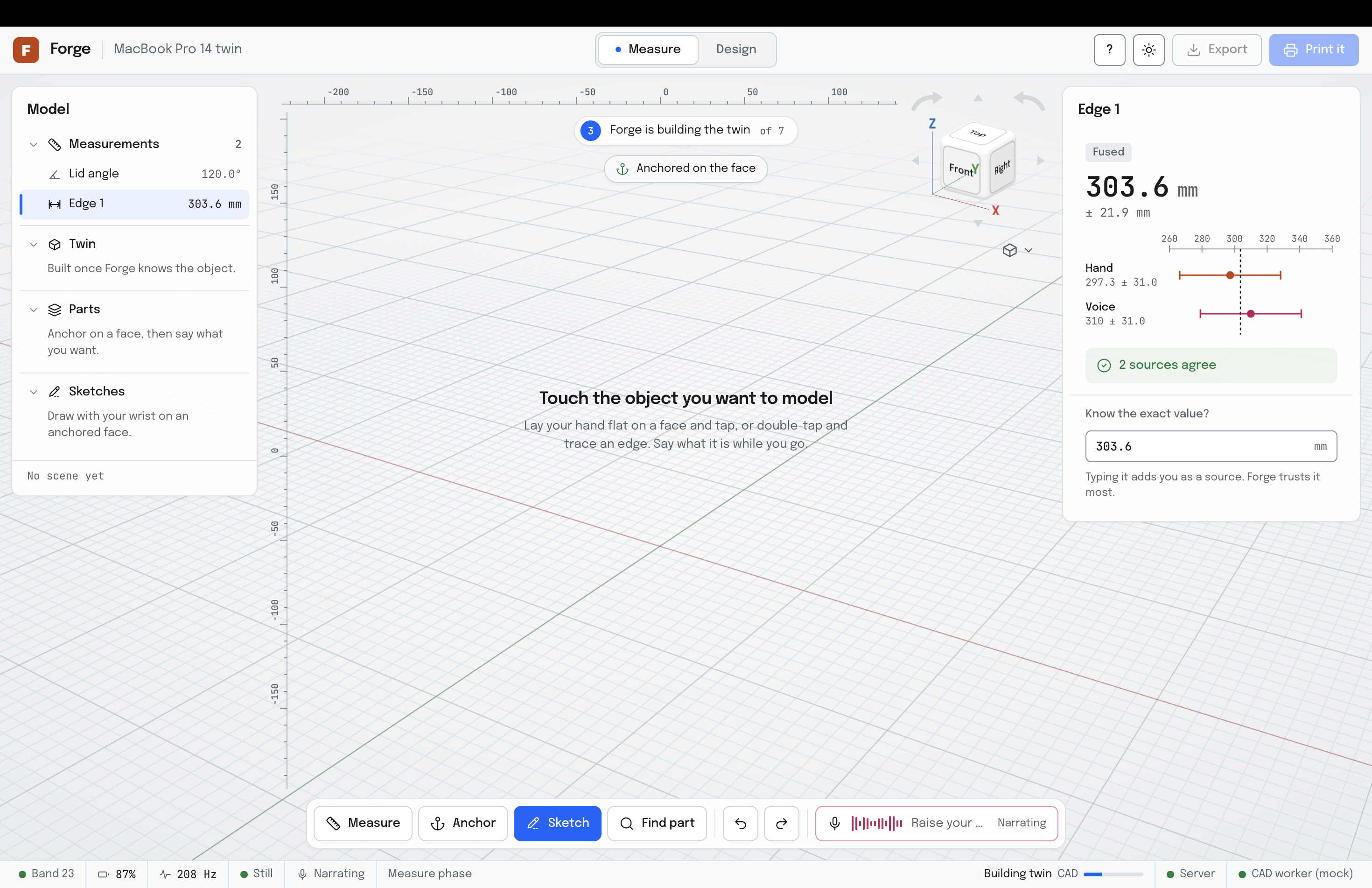
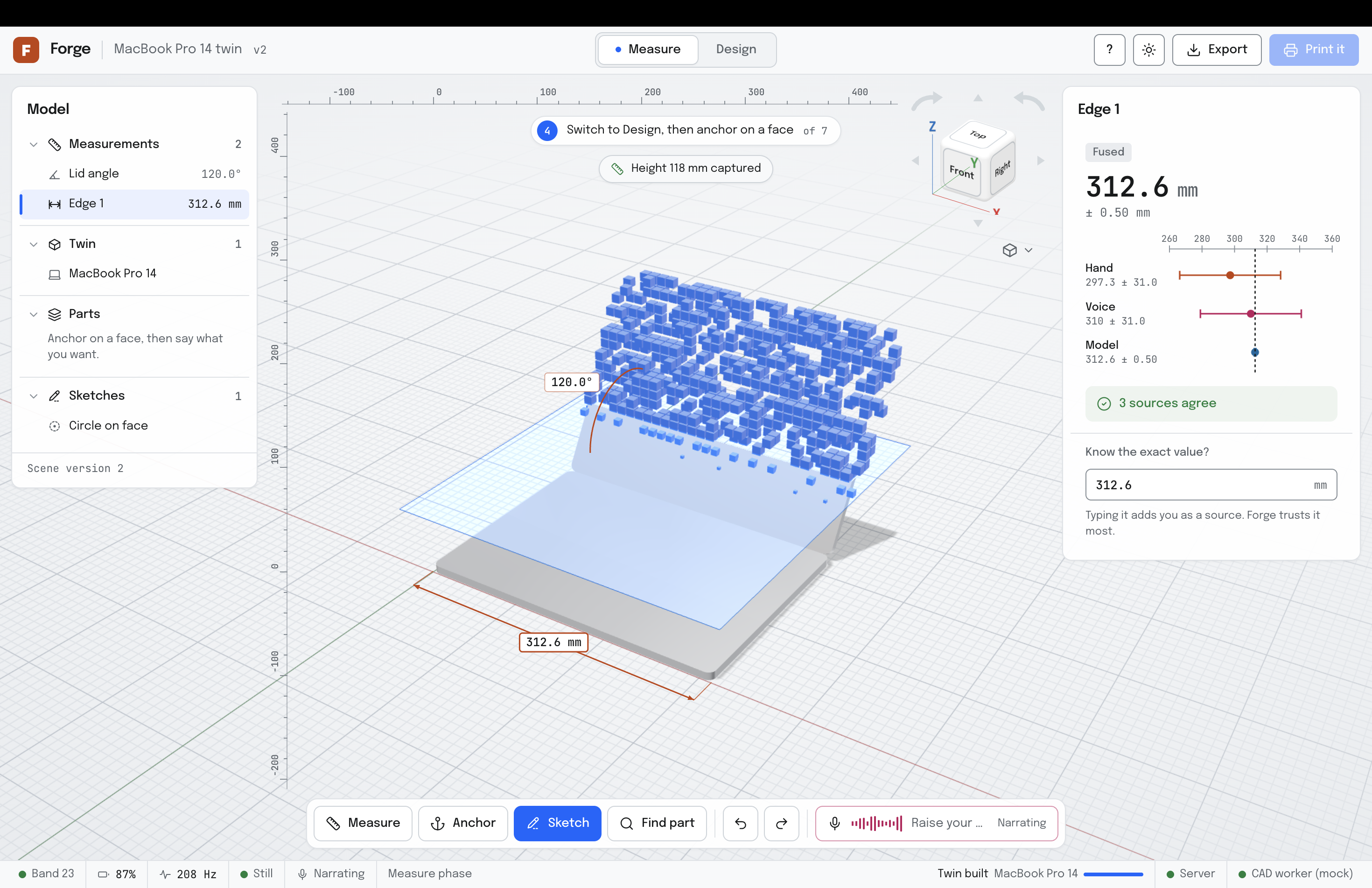
You put on a Vexo band, touch a real object and talk about it. Tap the base of a laptop, tap the screen, and Forge knows the lid angle. Slide your hand along an edge and say “about 31 centimetres,” and Forge measures it. Then it builds a 3D copy of your object, sitting at the same angle as the real one.
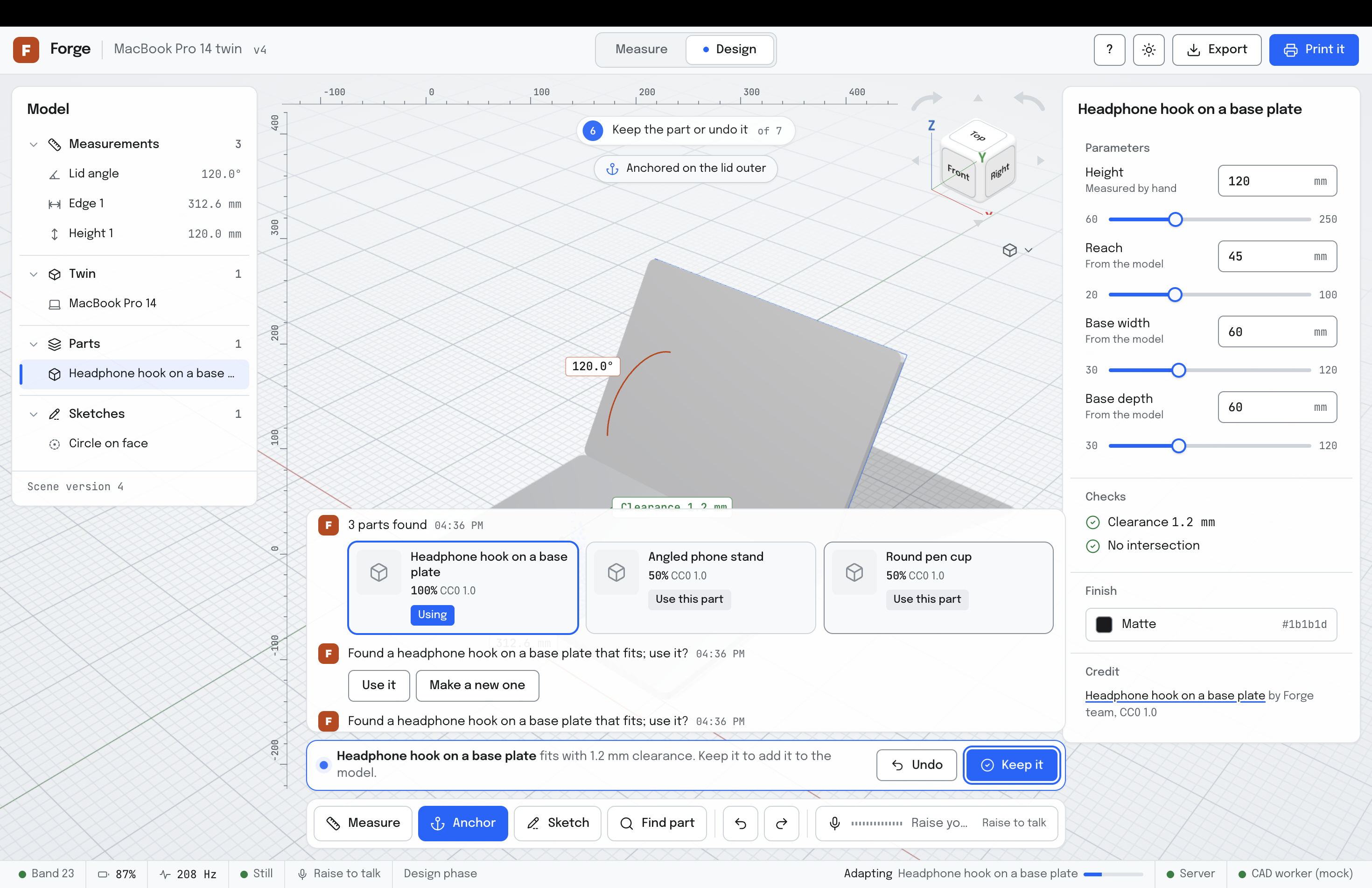
Then you design on it. Tap where you want something, draw it with your wrist, and say what you want (“headphone holder, matte black”). Forge finds a design that fits or makes a new one, checks that it doesn’t collide with anything, and lets you print it. Every number shows where it came from, and you can change any of them.
How we built it
The three of us split the project into three parts and agreed on how they’d talk to each other before writing any code. That let us build all three at the same time without waiting on each other.
The interface: a CAD workspace in the browser built with three.js. It’s modelled on tools like Onshape, so it feels like real software and not a toy. The sensing: reads the band’s motion data and turns taps, slides and lifts into angles and lengths. It then combines what your hand measured with what you said and what Forge already knows about the object. The platform: a Node server with a Mastra agent. Deepgram turns speech into text and handles the agent knowing when we are done talking and handling context, Gemini writes the CAD code, and that code runs in a sandboxed CadQuery worker. ElevenLabs gives Forge its voice, and Stripe handles ordering the print.
Challenges we ran into
The band can’t measure distance well on its own. Motion sensors drift fast. A straight line comes out 10 to 20 percent off, and knowing where your hand is in the room is basically impossible. For a while we thought that might kill the idea.
What saved it was not trusting the band alone. You’re already talking while you measure, and you usually know roughly how big something is. So Forge combines the hand, your voice and what it knows about the object, and shows how sure it is about each one. When they disagree, it says so instead of hiding it.
Other things that ate time: getting taps and slides to register reliably, timing speech so it matched the right gesture, and keeping three people’s code in sync.
Accomplishments that we're proud of
The first time all three numbers (hand, voice, model) landed close together on the measurement card, and the laptop appeared at the right angle. It looks and feels like a real engineering tool. You can edit any number and the part rebuilds. We were honest about accuracy. Forge never shows a number without showing where it came from. Three people built three separate parts that actually worked when we joined them.
What we learned
A sensor that isn’t accurate enough on its own can still be really useful if you combine it with other information and are upfront about the uncertainty. Agreeing on how the parts connect before writing code was the best decision we made. Voice is underrated for design. Saying “about 30 centimetres” is way faster than typing it into a box.
What's next for Forge
Better tracing of curves and wires, which still drift a lot after a couple of seconds. Working well on objects Forge has never seen before, not just ones it already knows. Letting people share the parts they make, so the next person with the same laptop gets a hook that already fits.
Built With
- cadquery
- deepgram
- elevenlabs
- fastapi
- gemini
- javascript
- mastra
- minimax
- node.js
- openai
- opencascade
- python
- superserve
- three.js
- typescript
- vexo
- web-bluetooth
- websockets
