-
-
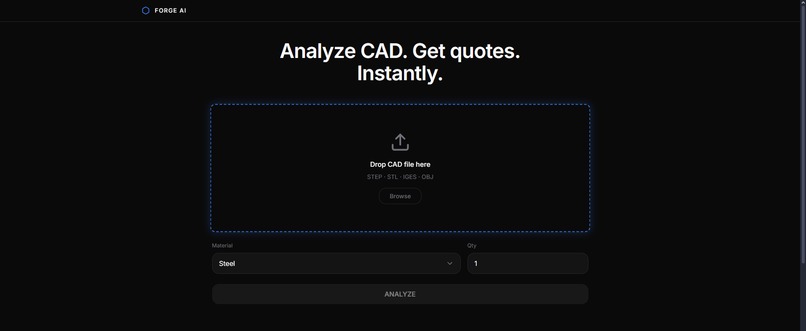
Landing Page
-
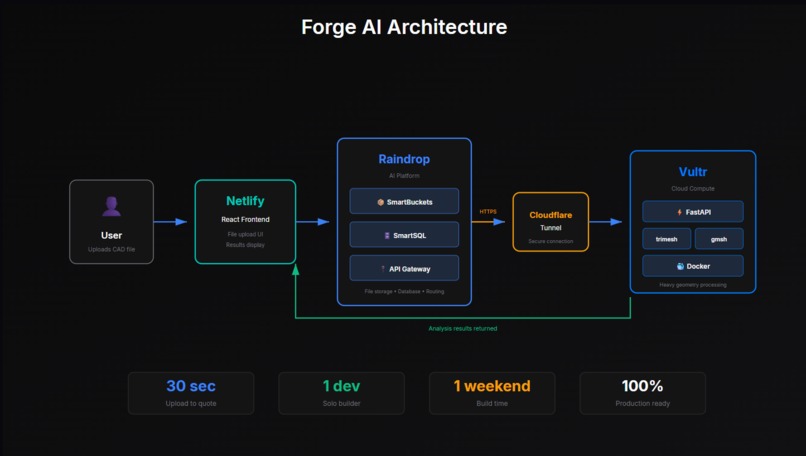
Architecture
-
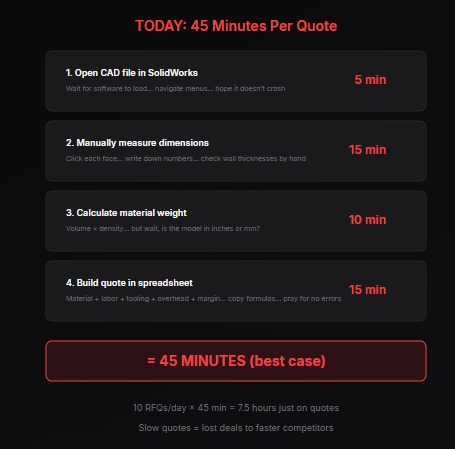
Process of Building
-
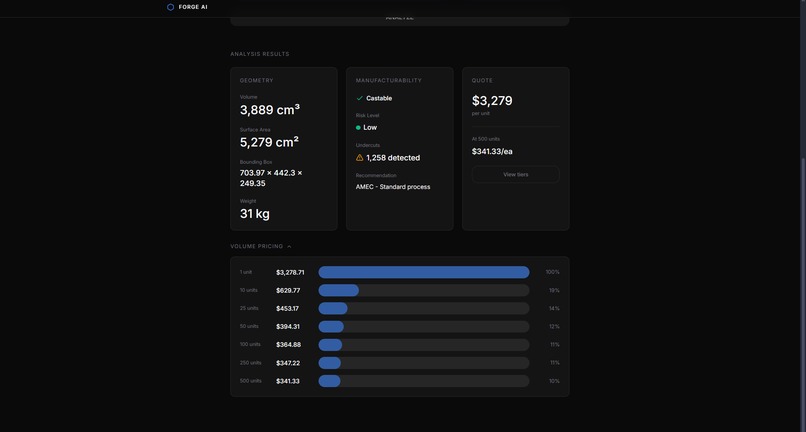
Analysis in action
-
Market Oppurtunity
Inspiration
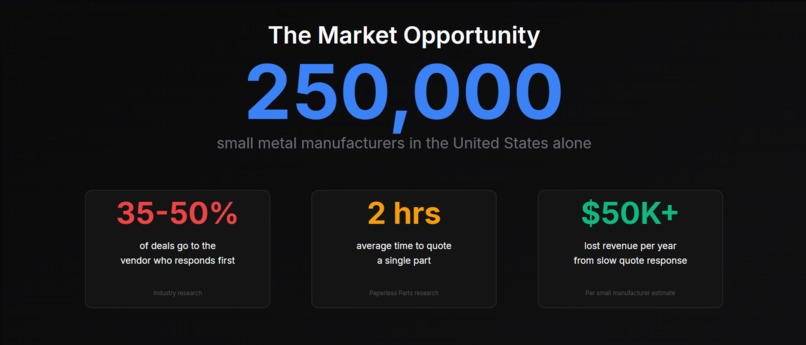
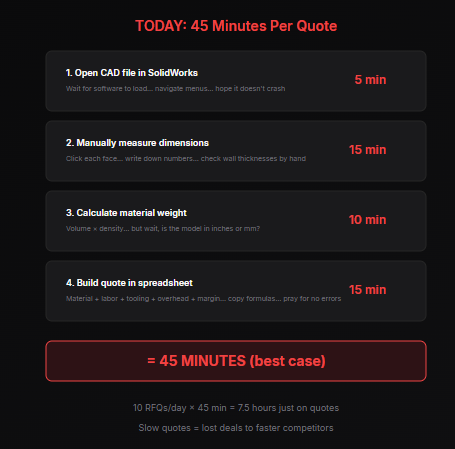
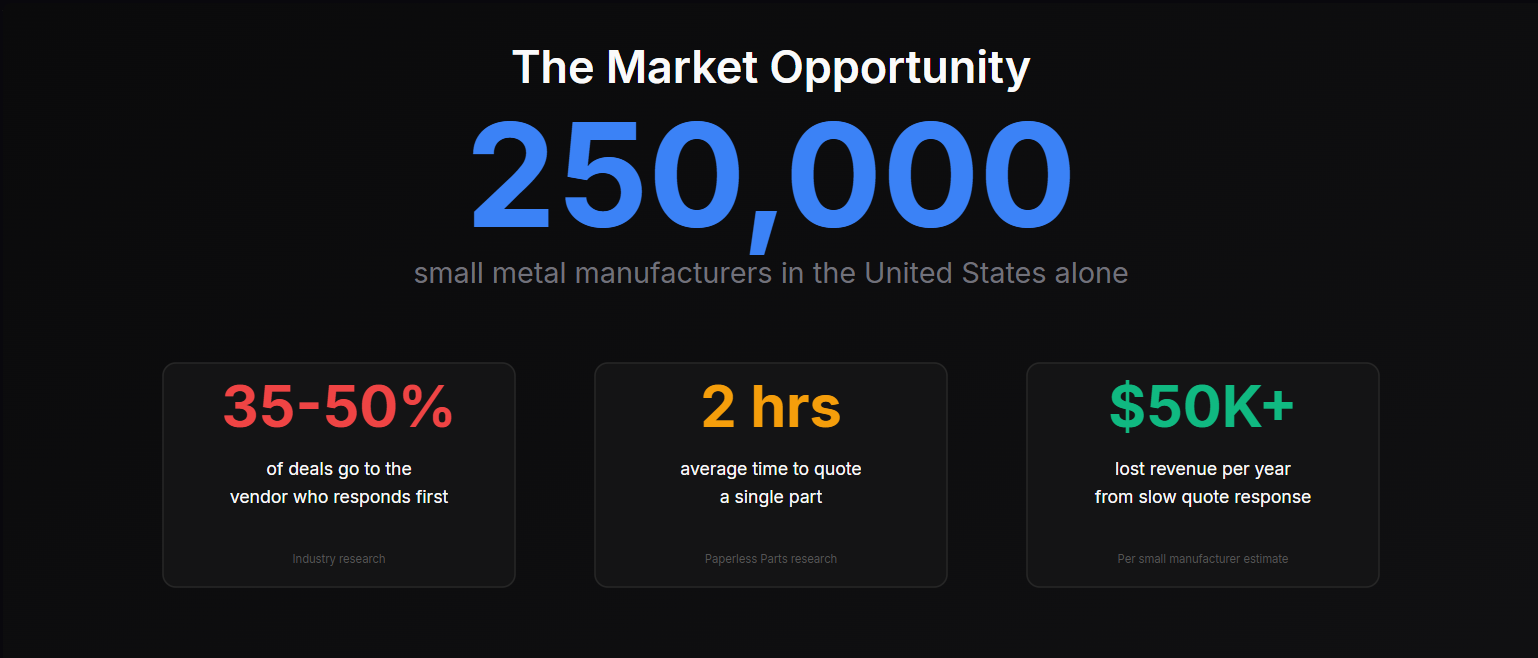
Manufacturing quoting is broken. Small foundries and machine shops spend 30-45 minutes per RFQ opening CAD files, manually measuring dimensions, calculating material weights, and building quotes in spreadsheets.
I've seen it firsthand working with metal manufacturers. A defense contractor showed me their process — opening every STEP file in SolidWorks, measuring by hand, typing numbers into Excel. A good amount of RFQs go unanswered, not because shops don't want the work, but because they can't respond fast enough.
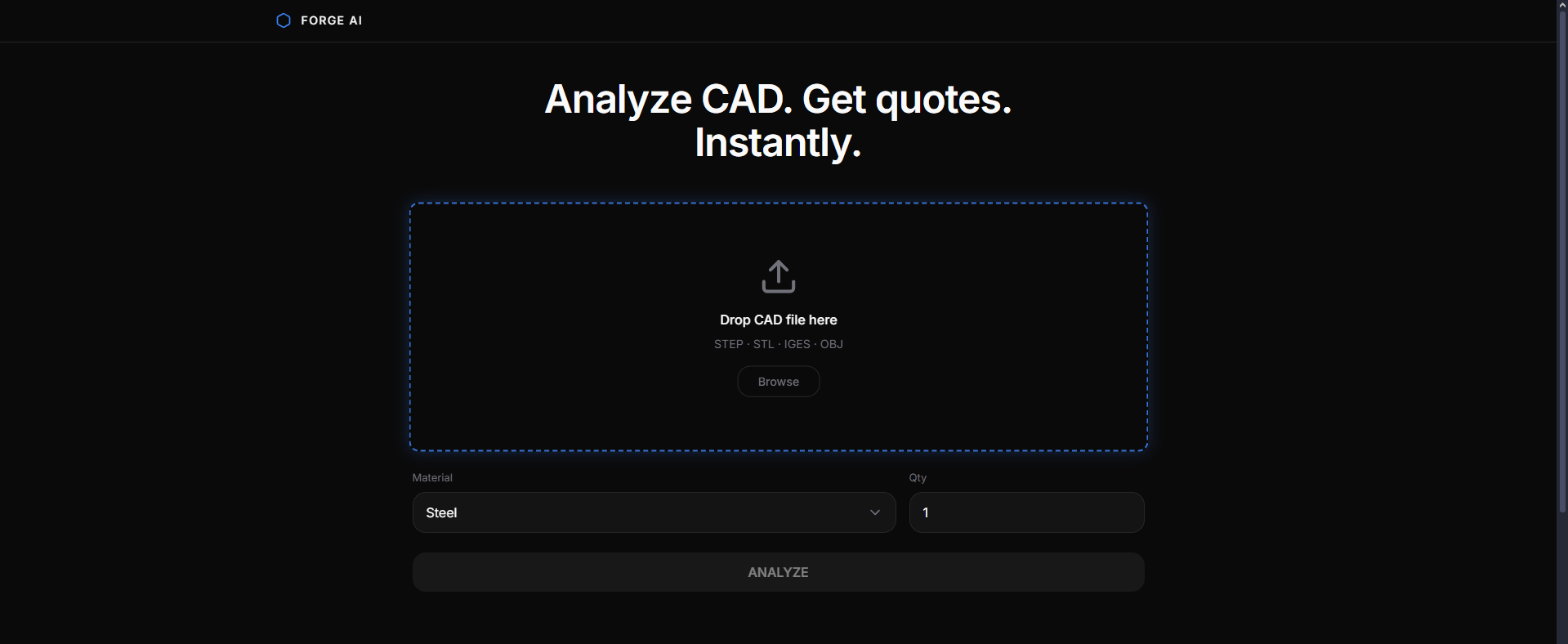
I aimed to solve this by making CAD analysis instant — upload a file, get geometry, manufacturability checks, and a quote in 30 seconds.
What it does
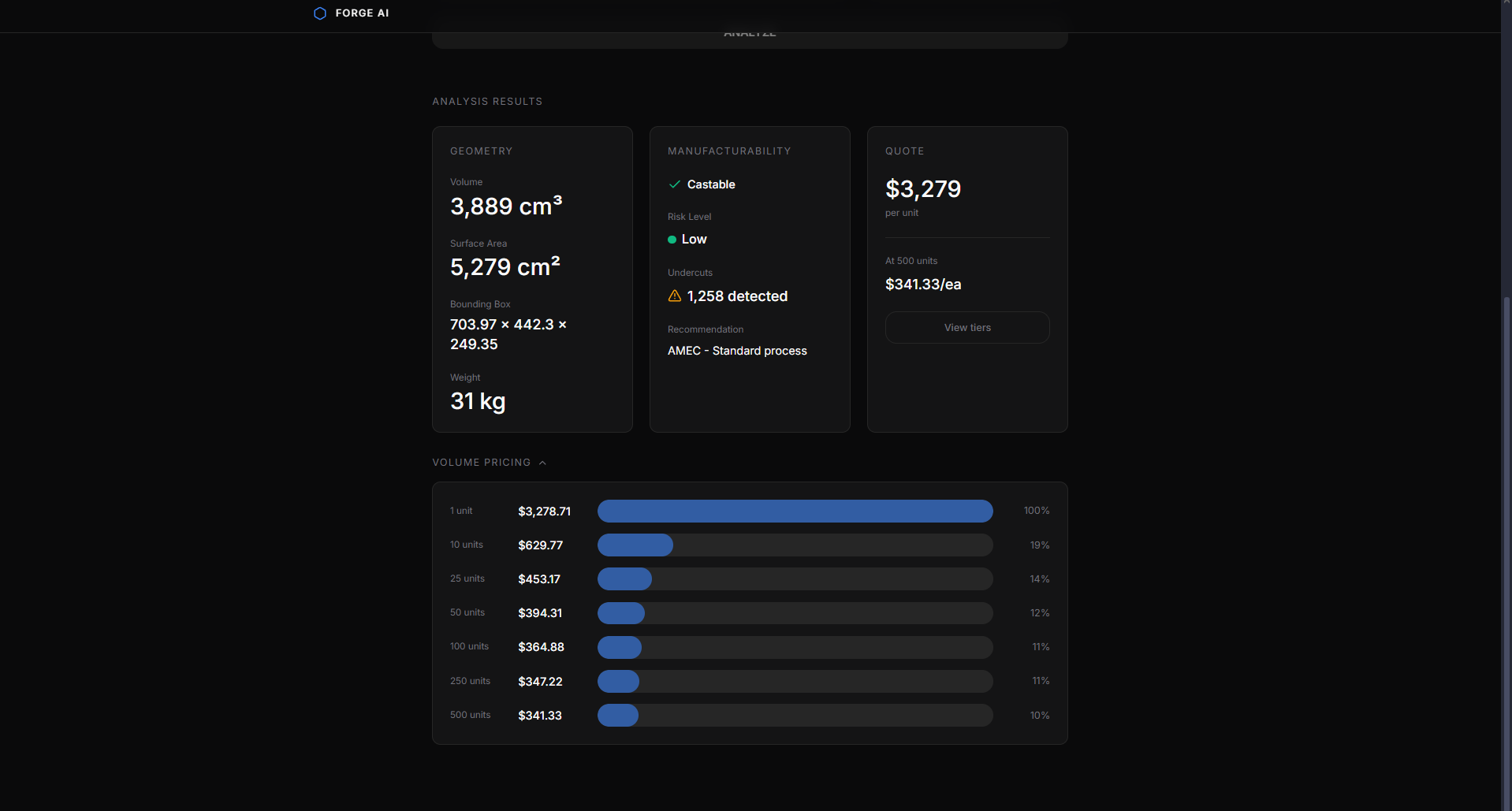
Forge AI lets metal manufacturers upload a CAD file and instantly generate a quote estimate. Drop a STEP, STL, IGES, or OBJ file, select the material, and get:
- Geometry extraction — volume, surface area, bounding box, weight
- Manufacturability analysis — undercut detection, wall thickness checks, risk assessment
- Quote generation — material cost, tooling cost, labor, overhead, margin, and volume pricing tiers
Quote while the customer is still on the phone. Win deals before competitors even open the file.
How I built it
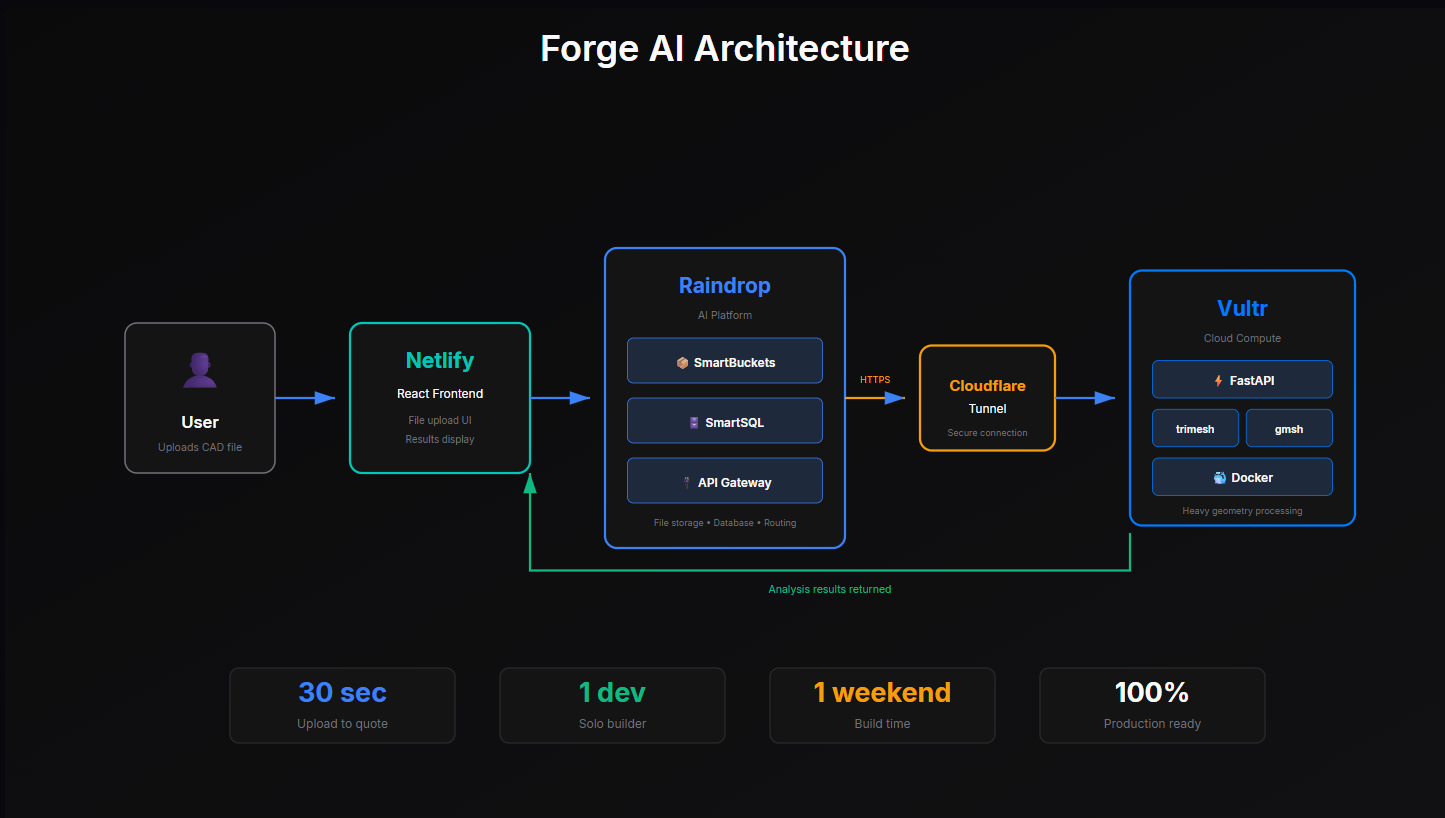
The backend is Python FastAPI running on Vultr Cloud Compute, containerized with Docker. Geometry libraries like trimesh and gmsh require native Python — they can't run in serverless environments. CAD files are parsed, geometry is extracted, undercuts are detected via face normal analysis, and quotes are calculated on this server.
Raindrop handles the platform layer — SmartBuckets for file storage, SmartSQL for the analysis database, and the API Gateway for routing. Since Raindrop runs on Cloudflare Workers, I architected a hybrid system: Raindrop receives requests, stores files, calls out to Vultr over HTTPS through a Cloudflare Tunnel, retrieves the analysis, and stores results.
The frontend is React with Tailwind CSS, deployed on Netlify. Clean drag-and-drop upload, material selection, and results display.
The entire system was built using Claude Code connected to Raindrop's MCP Server. I described the requirements, and the AI coding assistant scaffolded the architecture, configured endpoints, and deployed it live. My submission video includes footage of me drinking a milkshake while Claude Code pushes to production.
Challenges we ran into
Native library constraints: trimesh and gmsh require native dependencies (OpenGL, libGLU). These can't run in Cloudflare Workers. The solution was the Vultr + Cloudflare Tunnel architecture — Raindrop as the platform layer, Vultr as the compute layer.
Docker dependency hell: Getting libGL, libGLU, libXcursor, and X11 dependencies working in a container took multiple iterations. Each missing library crashed with cryptic errors.
HTTPS requirement: Cloudflare Workers only make outbound requests to HTTPS endpoints. My Vultr server only had HTTP. Solution: Cloudflare Tunnel to expose the API over HTTPS without needing a domain or SSL certificate.
CAD file complexity: Shell models have zero volume. Solid manufacturing parts have real mass. The tool needed to handle both gracefully and produce meaningful results regardless.
Accomplishments that I'm proud of
It works end-to-end. Upload a CAD file, get a real quote. Not a mockup — a functioning product.
Real customer validation. A defense manufacturing contractor is piloting this tool. Their CTO sent me a feature request list. They said "this would help us a lot if implemented right now."
The architecture scales. Raindrop handles platform concerns, Vultr handles compute. Adding capacity means spinning up more containers.
Built by one person in one weekend. Claude Code + Raindrop MCP made this possible. What would've taken a team weeks took me days.
The milkshake deployment. Video of the entire backend being deployed while I sat there drinking a milkshake. That's the future of software development.
What I learned
Raindrop changes how software gets built. I'm a solo developer. No DevOps team. I described what I needed to Claude Code, and it built a production system — SmartBuckets, SmartSQL, API routing, deployment. The MCP integration isn't just faster, it's a fundamentally different way to build.
Hybrid architectures are powerful. Serverless is great until you need native libraries. Raindrop + Vultr gives you managed platform services AND real compute when you need it.
Start with a real problem. I didn't build a toy demo. I built something a real customer asked for. That focus kept every decision grounded.
What's next for Forge AI
Hole and channel detection — identify cylindrical features, measure diameter and depth, flag machining costs.
PDF specification extraction — parse 2D drawings for ASTM standards, tolerances, and material specs.
Metal surcharge tracking — connect to commodity prices and calculate surcharges when material costs change between quote and production.
Multi-tenant SaaS — let any manufacturer configure their own pricing formulas and start quoting.
The client I'm piloting with has already requested most of these features.
Built With
- claude-code
- cloudflare
- fastapi
- gmsh
- raindrop
- react
- tailwind-css
- trimesh
- vultr

Log in or sign up for Devpost to join the conversation.