-
-
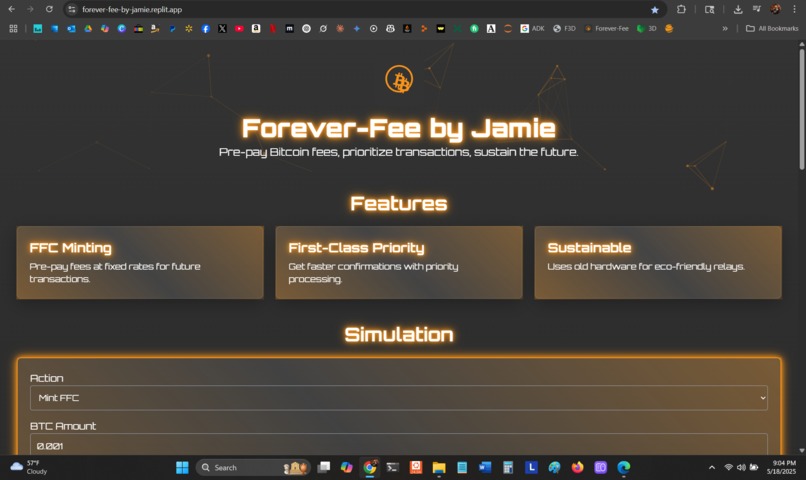
Webview
-

Logo

Forever-Fee by Jamie: Project Story
About the Project
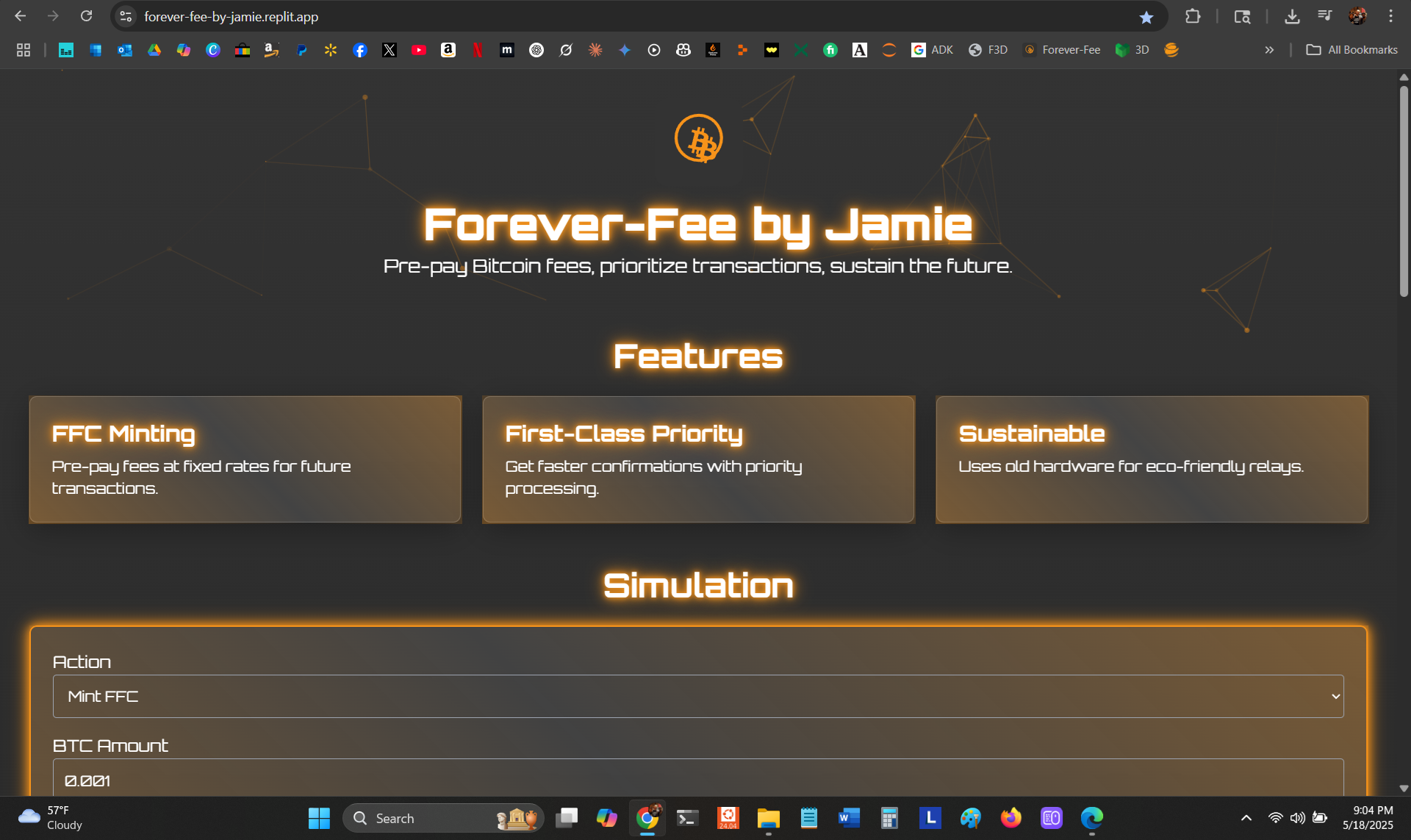
Forever-Fee by Jamie is a Bitcoin-native fee prepayment system that lets users lock in transaction fees at a fixed rate using Forever-Fee Credits (FFCs). Inspired by Forever Stamps, it tackles Bitcoin’s fee volatility, think 2023’s 200 sat/vByte spikes, offering First-Class (~1-block confirmation) or Standard (~3-block confirmation) tiers via a reserve pool for fee top-ups. Built as a layer-1 overlay with OP_RETURN tags, it’s sustainable, running relays on simulated old hardware (like 2013 Antminers). The futuristic 2030 UI features neon effects, glassmorphism, and animations, making the demo (https://forever-fee-by-jamie.replit.app/) a visual stunner.
Inspiration
The idea hit me while mailing a letter with a Forever Stamp, no matter the rate hike, the stamp worked. Why not apply this to Bitcoin fees? Fee volatility frustrates users, especially during bull runs. I wanted to empower Bitcoiners with predictable fees while keeping it eco-friendly by repurposing old hardware. Forever-Fee became my mission to make Bitcoin transactions seamless and sustainable.
What I Learned
I deepened my Bitcoin knowledge, OP_RETURN, multisig, and transaction prioritization. Rust taught me performance-driven coding for the wallet CLI, while Flask honed my UI skills. I learned glassmorphism and particle animations for the 2030 design, balancing aesthetics with Replit Core’s limits. Most importantly, I learned to iterate fast under hackathon pressure, refining my vision through feedback.
How I Built It
I started with a Rust CLI (ff_wallet.rs) for minting FFCs and signing TXs, using bitcoin and sha2 crates for mocked multisig and OP_RETURN (FF:CLS:1:<ffc16>:<hash16>). The Python Flask backend (ff_relay.py, ff_escrow.py) handles the relay, mempool, and UI, with tabulate for CLI tables. The UI (index.html) uses Tailwind CSS, Chart.js, and Particle.js for a futuristic look, neon glow, glass cards, and cosmic animations. Deployed on Replit Core with 2 vCPUs, 4 GiB RAM, and 2 machines (88 compute units/sec max), it’s optimized for the demo. JSON files (/tmp/ffc.json, /tmp/mempool.json) store data, preloaded with 2 FFCs and 2 TXs for instant testing.
Challenges Faced
Fee volatility logic was tricky, simulating First-Class vs. Standard confirmations required a realistic reserve pool model. Replit Core’s ephemeral storage meant data resets on restart, so I preloaded demo data. The UI design initially looked dated; iterating to a 2030 aesthetic (neon, glassmorphism) took multiple revisions, especially fixing a repeating HTML glitch. Balancing Rust’s performance with Flask’s simplicity was tough, but I learned to integrate them seamlessly. Time constraints pushed me to prioritize, deferring real testnet integration for a stable demo, but I’m proud of the result: a Bitcoin-native solution ready to redefine fees.
Built With
- chart.js
- clap
- flask
- google-fonts
- html/css/javascript
- particle.js
- python
- python-libraries-(tabulate
- rand)
- replit-core
- rust
- rust-crates-(bitcoin
- serde
- sha2
- tailwind-css


Log in or sign up for Devpost to join the conversation.