-
-
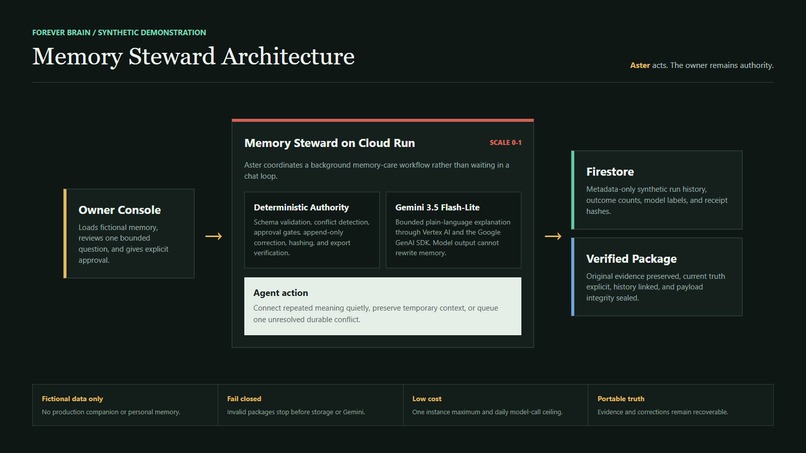
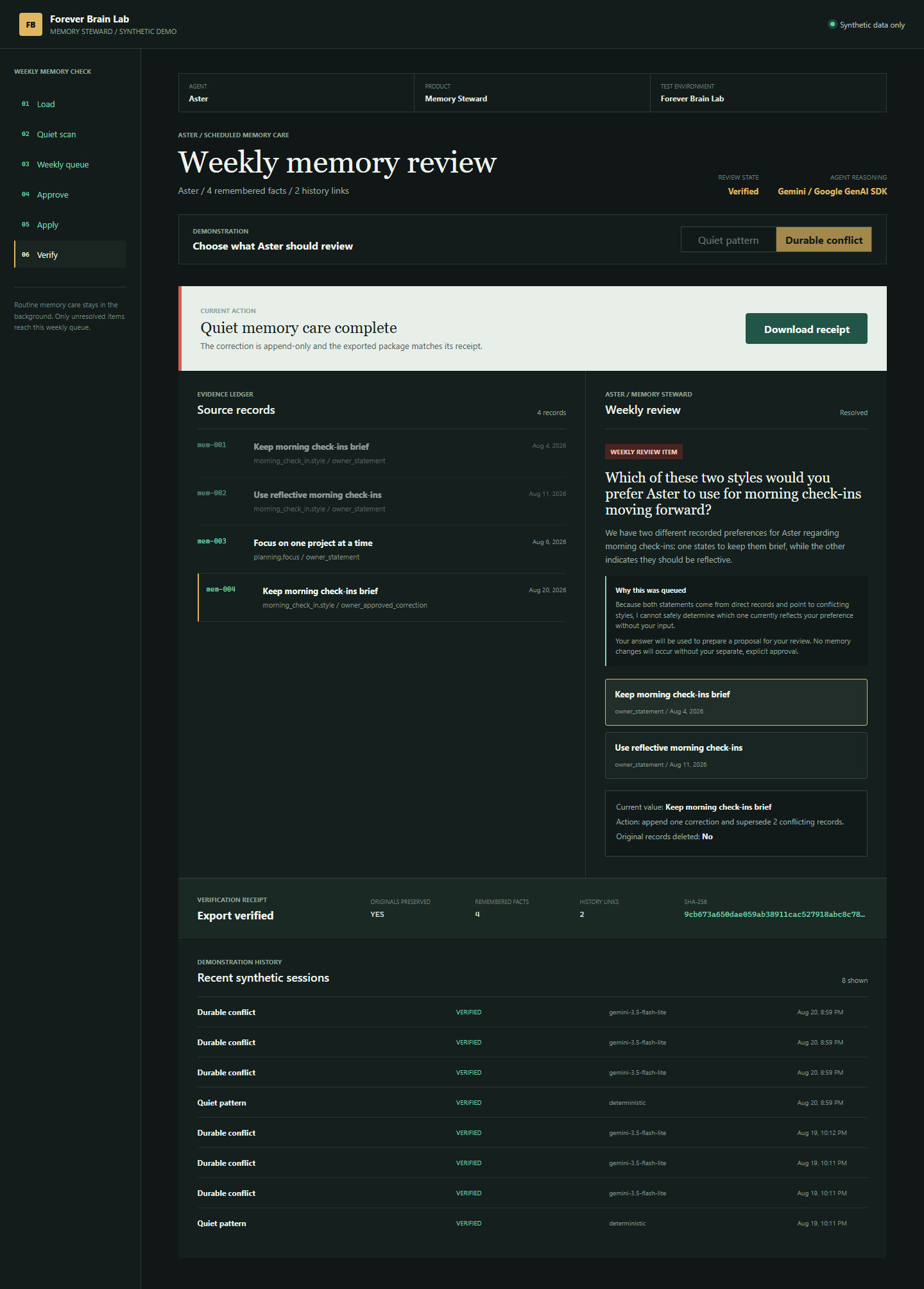
Aster resolves a durable conflict through an owner-approved, append-only correction with verified preservation.
-

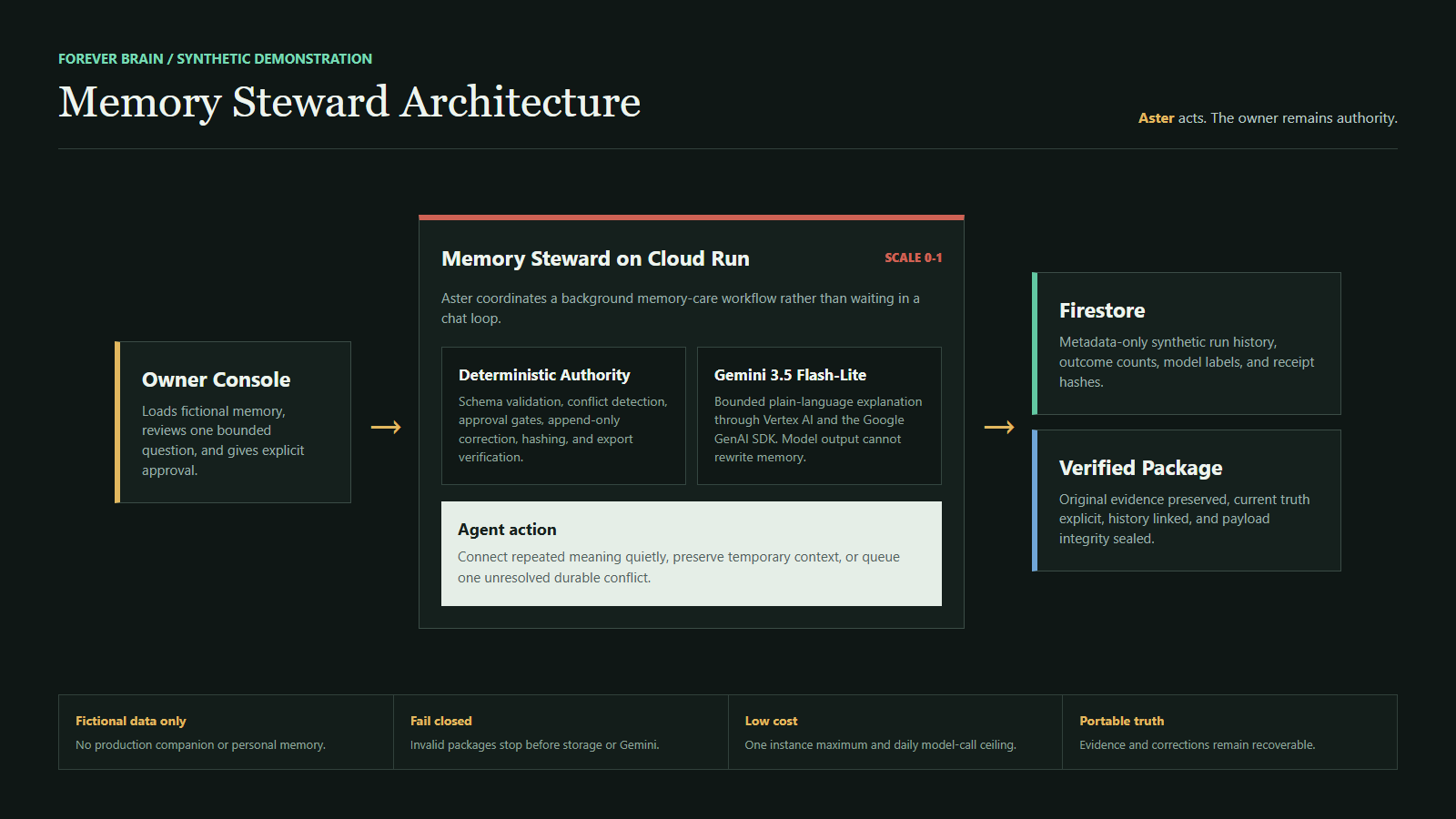
The Memory Steward architecture separates Gemini language interpretation from deterministic authority on Cloud Run.
-
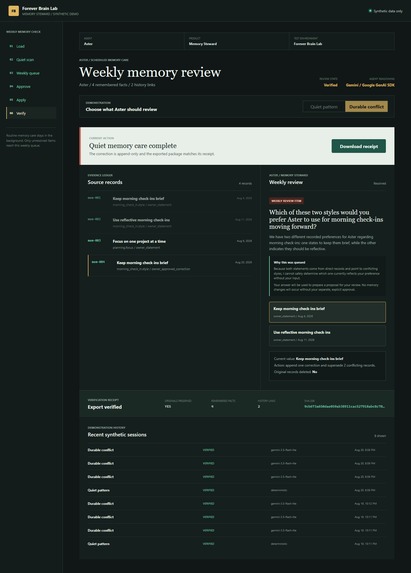
The responsive owner console keeps the same bounded workflow available on smaller screens.

Inspiration
The idea came from a simple problem we could see getting larger: long-running AI companions need memory that becomes more useful over time, not merely heavier. Saving every sentence forever creates noise. Flattening everything into summaries can erase corrections, evidence, and the personality that makes continuity matter.
We built Forever Brain: Memory Steward to explore a third path: quiet background memory care that preserves the past while keeping the current truth clear.
What it does
Our fictional companion, Aster, runs a weekly memory-care workflow:
- Load a clearly labeled synthetic memory vault.
- Connect repeated phrases that support the same meaning.
- Keep one-time emotional context from silently rewriting a durable preference.
- Detect genuine contradictions with deterministic rules.
- Use Gemini only when bounded language ambiguity needs a plain-language explanation.
- Ask the owner one focused question instead of creating a constant stream of confirmations.
- Require explicit approval before a durable correction is applied.
- Preserve every original record and issue a SHA-256 verification receipt.
The result is a companion memory system that stays mostly invisible during ordinary life and asks for attention only when human judgment is truly needed.
How we built it
Memory Steward is a JavaScript and Node.js application deployed on Google Cloud Run. It uses Gemini 3.5 Flash-Lite through Vertex AI and the Google GenAI SDK, while Firestore stores only bounded synthetic workflow metadata.
We deliberately separated interpretation from authority. Gemini can explain ambiguity, but it cannot rewrite memory. Deterministic code owns schema validation, conflict detection, approval binding, append-only correction, hashing, and export verification. The Cloud Run service scales to zero, permits one active instance, and enforces a 25-call daily Gemini ceiling.
Challenges we ran into
The hardest problem was not making the system ask more questions. It was teaching it when to stay quiet.
A safe product can still become unusable if every wording change creates a confirmation prompt. We had to distinguish repeated support, temporary exceptions, and durable contradictions before involving the owner. We also removed an earlier dependency path when its security review did not meet our release standard.
Accomplishments that we're proud of
- The quiet path connects differently worded signals without calling Gemini, asking the owner a question, or deleting evidence.
- The conflict path lets Gemini explain the ambiguity while deterministic controls preserve final authority.
- Corrections are append-only and independently verifiable.
- The hosted demonstration runs entirely on fictional data and requires no credentials.
- The project includes reproducible tests, a documented security boundary, deployment instructions, and an architecture diagram.
What we learned
The strongest agent is not a model making every decision. It is a partnership between bounded model judgment, deterministic authority, and a human who remains in control.
We also learned that continuity is not the same as storing everything. Good memory preserves evidence and identity while becoming easier to use.
What's next
Next we will expand the synthetic pressure laboratory, add portable import and export adapters for multiple companion frameworks, and evaluate smaller local models for private background maintenance. Any real companion integration will begin in read-only shadow mode and require a separate owner-approved safety gate.
Data and disclosure
The demonstration uses only repository-owned fictional fixtures for Aster and Demo Owner. It contains no customer data, personal memory, production companion data, credentials, private research corpus, or live-agent material.
This competition application and repository were created during the hackathon submission period. NextArk conducted earlier private product research into long-term AI continuity, but no private production code or data was imported. Codex assisted with implementation, documentation, review, testing, and media preparation. Dwayne Swinton made the product decisions and remains the human approving and submission authority.
Built With
- ai-agents
- cloud-run
- firestore
- gemini-3.5-flash-lite
- google-genai-sdk
- javascript
- memory-systems
- node.js
- vertex-ai
