-
-
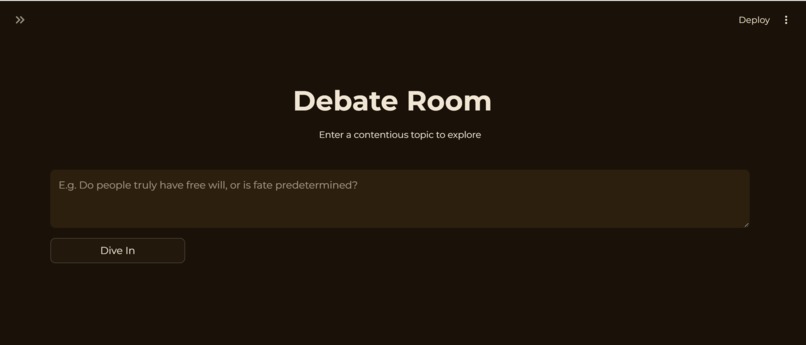
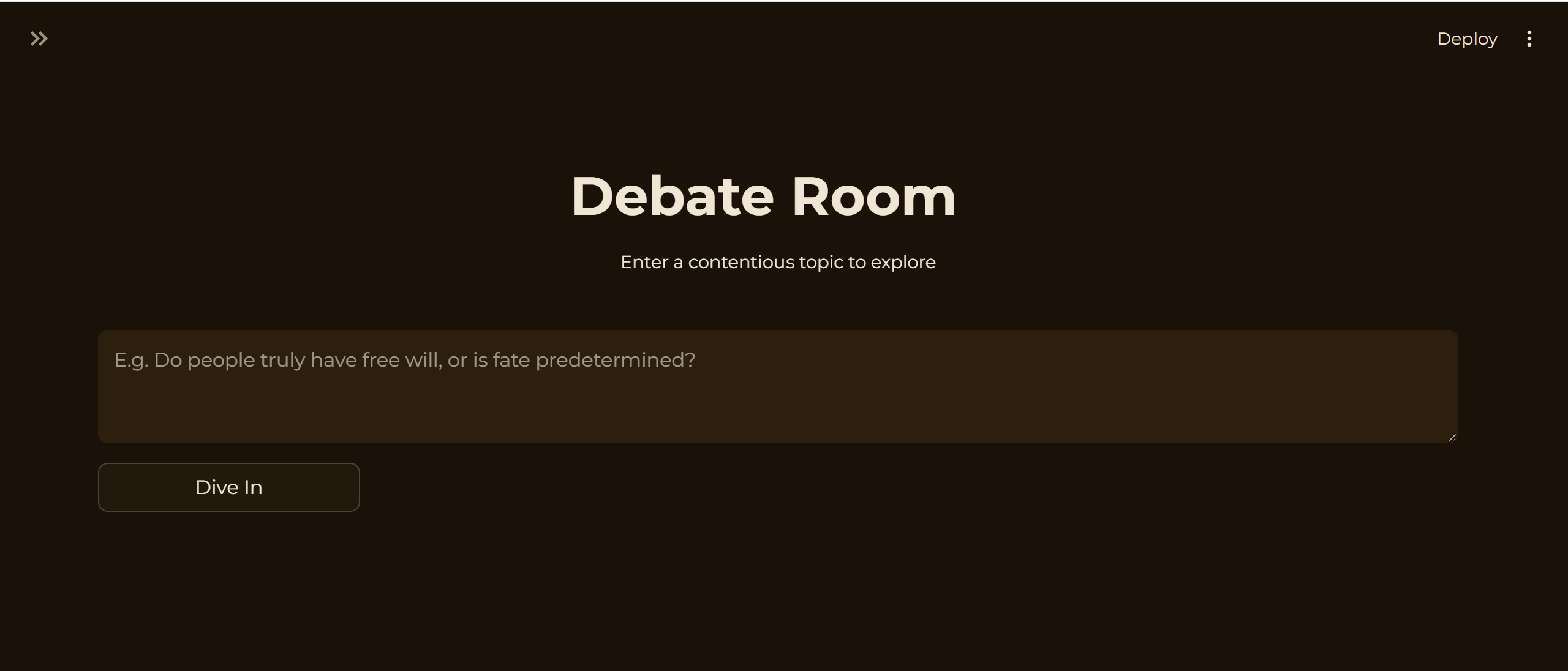
The debate room, where users can explore a topic of their choice.
Inspiration
In the current geopolitical and social landscape, the average citizen of a first-world country is unlikely to generate real contention on most issues, or to commit to one side of a debate with genuine forethought and analysis. This tendency to side with the masses allows people to support beliefs - whether it be social, environmental, scientific, or philosophical - without adequate information or consideration.
Why is this an issue? Well, the democratic process relies on the idea that the average perspective is a more reliable decision-maker than individuals alone. Its strength therefore depends on evaluation and discussion that a nation’s citizens engage in. The less people engage in real, diverse, and productive conversation - and instead pick sides blindly - the less accurate and effective a democracy becomes, since the average perspective is less informed and more reactive.
Forethought exists to bridge this gap. By bringing history's greatest minds into direct conversation with one another, it invites you to slow down, engage with ideas on their merits, and build a worldview that is genuinely your own. Not inherited. Not reactive. But earned, through curiosity and the willingness to sit with perspectives that challenge your own.
What it does
Forethought is a platform for those who refuse to inherit their opinions. Enter any contentious topic, choose two of history's sharpest minds, and watch their ideas collide in real time. For those still finding their footing, curated Essential modules break down how the world's great disciplines — philosophy, economics, science, and more — actually approach the questions that matter. Whether you're starting from scratch or stress-testing what you already believe, Forethought meets you where you are.
How we built it
The Forethought MVP is built on Python and Streamlit, with Anthropic's Claude API powering the core experience. When a user enters a topic, a structured API call returns five historically relevant figures with documented positions on the issue. Once two figures are chosen, a second API call simulates a debate between them, grounding each speaker's arguments in their real writings and philosophy.
- We used Python along with a Claude API to take in user inputs, modify them into detailed prompts, and submit them to Claude.
- The front-end was built using Streamlit, to enable a single-page 'Debate Room'
Challenges we ran into
Streamlit's limited styling made building a polished interface significantly harder than anticipated. Achieving custom fonts, layouts, and visual consistency required overriding internal CSS classes (some of which are undocumented and change between versions) rather than working with a flexible design system.
On the product side, time constraints forced us to prioritise depth over breadth. The core debate experience received the attention it deserved, but the Essentials feature — introductory modules for philosophy, economics, science, and other disciplines — remains unrealised. It is the natural next step.
Accomplishments that we're proud of
The debate quality exceeded our expectations. Claude's ability to produce exchanges in a consistent format, that are genuinely intellectually stimulating was impressive.
We're also proud of how cleanly the underlying logic works. The first API request does real research, returning structured data on each figure — their era, key works, and documented stance on the topic. The second takes that research and uses it as source material to generate the debate, ensuring each speaker argues from their actual worldview rather than a hallucinated one. The result is a pipeline that is simple to follow but produces consistent, decent quality output.
What we learned
Forethought was really just an excuse to figure out how to build something real with an AI API. We knew Python going in, but had never actually integrated a language model into an app before, so a lot of the learning was just working out how it all fits together in practice.
The thing that surprised us most was how little the code actually matters compared to the prompts. Calling the API is easy. The hard part is figuring out what to ask for, how to structure it, and what context to pass along. Splitting the experience into two calls (one to find the figures, one to run the debate) sounds simple in hindsight, but getting there took a lot of trial and error.
We also got a much better feel for where AI is genuinely useful and where it needs guardrails. Claude will produce something that sounds authoritative whether or not it actually is, so making sure the debate was grounded in each figure's real work, rather than just vibes, was something we had to deliberately design for.
What's next for Forethought
The immediate next step is the Essentials feature; curated modules across philosophy, economics, history, science, and political theory that give users the foundational literacy to engage meaningfully with a debate before it begins.
Beyond that, we see Forethought expanding in two directions. First, a richer debate experience with user interjections, and the ability to ask follow-up questions directly to a figure mid-debate. Second, a personalisation layer that tracks the topics and figures a user has explored, and surfaces new debates tailored to the worldview they are building.
Built With
- claude
- python
- streamlit

Log in or sign up for Devpost to join the conversation.