-
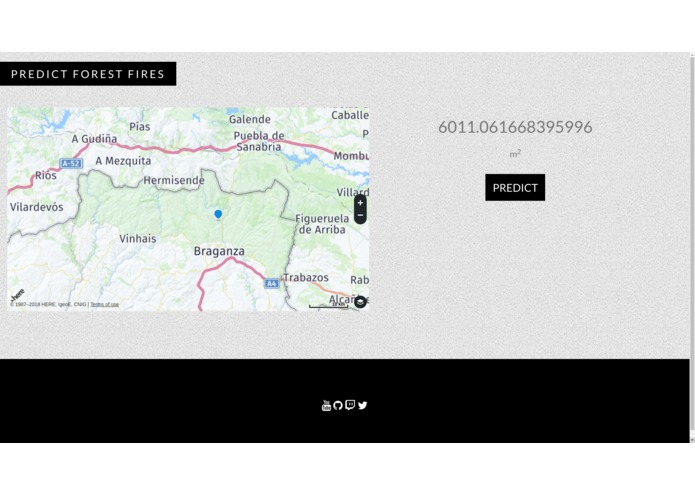
Front page of the website
Inspiration
- Recent Forest Fires have caused a lot of nuisance
- Forest Fires in general cause huge economic and personal loss to a lot of people, so reducing them could help a lot.
What it does
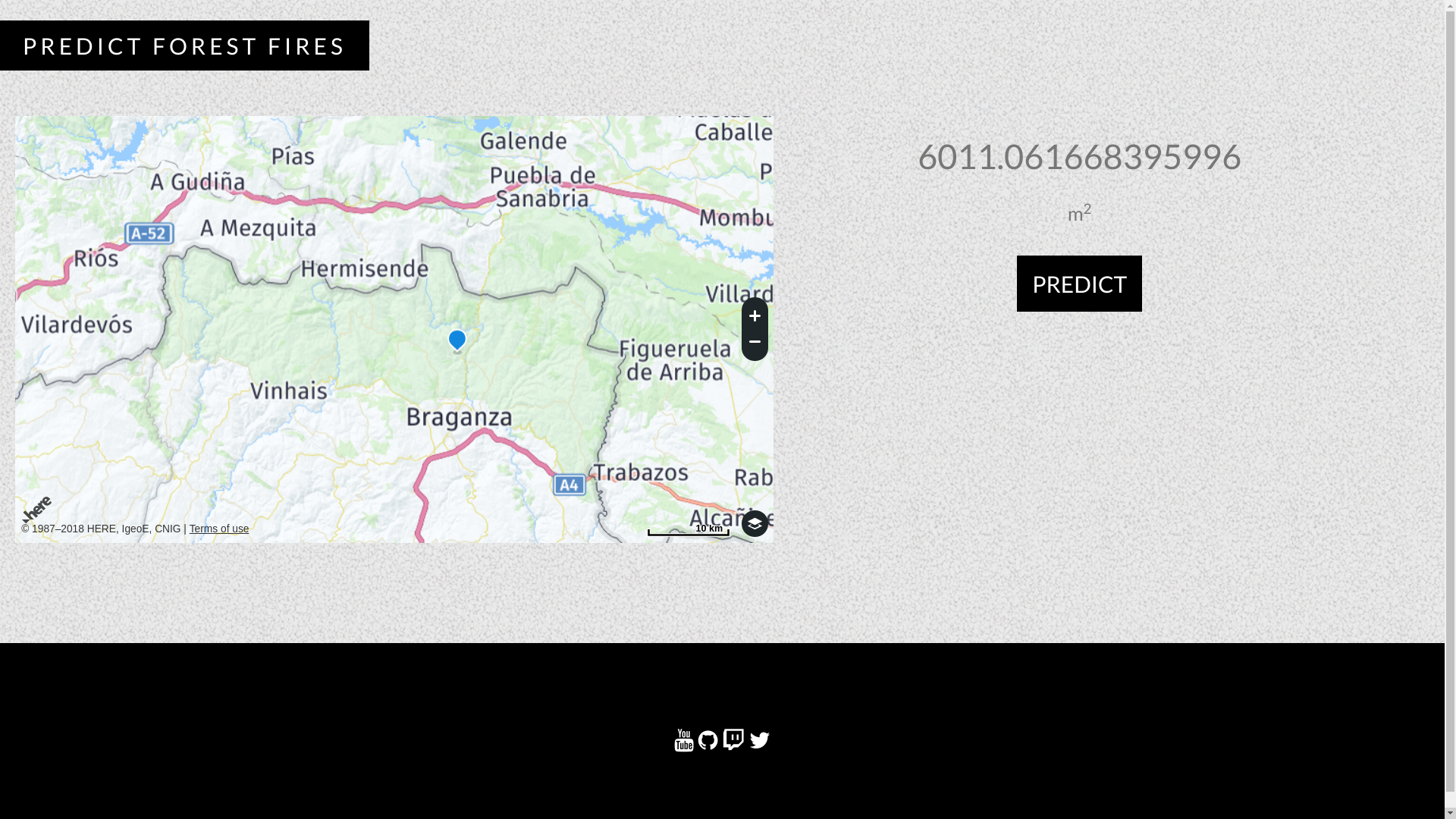
It predicts the area burnt at a location selected on a map by a forest fire.
How I built it
- When the user clicks the button on the web page, the Heroku API is sent the latitude and longitude of the place selected on the map.
- The python script then fetches weather data from the openweathermap API.
- This data is used to calculate the various Fire Weather Indices.
- The FWIs and the raw data from the API are fed into the Deep Regression model which outputs ## Challenges I ran into
- I rarely work with front end, so getting all of the css and html to work was challenging.
- Setting up the API was challenging as I had to go through a lot of documentation to figure out how to do it.
- Getting the formulas for calculating the Fire Weather Indices was extremely difficult as there is zero to no documentation on how to do it. I ended up looking at the source js code for some websites to find a link that provided me with what I needed.
Accomplishments that I'm proud of
- Integrating everything seamlessly, so that I have several parts hosted at different locations like Heroku and Github.
- Getting my machine learning model to have a low error on the test data.
What I learned
- A lot about js, as that was what I used to communicate between the API and the website
- How to make websites.
- Different tricks when approaching a machine learning problem.
What's next for Forest Fire Predictor
- Make it work throughout the World, also improve the variance of my model.
- Some more training data could help.
Built With
- flask
- html5
- javascript
- keras
- openweathermap
- python
- sklearn
- tensorflow


Log in or sign up for Devpost to join the conversation.