-
-
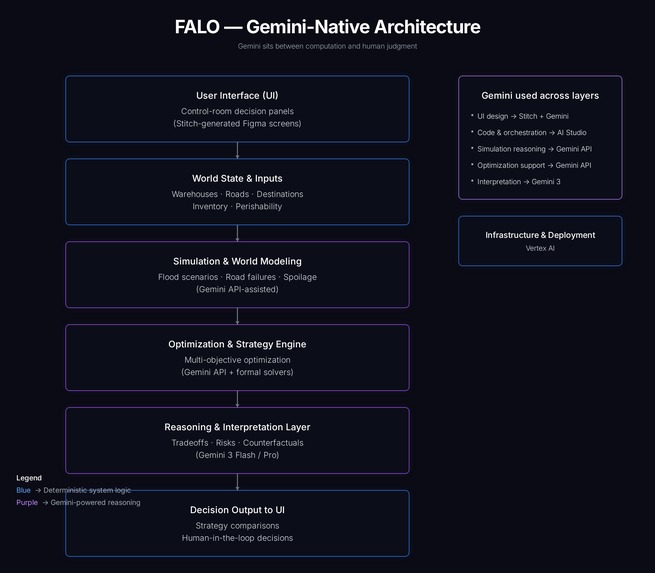
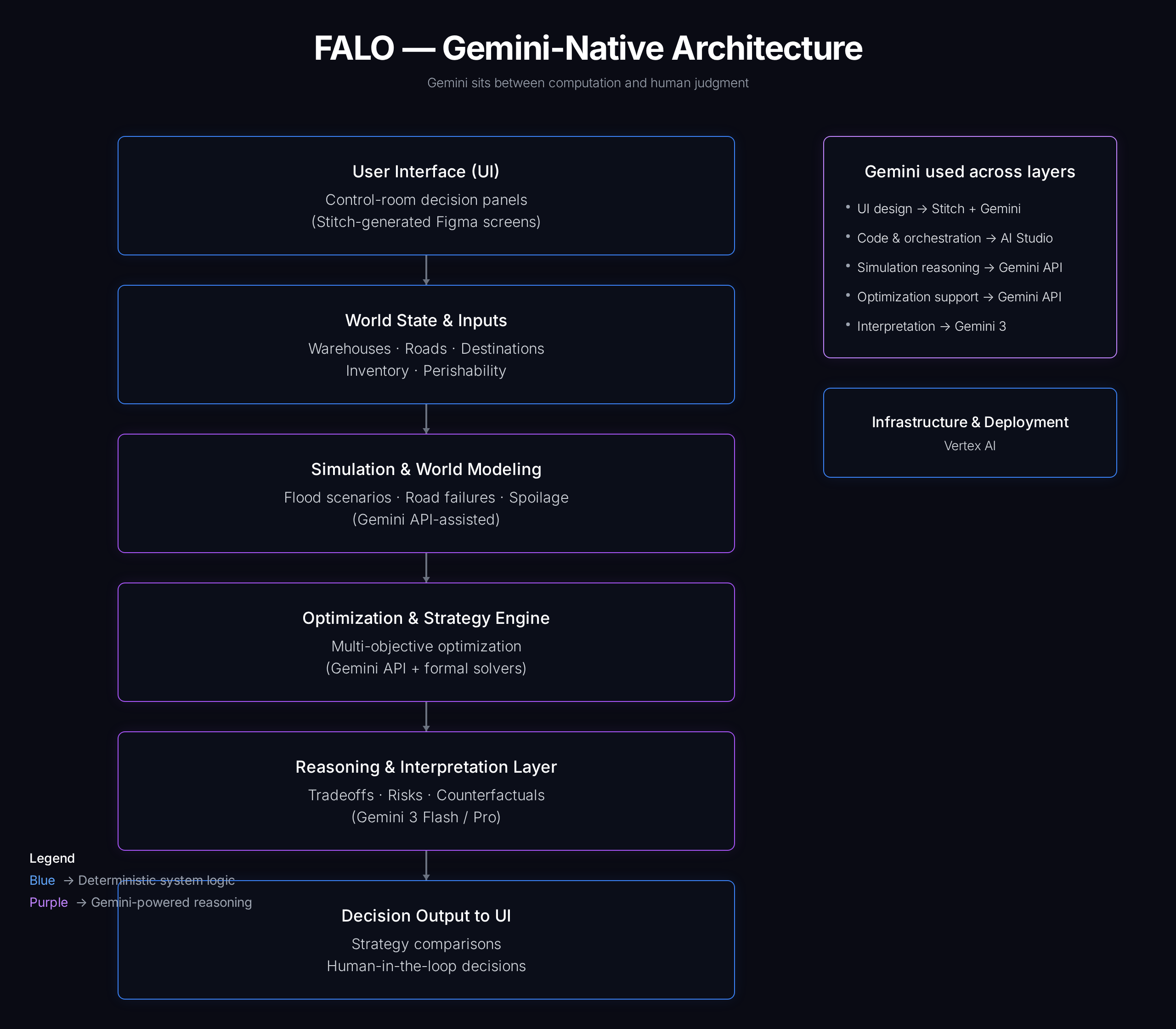
Gemini-native system using Gemini across UI, code, simulation, optimization, and reasoning to explain tradeoffs in disaster aid decisions
Inspiration
In disaster response, aid failure is rarely about missing supplies—it’s about making the wrong tradeoffs under uncertainty. Teams must constantly choose between speed, safety, coverage, and waste while conditions change hour by hour. We were inspired to build a system that doesn’t hide uncertainty, but models it directly and helps humans reason through it.
What it does
FALO (Foreign Aid Logistics Optimization) is a decision-support system for disaster relief operations.
It runs large-scale Monte Carlo simulations to model thousands of possible futures under uncertain weather, infrastructure damage, and supply constraints. Instead of producing a single “optimal” plan, FALO generates multiple strategies and shows their tradeoffs—delivery time, spoilage, failure risk, and equity of distribution.
Operators can adjust priorities, compare strategies side-by-side, inspect risks, and understand why a strategy succeeds or fails—keeping humans in control of high-stakes decisions.
How we built it
1. Gemini API — Decision Interpretation Layer
We use Gemini as an interpretation and explanation layer on top of hard simulation outputs.
Converts Monte Carlo results into:
- Trade-off explanations (“faster delivery increases spoilage by X%”)
- Failure mode summaries (“bridge washout dominates risk after 50mm rainfall”)
- Ethical risk flags (coverage bias, exclusion of remote zones)
- Produces auditable, text-based rationales tied to numeric metrics
- Every response is constrained to structured JSON outputs → no hallucinated authority
This is what powers:
- Strategy comparison insights
- Risk audit explanations
- “Why did the system shift priorities?” logs
Gemini acts like a calm analyst
2. Vertex AI — Simulation & Optimization Backend
Vertex AI runs the heavy lifting:
- Monte Carlo simulation batches (10k+ futures per scenario)
Multi-objective optimization:
- delivery time
- spoilage
- failure probability
- equity score
- Parallel execution with resource monitoring surfaced in the UI
Vertex lets us:
- Scale simulations in real time as conditions change
- Track system health, throughput, and cost
- Keep compute separate from interpretation for safety and auditability
3. Gemini + Vertex AI — Human-in-the-Loop Design
- Vertex AI computes
- Gemini explains
- Humans decide Everything is inspectable.
4. Google Maps Platform (Conceptual)
In production:
- Road networks
- Flood overlays
- Route feasibility scoring
In the hackathon:
- Simulated geospatial data structured to match Maps APIs
- Ready for drop-in real-world deployment
5. Stitch + Gemini — UI Generation & Iteration
We use Gemini with Stitch to:
- Generate consistent operational UI layouts
- Enforce dark-mode, accessibility, and information hierarchy
- Rapidly iterate dashboards from structured prompts
FALO uses Vertex AI to simulate thousands of disaster futures, and Gemini to interpret those simulations into transparent, auditable insights—keeping humans in control of high-stakes logistics decisions.
Challenges we ran into
Accomplishments that we're proud of
What we learned
What's next for Foreign Aid Delivery Optimization (FALO)
Built With
- babelstandalone
- body-parser
- cors
- css
- express.js
- googlefonts
- history
- html
- javascript
- mongodb
- mongoose
- node-canvas
- node.js
- react18
- reactdom
- reactrouter
- rest
- tailwind


Log in or sign up for Devpost to join the conversation.