Inspiration
What it does
How we built it
Challenges we ran into
Accomplishments that we're proud of
What we learned
What's next for FordgeOs
Inspiration: > We wanted to bridge the gap between "having an idea" and "having a deployed app." Most AI tools just give you code snippets; ForgeOS fabricates entire environments.
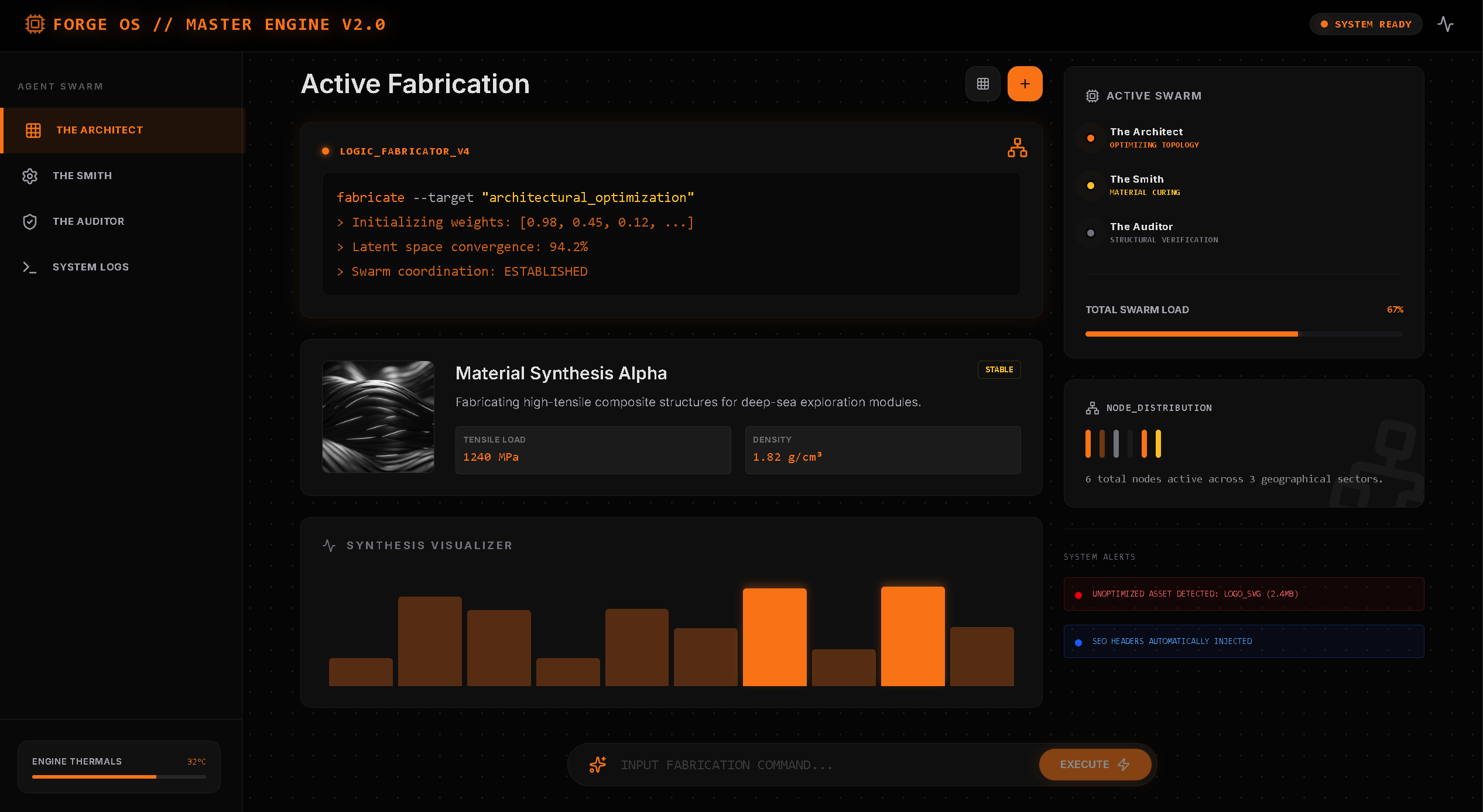
What it does: > ForgeOS is an autonomous fabrication engine. Users provide a high-level "vibe" or a professional prompt, and a swarm of specialized Gemini 1.5 Flash agents (The Architect, The Smith, and The Auditor) work in parallel to scaffold, style, and audit a functional web application.
How we built it: > 1. Vibe Design: We used Google Stitch to establish a Neo-industrial "Design DNA."
- Agentic Workflow: We utilized the Codex/Antigravity mindset to orchestrate agents. The Architect maps the file structure, The Smith (Gemini 1.5 Flash) generates the code at high speed, and The Auditor ensures styling consistency.
- Infrastructure: The entire engine is containerized and deployed on Google Cloud Run for serverless scalability.
Challenges we overcame: > Managing the "hand-off" between agents to ensure that the code generated by the Smith stayed true to the design vision created in Stitch. We solved this by using high-fidelity System Instructions and JSON-mode outputs.
Accomplishments we're proud of: > Achieving near-zero latency for full-page fabrication using the Flash model. It feels less like a chat and more like a physical materialization of software.

Log in or sign up for Devpost to join the conversation.