-
-
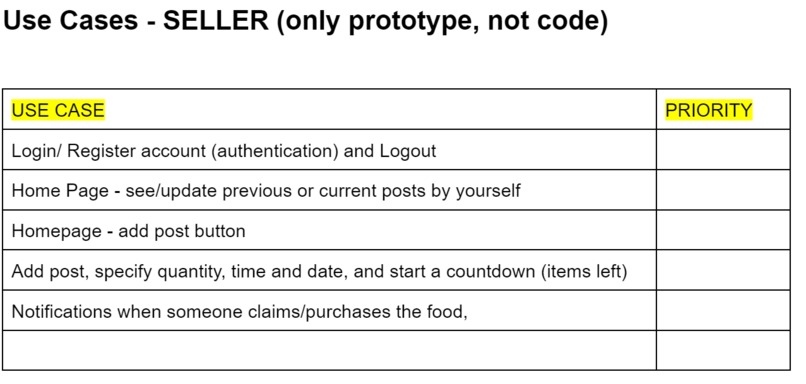
Use cases - provider/seller
-
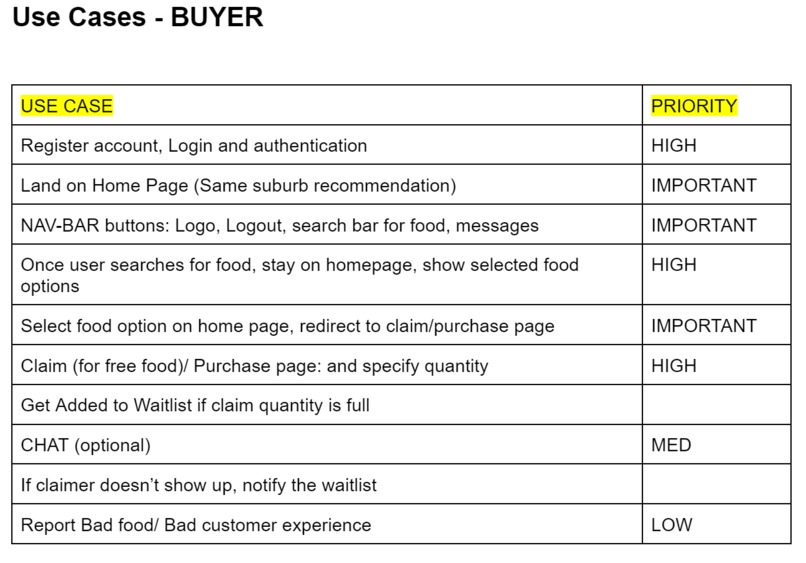
Use cases - buyer
Inspiration
Food waste is a huge issue globally. Roughly one third of all food produced ends up being wasted or lost. More specifically, commercial food production (e.g. cafes, bakeries, restaurants) are responsible for 35% of food wastage; while 20% of all food prepared for catered events and buffets. On the other hand, household wastage is also an issue; 1 in 5 grocery bags ends up being wasted. We decided to try and find a solution to such issues, by targeting both commercial scale and household scale food waste.
What it does
Forager provides a platform to give away excess food, either for free or at a heavily discounted rate (only for verified businesses); as well as the chance to find affordable and available food. As an online marketplace, Forager covers two demands; the demand to reduce food waste, and the demand for cheap food.
How we built it
- Brainstorming ideas, eventually settling on food waste as a solution topic
- Devising solutions to food waste, deciding on a marketplace for repurposing food surpluses.
- Develop use cases, models to begin rendering our website
- Begin Figma protoype, making sure all relevant website pages are included
- Begin front-end implementation
Challenges we ran into
Commercial competition, monetary transactions was an issue we encountered in our project plan. By including transactional functionalities in our website, this would leave us liable for any issues, conflicts or sources of damage in relation to transactions associated with Forager. Hence, to start with, leaving transactions off the website would be significantly easier. This also means that our motivations, which are inherently non-profit, align with our solution.
However, one concern is that there will then be no motive for businesses to give away food if there is no monetary difference between wasting food and donating it. Hence, we will include the option to list food for a cost; there will be strict regulations surrounding advertised costs (e.g. maximum price per kg). But, there will still be no transactional processes through the website.
Another issue in considering our solution was user competition - how would reservations/claims work? We decided that a 'wait list' functionality would work well; for a giveaway, if there is no queue, you may claim the food. You will then have a set amount of time to pick up this food before the next person in line is then able to claim it. This was the fairest way to avoid any kind of user competition.
In terms of implementation, we found that given such a small time frame it was unrealistic to expect to fully implement our website, especially considering complex functionalities such as location, account types, and suggested feeds.
For this reason, our implementation at this point in time is solely front-end, with no back-end or database implemented yet.
Accomplishments that we're proud of
- Developing a considered and thoughtful solution to our cause
- Submitting despite an injury to one of our members
- Complete prototype design for a website with several different functionalities
- Implementation underway of website despite having very little experience in web development
What we learned
This was a first hackathon for all members of the team and all of us focused on meeting new people, learning new tools while finding solutions to problems which have an impact to community. During the design and development process our team learned and used new tools (MERN Stack, Figma, Netlify)
Member specific roles-commitments:
Matt and Leo - Frontend UI/UX (Prototyping and Designing) Suren - Backend Development (NodeJs, MongoDb, ExpressJs) Sonika, Calvin - Frontend Development (React)
What's next for Forager
- Fully implement website
- Arrange certification and verification possibilities for food providers, ensure our model is legally apt
- Campaign for usage of app; prioritising campaigning for food donors, rather than food seekers. There will be a natural demand for free/affordable food given there is a supply.
Built With
- express.js
- figma
- mern
- mongodb
- netlify
- node.js
- react


Log in or sign up for Devpost to join the conversation.