-
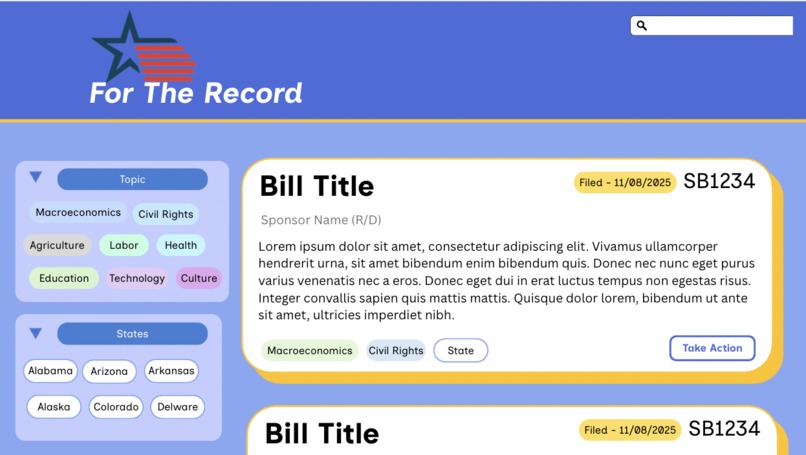
Style Template
-
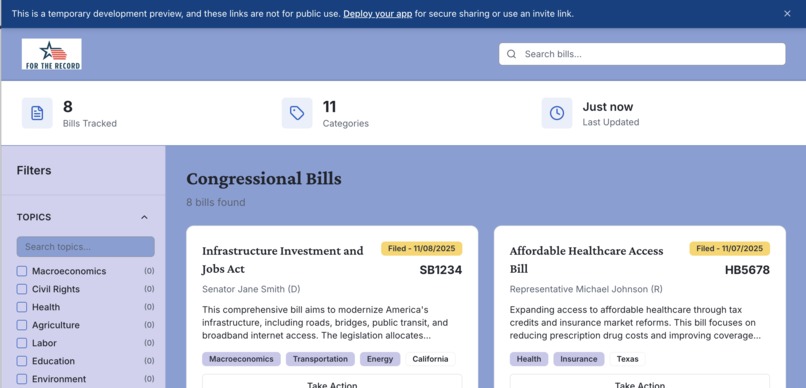
Prototype Image
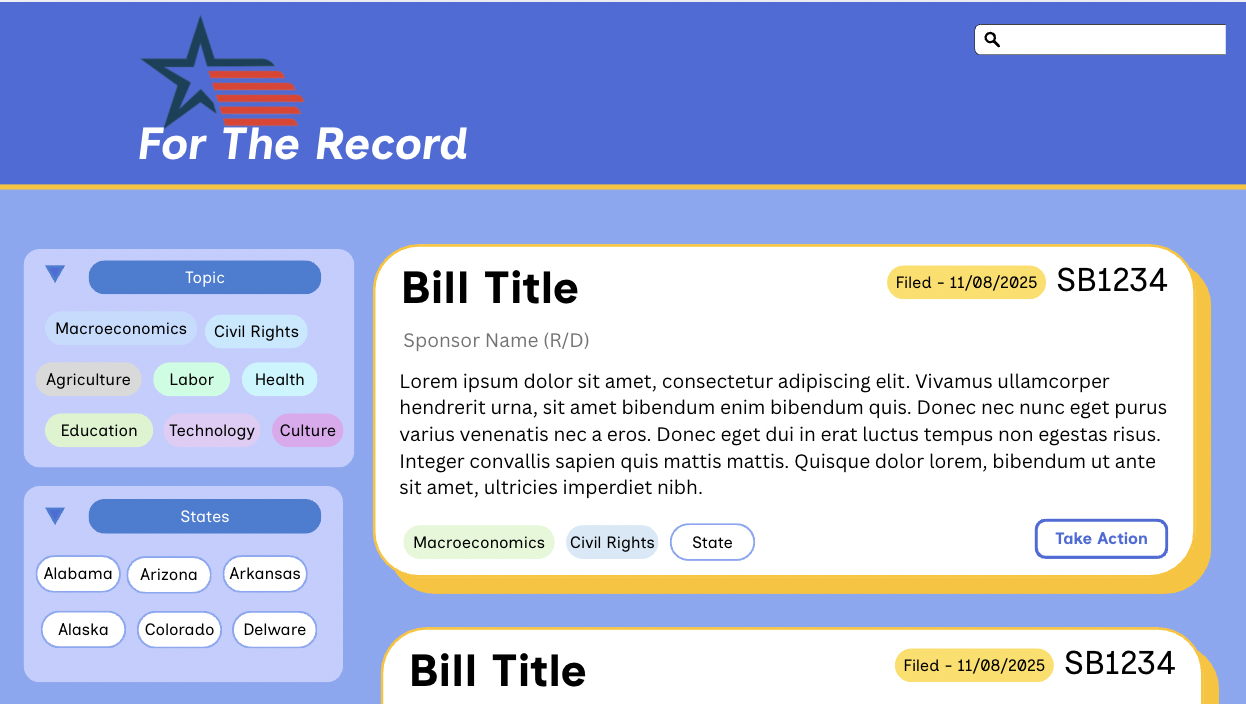
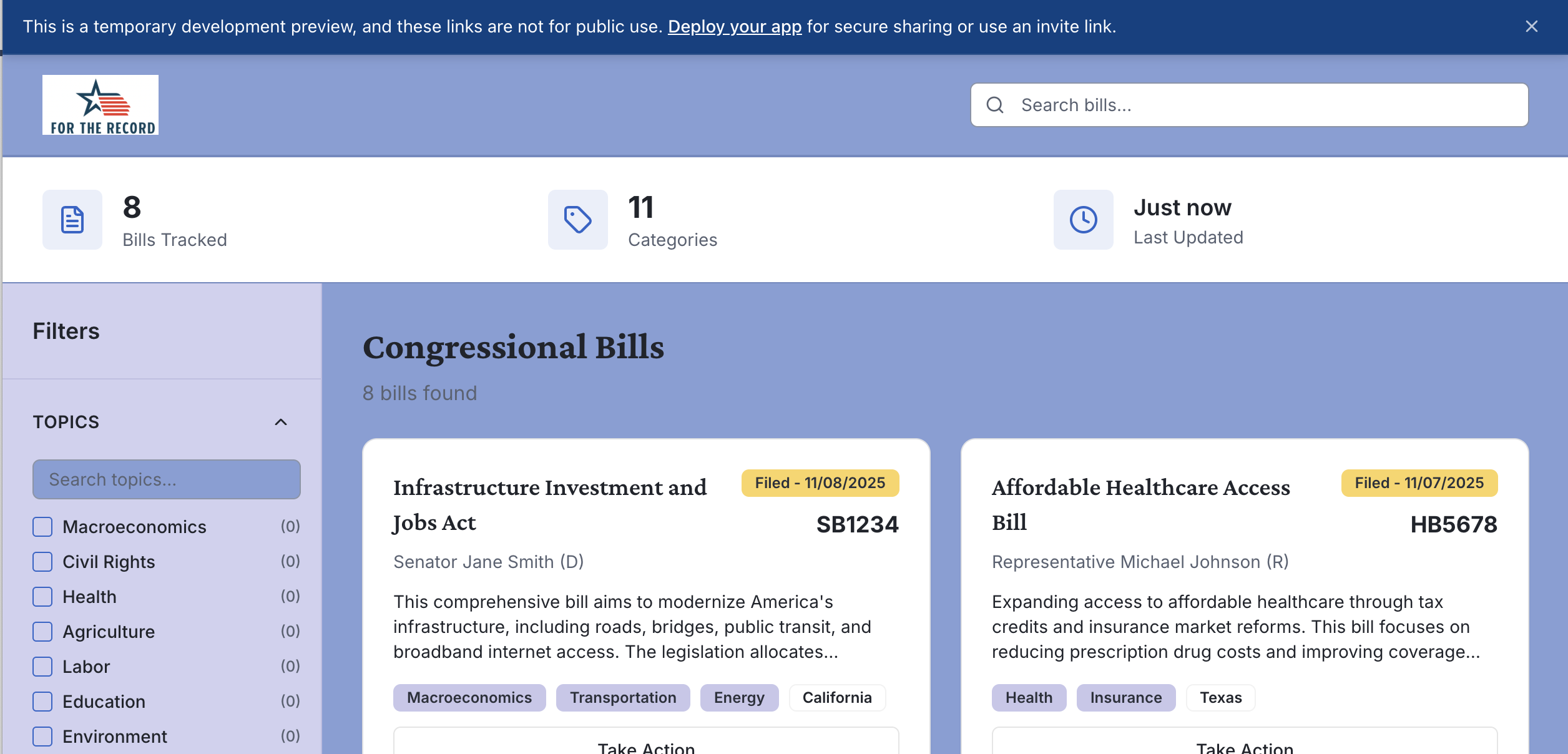
Inspiration
Each year, the United States Congress sees over 20,000 bills through its halls, to say nothing of local and state governments. What this means is that for the average citizen, policy is hard to understand, and even harder to break down in a timely fashion to do something about.
What it does (Or, Rather, What It's Supposed To Do)
A script scrapes the Congress Bulk Data Repository at https://www.govinfo.gov/bulkdata/BILLS/119/1 for bill data every four hours. This should yield the sponsoring politician, party, state, any affected areas, and a summary.
Using machine-learning, the output of the scraper (all formally proposed pieces of legislation available publicly) can be placed into one of the Comparative Agendas Project categories, which can then be matched with user interests. An LLM could also summarize the bill, but we have seen issues with this before. Thankfully, most Congressional bills come with summaries.
The above data allows us to highlight relevant information to users based on state/area/interests. This is important because most people only hear about legislature long after it has become law, outside of comment periods and any ability to change it.
What does AI/ML Do?
We have three pieces of ML that we (tried/wanted) to integrate. First, we have a PyTorch script that predicts the Comparative Agendas Project category given the title of the bill, to categorize each piece of legislation. This uses a multi-layer perceptron and enjoys 85% out-of-sample accuracy, with a good number of inaccuracies due to overlap (e.g., a bill on soybean farmers falling into agriculture vs. economics).
We wanted to use an LLM to summarize bills, but ended up depending on given summaries of bills available via webscraper because of hallucination issues. We also would have liked to use machine learning to predict users' interests, but did not have the data available to support it.
How We Built It
With a lot of vibe coding. Nobody in this team had previous web/app dev experience, but the hackathon was a great chance to learn some of the basics.
What's next for For the Record
Well, if we ever finish learning how to code an app in the future, it would be nice to make something like this again and refine it into a finished product. But as a proof of concept, we think it would be great to expand to State and County-level legislature, which across a majority of the United States is decided by dozens of voters rather than hundreds or thousands.

Log in or sign up for Devpost to join the conversation.