-
-
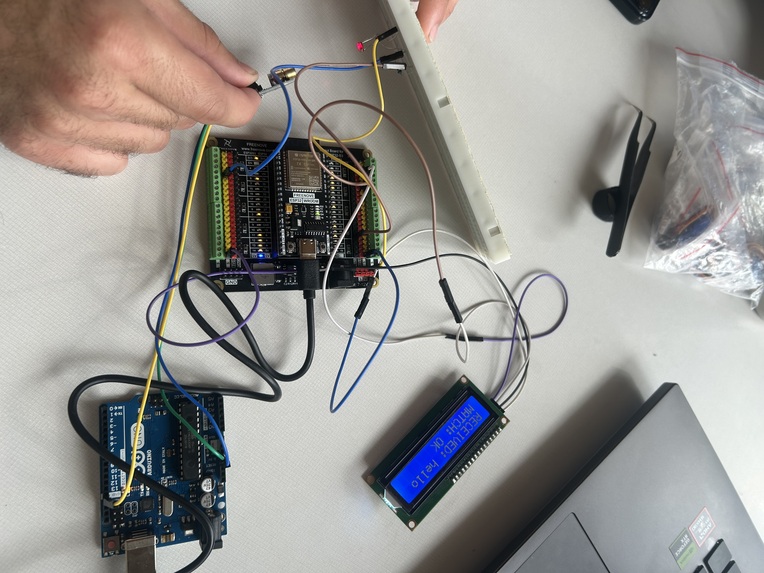
Hardware system with laser shining at photoresistor
Inspiration
As low Earth orbit becomes increasingly crowded, satellites need to transmit inertial data more frequently to help their control systems prevent collisions. Traditional radio-frequency communication methods face bandwidth limitations as satellite networks grow, while laser-based methods offer significantly higher data throughput. Furthermore, not all satellite data is equally important or time-sensitive, creating a need for more efficient data prioritization. PhotonIQ was inspired by these challenges, exploring how the transmission of laser-encoded packets, combined with local data prioritization, could enable faster communication between satellites and support more effective collision avoidance.
What it does
PhotonIQ is a laser-based communication system consisting of an independent transmitter and receiver, supported by a local edge-computing algorithm. The system uses a rule-based priority scheduling algorithm that ranks collected data according to its importance, urgency, and value, determining the order in which messages are transmitted. The transmitter then encodes these messages into binary data and transmits them through timed pulses of laser light. The receiver detects these pulses using a photoresistor and decodes the binary data to reconstruct the original message. By combining packet-based optical communication with edge-based data prioritization, PhotonIQ serves as a proof of concept for higher-throughput, more efficient communication systems that could improve satellite coordination in low Earth orbit.
How we built it
We built PhotonIQ using an Arduino-controlled laser transmitter and an ESP32-based receiver connected to a photoresistor and LCD display. We also developed a rule-based priority scheduling algorithm that runs locally on a computer, using edge computing to evaluate collected messages based on their importance, urgency, and value before determining their transmission order. On the transmitting side, the Arduino converts messages into binary data and uses on-off keying (OOK) to represent individual bits by switching the laser on and off at timed intervals. On the receiving side, the photoresistor detects changes in light intensity, which the ESP32 interprets as binary signals to reconstruct the original message. The decoded text is then displayed on the LCD screen, completing the end-to-end optical communication process. The transmitter and receiver operate independently, with information traveling wirelessly through the laser beam.
Challenges we ran into
One of the biggest challenges we faced was synchronizing the timing between the transmitter and receiver. Since the system communicates through precisely timed laser pulses, even small differences in the time delays could cause the receiver to misinterpret bits and decode messages incorrectly. We spent considerable time adjusting these delays to ensure reliable communication. We also encountered issues with software libraries and configuring the LCD display to show the decoded messages correctly. On the hardware side, aligning the laser with the photoresistor was another challenge, as the receiver needed consistent exposure to the laser beam to accurately detect changes in light intensity. Overcoming these issues required repeated testing and adjustments to both the hardware and software.
Accomplishments that we're proud of
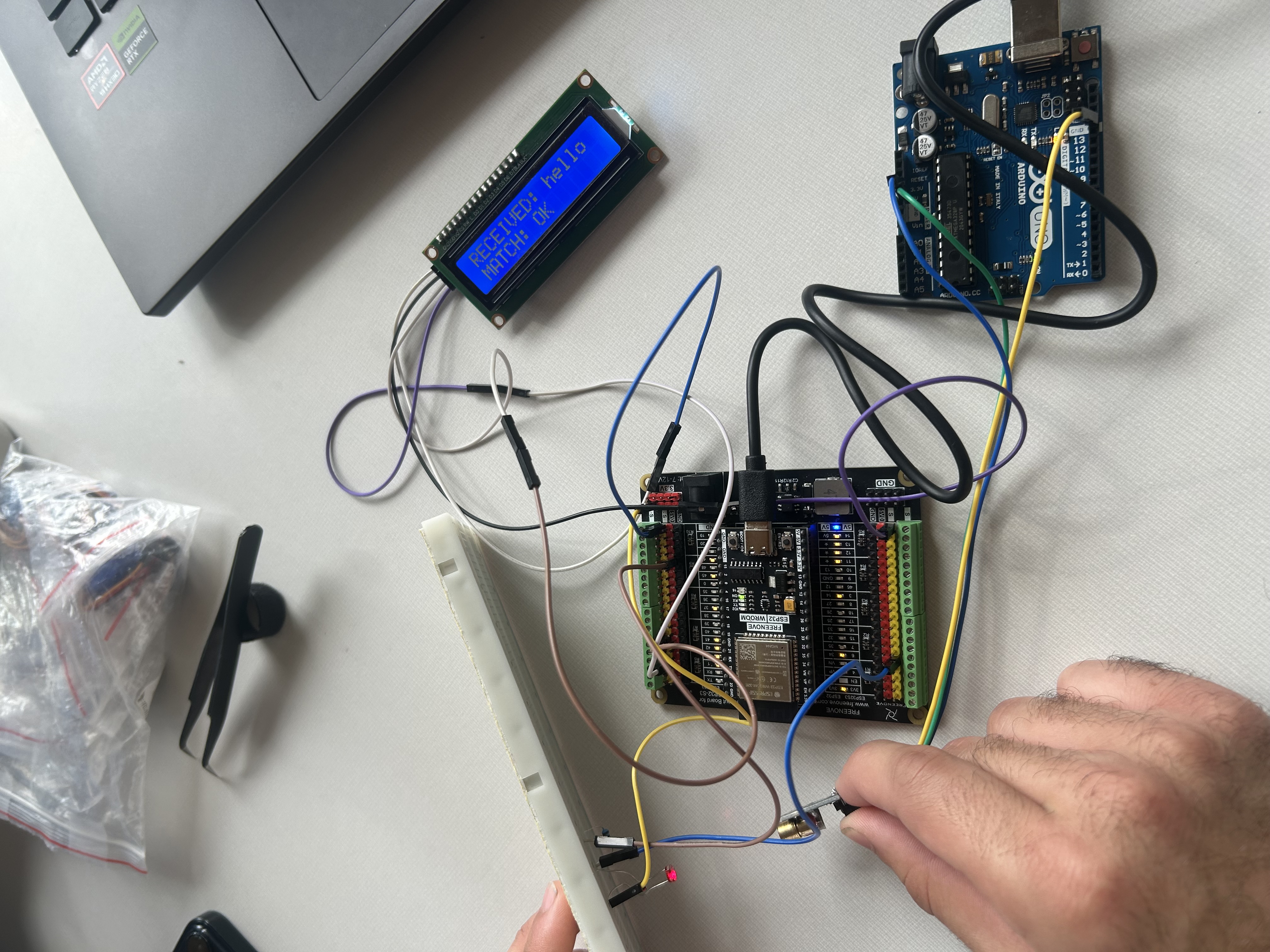
One of our biggest accomplishments was successfully building a transmitter and receiver that operate independently while maintaining reliable communication through laser pulses. We are especially proud of implementing the encoding and decoding process, allowing the receiver to accurately reconstruct messages from transmitted binary data. We also integrated an LCD screen that displays how incoming bits are interpreted and converted into ASCII characters, making the communication process easier to visualize. Another accomplishment was developing a local priority scheduling algorithm that evaluates the importance, urgency, and value of collected data to determine which messages should be transmitted first. Most importantly, we are proud of researching the growing challenges of satellite communication in low Earth orbit and translating a futuristic concept into a simplified, working model that serves as a strong proof of concept for future optical communication systems.
What we learned
Throughout the development of PhotonIQ, we gained a deeper understanding of the complexities and challenges involved in signal processing and data transmission, particularly the importance of timing and synchronization in ensuring reliable communication. We also learned how communication networks can be made more efficient, not only by improving how data is encoded and transmitted, but also by prioritizing information based on its urgency and importance. Developing our edge-computing algorithm helped us understand how rule-based scheduling can make better use of limited communication capacity. Beyond the technical concepts, we gained valuable experience in systematically testing our system, identifying bottlenecks, and troubleshooting issues through repeated experimentation. Most importantly, we learned how to approach complex engineering problems by breaking them down into smaller challenges and continuously refining our hardware and software to improve the overall system.
What's next for PhotonIQ
One of our next steps is to implement an automated satellite alignment and tracking system. Currently, PhotonIQ relies on the laser remaining precisely aligned with the photoresistor, which would be challenging in real-world satellite communication due to the constant movement of satellites. Developing a system that dynamically adjusts the laser's direction would allow us to maintain a reliable optical connection between moving satellites. We also plan to explore a hybrid communication system that automatically switches to radio-frequency communication if the optical link is lost for an extended period. This would provide a backup communication channel when laser transmission is interrupted by misalignment or other obstacles. Together, these improvements would bring PhotonIQ closer to a practical and reliable satellite communication system.

Log in or sign up for Devpost to join the conversation.