-
-
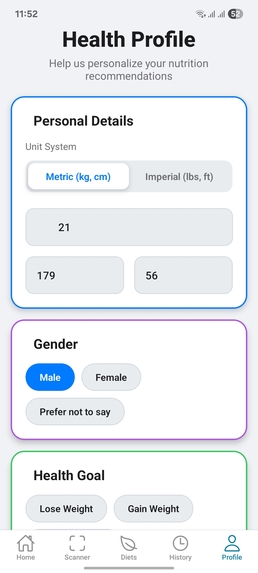
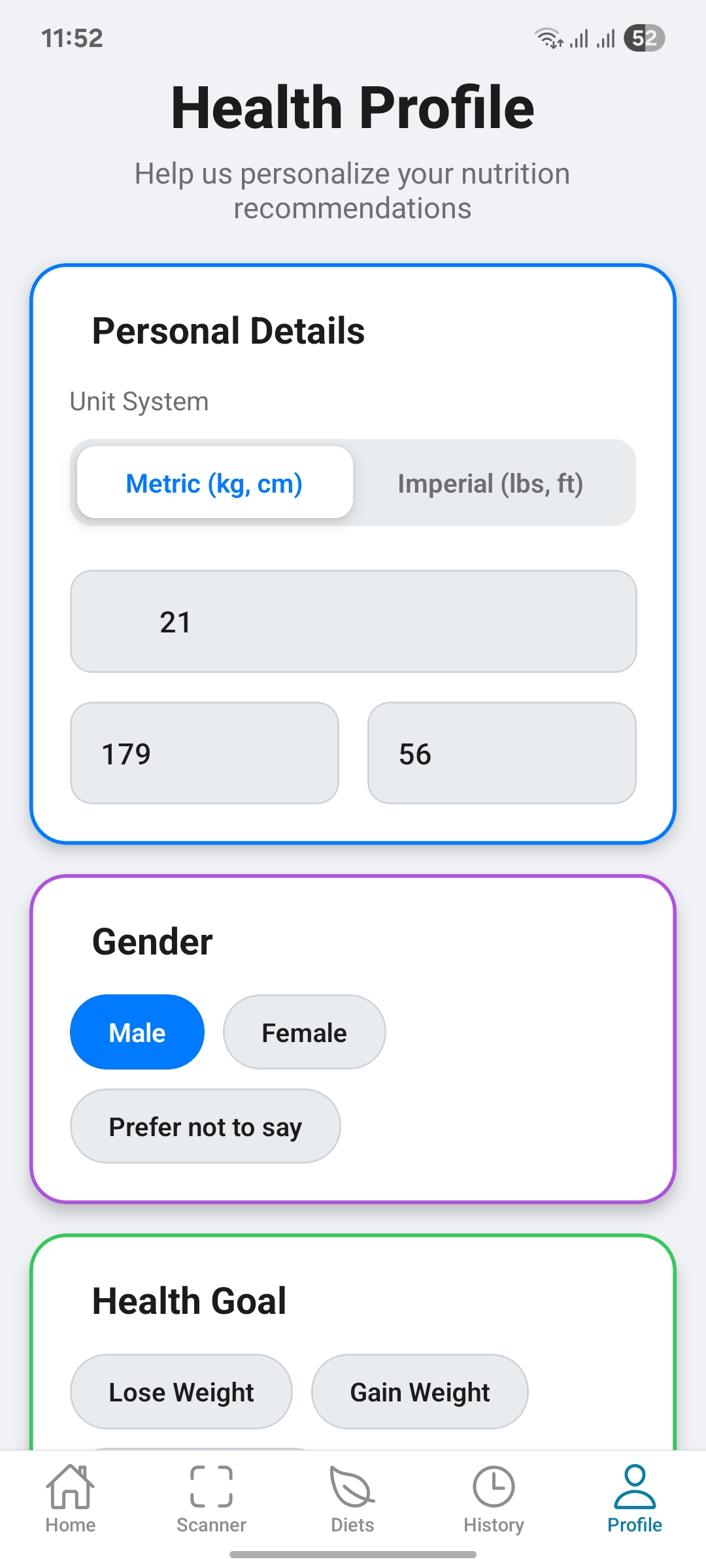
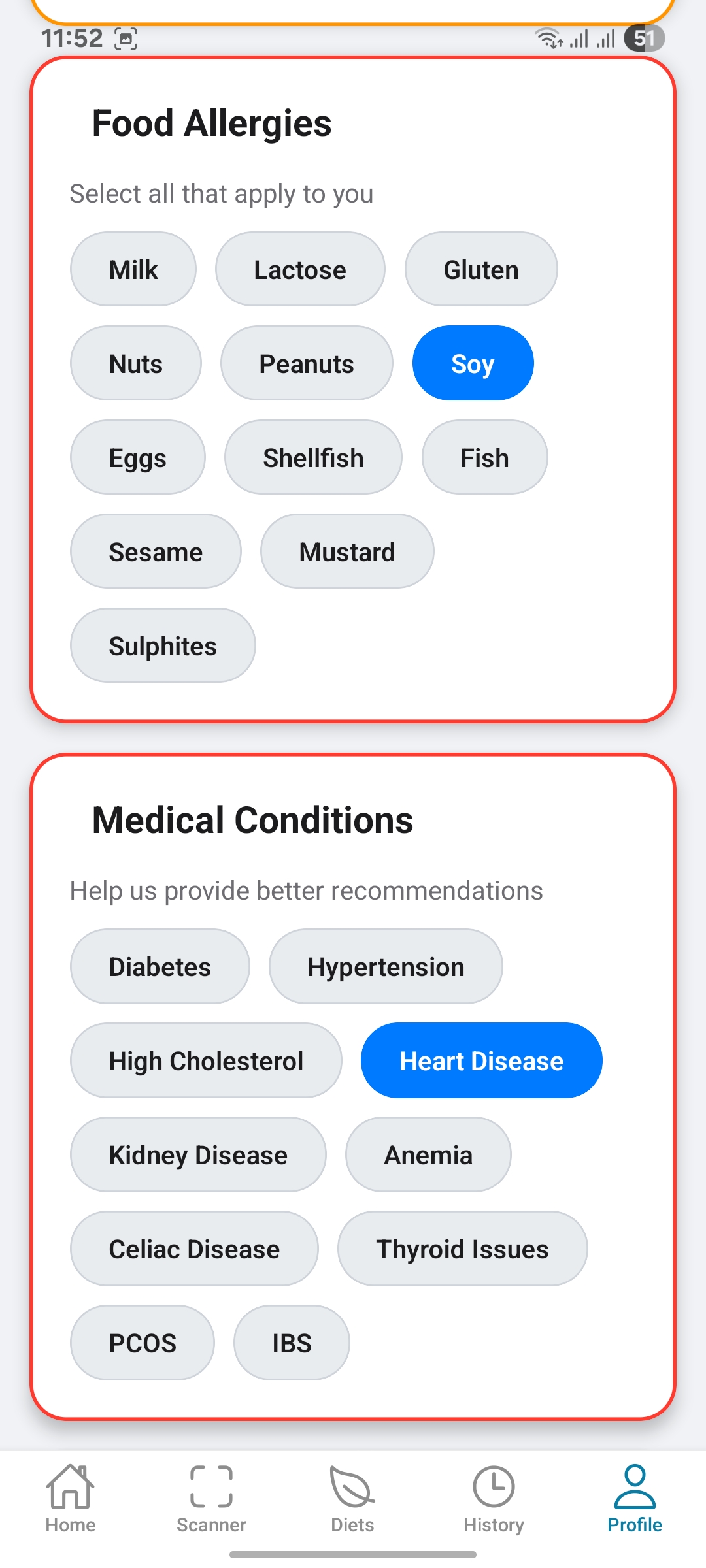
Your hyper-personalized experience starts here. Set your goals, allergies, and medical conditions to get advice tailored just for you.
-
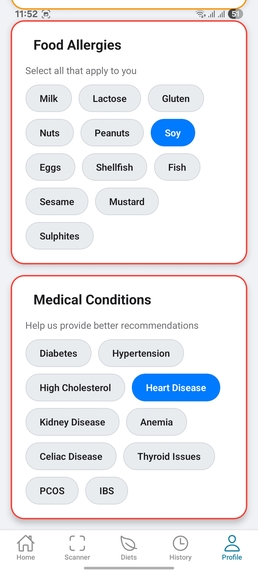
Continuation of the profile section.
-
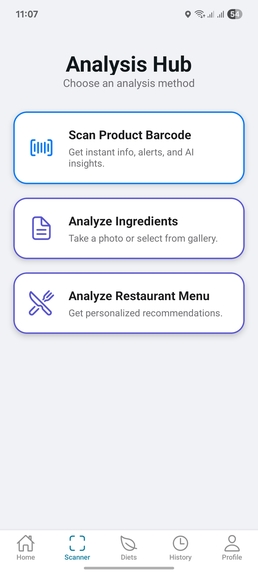
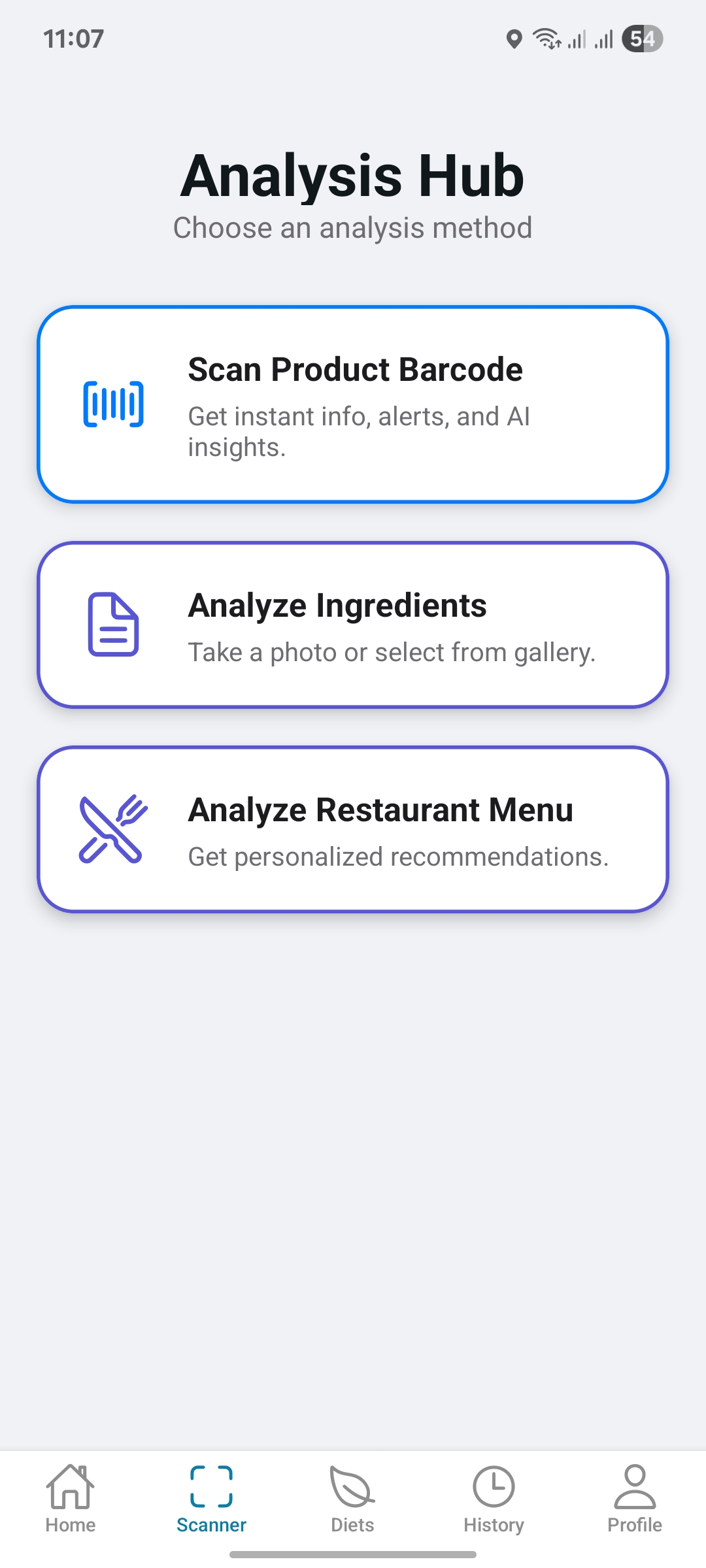
The Analysis Hub: Scan product barcodes, analyze ingredient lists from a photo, or get recommendations from a restaurant menu.
-
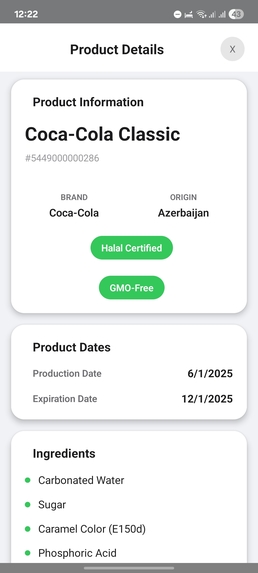
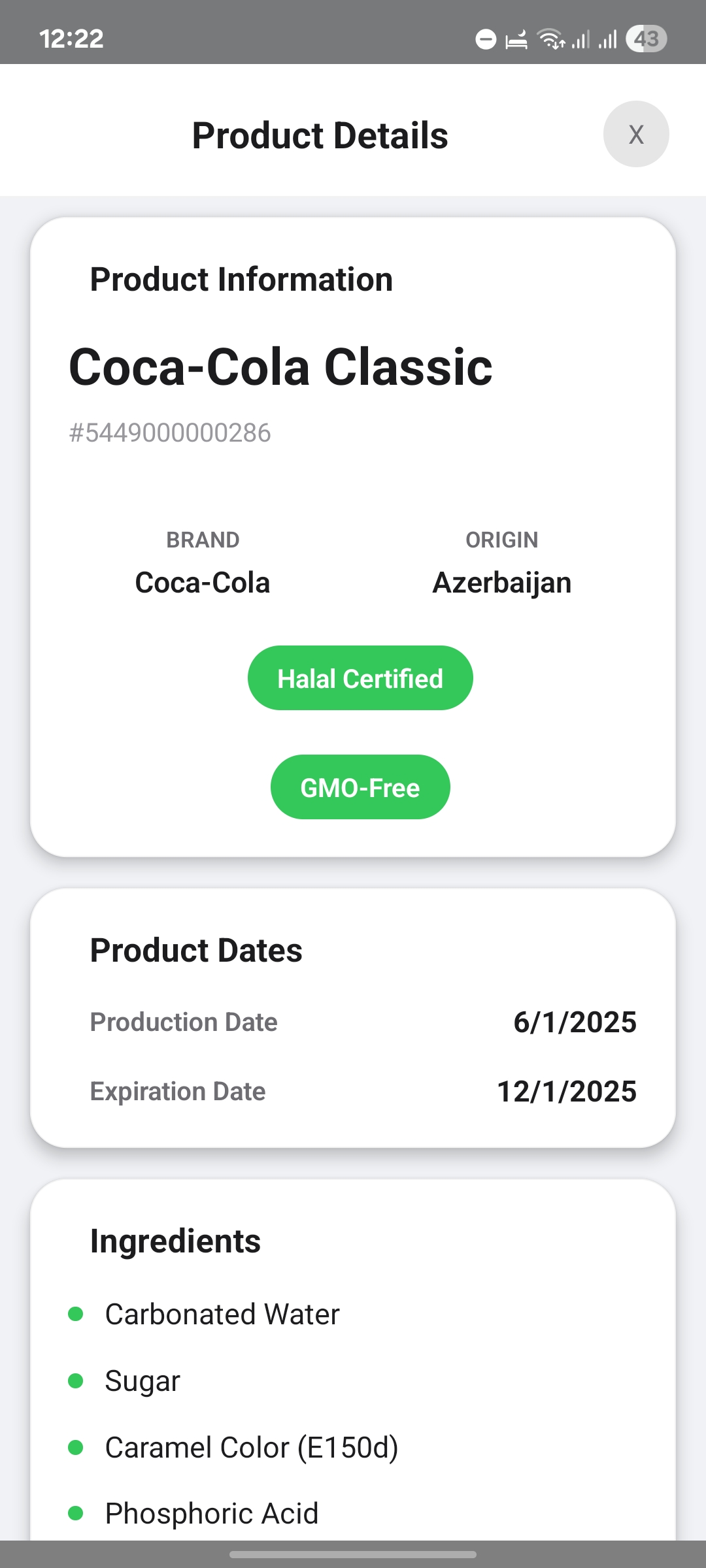
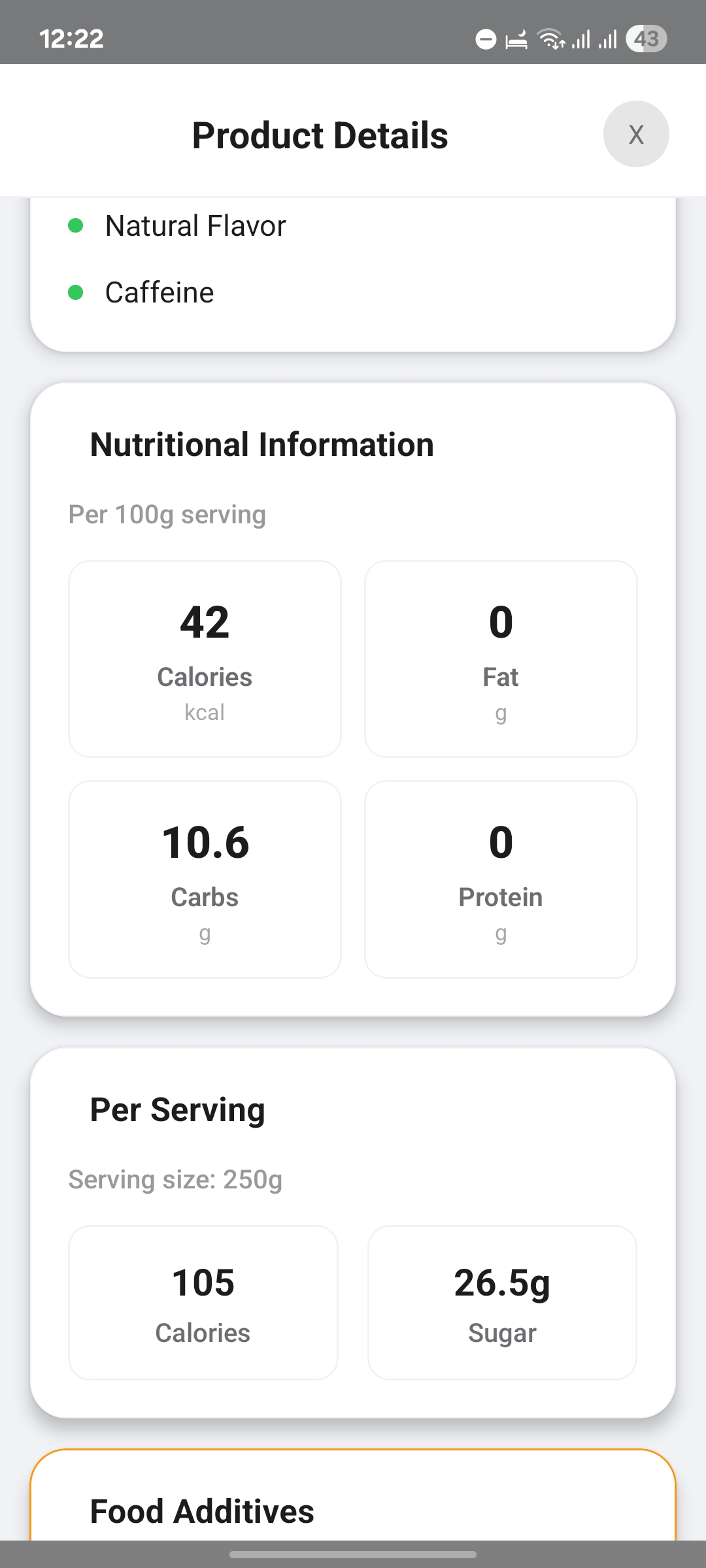
Product Details (after the QR code scan)
-
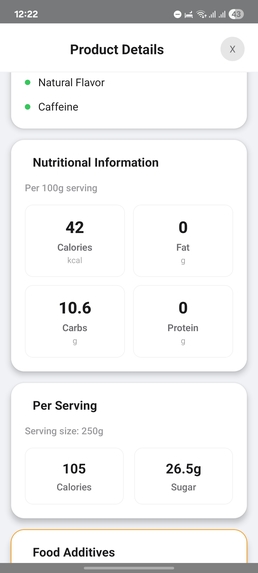
Product Details (after the QR code scan)
-
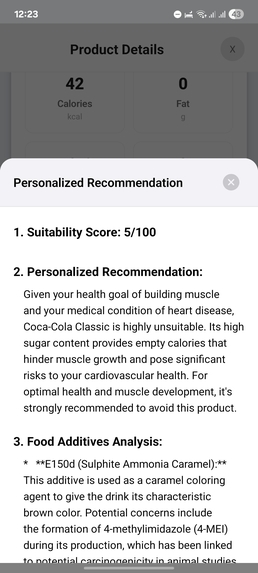
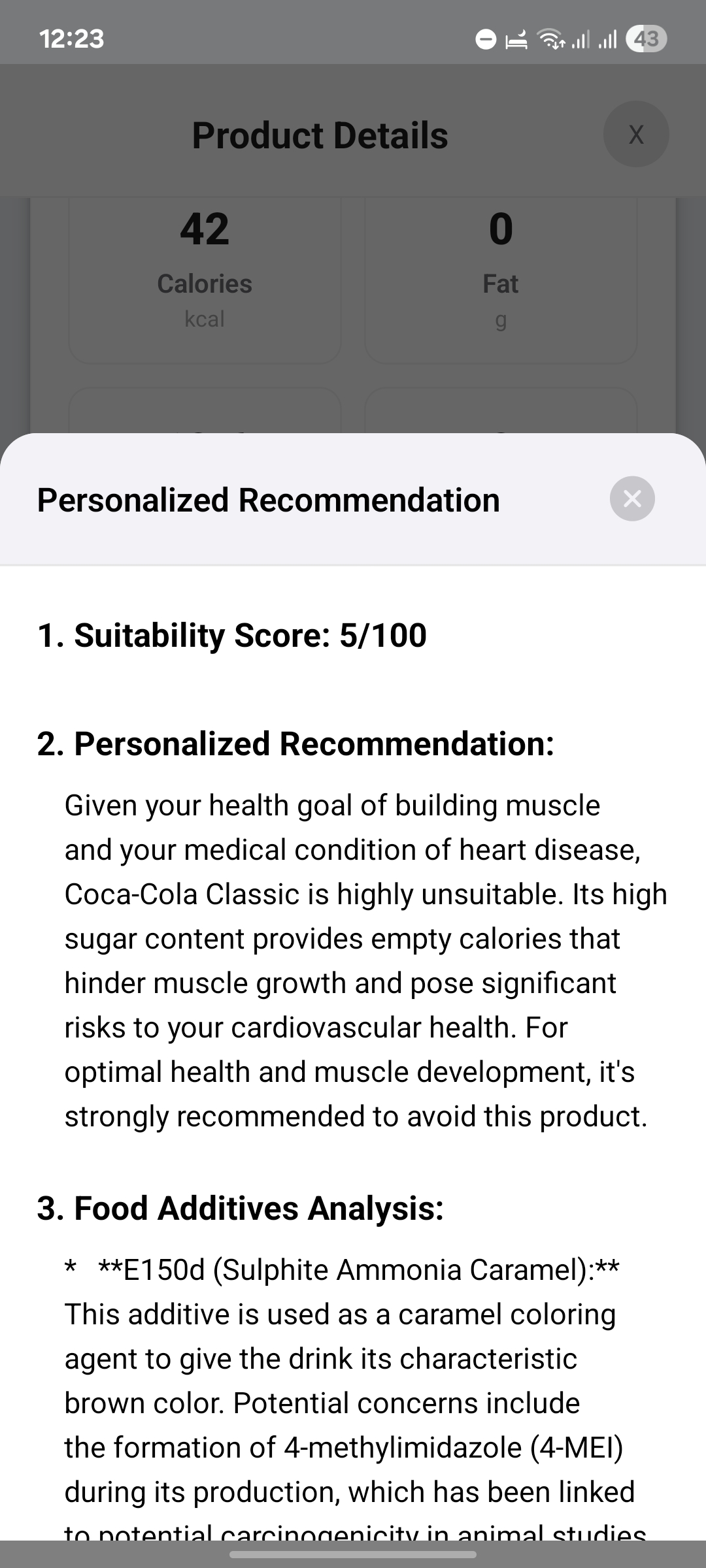
AI Recommendation: After every scan, our AI provides a "Suitability Score" and detailed advice tailored to your unique health profile
-
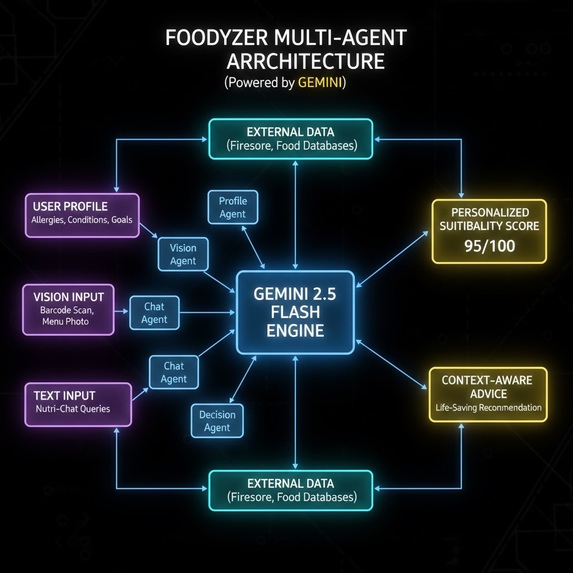
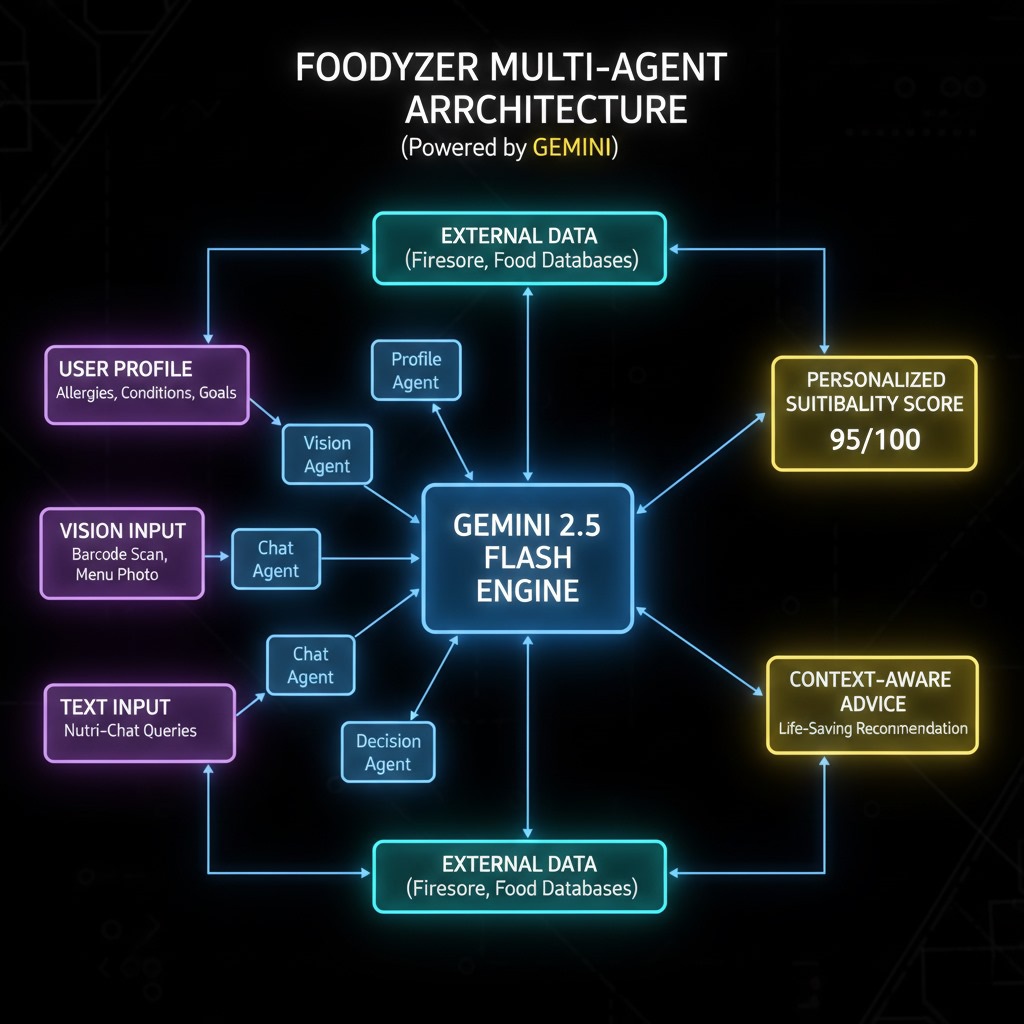
Foodyzer Multi-Agent Architecture
💡 Inspiration
Today’s global consumers are trapped by a critical civic challenge: Food Information Poverty. Over 422 million people manage Diabetes, and 0.5 billion face severe food allergies. They navigate a market flooded with misleading nutritional data and confusing, unreadable labels, turning simple shopping into a high-risk health calculation.
As a Food Engineer, I realized the core problem wasn’t the food itself, but the lack of personalized, actionable intelligence. Foodyzer was conceived to hack this information inequality, creating a life-saving AI Co-Pilot that restores health equity by empowering the consumer at the point of decision.
🛠️ What it does
Foodyzer is a comprehensive, multi-modal nutritional guide tailored to each user's unique medical profile. We provide immediate safety and radical transparency:
- Hyper-Personalized Suitability Score: Scan any product barcode. Our AI instantly delivers a Suitability Score (0-100) and a clear warning, not based on generic standards, but on your specific allergies, chronic conditions (e.g., Diabetes), and diet goals.
- Multi-Modal Analysis Hub: Our Vision Agent uses Gemini 2.5 Flash to analyze photos of ingredients and restaurant menus (OCR), demystifying complex E-numbers and hidden allergens in any setting.
- Context-Aware Nutri-Chat: A built-in conversational agent that processes multi-conditional queries, such as: "I am thinking of having spaghetti Bolognese... what minimal changes can I make to reduce the meal's glycemic load?"
⚙️ How we built it
The most significant achievement is that Foodyzer was built by a domain expert (Food Engineer) with zero prior coding experience. This was only possible by treating AI as a full development partner (using Kiro).
Instead of traditional coding, we engaged in spec-driven development, describing our domain expertise and vision in plain English. The AI architected and generated the production-ready React Native code. This dialogue-based process allowed a domain expert to directly build a solution to a civic problem that would traditionally require a full development team, thus proving the power of AI in democratizing complex solution development.
🏃 Challenges we ran into
Our primary challenge was architecting the secure and resilient Multi-Agent System at the core of the app. This involved:
- Managing three complex data flows (Barcode, OCR Ingredient, Menu Photo) on a single screen.
- Ensuring the Gemini 2.5 Flash API reliably orchestrated the five distinct AI agents (Profile, Vision, Chat, etc.) to deliver precise, personalized results every time.
We overcame this by breaking the system down into minute specifications, iteratively refining the state management and conditional logic through focused AI dialogue.
🎉 Accomplishments that we're proud of
- Building a functionally complex, data-driven, and truly useful application that solves a significant public health problem without writing manual code.
- Successfully integrating a sophisticated Multi-Agent AI backend (Google Gemini) with a sleek, user-friendly frontend.
- Proving that domain experts can be empowered by AI tools to become powerful tech-activists who directly build the solutions they envision for a better society.
🧠 What we learned
This project provided a profound lesson in the future of tech-enabled activism. We learned that spec-driven development dramatically shortens the gap between recognizing a major civic problem and building a comprehensive solution. It allows for unprecedented rapid prototyping and iteration, making ambitious, high-impact projects feasible for individuals.
🚀 What's next for Foodyzer: Hacking Food Information Poverty
Our focus remains on scaling our social impact and achieving true health equity:
- Expanding our food database and refining AI models for greater cross-cultural and regional accuracy.
- Seeking B2B partnerships to integrate Foodyzer's personalized safety protocol into corporate wellness programs and national healthcare systems. Our ultimate goal is to make personalized nutritional guidance accessible to everyone, everywhere.
Built With
- ai
- api
- expo-router
- expo.io
- firebase-firestore
- gemini
- javascript
- kiro
- node.js
- react-native
- typescript

Log in or sign up for Devpost to join the conversation.