Inspiration
Every team knows the thread. It's 12:14, someone posts "lunch?", and twenty minutes vanish into scrolling menus, pasting links, copy-pasting orders into a DM, and one person becoming the human spreadsheet who tallies it all up and pays.
The food is easy. The coordination is the tax.
So we looked for the simplest interface imaginable — and realised the team is already in Slack, which already has a universal, zero-learning-curve input device: the emoji reaction. Everyone knows how to tap one. What if ordering lunch together was just… reacting to a message? And what if planning the order was just telling an assistant what you're in the mood for? No new app, no link, no spreadsheet. That idea became Foody.
What it does
Foody is a Slack AI app: it lives in the ✨ AI-apps pane with a full assistant surface — assistant threads, live status updates, and suggested prompts — powered by Claude with tool use. It has no interface of its own; Slack is the interface.
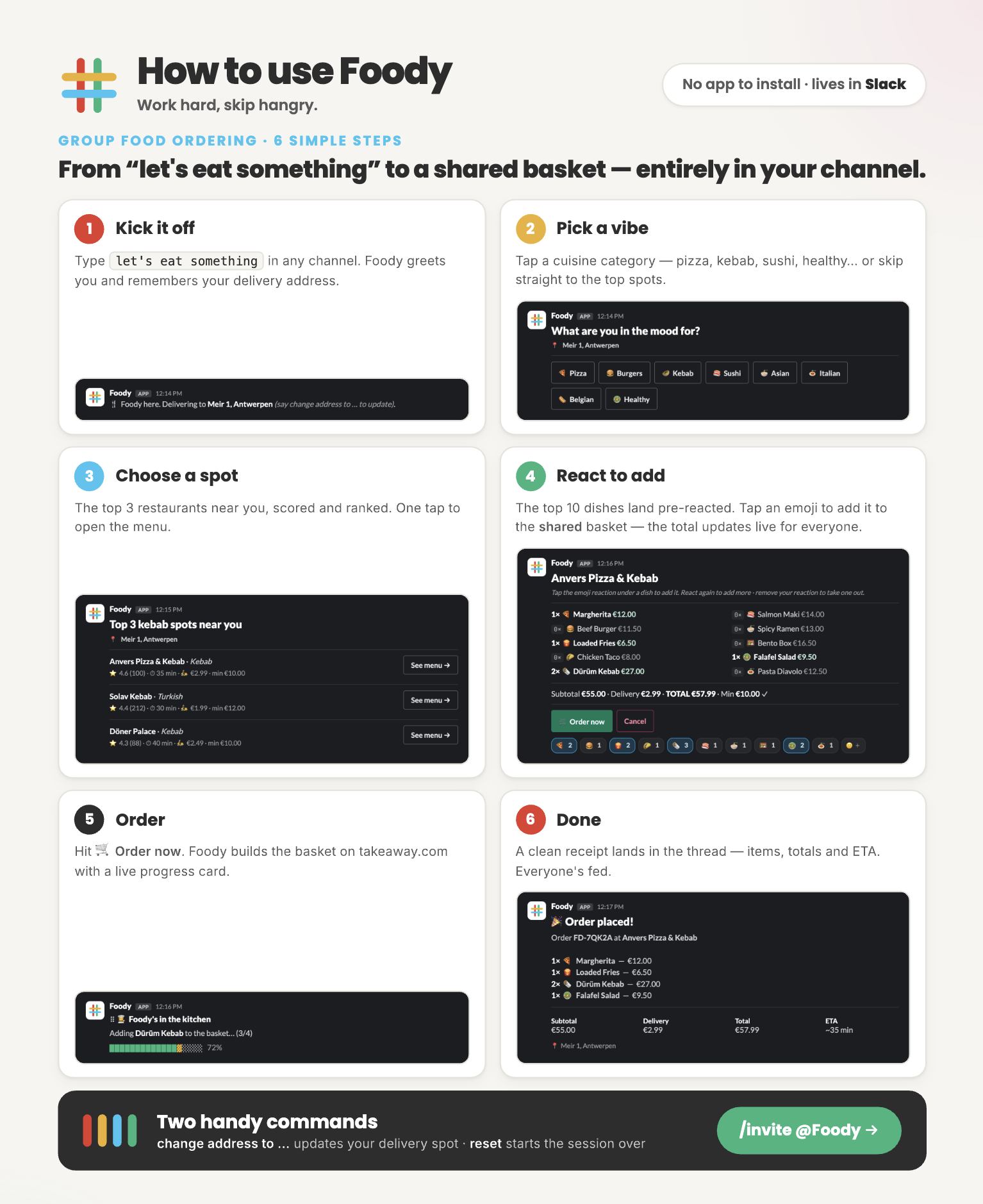
Start with the AI assistant — "top pizza spots near the office? what does the best one charge for a margherita?" — and Claude compares restaurants, answers budget and menu questions, remembers your delivery address, and shows a live status ("is scanning takeaway.com…") while it works. When you say go, its start_group_order tool posts the order into your channel. Or skip the chat and type "let's eat something" — both doors lead to the same flow:
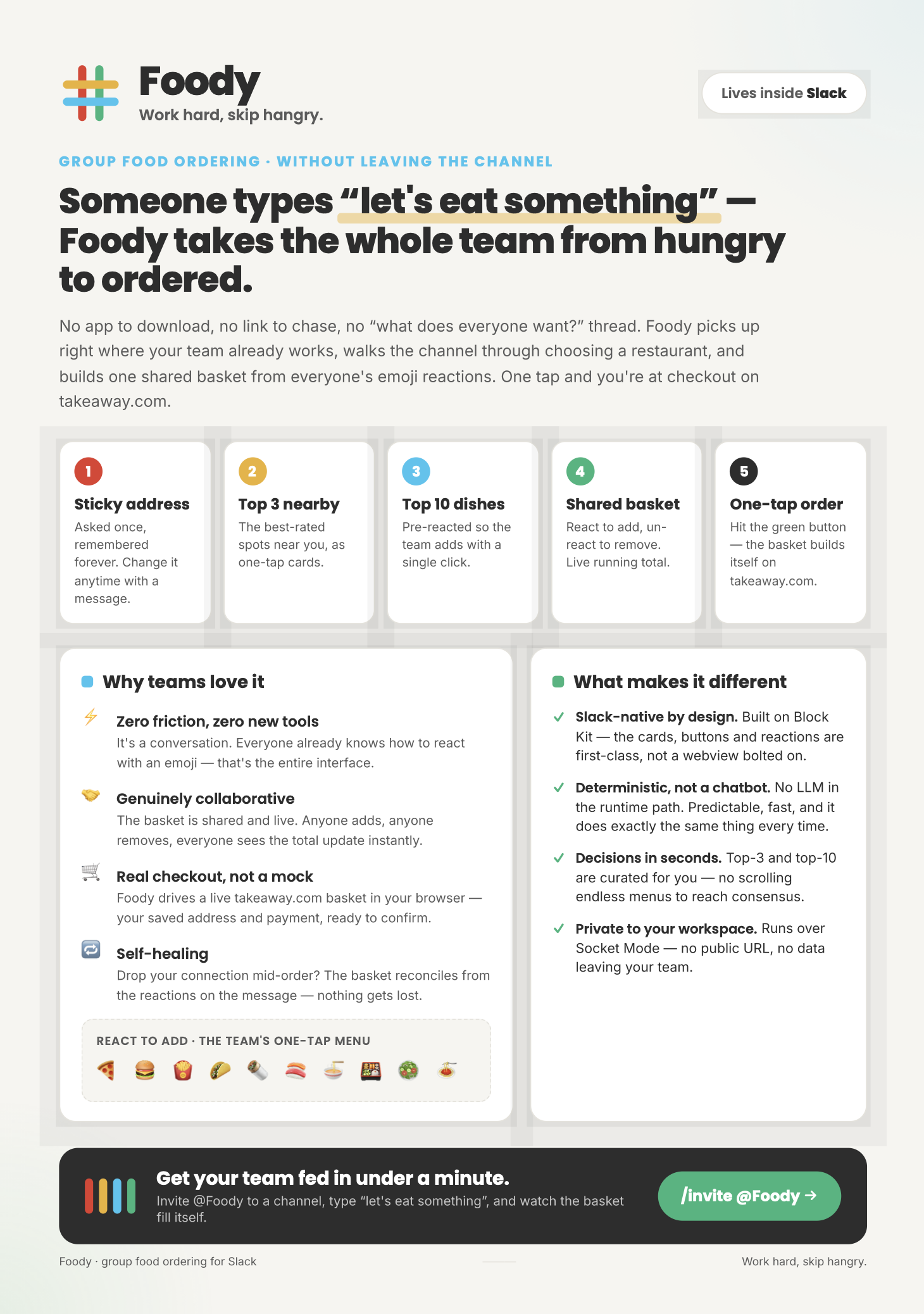
- 📍 Address — sticky per Slack user. Asked once, remembered forever; change it anytime with "change address to …".
- 🏠 Top 3 restaurants near you — ranked, shown as one-tap Block Kit cards.
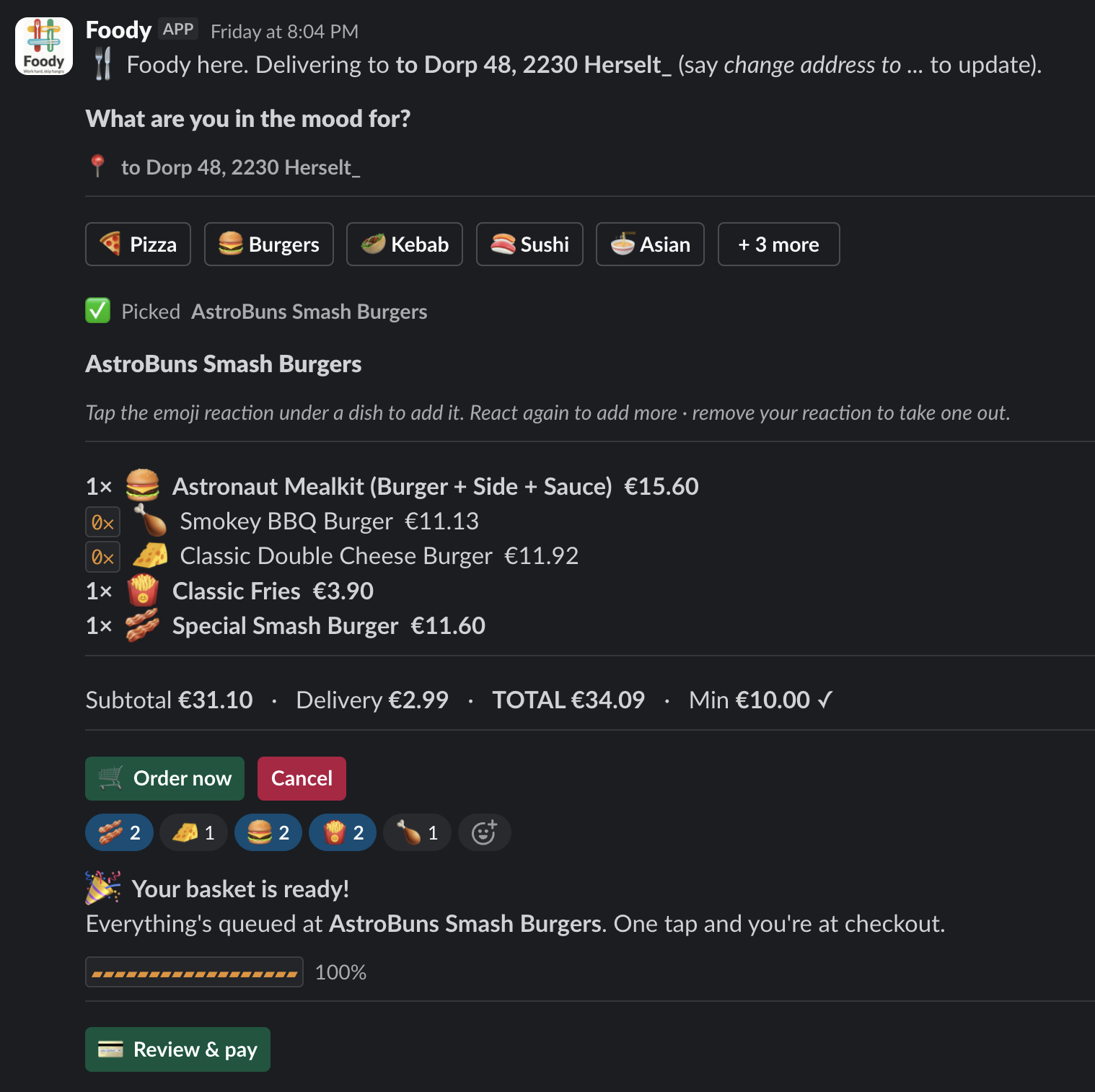
- 🍽️ Top 10 dishes — one single message that Foody pre-reacts to. Compact emoji grid, or 📸 photo view with real dish photography from the restaurant — the order starter picks.
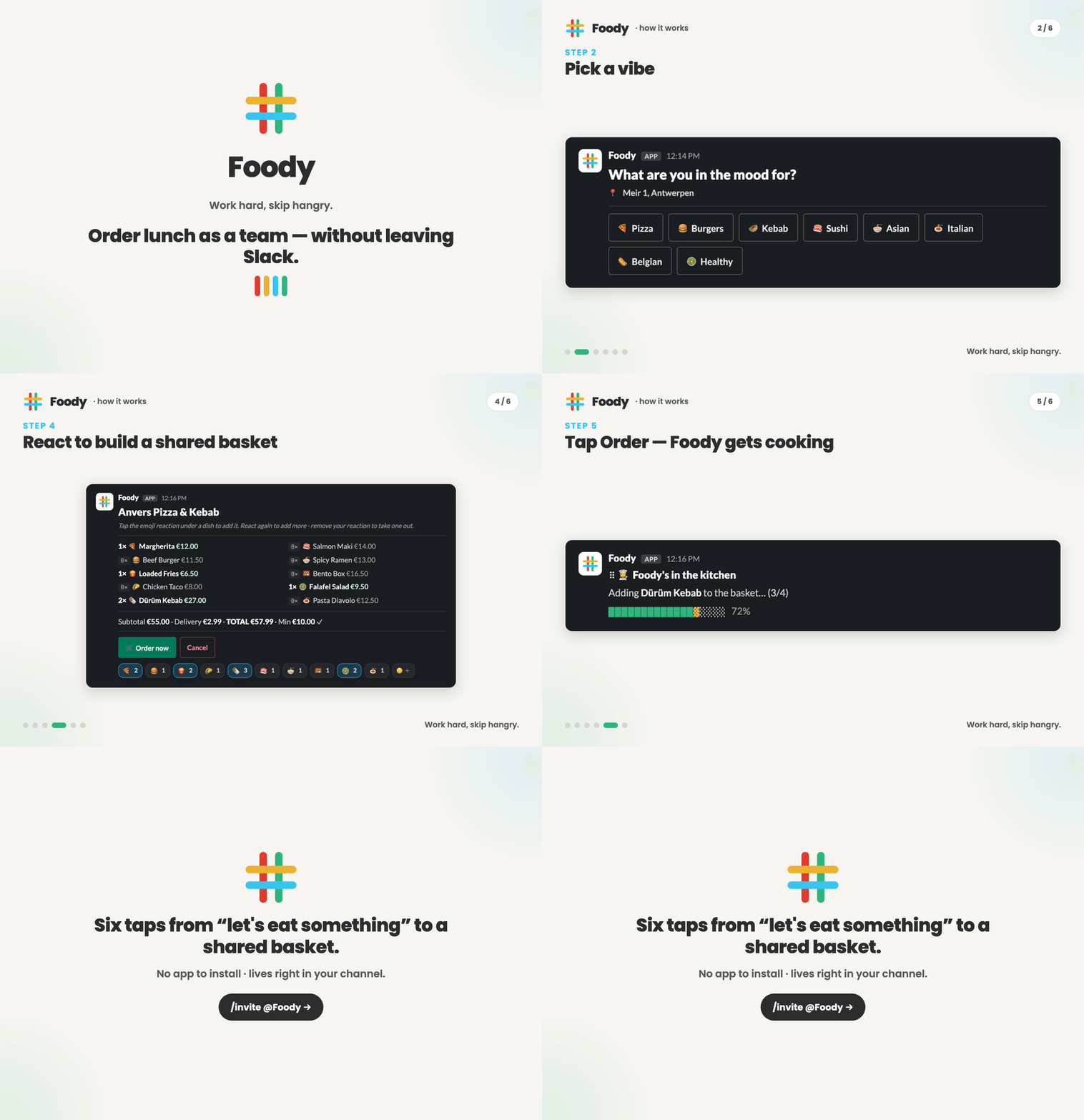
- 🛒 Shared basket — anyone's reaction adds a dish, un-reacting removes it; the running total updates live for the whole team.
- ✅ One-tap order — hit the green button and Foody assembles the real basket on Takeaway.com, ready to confirm.
The entire experience is the chat itself: an assistant conversation, messages, cards, buttons, and reactions. Nothing to install, nothing to learn.
How we built it
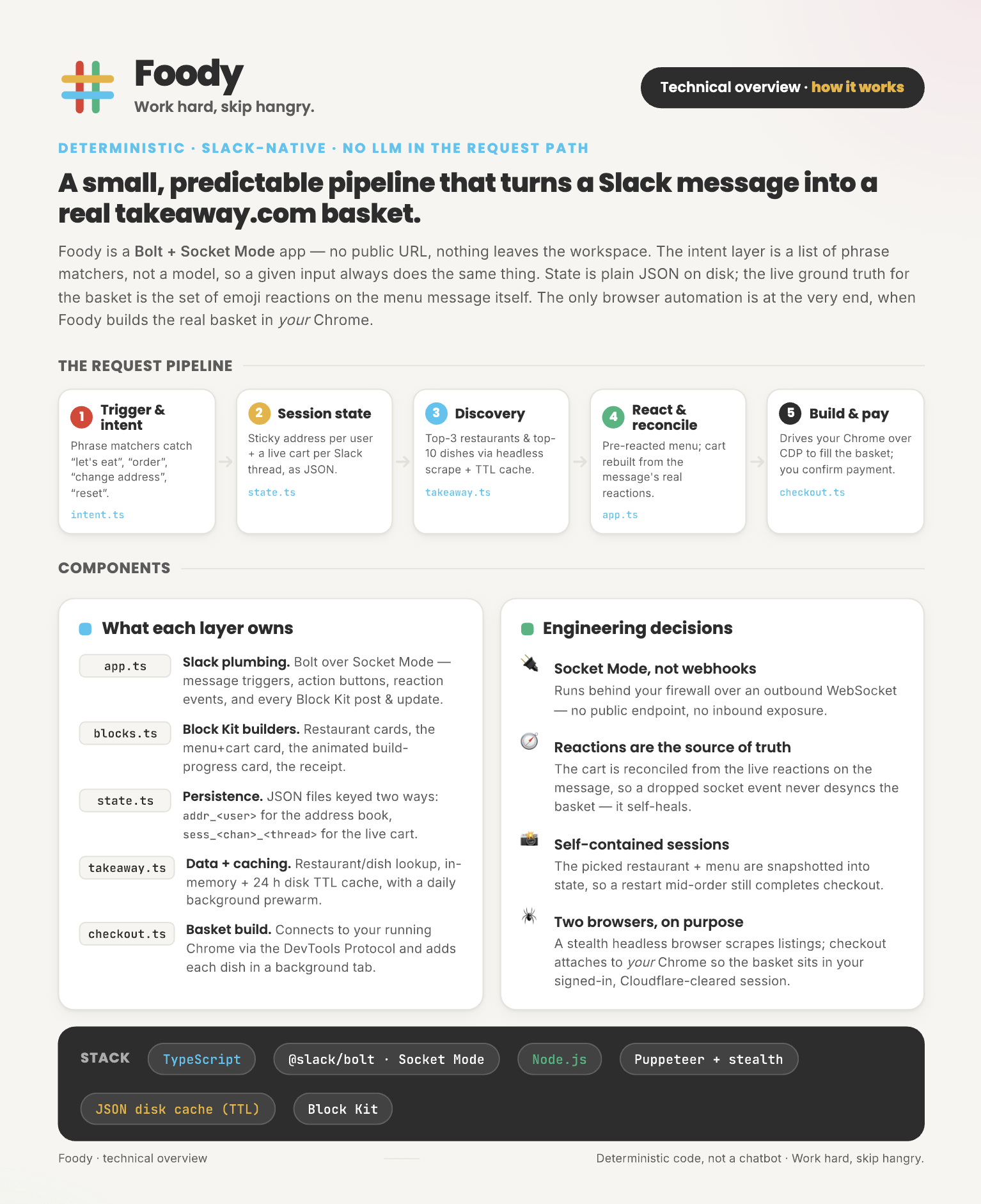
Foody is a small TypeScript app that runs headless behind your firewall — a background worker with no public URL and no frontend. Slack's AI capabilities are the front door: the assistant surface hosts Claude with tools to plan the order in natural language. The moment an order starts, the assistant hands off to a deliberately deterministic flow — phrase matchers, reactions, reconciliation — so the shared basket itself always behaves exactly the same way: fast, predictable, debuggable.
| Layer | Responsibility |
|---|---|
assistant.ts |
The Slack AI assistant: assistant threads, live status, suggested prompts, Claude tool use, and the start_group_order bridge into the channel flow. |
app.ts |
Slack on Bolt + Socket Mode: triggers, buttons, reaction events, every Block Kit post & update. |
blocks.ts |
Block Kit builders: restaurant cards, the unified menu+cart card (emoji grid or photo view), the animated build-progress card, the receipt. |
intent.ts |
Plain phrase matchers for "let's eat", "order", "reset", "change address to …". |
state.ts |
JSON persistence keyed two ways: addr_<user> for the sticky address book, sess_<channel>_<thread> for the live cart. |
takeaway.ts + scrape-live.ts |
Restaurant/dish discovery with an in-memory + 24-hour disk-TTL cache and a daily background prewarm. Market-configurable: Belgium by default, any Just Eat Takeaway country by env switch. |
checkout.ts |
Assembles the real basket on Takeaway.com, ready to confirm. |
Three design decisions we're proud of:
- 🧠 AI where it helps, deterministic where it counts. Claude plans, compares, and negotiates budgets in the assistant pane. The basket itself is pure reconciliation — every reaction maps to exactly one outcome. The AI can never "hallucinate" your lunch: it only ever hands off to a flow the whole team can see and verify.
- 🩹 Reactions are the source of truth. The basket is reconciled from the actual emoji reactions on the menu message — not a running tally of events. Any single interaction re-derives the entire cart from ground truth, so it stays perfectly in sync with what the team can see and self-heals by construction.
- 🛰️ Headless and private, with no public URL. Foody talks to Slack over an outbound WebSocket (Socket Mode) — nothing inbound, nothing leaving the workspace. The agent never needs a UI of its own, because Slack is the UI.
The food layer is deliberately swappable: today Foody discovers menus through a headless browser and assembles the basket in your signed-in session, all behind a clean interface — so the exact same Slack experience (assistant included) can sit on top of an official partner API with zero changes above it (see What's next).
What makes it special
- ✨ Slack AI capabilities, used for real. Assistant threads for multi-turn planning, live status while tools run, suggested prompts for one-tap starts — the assistant isn't a chatbot bolted on, it's the front door that hands off to the group.
- 🪄 The interface is just emoji. No forms, no webview — the entire group-ordering UX is reactions on a message, and it feels effortless.
- 📸 Menus you can taste. One tap flips the menu from a compact emoji grid to real dish photography, straight from the restaurant.
- 🩹 A self-healing basket. Because the cart is reconciled from the message's real reactions, it converges to the correct state every time — robust by construction, not by luck.
- 🛒 A real checkout. Not a mocked receipt — Foody assembles an actual Takeaway.com basket with your address ready to confirm.
- 🎨 A brand of its own. A utensil-hashtag mark in the Slack palette, a tagline ("Work hard, skip hangry"), and a small design system — down to an animated, constantly-moving build-progress card.
What we learned
- Pair the model with a machine. An LLM is brilliant at the fuzzy front ("spicy, six people, under €15") and wrong for the exact back (money, shared state). Letting Claude plan and a deterministic flow execute gave us both — and Slack's assistant surface is precisely the seam to split them along.
- Design for the message, not the event. Treating the visible state (reactions on a message) as the source of truth — reconcile, don't accumulate — turns a fragile event stream into something inherently robust.
- Headless + Socket Mode is a sweet spot for agents. An outbound WebSocket with no public URL makes a Slack agent simple to deploy, private by default, and safe to run anywhere.
- Constraints make better UX. Limiting the interface to emoji reactions forced a design that's faster and friendlier than any custom form we could have built.
What's next for Foody
- 🔌 Fully headless ordering via an official partner API. The Slack experience — assistant included — stays identical; the food layer swaps from a headless browser to Just Eat Takeaway.com's partner API: real orders, payment, and live delivery tracking pushed straight back into the thread.
- 💸 Built-in bill splitting. Automatic per-person totals and a "you owe" summary posted to the thread when the order closes.
- ⏰ Scheduled & recurring lunches. "Every Friday at 12:00, ask the channel," plus one-tap re-orders of last week's favourite.
- 🗳️ Smarter consensus. Dietary filters and budget caps the assistant already understands, promoted into quick polls for the whole group.
- 🌍 Broader coverage. Any Just Eat Takeaway market is already a config switch (🇧🇪🇳🇱🇩🇪…); more providers behind the same emoji interface next.
Built With
- bolt
- node.js
- puppeteer
- slack
- slackagent
- typescript


Log in or sign up for Devpost to join the conversation.