-
-
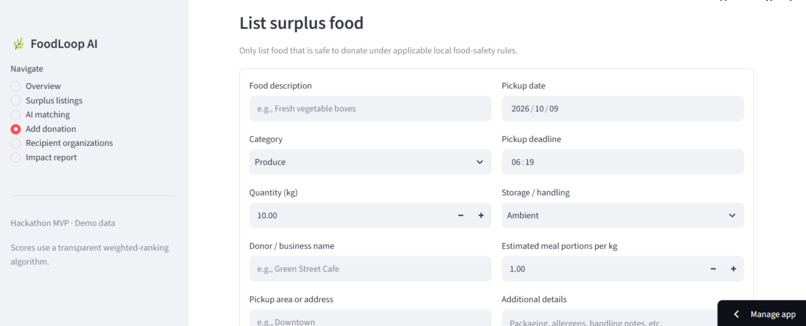
Add Donation
-
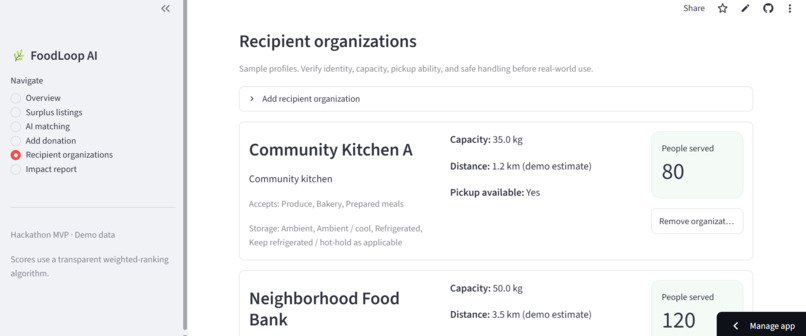
Recipient organization
-
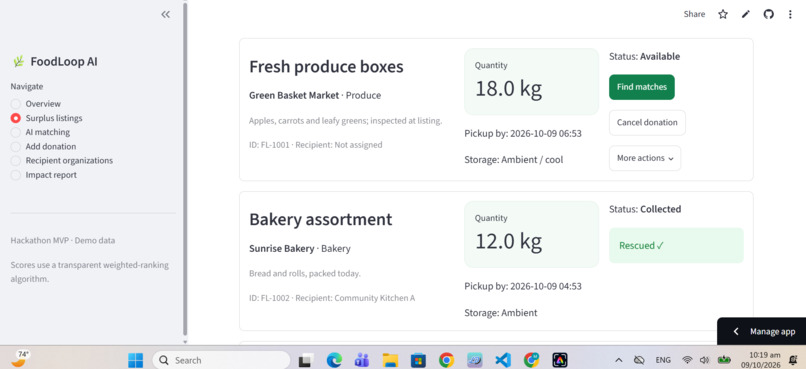
Surplus Listing
-
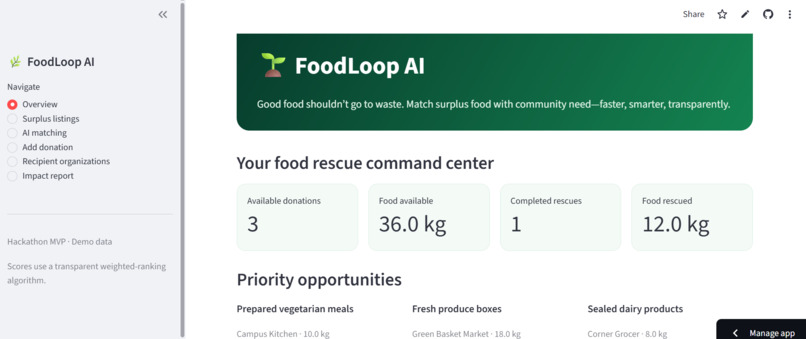
Dashboard
-
Impact Report
-
Ai Match
Inspiration
I created FoodLoop AI around a simple question: how can we make surplus food easier to share with the organizations that need it? Businesses may have edible surplus food, while community organizations face challenges sourcing food for the people they serve. Connecting the two involves more than identifying a recipient. Food categories, available capacity, pickup schedules, distance, and collection deadlines all affect whether a donation can work. I wanted to explore this coordination problem through a practical AI + Climate hackathon project. My goal was to bring surplus food listings, transparent recipient recommendations, and donation tracking into one accessible workflow. The idea was not just to recommend an organization, but to help users understand the recommendation and follow the donation through to recorded collection.
What it does
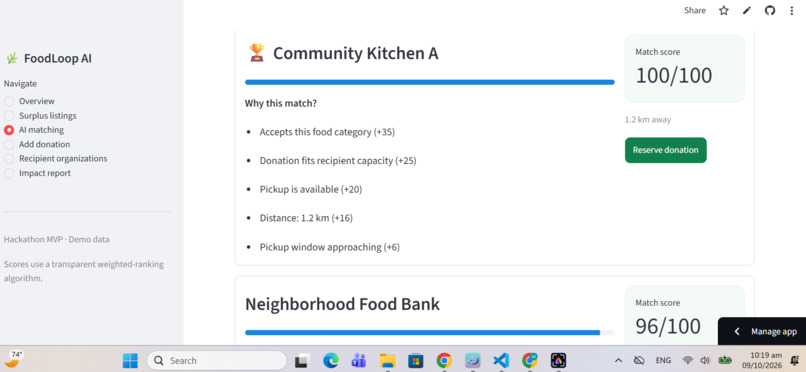
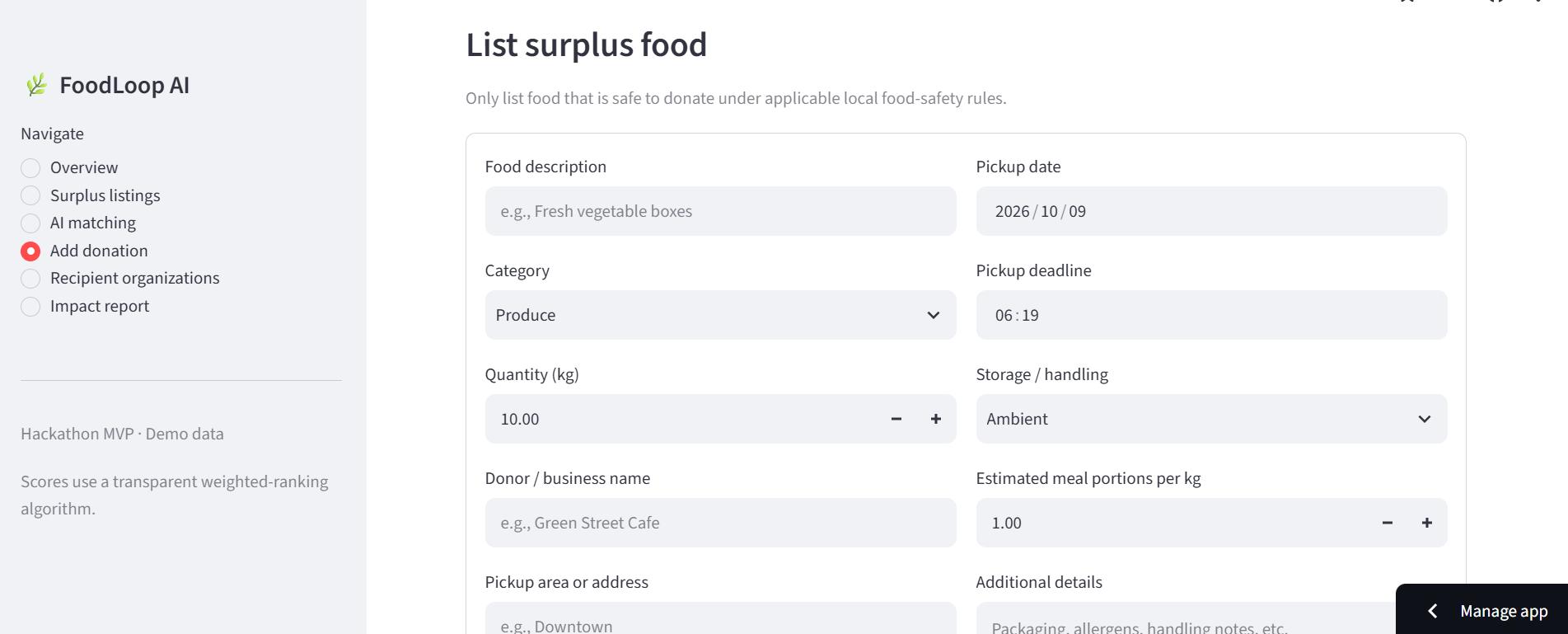
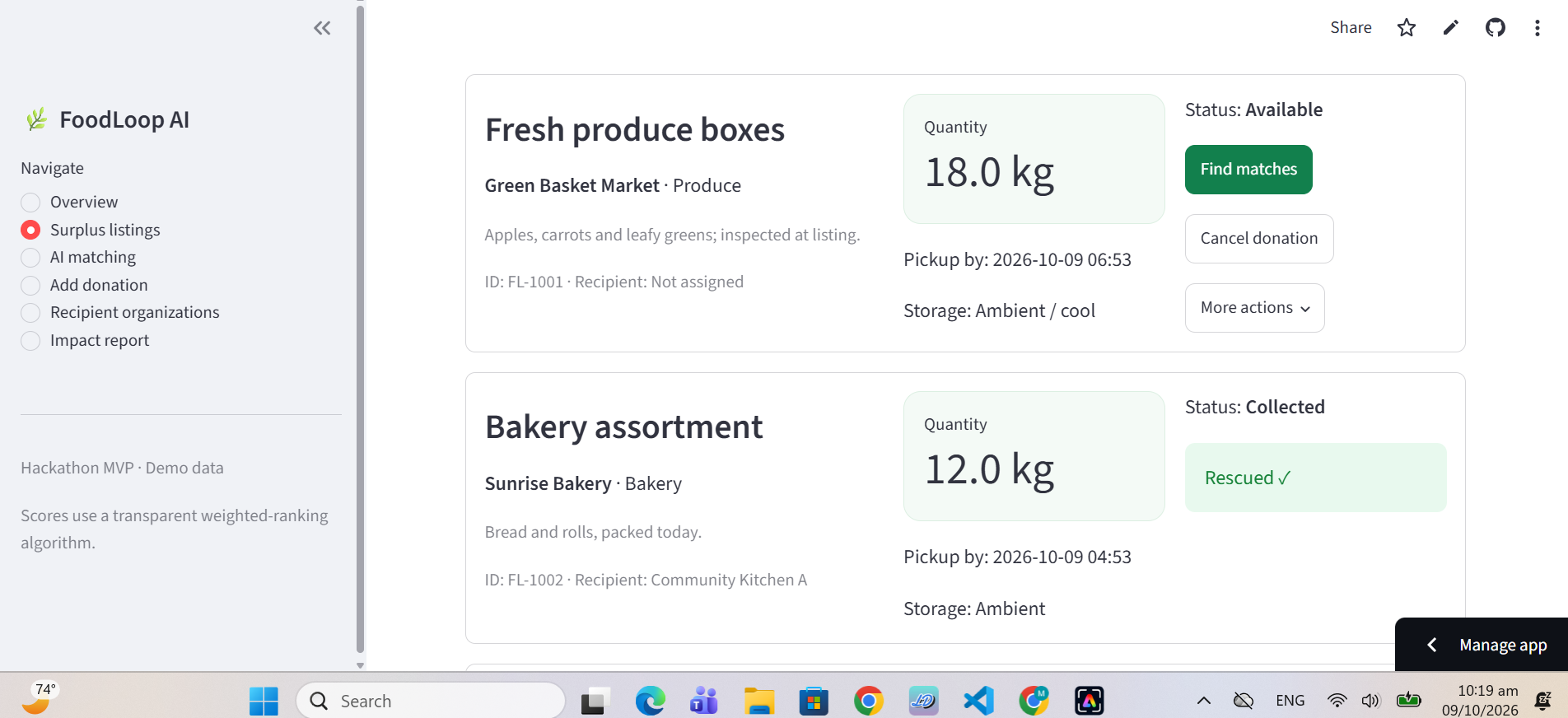
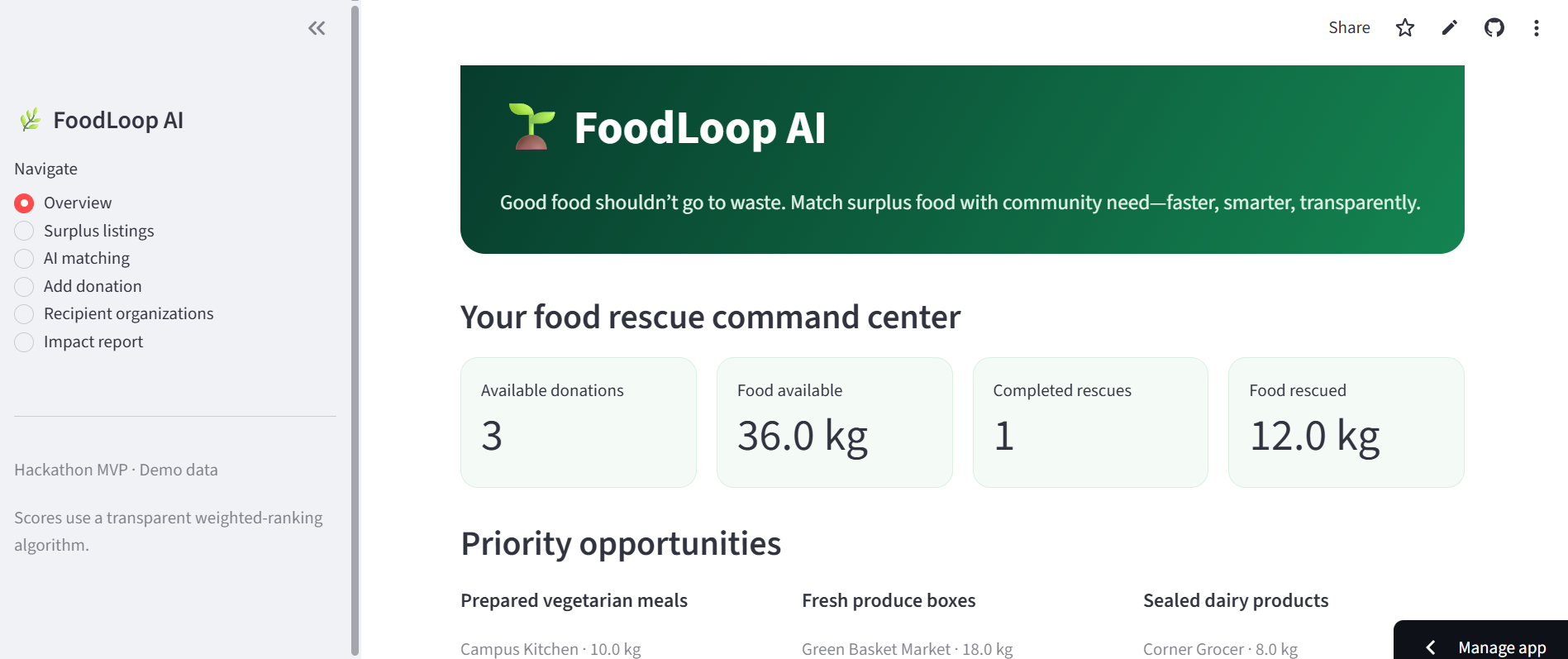
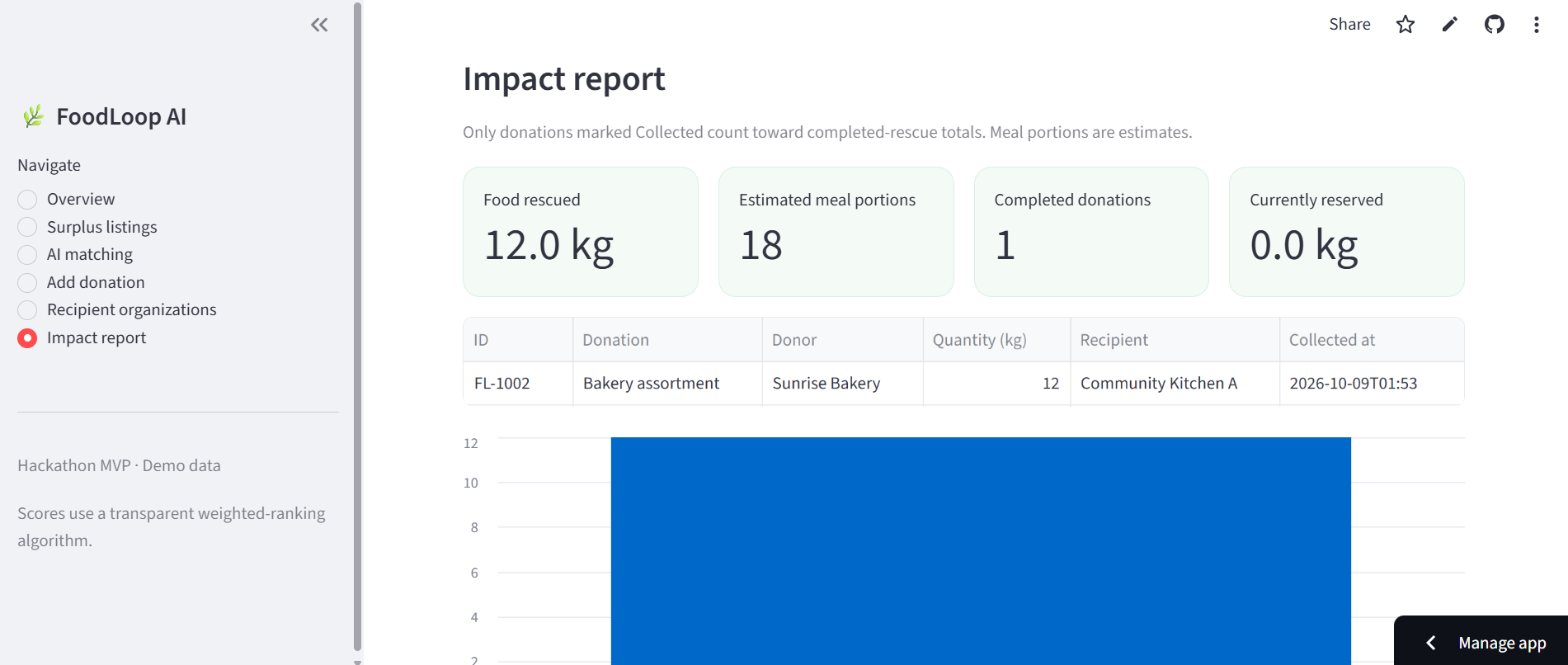
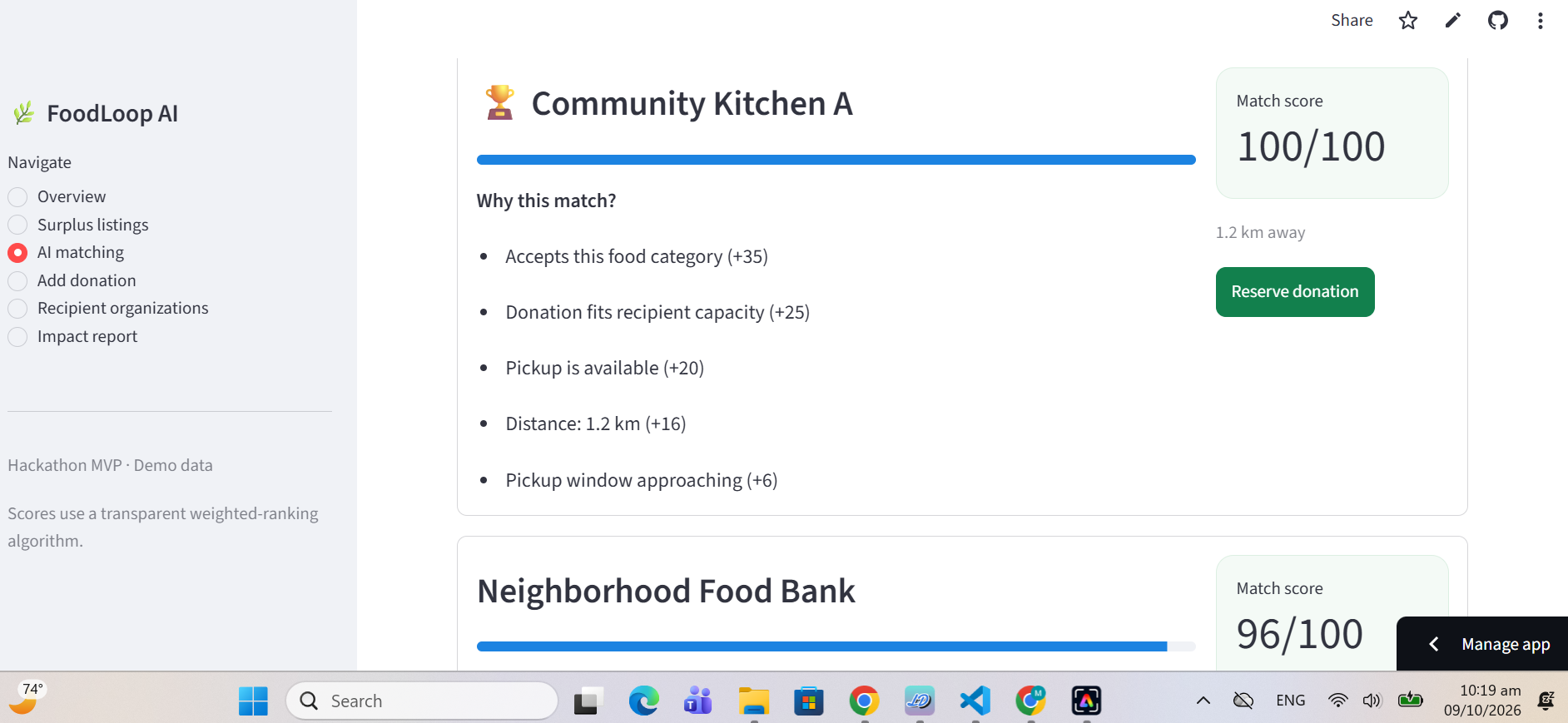
FoodLoop AI is a web application that demonstrates the journey of a surplus food donation—from creating a listing to recording a completed collection. Users can: Create surplus food listings with categories, quantities, storage notes, and pickup deadlines. View available listings and donation statuses in an interactive dashboard. Rank eligible recipient organizations using food category compatibility, capacity, pickup availability, distance, and urgency. Inspect explanations showing the factors behind recipient rankings. Reserve a donation for a selected recipient organization. Mark a reserved donation as collected. Review completed-donation summaries and estimated meal portions. Export donation records as CSV files for reporting and analysis. The MVP uses synthetic demonstration records. Its purpose is to show how the workflow operates, not to claim verified food recovery or measured environmental impact.
How I built it
I built the application using Python and Streamlit, with Pandas for tabular data handling and reporting. JSON files provide lightweight local persistence, and CSV export makes donation records available for further analysis. The central decision-support component is a transparent weighted-ranking heuristic—not a trained machine-learning model. It evaluates recipient candidates against configured matching criteria and presents explanations alongside their rankings. I chose this approach to make the recommendations understandable and inspectable. For this MVP, transparent rules offered a practical way to demonstrate matching without implying that the system had learned from real donation outcomes. I organized the application around a straightforward sequence: Create a surplus food listing. Review suitable recipient candidates. Inspect the matching explanations. Reserve the donation. Record collection. Review the updated impact report.
I published the source code on GitHub, deployed the application using Streamlit Community Cloud, and tested the main workflow in the deployed version.
Challenges I ran into
Balancing multiple matching criteria
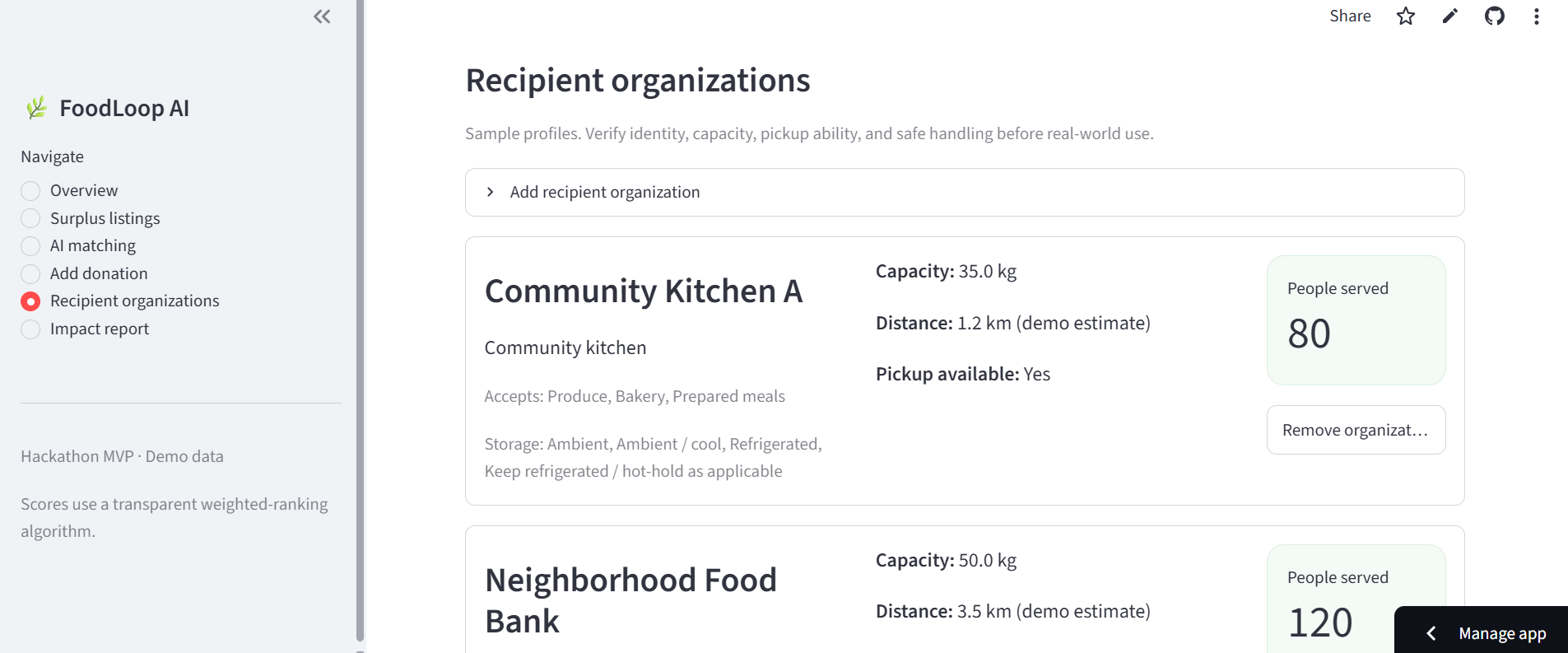
One challenge was translating a real-world coordination problem into a manageable hackathon prototype. Matching food categories alone was not enough: an organization also needed suitable capacity and practical collection availability. I addressed this by incorporating multiple criteria into the ranking process and making the reasoning visible. However, the current weights have not been validated against real donation outcomes. Determining whether they produce useful recommendations remains an important next step.
Reporting impact honestly
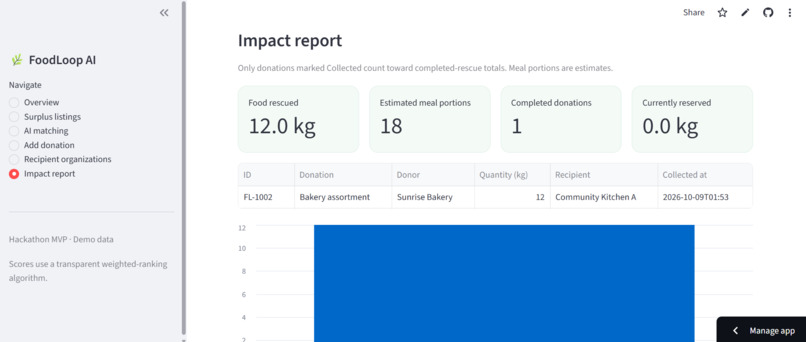
Another challenge was deciding what the dashboard should count as a successful rescue. A listing represents available food, not a completed donation. A reservation indicates an intention to collect, not proof of collection. I therefore kept these stages distinct and based completion summaries on recorded collection status. I also treated meal portions as estimates rather than verified meals served. This helped me keep the demonstration informative without overstating its results.
Working within prototype limitations
JSON storage made the MVP simple to build and demonstrate, but it also highlighted the gap between a prototype and an operational platform. A production version would need stronger data management, reliable transaction handling, access controls, and auditability. Real donations would also require recipient verification, food-safety checks, and confirmed collection arrangements that a ranking score cannot establish.
Accomplishments that I'm proud of
I am proud of turning an idea into a working, browser-accessible prototype with a complete donation workflow. My main accomplishments include: Building an interactive dashboard for surplus listings and donation tracking. Implementing recipient ranking with understandable explanations. Connecting listing creation, matching, reservation, and collection tracking. Adding local persistence and CSV export. Publishing the source code and deploying the application. Preparing a demonstration that clearly distinguishes synthetic records, estimated portions, and recorded collections. The most rewarding part was bringing these features together into an application that users can explore, rather than leaving the project as a concept or an isolated matching algorithm.
What I learned
Building FoodLoop AI taught me to think beyond the ranking algorithm. I had to consider what information users need, how donation statuses change, and how recommendations fit into an actual coordination workflow. I learned to communicate the distinction between rule-based decision support and trained machine learning. The MVP’s scores represent configured priorities not probabilities, learned predictions, or evidence of model accuracy. I also learned to separate demonstrated functionality from demonstrated impact. Synthetic records can show that a workflow works, but they cannot establish how much food has actually been recovered or what environmental benefits have occurred. Finally, I gained practical experience connecting application development, version control, deployment, testing, and project storytelling into one hackathon submission.
What's next for FoodLoop AI
My next priority is to make the platform more reliable and evaluate its matching approach using real, appropriately collected donation outcomes. Planned improvements include: Authentication and roles for donors and recipient organizations. A managed database with reliable reservation and status updates. Verification of recipient organizations, eligibility, and collection capacity. Geocoding and improved route-distance estimates. Notifications, reservation expiry, and pickup confirmations. Evaluation and calibration of matching criteria and weights. Stronger privacy controls, audit logs, and operational monitoring. A documented methodology for measuring recovered food and estimating potential environmental benefits. My long-term vision is a food recovery platform that combines transparent recommendations with dependable coordination and evidence-based reporting.
FoodLoop AI - Rescue Surplus Food. Reduce Waste. Strengthen Communities.

Log in or sign up for Devpost to join the conversation.