-
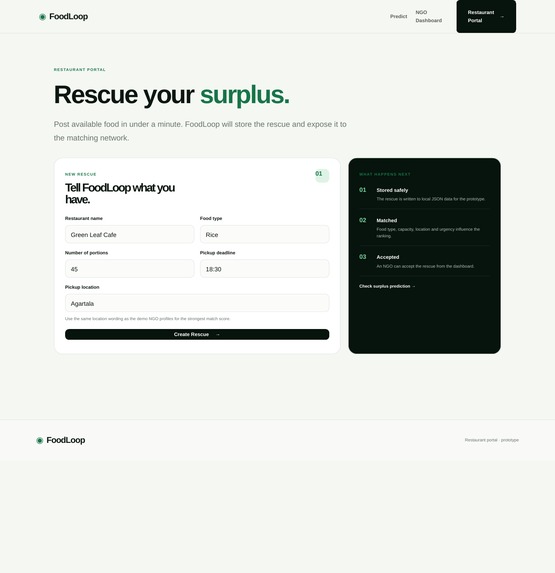
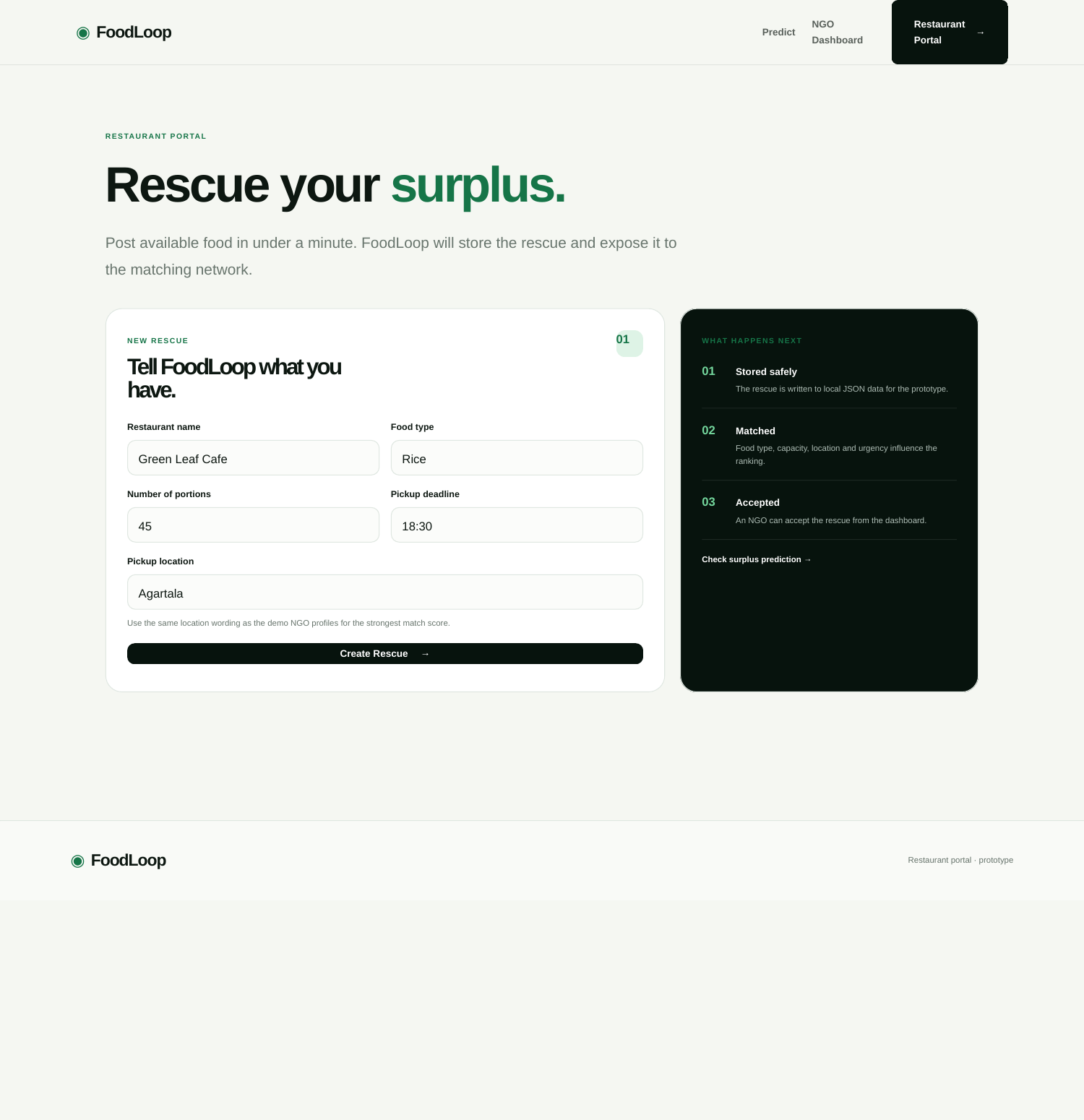
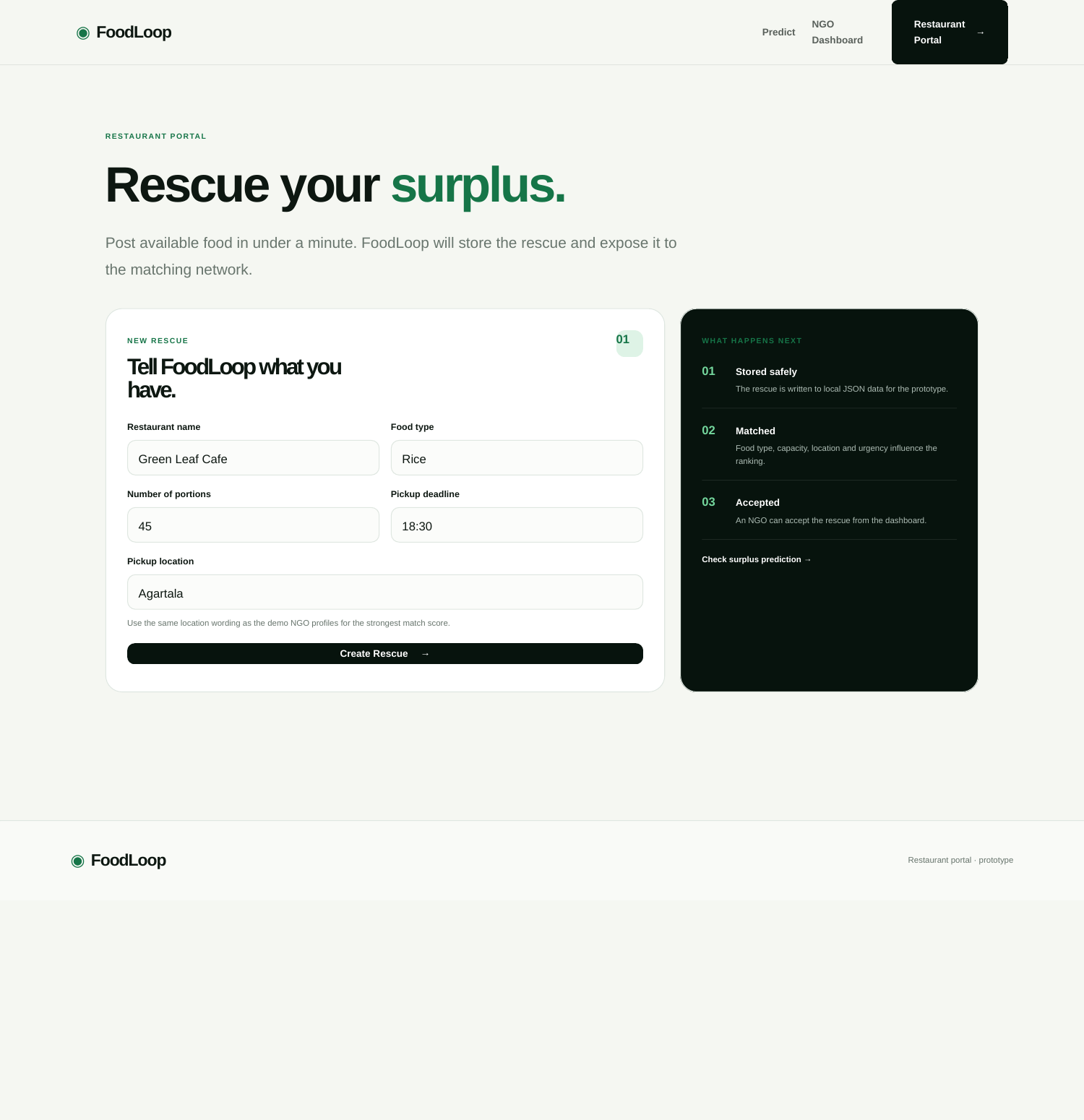
Restaurant Portal
-
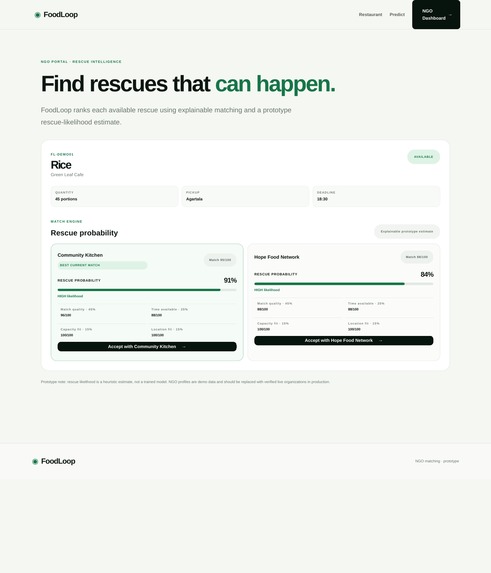
NGO Matching
-
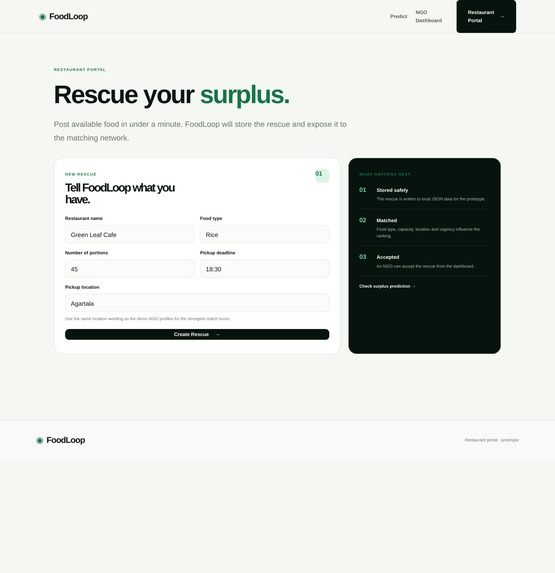
Prediction / Recurring Surplus
Inspiration
Food waste is not always caused by a lack of food. Sometimes usable food becomes waste because the people who could redistribute it are not prepared at the right time.
We wanted to explore a different approach: instead of waiting for surplus food to appear and then searching for a recipient, what if a system could recognize recurring surplus patterns and prepare the rescue network in advance?
That idea became FoodLoop.
What FoodLoop Does
FoodLoop is a lightweight food-rescue prototype built around:
Predict → Detect → Pre-coordinate → Match → Rescue
A restaurant can report surplus food, while FoodLoop learns from previous rescue history to identify recurring patterns.
For example:
A restaurant has repeatedly reported surplus rice every few days.
FoodLoop can detect that recurring pattern, estimate the likely quantity of the next surplus event, and recommend suitable NGOs before the next event happens.
The goal is to shift food rescue from being purely reactive toward being more proactive.
Key Features
1. Surplus Prediction
FoodLoop uses an explainable historical-average baseline to estimate the likely amount of surplus for a restaurant and food type.
The prototype clearly labels this as a baseline rather than pretending it is a trained machine-learning forecasting model.
2. Recurring Surplus Detection
When enough confirmed rescue history exists for the same restaurant and food type, FoodLoop identifies a recurring pattern.
It estimates:
- previous rescue count
- average surplus quantity
- typical time interval
- next likely surplus window
3. NGO Pre-coordination
When a recurring pattern is detected, FoodLoop recommends suitable demo NGO profiles based on food compatibility, capacity and location.
A pre-coordination plan can then be created before the expected surplus event.
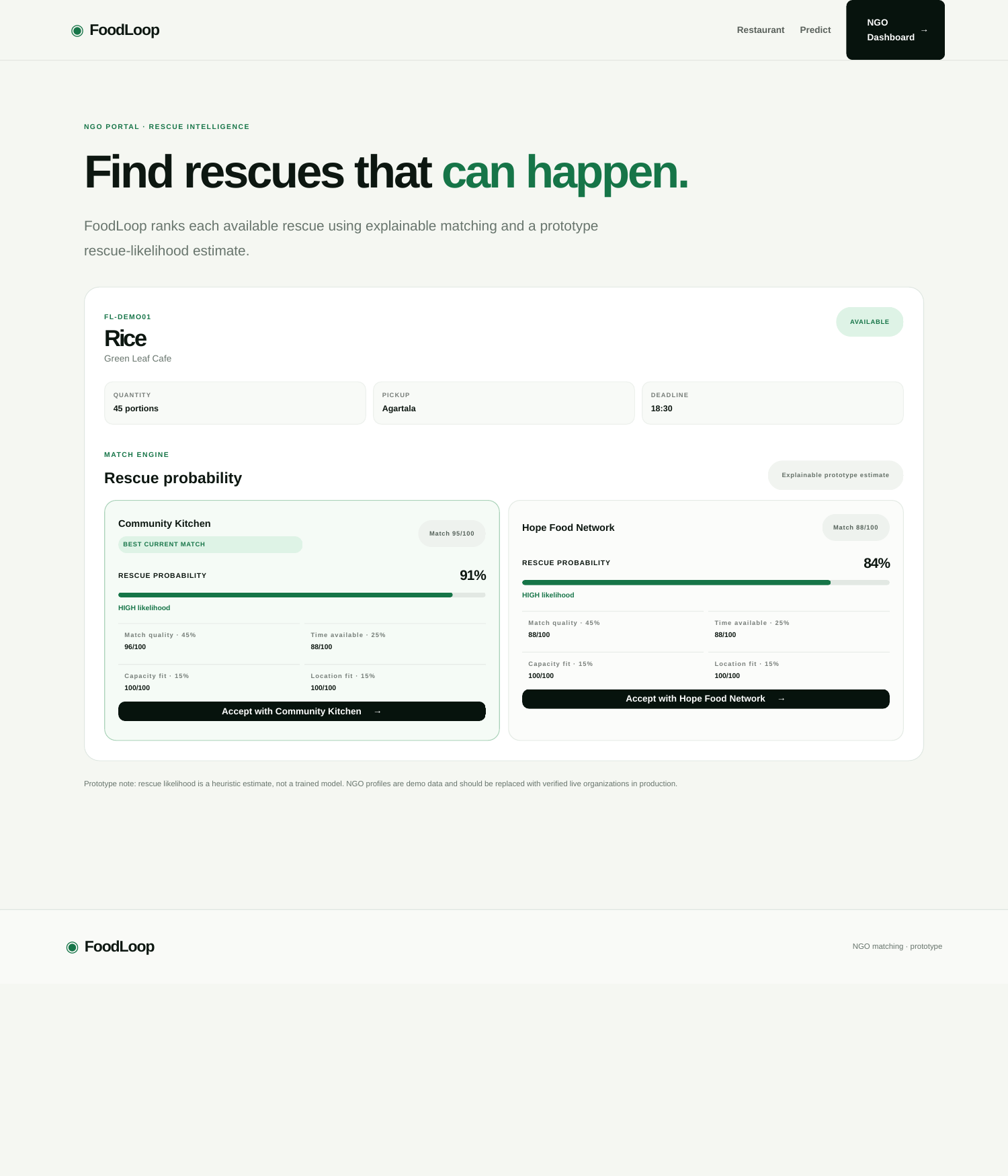
4. Intelligent Matching
For active rescue requests, FoodLoop ranks suitable NGOs using an explainable scoring system based on:
- food compatibility
- capacity
- location
- urgency
5. Rescue Probability
FoodLoop provides an explainable rescue-likelihood estimate using match quality, available time, capacity fit and location fit.
This is intentionally presented as a heuristic estimate rather than a calibrated real-world probability.
6. NGO Acceptance
An NGO can directly accept an available rescue through the dashboard, creating a simple end-to-end rescue workflow.
How We Built It
FoodLoop was built as a lightweight local web application using:
- Python
- Flask
- Jinja
- HTML
- CSS
- Local JSON persistence
The prototype does not require a paid API or external database.
The architecture was deliberately kept lightweight so the complete system can run locally on modest hardware.
What We Learned
One of the biggest lessons was that the interesting part of food rescue is not only finding a recipient after surplus appears.
The more interesting opportunity is the coordination problem before the surplus event.
Building FoodLoop also taught us how to design explainable prototype intelligence rather than adding an "AI" label without a real mechanism behind it.
Challenges
The main challenge was balancing ambition with a realistic hackathon prototype.
We wanted FoodLoop to feel intelligent without pretending to have a large trained dataset.
We therefore chose transparent baselines and heuristics that can be inspected and explained.
Another challenge was creating a complete flow rather than a static concept. The final prototype connects restaurant surplus creation, prediction, recurring-pattern detection, NGO recommendation, rescue scoring and acceptance into one workflow.
SDG Alignment
SDG 2 — Zero Hunger
FoodLoop is designed to help connect usable surplus food with organizations that can redistribute it.
SDG 12 — Responsible Consumption and Production
FoodLoop focuses on earlier planning and coordination to reduce avoidable surplus-food waste.
Prototype Limitations
FoodLoop is a hackathon prototype.
The prediction system is a historical-average baseline, not a trained machine-learning forecasting model.
The rescue probability is an explainable heuristic estimate, not a calibrated real-world probability.
The NGO profiles shown in the prototype are demo data and would need to be replaced with verified real organizations before real-world deployment.
Future Direction
A production version could integrate verified restaurant and NGO networks, real-time location and pickup availability, larger historical datasets, volunteer coordination, food-safety constraints and a trained forecasting model.
The core idea would remain the same:
Predict earlier. Coordinate earlier. Rescue more usable food.
Built for the Acodemic × G.I.R.L.S. Global SDG Hackathon 2026
FoodLoop explores how lightweight technology can support SDG 2: Zero Hunger and SDG 12: Responsible Consumption and Production by improving the timing and coordination of food rescue.

Log in or sign up for Devpost to join the conversation.