Inspiration
Food rescue teams juggle three clocks at once. Produce wilts at ambient temperature, cold food spends down a four hour danger-zone budget, and pantry closing times keep moving closer. FoodLink turns that invisible timing problem into a planning surface volunteers can rehearse before anyone starts a van.
What it does
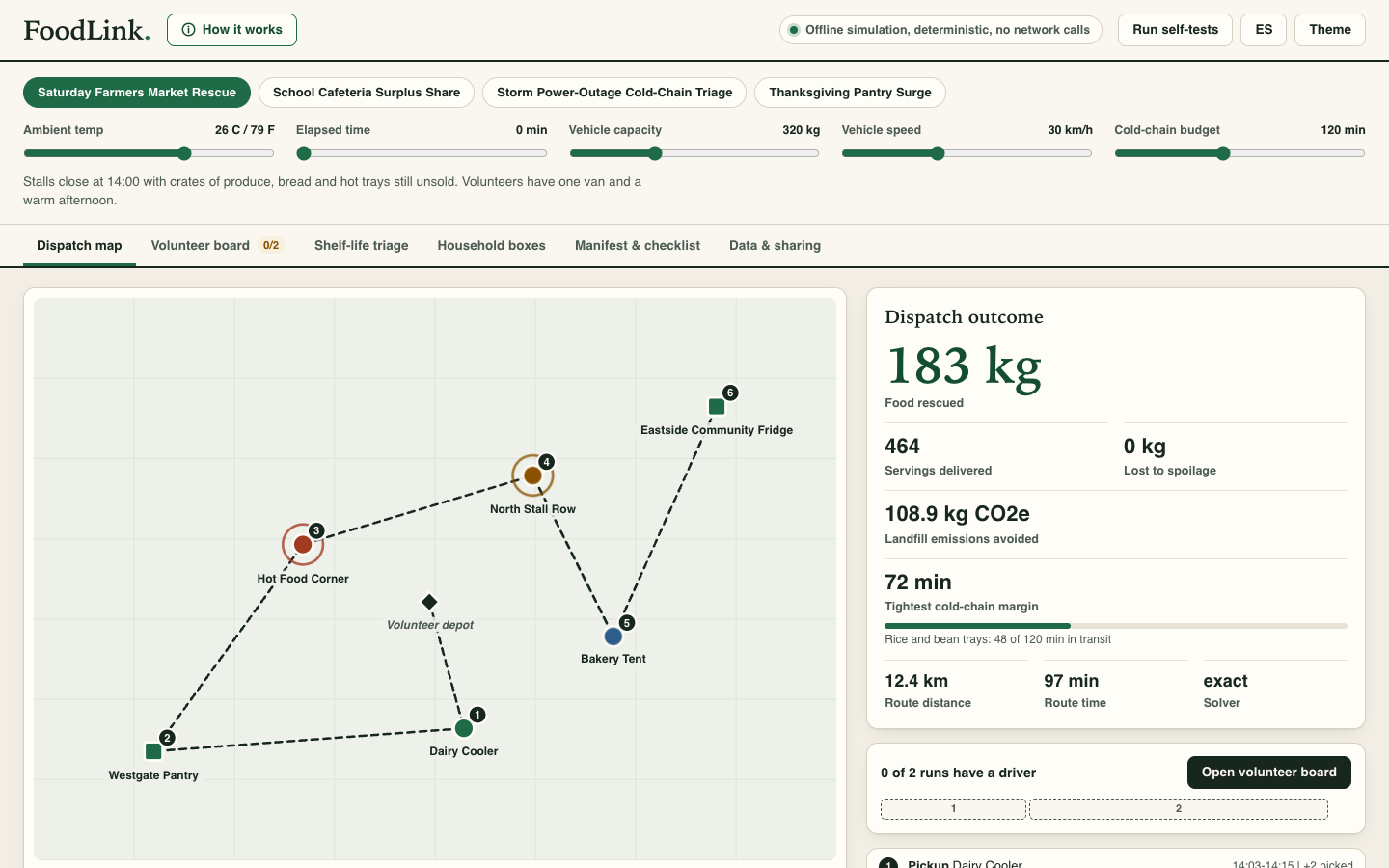
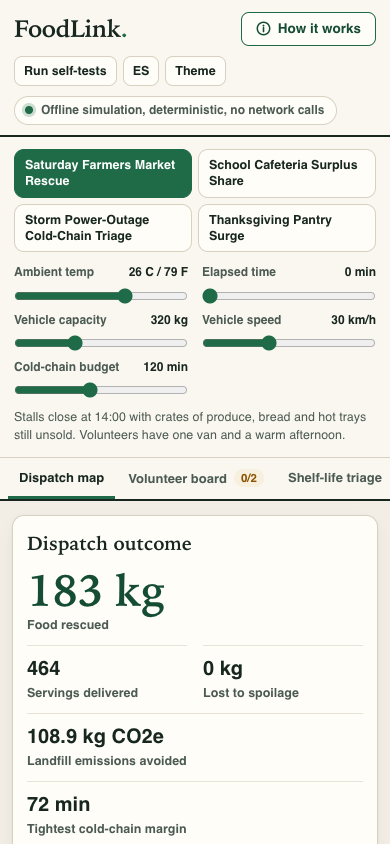
FoodLink is an offline community food-rescue and perishable pantry allocation workbench. It models shelf life with a Q10 thermal-decay clock anchored to FDA Food Code holding temperatures, routes a volunteer van inside cold-chain limits with exact and 2-opt solvers, and packs household boxes against food-group targets while enforcing allergy and dietary constraints. A volunteer board splits the route into claimable runs, and a printable bilingual manifest carries the donation safety checklist. Four fictional civic scenarios cover a farmers market rescue, cafeteria surplus share, storm power outage, and pantry surge. The app runs entirely in the browser with no accounts, server, network calls, or build step.
How it was built
FoodLink is one static HTML application written in plain ES modules with zero runtime dependencies. The spoilage engine uses Q10 and Arrhenius relationships plus the FDA cumulative four-hour TCS rule. The router uses subset-aware exact search up to eight stops and nearest-neighbor with feasibility-aware 2-opt beyond that. The allocator uses per-person food-group targets and dietary constraints. The interface is bilingual English and Spanish, prints a dispatch manifest, and exposes 31 in-page invariant self-tests.
Verification and honest scope
AI coding assistants Devin and Claude helped write the code, tests, and documentation under Aariv Patel's direction. The product does not call an AI service at runtime. Fresh verification on November 27, 2026 passed 1,330 Node tests with zero failures. The repository also includes a real-Chrome audit script covering three viewports and every major control. FoodLink is a planning and teaching tool, not medical, legal, or regulatory advice. Real donations should be checked against local food code and receiving organization policy.
Built With
- css
- epa-warm
- fda-food-code
- html
- javascript
- node.js
- svg
