-
-
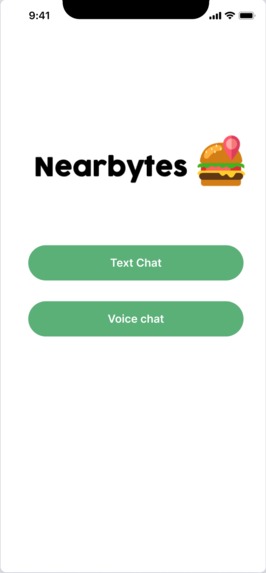
Home page
-
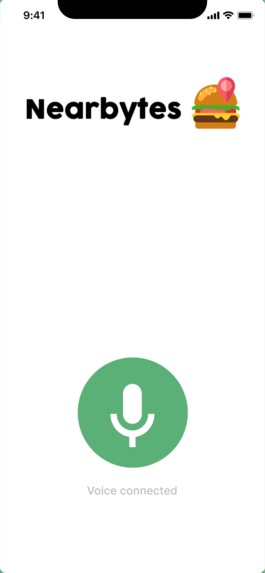
Phone call capabilities
-
-
-
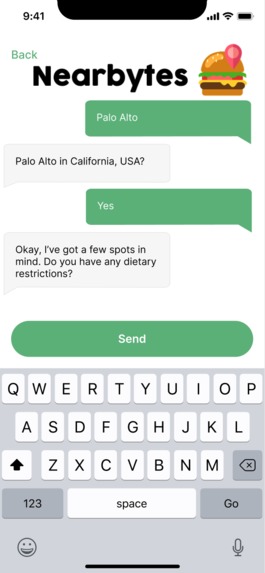
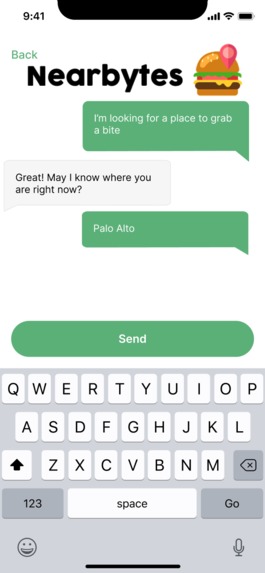
Nearbytes asking for dietary restrictions
-
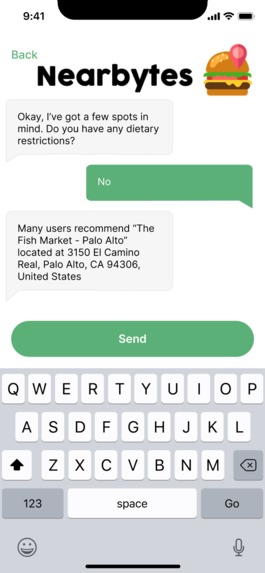
Nearbytes recommending a nearby restaurant


Inspiration
As avid travellers, we have always enjoyed exploring other landmarks and cultures, but every time, there has always been a looming feeling of isolation due to a lack of familiarity with our surroundings. The lack of a connection builds upon this feeling of being stranded even further, and it isn't realistic to call friends or family with a connection to ask them for guidance. In situations where a wifi connection is unfeasible, the ability to gather information in other provinces with a phone call (covered by data plan) would have been invaluable. We were also motivated by the struggle with technology that the elderly have. Many times, tasks that seem simple to the tech-literate such as navigating google maps may be extremely difficult for others. However, voiced based commands and phone calls are much more simple and relatable for everybody.
What it does
Nearbytes, a concept developed during the 2021 "Dashathon" hackathon, allows users to make a phone call to gather information about the closest and trendiest restaurants and supermarkets from an AI based voice chat service. With this phone call, the user is able to connect with a server that is able to communicate with other APIs through a traditional connection and return appropriate information through the phone call to the user.
How we built it
- Nearbytes is a voiced-based communicative tool based on Dasha, an easy-to-implement conversational AI platform. It’s very convenient and developer friendly. Although we have no experience of using AI, we are still able to learn it quickly due to its friendly syntax and structured flow (kindly checkout the main.dsl).
- We used the API service provided by geoapify. It acts as a prove of concept that dasha can be combined with other external API services to create more interesting application. They also provides some cool APIs besides from what we’ve used in this project. Be sure to check out them.
- Nodejs was used to connect Dasha and Geoapify.
Challenges we ran into
Though our hack works, it was far from easy to develop due to lack of time and resources. Our first issue was just a general lack of experience in some of the areas that we explored, but a larger issue arose from the restrictiveness of many of the APIs.
Our entire hack could have been completed easily through Google Maps API, which would have allowed us to find nearby restaurants just like geoapify, but also sort by rating. Initially, we planned to do this by using ajax to send the data to a python program. Using the many more libraries, the nearby restaurants gathered through geoapify could have been sent to a python webscraper and have their reviews gathered and sorted appropriately. However, due to the limited time and lack of knowledge in ajax, this vision of implementing reviews was unable to come to fruition and the code was scrapped.
Additionally, some of us were unfamiliar with Node.js in general and all of us were a bit unfamiliar with AI. Thankfully, Dasha simplified everything as much as possible.
What's next for Nearbytes
- More and more facilities We wish for Nearbytes to not be limited to only restaurants, supermarket and hotels. Nearbytes could be a tool for everyone to enjoy their trip without worrying about language barriers or internet connections.
- We hope to improve Nearbytes to suit for more detailed needs. For example, user will be able to find reviews provided by others, and also find the nearest sushi restaurant from them.
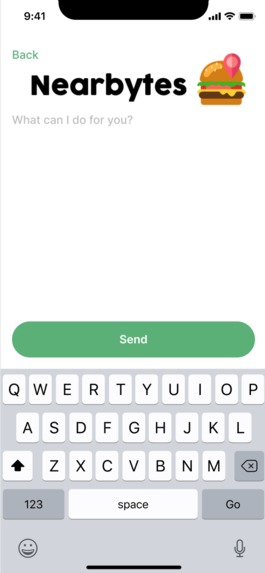
- We plan to develop and publish a mobile user interface for a future app. Some mockups can be seen below:
Built With
- dasha
- geoapify
- javascript
- node.js

Log in or sign up for Devpost to join the conversation.