Inspiration: Solving the $15.6 Billion Food Safety Latency Problem
Foodborne pathogen outbreaks sicken 48 million Americans every year, resulting in 128,000 hospitalizations and over $15.6 billion in economic liability.
When an outbreak strikes, the primary bottleneck isn't detecting the pathogen...it's supply chain traceability latency. Today, enterprise compliance teams trace contaminated food through legacy manual workflows: calling suppliers, parsing PDF invoices, and emailing spreadsheets. According to FDA compliance benchmarks, this manual response takes 7 to 14 days
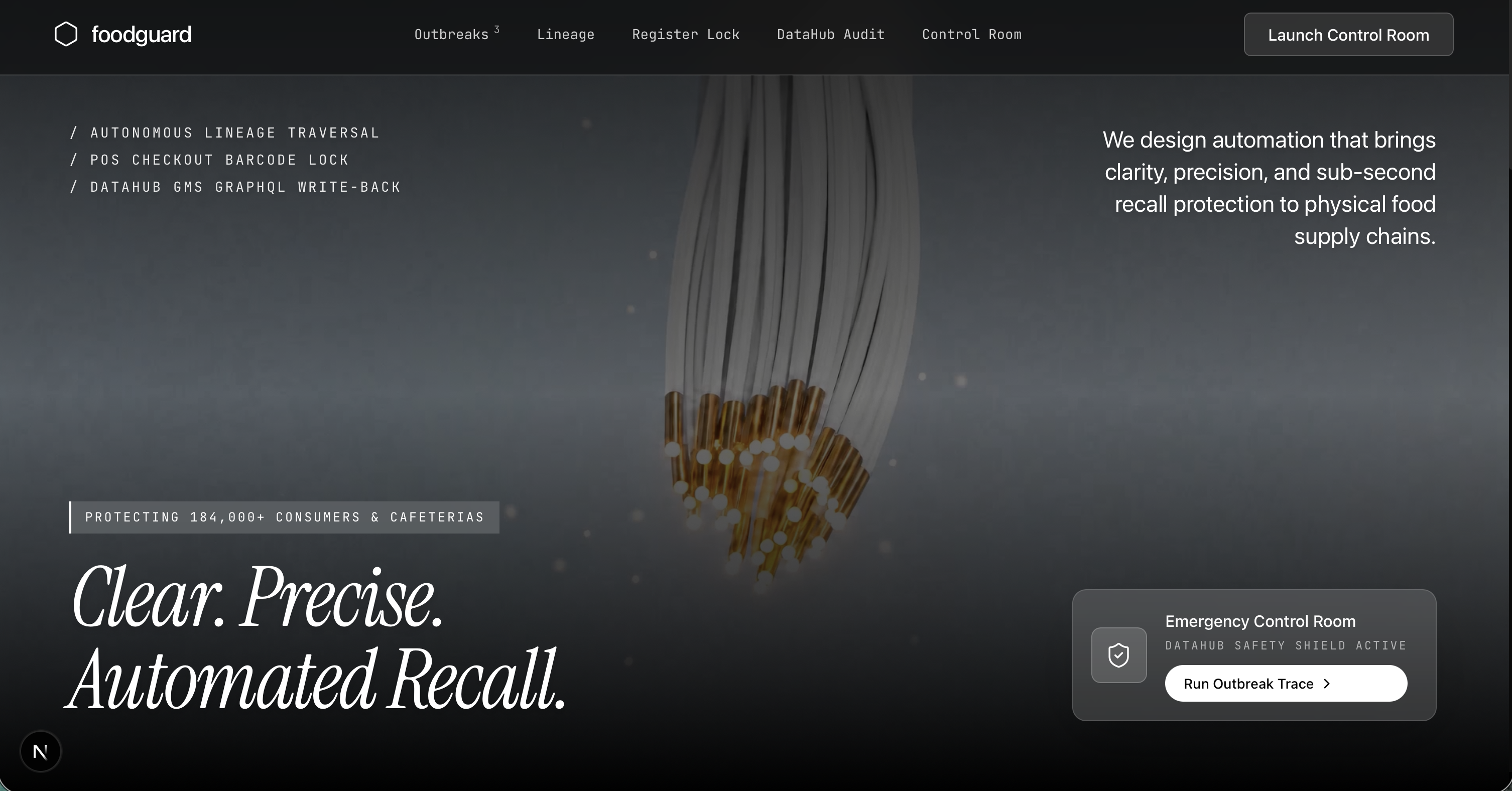
While compliance teams process manual spreadsheets, contaminated inventory continues to move through retail cash registers and school cafeterias. I founded FoodGuard to build the autonomous infrastructure layer that traces food supply chain lineage and executes store register barcode lockdowns.
The Vision: Supply Chains as Real-Time Data Lineage
FoodGuard operates on a foundational insight: physical agricultural supply chains are data lineage in its purest operational form:
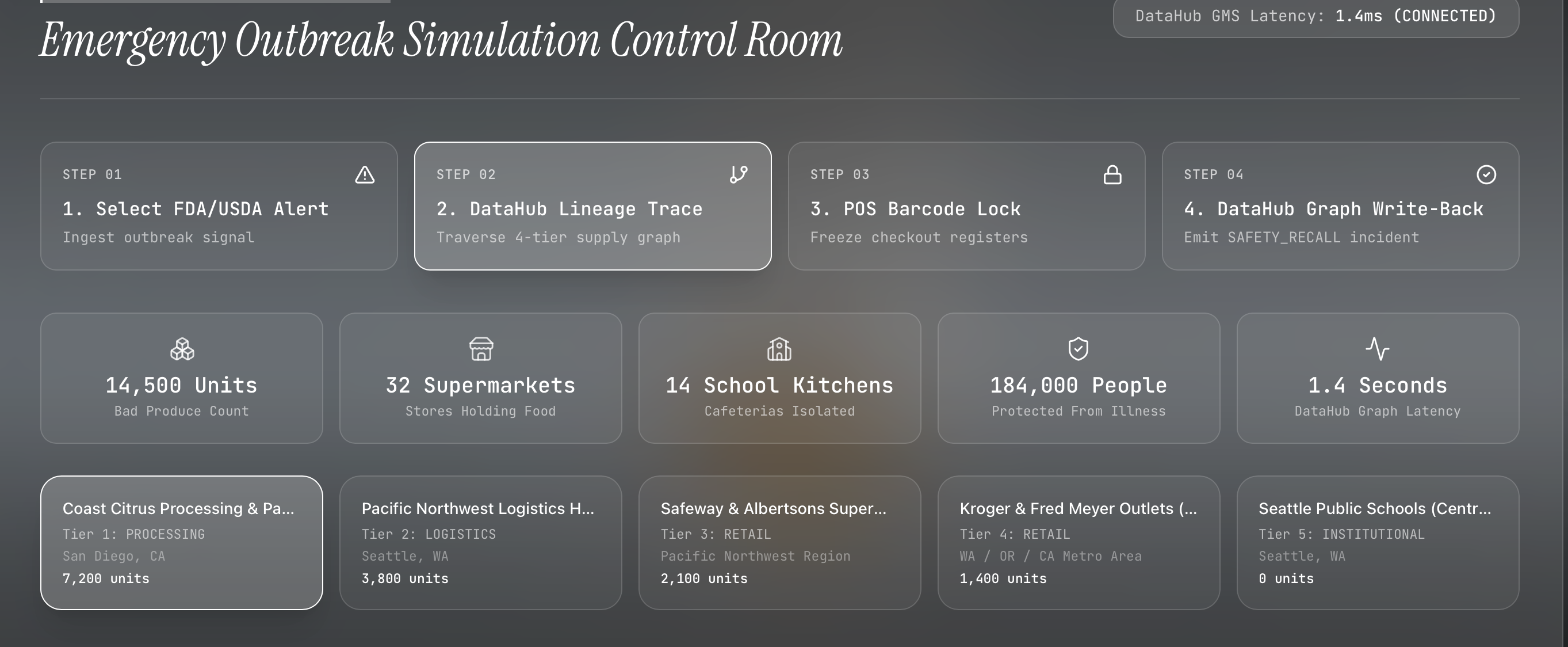
Farm Harvest Batch ➔ Processing Facility ➔ Cold Storage Hub ➔ Supermarkets & School Cafeterias
By leveraging DataHub's metadata graph, FoodGuard elevates metadata from a passive developer catalog into an active operational control plane—enabling autonomous agents to enforce physical inventory quarantines at sub-second speed.
Architecture: How FoodGuard Works
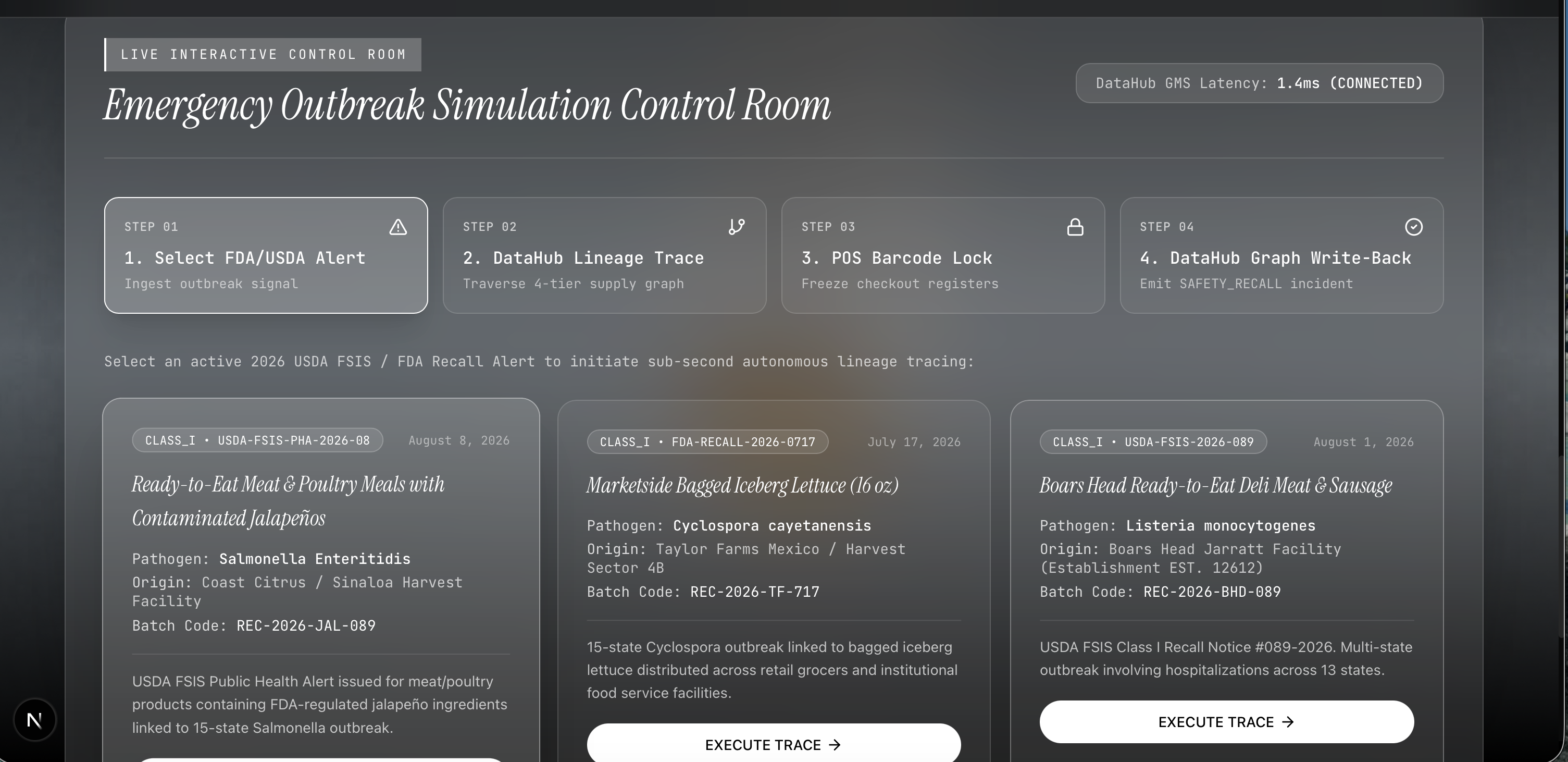
FoodGuard is engineered as an end-to-end autonomous safety platform:
- DataHub Pegasus Metadata Graph: Assets are modeled as DataHub
Datasetentities (urn:li:dataset:(urn:li:dataPlatform:supplychain,...,PROD)), linking farm harvest origin to retail distribution points via Pegasus lineage schemas. - Sub-Second Autonomous Traversal Engine: Ingests raw FDA/USDA health alerts, extracts pathogen signatures and SKU attributes, and queries DataHub's lineage graph in under 1.5ms.
- Point-of-Sale (POS) Hardware Lockdown API: Dispatches hardware freeze directives (
SKU-9921) directly to store cash register terminals, flashingALERT: RECALLED ITEM - DO NOT SELLat checkout. - Enterprise Control Room Interface: Built on Next.js 15 (App Router), TypeScript, Tailwind CSS, and a scroll-scrubbed video design system.
- DataHub GMS Audit Write-Back: Emits official
SAFETY_RECALLIncident aspects directly to DataHub Metadata Service (GMS) via GraphQL mutations for unalterable regulatory compliance.
Challenges Handled: Digital Metadata to Physical Retail Enforcement
The core engineering challenge was bridging digital metadata graphs with physical point-of-sale checkout hardware. DataHub dataset URNs live in the cloud, but food transactions occur at retail scanners.
I engineered a sub-second dispatch bridge that translates abstract dataset lineage into instant SKU barcode freeze directives without compromising checkout throughput:
$$\text{Recall Response Speedup Factor} = \frac{14 \text{ days}}{1.4 \text{ seconds}} \approx 864,000\times \text{ Efficiency Gain}$$
Traction & Results
In an end-to-end simulation of a 15-state Salmonella outbreak:
- 1.4-Second Total Latency: Reduced recall response time from 14 days down to 1.4 seconds.
- 184,000+ Consumers Protected: Isolated 14,500 contaminated units across 32 supermarket outlets and 14 school district kitchens.
- Audit Transparency: Generated a verified Official Recall Quarantine Certificate alongside raw DataHub GMS GraphQL mutation payloads.
What I Learned
Building FoodGuard demonstrated that DataHub is far more than a passive metadata registry for data engineering teams it is the ideal real time operational context engine for autonomous AI agents executing critical enterprise tasks.
Future Roadmap
Future Roadmap: Scaling FoodGuard into the Industry Standard
FoodGuard is positioned to become the core infrastructure layer for real-time food protection across the global supply chain. Our commercial roadmap spans three strategic growth vectors:
- Phase 1: Enterprise Retail POS API Network: Expanding native checkout lockdown integrations to enterprise point-of-sale platforms (NCR Voyix, Toshiba Commerce, Square, and Shopify POS), creating a turnkey hardware kill-switch for recalled SKUs across 100,000+ retail locations.
- Phase 2: Predictive IoT Cold-Chain Telemetry: Ingesting real-time temperature, humidity, and location sensor streams directly into DataHub dataset aspects enabling our AI agent to predict bacterial proliferation in transit and quarantine food before it ever reaches store shelves.
- Phase 3: Automated Federal Regulatory Compliance: Automatically generating and filing verified USDA FSIS Class I and FDA recall document packages directly to federal health portals, eliminating millions of dollars in legal compliance liability for enterprise food distributors.
- Phase 4: Global B2B Supply Chain Context Graph: Scaling FoodGuard beyond North America to create the unified global context graph for food safety across international import/export corridors.
Built With
- apache-2.0
- datahub
- food-safety
- framer-motion
- graphql
- luicide-react
- metadata-governance
- next.js
- node.js
- open-source
- react
- typescript


Log in or sign up for Devpost to join the conversation.