Inspiration
FoodFlow AI was inspired by a problem that feels deeply personal to our team. We are a group of four Latin American students, and many of us grew up close to communities where hunger and food insecurity were not abstract social issues, but everyday realities. Back home, it is relatively common to know families who struggle to afford enough food, and some of us have seen people close to us experience this directly.
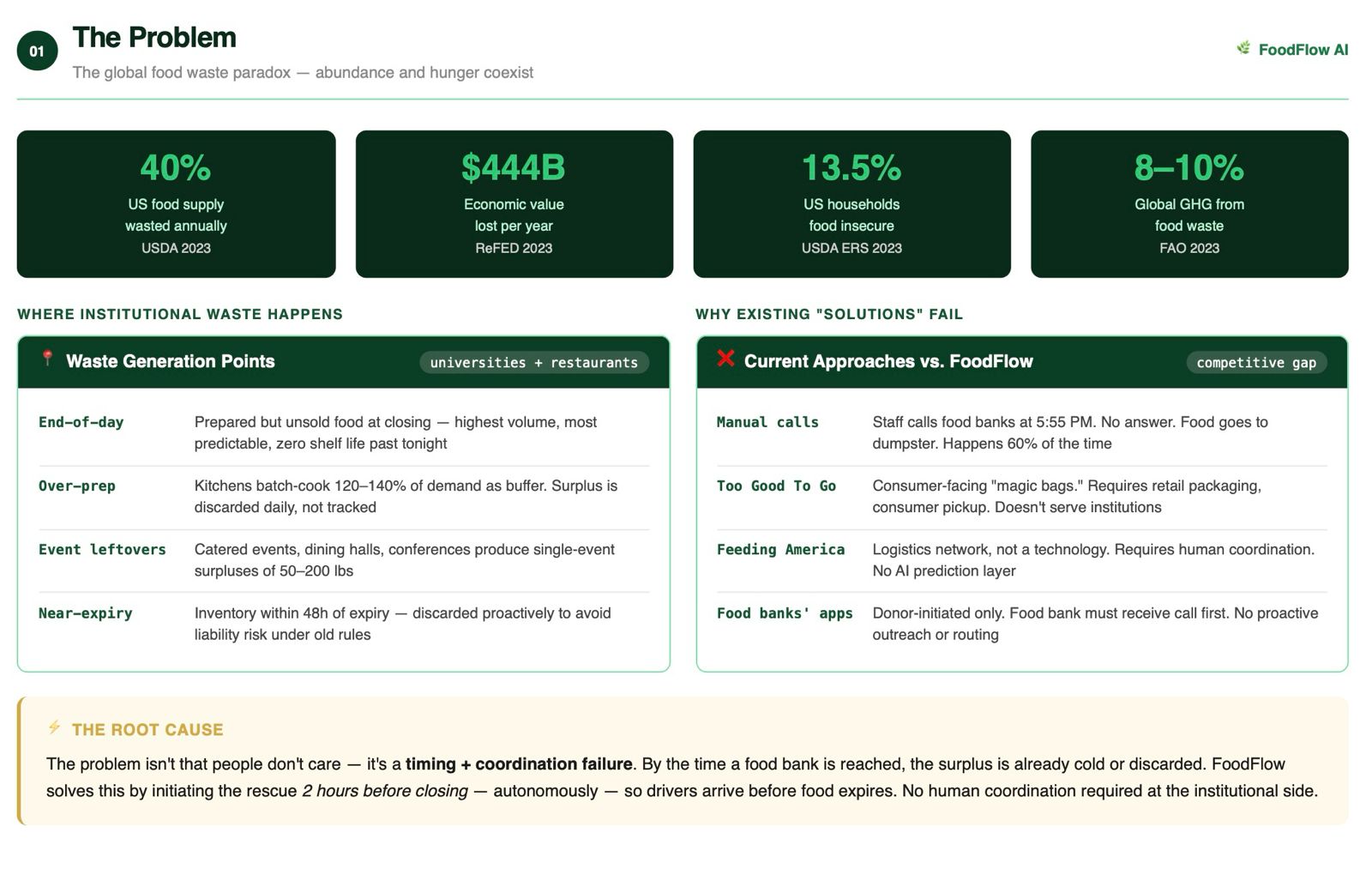
At the same time, coming to Cornell exposed us to a very different reality. Around dining halls, cafeterias, campus events, restaurants, and food service operations, we noticed how much edible food can be left over or discarded simply because redistribution is difficult to coordinate. Seeing food scarcity in one part of our lives and food surplus in another made the problem impossible to ignore.
That contrast became the foundation of FoodFlow AI. We wanted to build something that connects excess food to real need before it becomes waste. Our goal was not just to create another food donation platform, but to design an intelligent coordination system that helps institutions, restaurants, cafeterias, food banks, and volunteers act faster, more efficiently, and more responsibly.
What it does
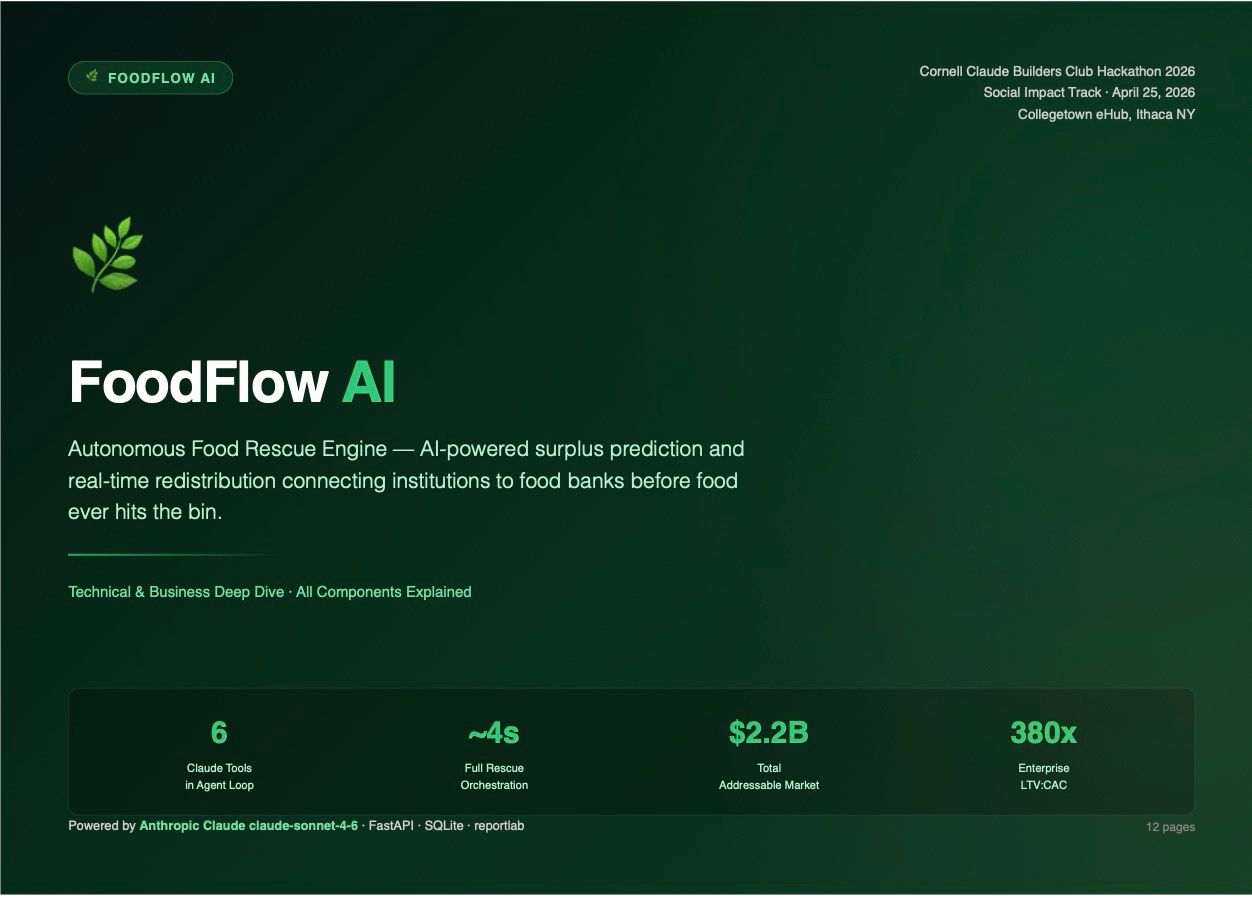
FoodFlow AI is an AI-powered surplus food redistribution network that helps move edible surplus food from donors to organizations that can use it.
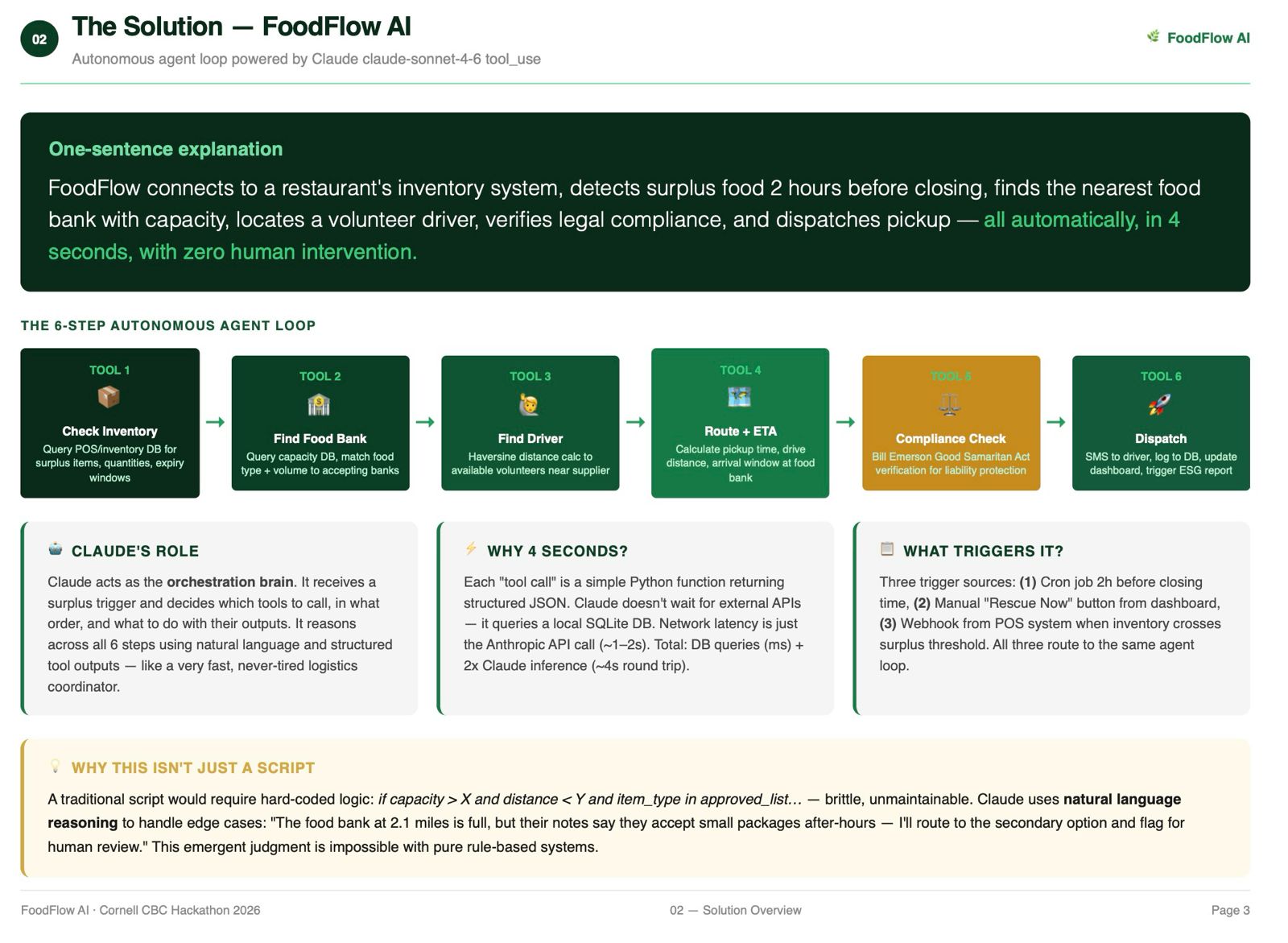
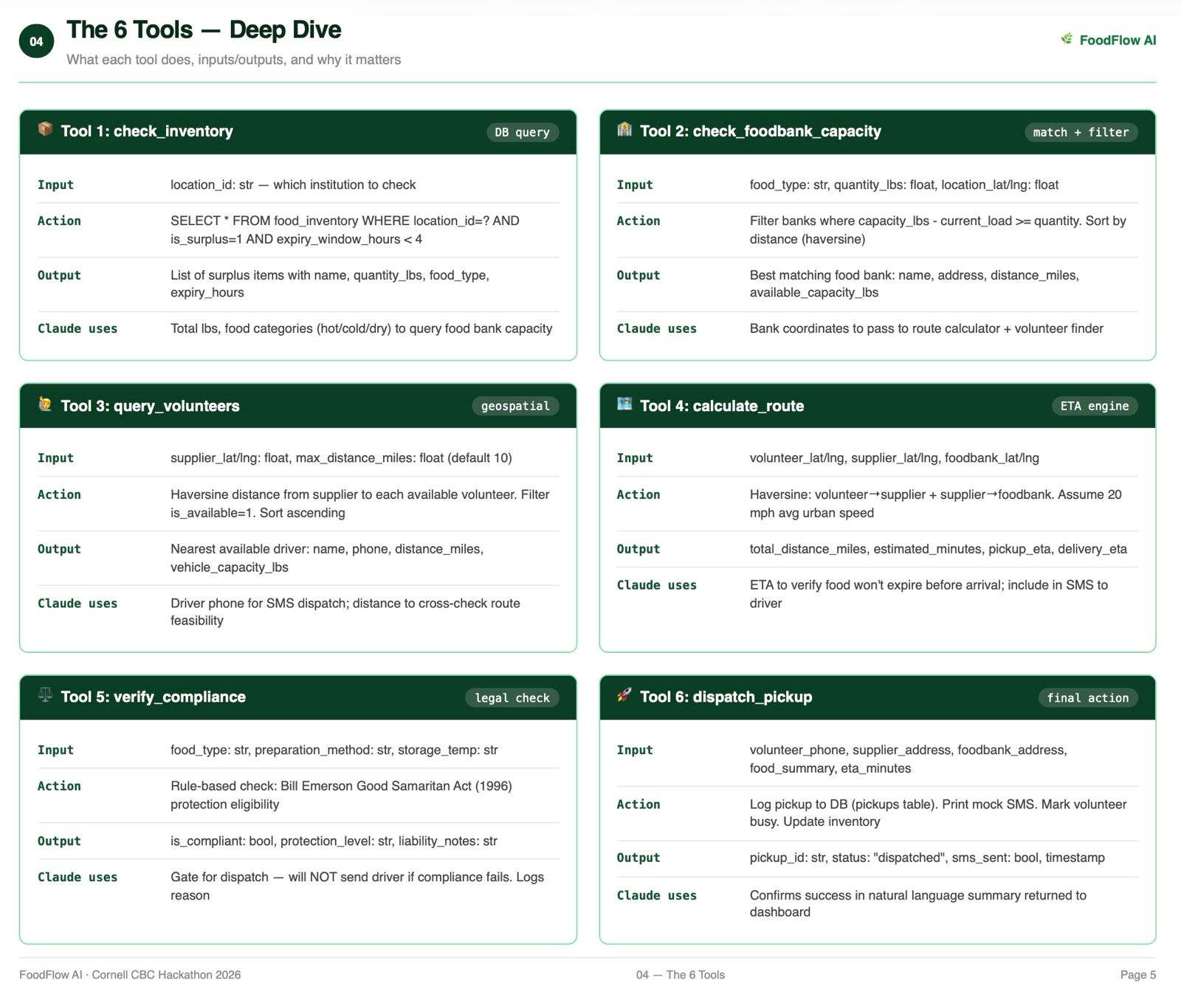
Instead of functioning as a passive marketplace where donors manually post food and recipients manually claim it, FoodFlow AI acts as an autonomous coordination engine. The system identifies available surplus food, matches it with an appropriate food bank or recipient organization, checks volunteer availability, verifies compliance, coordinates dispatch, and generates an impact report.
The basic workflow is:
- A donor has surplus food available.
- FoodFlow AI evaluates the food type, quantity, expiration window, and pickup location.
- The system matches the donation with a nearby food bank or recipient organization that has capacity.
- It checks whether a volunteer driver is available.
- It verifies compliance and food safety requirements before dispatch.
- It creates a rescue plan and impact report showing the value of the recovered food.
The long-term goal is to reduce both food waste and food insecurity by turning fragmented food donation efforts into a faster, smarter, and more reliable redistribution network.
How we built it
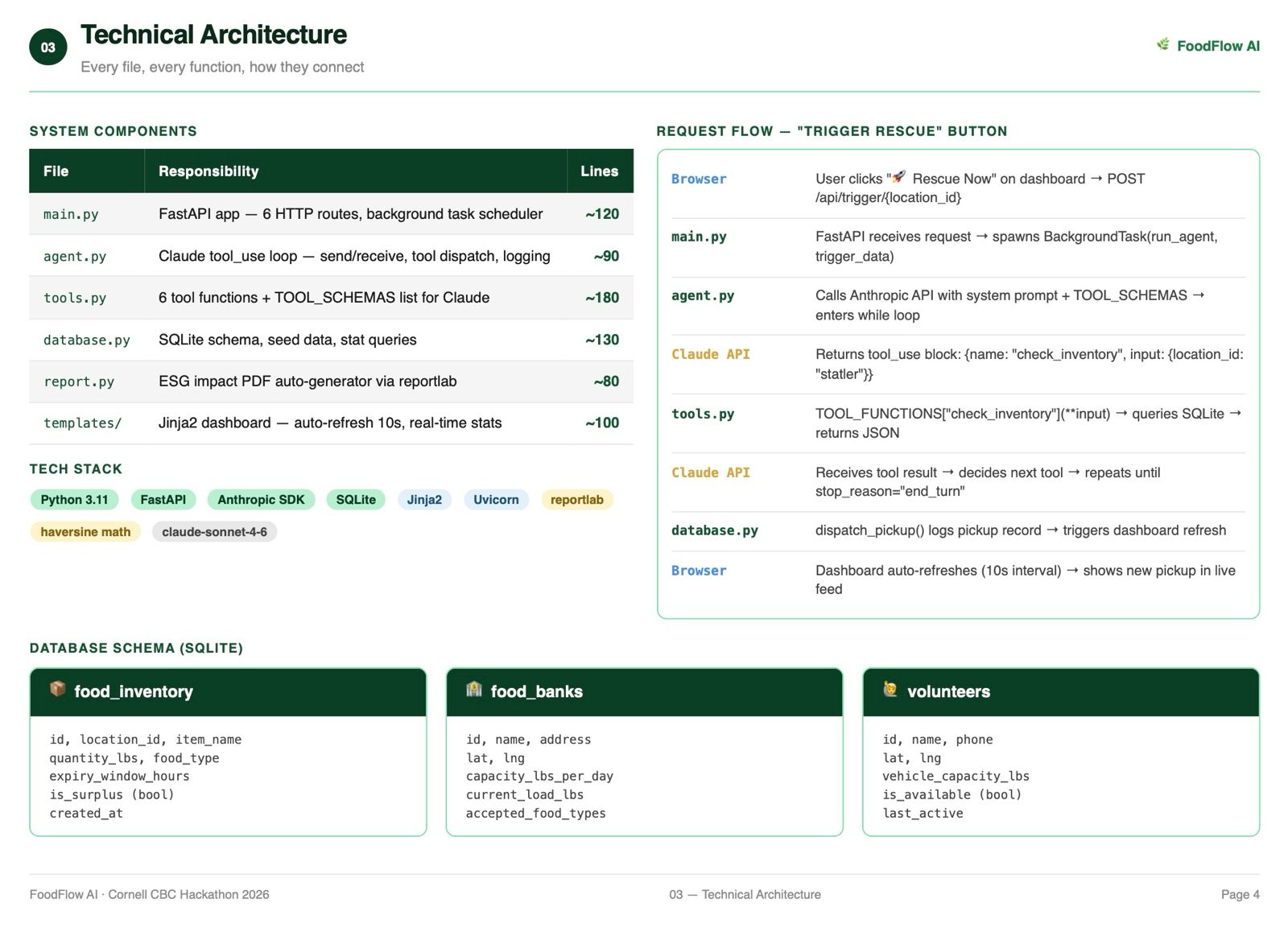
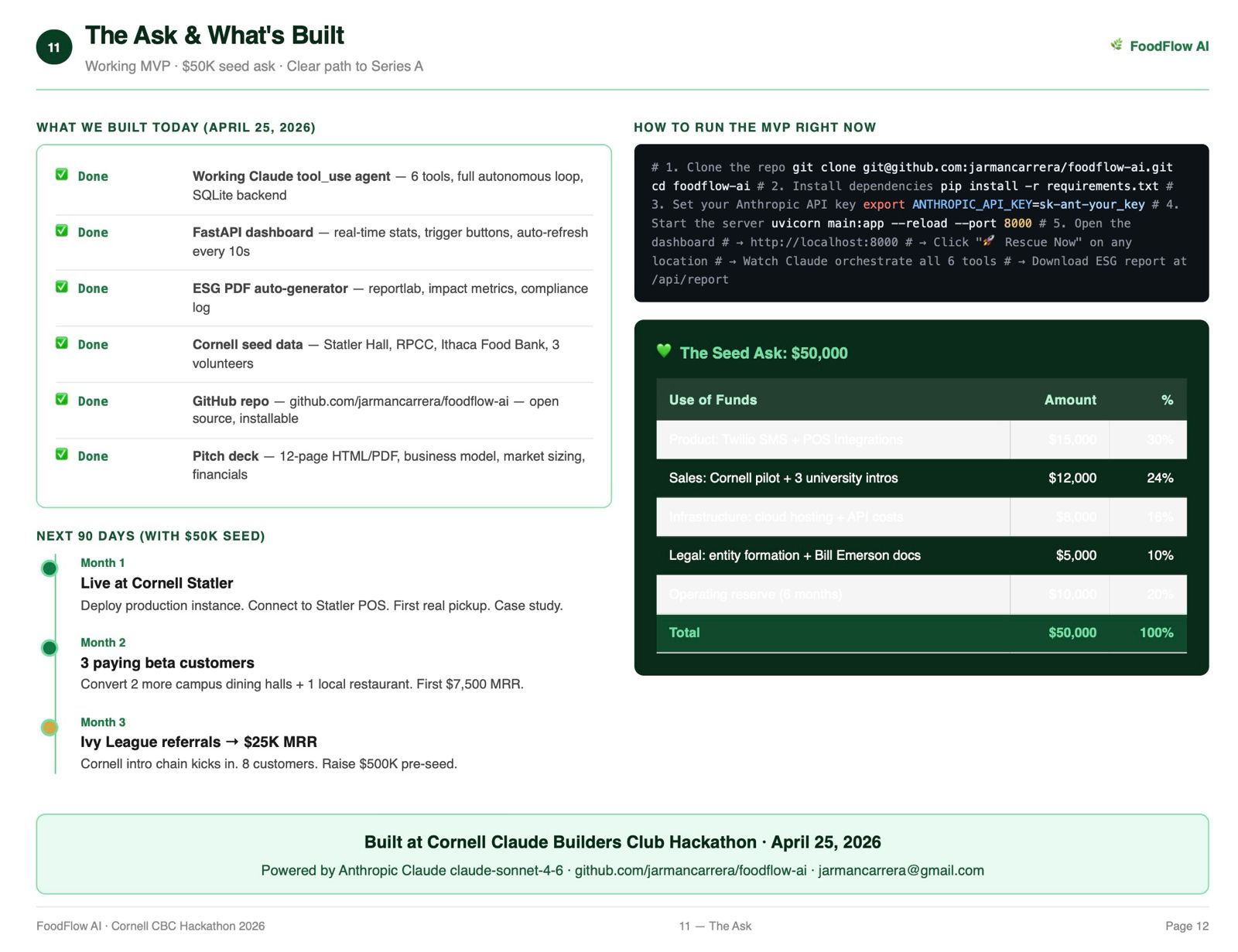
We built FoodFlow AI as a working prototype that combines backend logic, structured data, Claude-powered reasoning, and a simple user-facing dashboard.
Since we did not have access to live restaurant POS systems, grocery inventory databases, dining hall inventory data, or food bank management systems during the hackathon, we used realistic seeded data to simulate a food redistribution environment. This allowed us to demonstrate the core logic of the platform while keeping the prototype reliable and understandable.
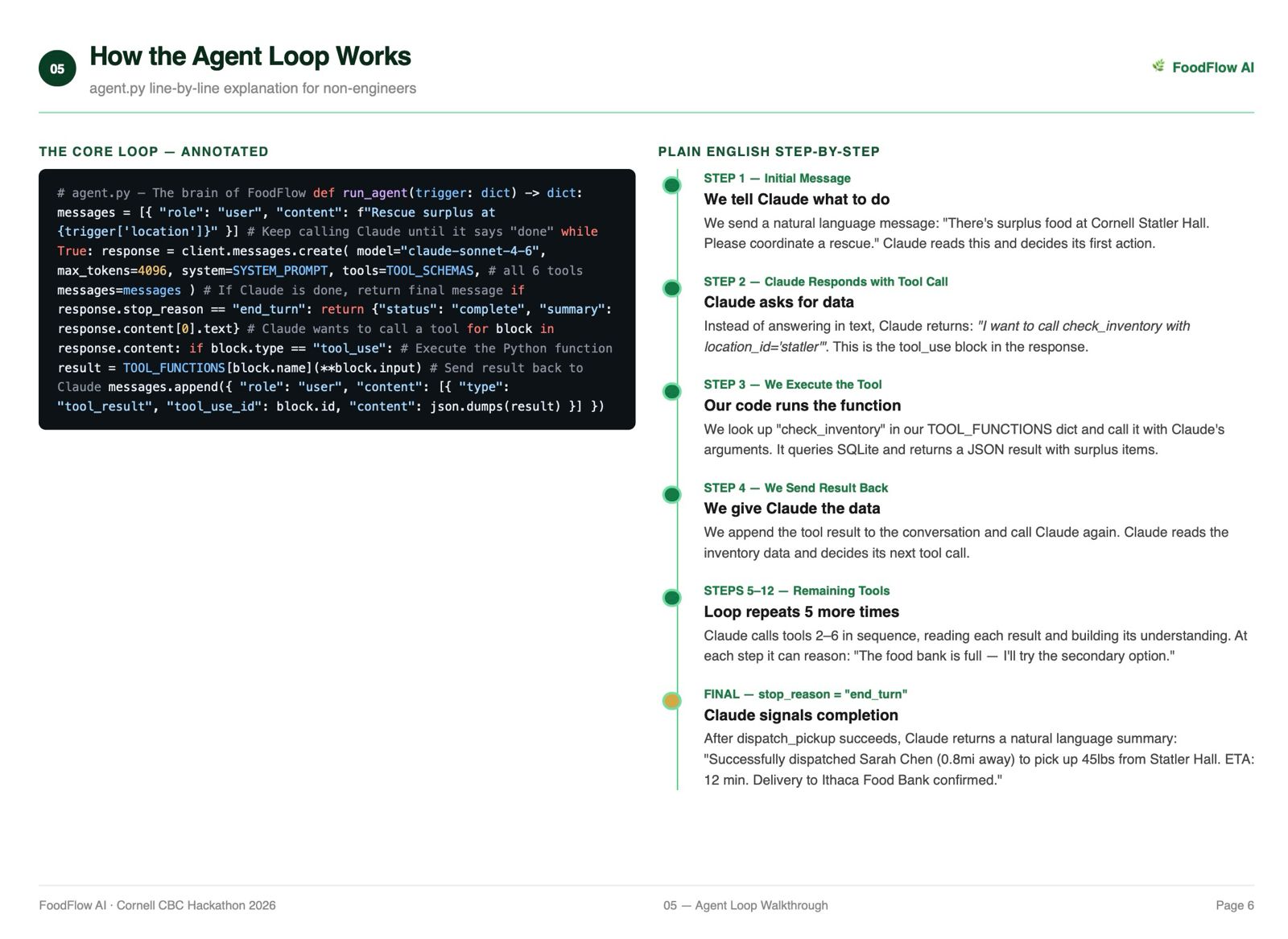
Claude was integrated as the reasoning layer of the system. Rather than using AI only as a chatbot, we designed Claude to support operational decision-making. The system reasons across multiple pieces of information, including surplus inventory, food bank capacity, volunteer availability, route feasibility, and compliance requirements. Based on these inputs, it produces a coordinated dispatch recommendation.
The prototype was built around one clear end-to-end demo: a surplus food event enters the system, FoodFlow AI evaluates the situation, matches the food to the right recipient, checks logistics and compliance, and generates a rescue plan with measurable impact.
Challenges we ran into
One of the main challenges we faced was translating a very broad social problem into a focused and buildable prototype. Food waste and food insecurity are deeply connected to logistics, timing, data access, safety, and coordination between many different actors. Instead of trying to solve the entire food redistribution system at once, we narrowed FoodFlow AI into one clear end-to-end workflow: identifying surplus food, matching it with an appropriate food bank, checking volunteer availability, verifying compliance, dispatching the pickup, and generating an impact report.
A second challenge was making sure the AI was meaningfully embedded in the product rather than simply functioning as a chatbot. We wanted Claude to support real operational decision-making, so we designed it as an agent that reasons across multiple tools and data points. The system does not just explain what should happen; it evaluates inventory, food bank capacity, volunteer availability, route feasibility, and compliance requirements before recommending a coordinated action.
We also faced the challenge of limited access to real-time food inventory and food bank data. In a full deployment, FoodFlow AI would ideally integrate with restaurant POS systems, grocery inventory platforms, dining hall systems, food bank databases, volunteer networks, and routing APIs. Because those integrations were not feasible within the hackathon timeframe, we used realistic seeded data to simulate the donation environment while still demonstrating the core logic of the platform.
Another important challenge was balancing automation with responsibility. Food redistribution involves food safety, expiration timing, liability, and the dignity of the communities being served. To address this, we included a compliance verification step before dispatch and framed the AI as a coordination assistant rather than a replacement for human judgment. This helped us preserve the benefits of automation while recognizing that decisions involving food safety and community needs require accountability.
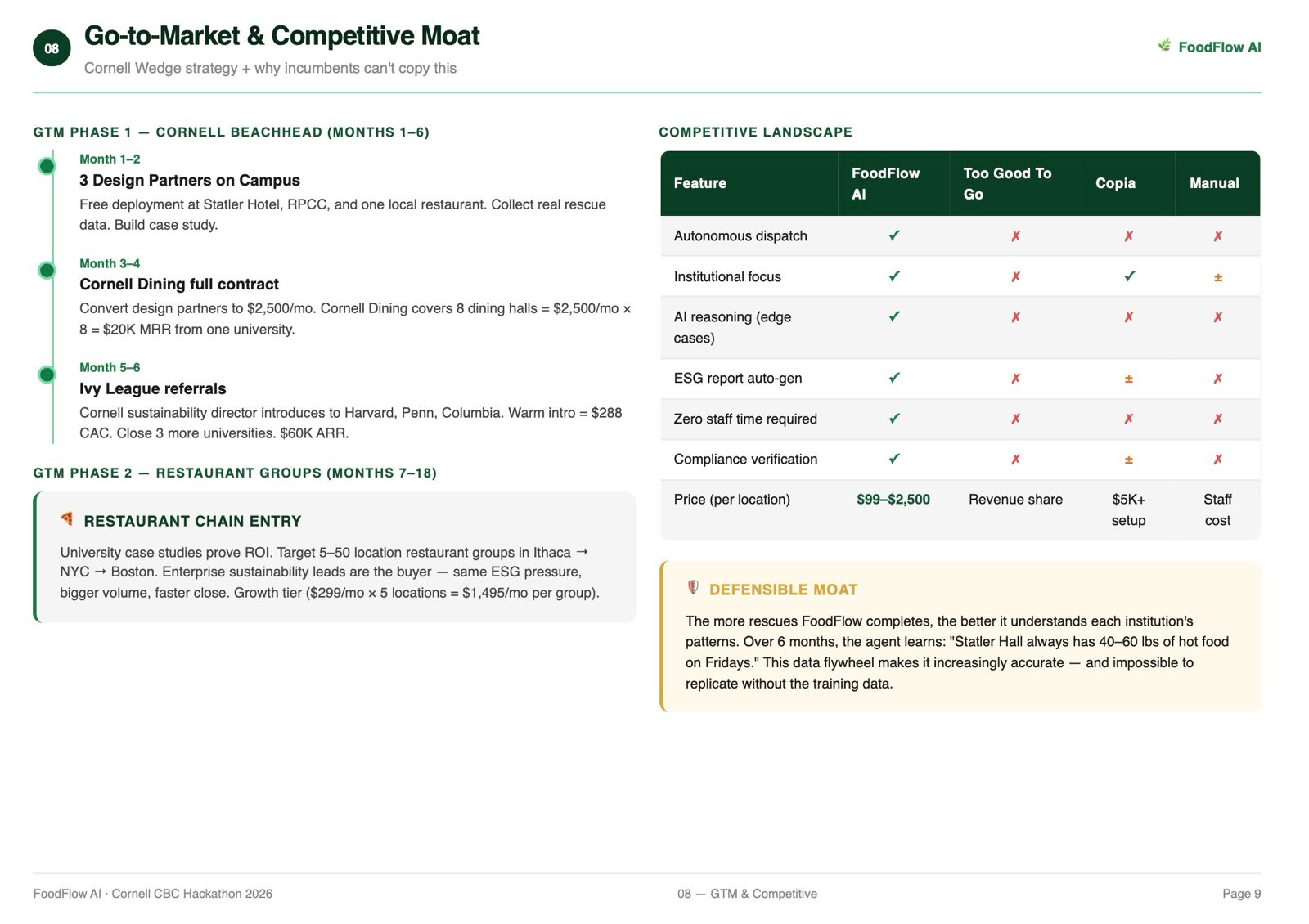
Finally, we had to communicate why FoodFlow AI is different from existing food surplus or donation platforms. Many current solutions function as passive marketplaces where donors manually post available food and recipients manually claim it. Our approach is different because FoodFlow AI aims to predict and coordinate surplus redistribution before food becomes waste. This distinction shaped both our technical design and our presentation: the goal was not just to list available food, but to build an intelligent system that actively closes the gap between surplus and need.
Accomplishments that we're proud of
We are proud that we were able to take a very large and personal social issue and turn it into a concrete, working prototype. Food insecurity and food waste are both complex problems, but we found a focused way to demonstrate how AI could improve coordination between food donors, food banks, and volunteers.
We are also proud that FoodFlow AI uses Claude as more than a conversational assistant. The system is designed around multi-step reasoning and operational decision-making, where the AI evaluates different constraints before recommending an action. This made the project feel more like an intelligent logistics engine than a simple chatbot.
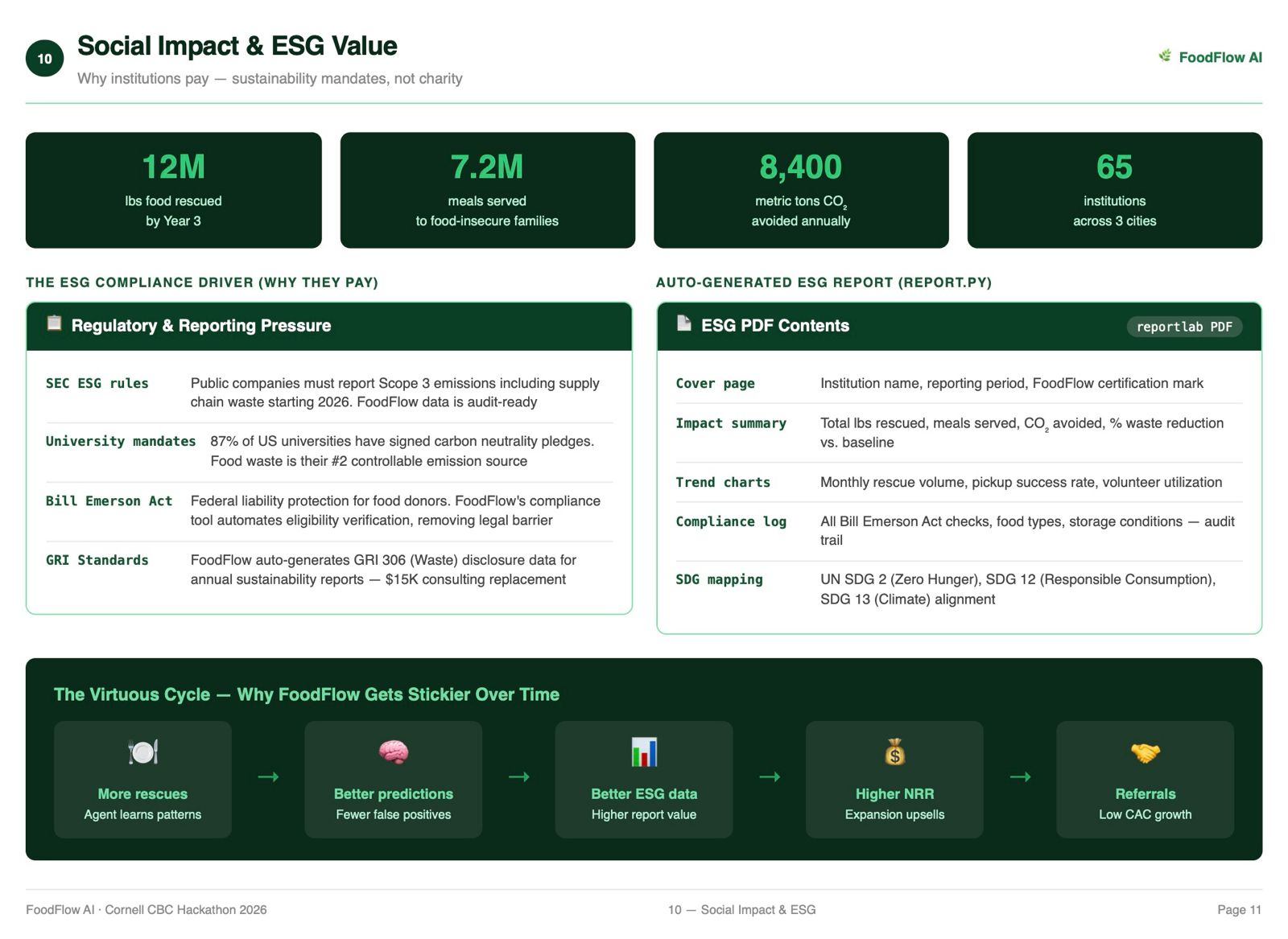
Another accomplishment we are proud of is connecting technical execution with human impact. The prototype does not only show a dispatch workflow; it also translates each rescue into measurable outcomes such as food recovered, meals supported, and waste avoided. This helped us keep the project grounded in the reason we built it in the first place: getting edible food to people who need it.
Finally, we are proud of building a project that reflects our own backgrounds and values. As Latin American students who have seen hunger and inequality closely, this project allowed us to use technology to address a problem that feels real to us.
What we learned
One of the biggest things we learned is that food waste is not only a supply problem. In many cases, the food exists, the need exists, and the people willing to help exist. The missing piece is coordination. Timing, logistics, trust, safety, and communication are what often prevent surplus food from reaching people who need it.
We also learned that AI is most powerful when it reduces friction in complex systems. A chatbot alone would not solve food redistribution. The real value comes from using AI to reason across multiple constraints and help people make faster, better, and safer decisions.
Another important lesson was that social impact projects need both empathy and execution. It is not enough to care about hunger or food waste; the product also has to work within real-world constraints. Food safety, compliance, volunteer reliability, recipient capacity, and human dignity all matter.
We also learned how important it is to narrow the scope of an ambitious idea. The full version of FoodFlow AI could involve many integrations and stakeholders, but for the hackathon we had to focus on one workflow that clearly demonstrated the concept from beginning to end.
What's next for FOODFLOW AI
The next step for FoodFlow AI would be integrating with real data sources. This could include dining hall inventory systems, restaurant POS systems, grocery inventory platforms, food bank databases, volunteer networks, and routing APIs. With live data, the system could move from a simulated prototype to a real-time food rescue coordination platform.
We would also like to improve the surplus prediction layer. In the future, FoodFlow AI could use historical demand, weather, campus events, purchasing patterns, and inventory data to predict surplus before it happens. This would allow donors and food banks to plan ahead instead of reacting after food is already at risk of being wasted.
Another important next step is expanding the compliance and safety framework. Food donation involves expiration windows, storage requirements, transportation conditions, and liability concerns. We would want to work with food banks, dining services, public health experts, and nonprofit organizations to make sure the system is safe, responsible, and practical.
We also see potential for FoodFlow AI beyond Cornell. The same coordination problem exists in cities, universities, restaurants, farms, grocery stores, and communities across the world. In the long term, we hope FoodFlow AI could help build more efficient food redistribution networks in places where hunger and food waste exist side by side, including communities like the ones we grew up around in Latin America.
Built With
- anthropic-claude-api
- anthropic-claude-sonnet-4.6-api
- autonomous-agent-loop-design
- background-task-scheduling
- claude-tool-use
- claude-tool-use-/-function-calling
- css
- esg
- fastapi
- github
- haversine-distance-calculations
- haversine-routing-logic
- html
- html/css
- impact
- javascript
- jinja
- jinja2-templates
- prompt-engineering
- python-3.11
- reporting
- reportlab
- reportlab-pdf-generation
- rest-api-architecture
- sqlite
- structured-json-tool-schemas
- uvicorn

Log in or sign up for Devpost to join the conversation.