
🌱 Inspiration
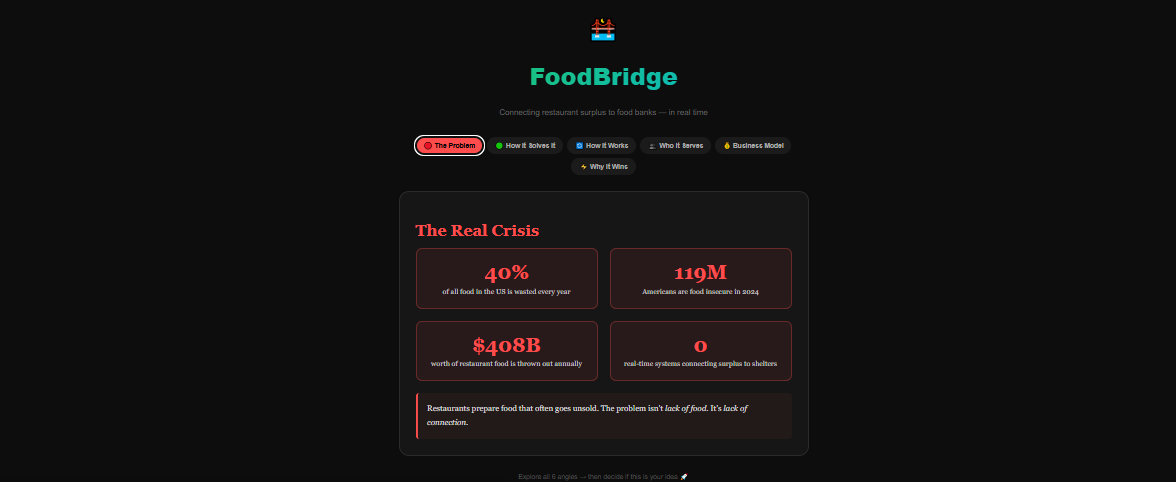
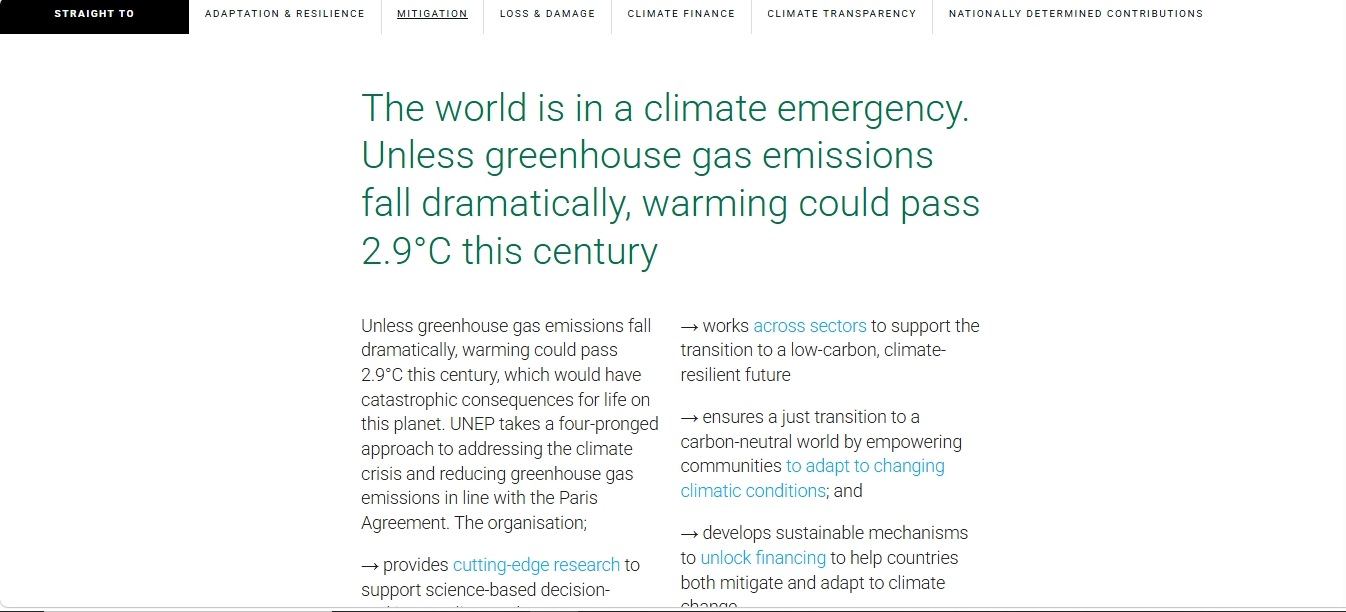
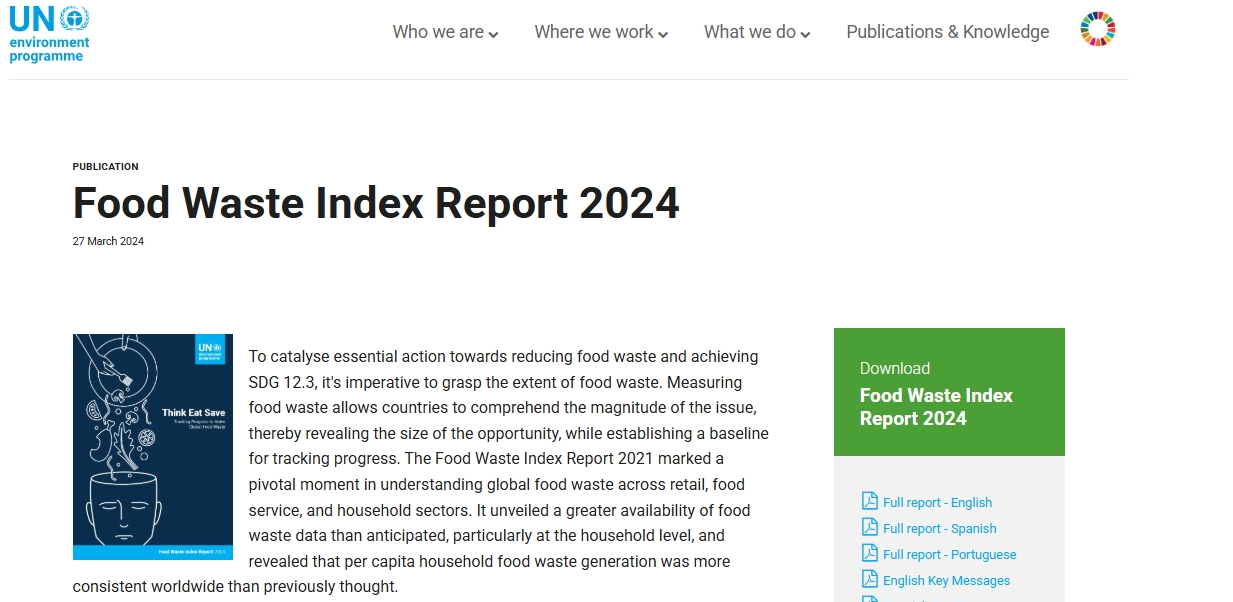
Every night, restaurants across the world throw away hundreds of perfectly good meals. Every night, food banks nearby run short. We kept asking ourselves — why does this keep happening when the food already exists? Then we looked at the numbers. According to the UN Environment Programme's 2024 Food Waste Index, the world wasted 1.05 billion tonnes of food in a single year — generating 8–10% of all global greenhouse gas emissions. That is nearly five times the emissions of the entire aviation industry. Meanwhile, 783 million people go hungry every day. This is not a food shortage problem. It is a connection problem. Food exists. People who need it exist. The bridge between them does not. That gap — urgent, solvable, and ignored — is exactly what inspired FoodBridge.
🍽️ What It Does
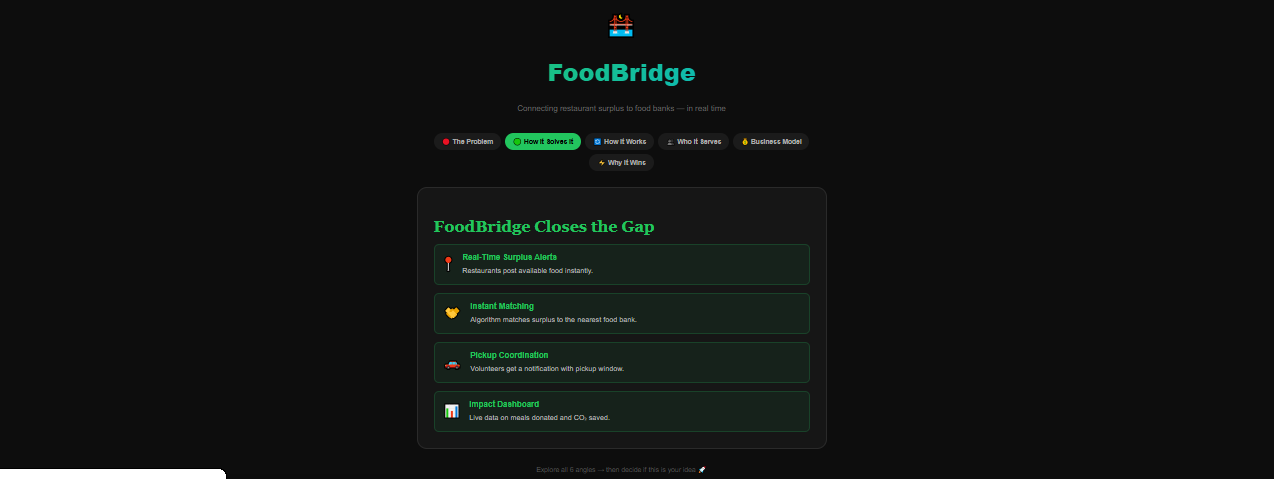
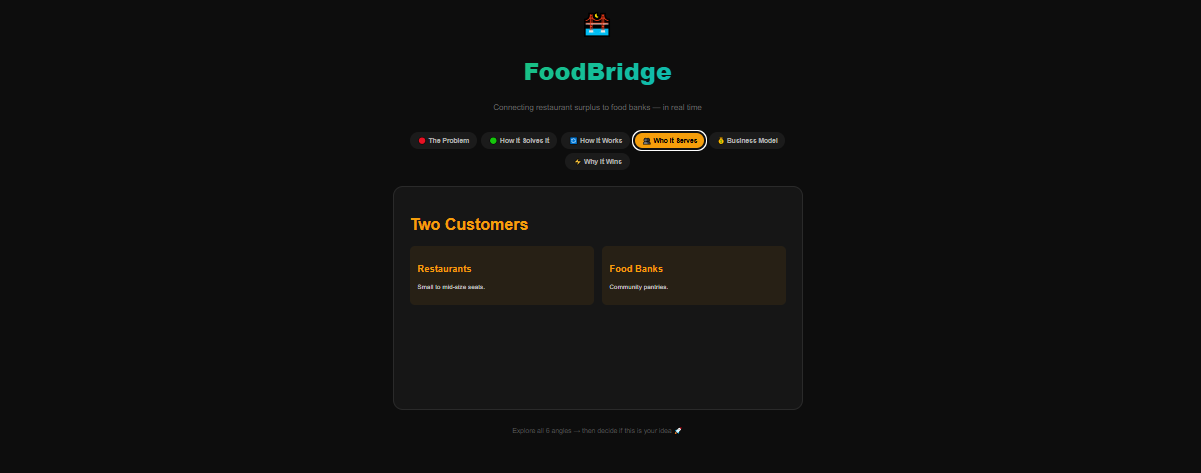
FoodBridge is a mobile app that connects restaurants with nearby food banks and shelters in real time — not on a weekly schedule, not through phone calls, but instantly. Here is how a single donation works tonight:
🍕 A restaurant has 20 leftover portions at 9pm. They open FoodBridge and post the surplus in under 60 seconds — quantity, food type, pickup deadline 📡 FoodBridge instantly notifies all food banks within a set radius that have confirmed availability today 🏠 A food bank sees the alert, taps "Claim", and gets the restaurant's address automatically 🚗 A volunteer picks up the food before closing time 📊 Both sides receive an impact summary — meals saved, CO₂ avoided, and a shareable donor badge
No bureaucracy. No scheduling. No waste.
🔨 How We Built It
FoodBridge is a concept-stage solution designed with real-world feasibility at its core. Our approach involved:
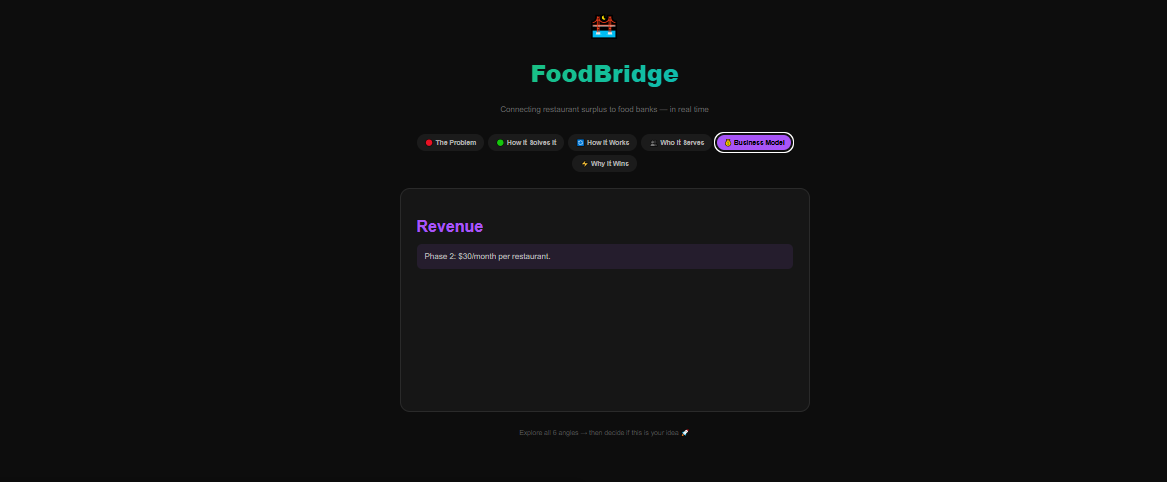
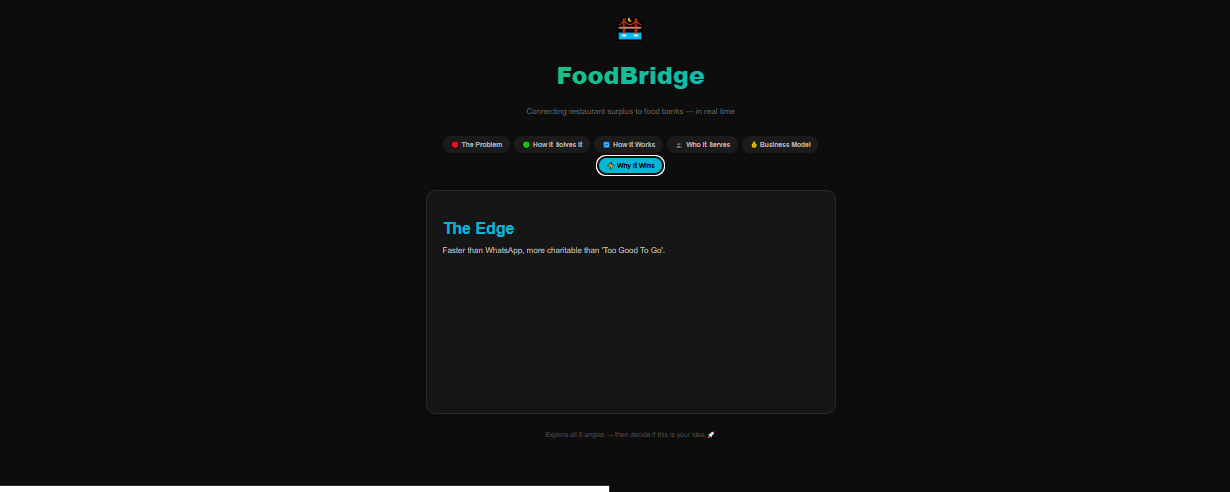
Research — grounding the idea in UN UNEP 2024 Food Waste Index data, WHO hunger statistics, and existing platforms like Too Good To Go to identify the gap System design — mapping the full user journey for both restaurants and food banks, identifying every friction point in current donation processes Business modeling — designing a two-sided marketplace where restaurants pay a small monthly subscription ($30/month) and food banks access the platform completely free Climate lens — calculating how redirecting food waste directly reduces methane emissions from landfills, the single largest source of food-related GHG emissions
Our solution requires no new infrastructure — just a smart layer connecting existing supply with existing demand.
🧱 Challenges We Ran Into
The coordination problem is harder than it looks. Current food donation systems fail not because people don't care, but because the logistics are broken. Restaurants don't know which food banks need food today. Food banks can't plan pickups around unpredictable surplus. Volunteers don't get notified fast enough. We also wrestled with the liability question — many restaurants fear donating food due to concerns about food safety lawsuits. Our research showed that most countries have Good Samaritan food donation laws protecting donors, but awareness of these laws is extremely low. FoodBridge would need to build this education into onboarding. Finally, trust and adoption — getting the first 20 restaurants on board in a new city with zero existing network is the classic cold-start problem every two-sided marketplace faces.
🏆 Accomplishments That We're Proud Of
Framing a climate solution that tackles 8–10% of global emissions through a practical, non-technical, immediately deployable concept Designing a model that is free for those who need it most — food banks and shelters — while being financially sustainable Grounding every statistic in verified UN and UNEP data rather than estimates Building a solution that works in any country — from Pakistan to Nigeria to Brazil — not just wealthy nations, because food waste is not a rich-country problem Thinking through equity — the communities most harmed by food insecurity are often the same communities most impacted by climate change
📚 What We Learned
Food waste is one of the most under-discussed climate solutions available to us right now. Unlike solar panels or carbon capture — which require massive investment and years of infrastructure — redirecting surplus food requires almost nothing new. The food exists. The hunger exists. The technology to connect them is simple. We also learned that the most effective climate solutions are often the ones that solve two problems at once — in FoodBridge's case, food insecurity and greenhouse gas emissions from landfill decomposition. Solutions with compounding benefits like this deserve far more attention than they currently receive.
🚀 What's Next for FoodBridge
Pilot launch in one mid-size city — targeting 50 restaurants and 20 food banks in the first 3 months Partnership with municipal governments — several cities already have food waste reduction targets under their climate action plans; FoodBridge can become their implementation tool Carbon credit integration — quantifying the exact CO₂ saved per donation and eventually allowing restaurants to earn verified carbon credits for their contributions Expansion to schools, hotels, and catering companies — the same surplus problem exists across every food service sector Advocacy layer — sharing anonymized impact data with city governments and the UN to support SDG 12.3: halving global food waste by 2030
The goal is not just an app. It is a global food rescue infrastructure — starting small, scaling fast, and built for the planet.
Climate Themes Addressed ✅
ThemeHow FoodBridge Addresses ItClimate Technology & InfrastructureApp-based real-time system replacing wasteful manual processesMobilizing Collective ActionEngages restaurants, volunteers, food banks as a communityEquity & Justice LensFree for food banks, serves most vulnerable communities firstSystems ApproachTackles emissions AND hunger simultaneously


Log in or sign up for Devpost to join the conversation.