Inspiration
The inspiration behind FoodBridge stems from the growing problem of food waste and hunger around the world. Despite the surplus of food, logistical inefficiencies and outdated processes prevent donations from reaching the people who need them the most. Traditional donation workflows require donors to fill out complex forms, navigate confusing interfaces, and coordinate pickups manually—creating friction that discourages participation.
With the vision to reduce both food waste and hunger, FoodBridge was created to streamline the donation process using conversational AI and technology to simplify agreements, improve coordination, and ensure food reaches those who need it.
What it does
FoodBridge is a web-based platform designed to revolutionize the food donation process by combining conversational AI with digital workflows. Key features include:
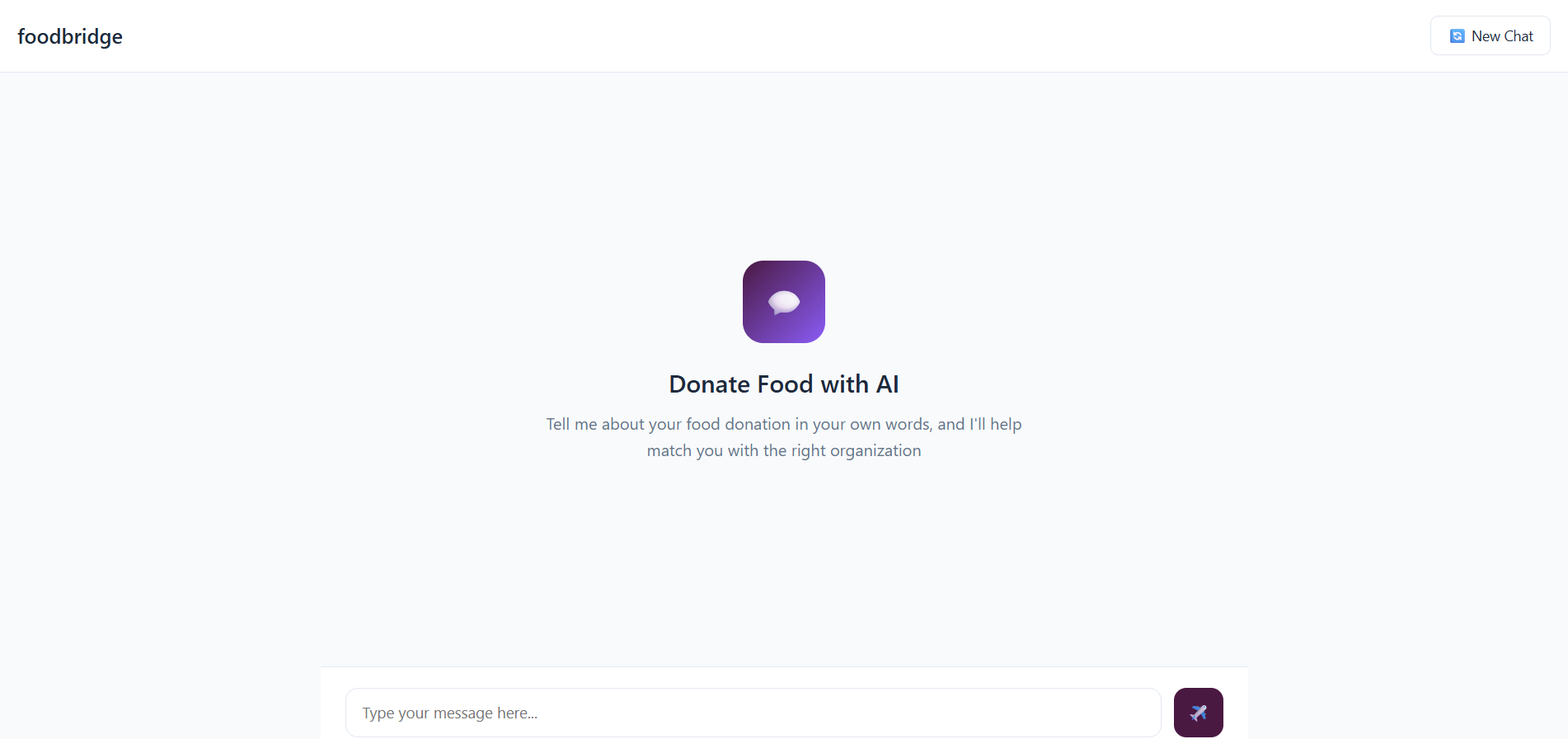
AI-Powered Conversational Interface: Donors interact naturally with an intelligent assistant that understands food donations in their own words (e.g., "I have 10 bags of rice and 20 sandwiches"). The AI extracts donation details, asks clarifying questions, and guides donors through the process without forms.
Intelligent NGO Matching: The system uses machine learning to match donations with the most suitable non-profit organizations based on location, food type, capacity, organizational mission, and community served. Donors can view matched organizations as interactive cards, choose a single recipient, or split donations across multiple organizations.
Digital Agreement Creation & Signing: Non-profits and donors can easily create, send, and sign agreements through an integrated DocuSign eSignature system, reducing paperwork and accelerating the donation process.
Real-Time NGO Dashboard: Non-profits manage and track the status of donations in real-time, reducing the risk of missed or delayed food donations. They receive instant notifications when new donations are matched to their organization.
Automated Messaging System: Real-time WhatsApp and SMS notifications powered by Twilio API send four types of alerts: donation match notifications to nonprofits, agreement confirmations, donor receipts, and detailed pickup assignments to logistics providers.
Logistics Coordination: The system supports seamless coordination with logistics providers and tracks the status of food delivery through automated messaging and integration planning.
Impact Analytics Dashboard: A comprehensive analytics platform featuring interactive charts and visualizations that track donation trends, food distribution patterns, environmental impact (CO₂ saved), and operational metrics with automated PDF report generation.
How we built it
The project was built using Django for the backend framework, with MySQL as the database for storing donation data and user information.
AI & Conversational System: We integrated a conversational donation agent that processes natural language input using regex-based extraction with AI fallback. The system understands food quantities in various units (bags, sandwiches, kg), recognizes dates and times from natural language, and maintains conversation context across multiple exchanges.
Frontend Interface: The platform features a modern chat interface built with HTML, CSS, and JavaScript, using Bootstrap for responsive UI components. We implemented interactive NGO selection cards with multi-select support, allowing donors to choose single or multiple organizations for split donations.
Digital Agreements: We leveraged DocuSign's eSignature API to automate agreement workflows with proper signature verification and status tracking.
Messaging System: Twilio API handles WhatsApp and SMS messaging with proper phone number formatting, sandbox mode support for development, and reliable delivery across different stakeholder groups.
Analytics & Reporting: We implemented Chart.js for interactive line and doughnut charts, D3.js for advanced data visualizations, and jsPDF for automated PDF report generation.
Data Processing: Python backend logic handles the matching algorithm, data extraction, natural language processing, and logistics optimization.
Challenges we ran into
Natural Language Understanding: Building a regex-based extraction system that accurately interprets diverse food donation descriptions required iterative refinement and fallback mechanisms to handle edge cases and ambiguous inputs.
Multi-Turn Conversation State Management: Maintaining conversation context across multiple user messages while correctly merging new extracted data with existing information proved complex, especially when preventing duplicate data entry and handling implicit confirmations.
NGO Matching Algorithm Complexity: Creating an intelligent matching system that considers location, food type, organizational capacity, mission alignment, and community demographics required multiple iterations to balance accuracy with scalability.
Integration of DocuSign API: Managing digital signatures, envelope status tracking, and proper error handling during the agreement workflow took significant effort due to API complexity.
Twilio Messaging Integration: Implementing reliable messaging across multiple stakeholder types while handling phone number formatting, sandbox mode configurations, and delivery confirmation presented technical challenges.
UI/UX for Complex Workflows: Designing an intuitive interface that handles both simple single-donation flows and complex split-donation scenarios required careful UX consideration to avoid overwhelming users.
Data Validation & Error Handling: Ensuring robust validation for dates, phone numbers, addresses, and food quantities across different input formats required comprehensive testing.
Accomplishments that we're proud of
Natural Conversational AI: Successfully implemented an AI-driven donation process that feels like talking to a helpful person, not filling out a form. The system understands diverse food descriptions, recognizes dates and times in various formats, and maintains intelligent conversation flow.
Smart NGO Matching with Visualization: Built an intelligent matching algorithm that considers multiple criteria and presents results as interactive cards with real-time selection capabilities, enabling donors to make informed decisions instantly.
Seamless Split Donation Workflow: Implemented support for donors to split donations across multiple organizations, with the AI handling allocation logic and presentation of results in a clear, understandable format.
Multi-Channel Messaging System: Successfully deployed a comprehensive automated messaging system using Twilio API that delivers contextual information to each stakeholder at the right time.
End-to-End Automation: Created a fully automated workflow from conversational donation entry to pickup coordination, with digital agreements and real-time tracking.
Advanced Analytics Dashboard: Built an interactive analytics platform that provides meaningful insights into donation impact, enabling nonprofits to track their reach and demonstrate value to donors.
What we learned
Conversational UX is Powerful: Removing form barriers and enabling natural conversation dramatically improves user engagement and donation completion rates. Natural language interaction reduces cognitive load for donors.
Context Matters in Extraction: Building effective data extraction requires understanding not just what was said, but the context of the conversation. Maintaining accurate state across multiple turns is critical.
Matching Logic Requires Domain Knowledge: Creating an effective matching algorithm goes beyond data points—it requires understanding organizational missions, community needs, food types, and logistics constraints.
API Integration Requires Robust Error Handling: Third-party APIs like DocuSign and Twilio need careful error handling, retry logic, and fallback mechanisms to ensure reliability.
Split Donations Add Complexity: Supporting split donations introduces additional UI/UX challenges but significantly increases impact by allowing donors to help multiple organizations from a single donation.
Real-Time Notifications Drive Engagement: Automated messaging to nonprofits and donors keeps everyone informed and engaged throughout the donation lifecycle.
Data Presentation is Key for Impact: Visual dashboards help nonprofits understand their impact and donors see the tangible effects of their generosity.
What's next for FoodBridge
Enhanced AI Capabilities: Implement machine learning models that learn from past donations to improve matching accuracy over time, predict which organizations are most likely to successfully complete donations, and provide personalized recommendations.
Multi-Language Support: Add internationalization to support donors and nonprofits in different countries and languages, enabling global scaling.
Mobile App Development: Develop native mobile applications for iOS and Android to increase accessibility for donors, nonprofits, and logistics providers with offline support and push notifications.
Advanced Logistics Integration: Integrate with real-time logistics platforms (FedEx, DHL) for GPS tracking, automated route optimization, and delivery confirmations.
Predictive Analytics: Implement machine learning to forecast donation trends, predict food waste patterns, and optimize nonprofit resource allocation.
Gamification & Incentives: Add features that recognize and reward frequent donors, organizations with high impact metrics, and logistics partners with excellent delivery records.
Community Features: Enable donors to connect with nonprofits, see real stories of impact, and join community giving challenges.


Log in or sign up for Devpost to join the conversation.