-
-
FoodBridge — A community platform to share surplus food and fight hunger
Inspiration
Every day, I see food being thrown away — leftover meals, excess vegetables, unsold groceries. At the same time, millions of people go to bed hungry every night. This disconnect inspired me to build FoodBridge — a platform that connects people who have surplus food with people who need it, completely free of cost.
The UN estimates that 1/3 of all food produced globally is wasted, while 828 million people face hunger. I wanted to do something about that, even at a small community level.
What it does
FoodBridge is a community-driven web application that allows anyone to:
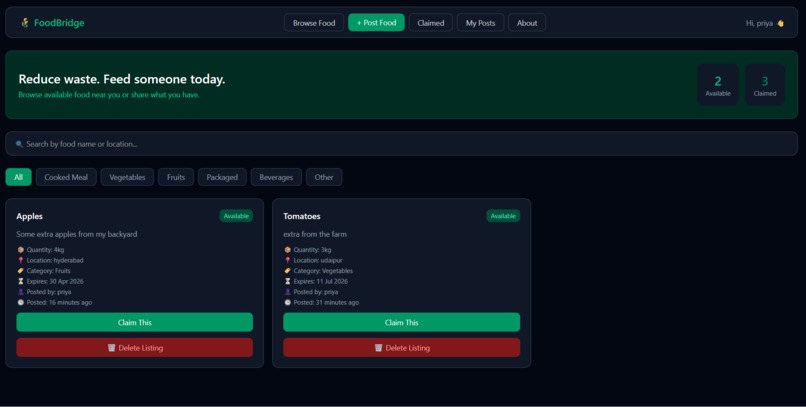
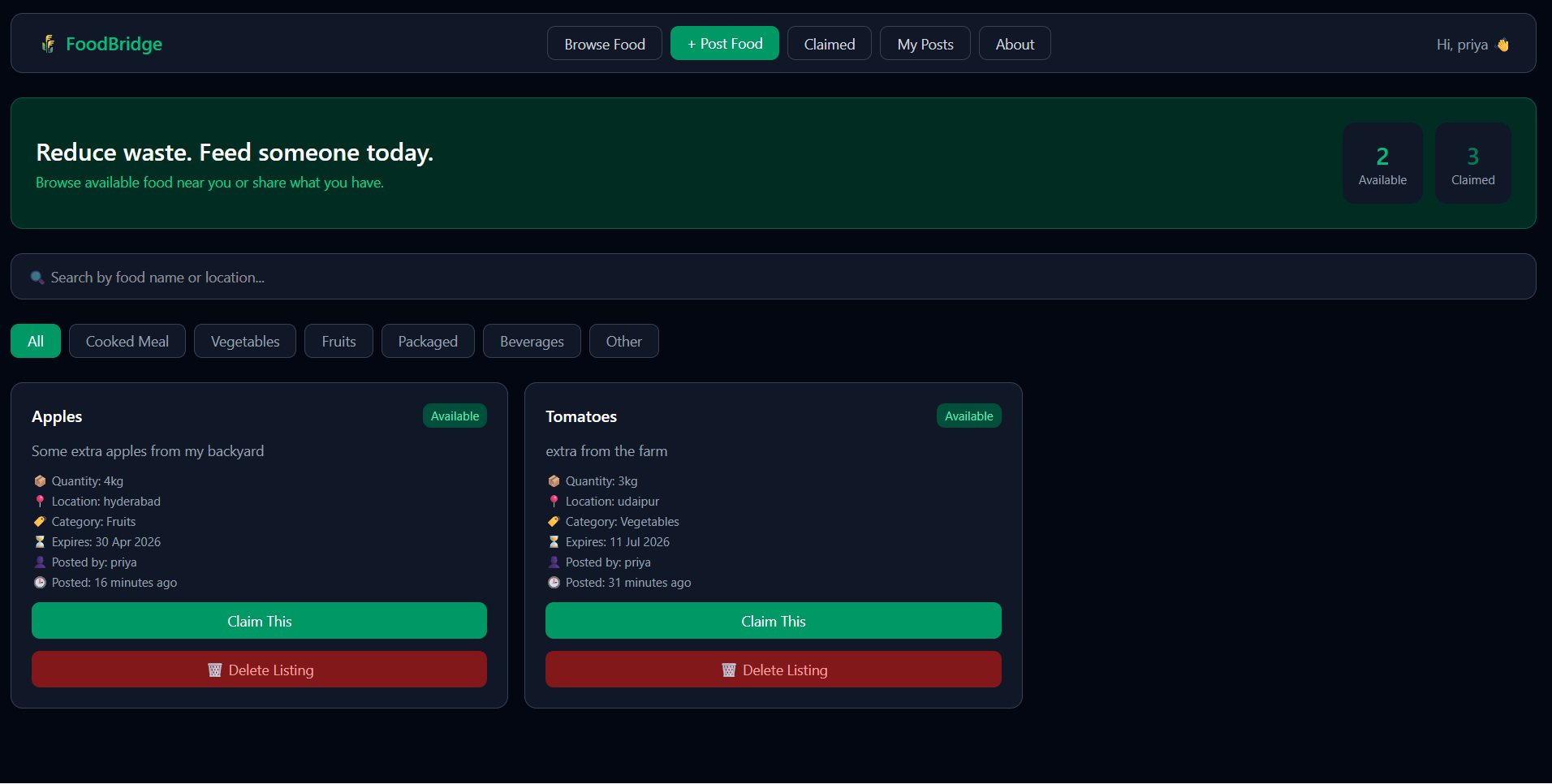
- Post surplus food they want to give away — cooked meals, vegetables, packaged goods and more
- Browse available food listings in their area
- Search by food name or location to find what's nearby
- Claim a listing to reserve it for pickup
- Track their own posts and claimed items
How we built it
FoodBridge is built using the MERN stack:
- MongoDB Atlas — cloud database to store all food listings
- Express.js — REST API backend with full CRUD operations
- React.js — dynamic frontend with React Router for navigation
- Node.js — server runtime environment
- Tailwind CSS — dark themed, responsive UI
- Axios — API communication between frontend and backend
- Day.js — relative time display ("Posted 2 hours ago")
- React Hot Toast — clean notification system
The backend is deployed on Render and the frontend on Vercel, making it completely free to run and scale.
Challenges we ran into
-CORS issues between the deployed frontend and backend — solved by configuring explicit allowed origins in Express
- Environment variables — learned the difference between Create React App
and Vite's approach to env variables (
process.envvsimport.meta.env) - Data consistency — fixing a bug where claimed listings disappeared from the database query, causing incorrect counts
- Ownership without auth — implementing a name-based identity system using
localStorageto allow users to manage their own listings without a full authentication system
Accomplishments that we're proud of
What we learned
- How to build and deploy a complete full stack MERN application from scratch
- How to design and implement a REST API with Express and Mongoose
- How to connect a React frontend to a Node.js backend using Axios
- How to deploy a full stack app for free using Render and Vercel
- How to use Tailwind CSS to build a clean, dark themed UI
- The importance of environment variables for managing different development and production configurations
What's next for FoodBridge
- JWT Authentication — secure user identity with real login/signup
- Map View — show nearby food listings on an interactive map
- Real-time notifications — notify users when food near them is posted
- Mobile App — React Native version for easier on-the-go access
- NGO Integration — allow verified NGOs to post and claim in bulk
- Expiry automation — auto-remove listings past their expiry date
Built With
- axios
- express.js
- javascript
- mongodb
- node.js
- react
- render
- tailwind
- vercel


Log in or sign up for Devpost to join the conversation.