-
-
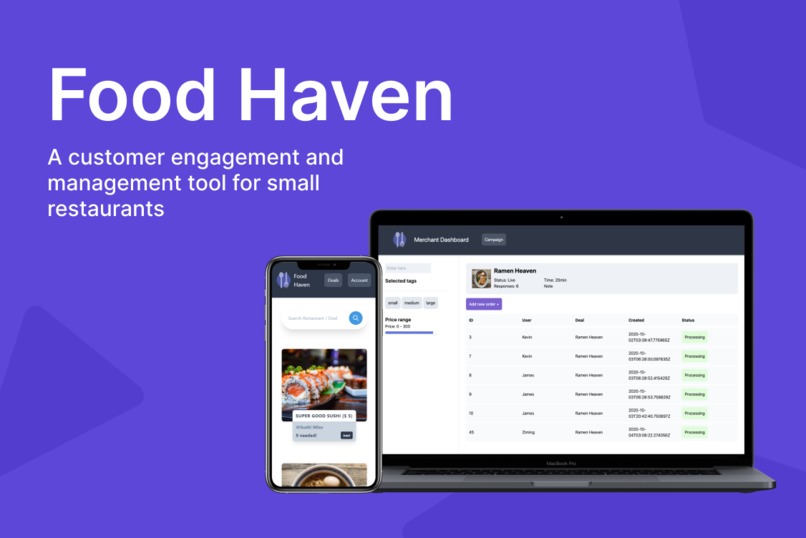
Food Haven!
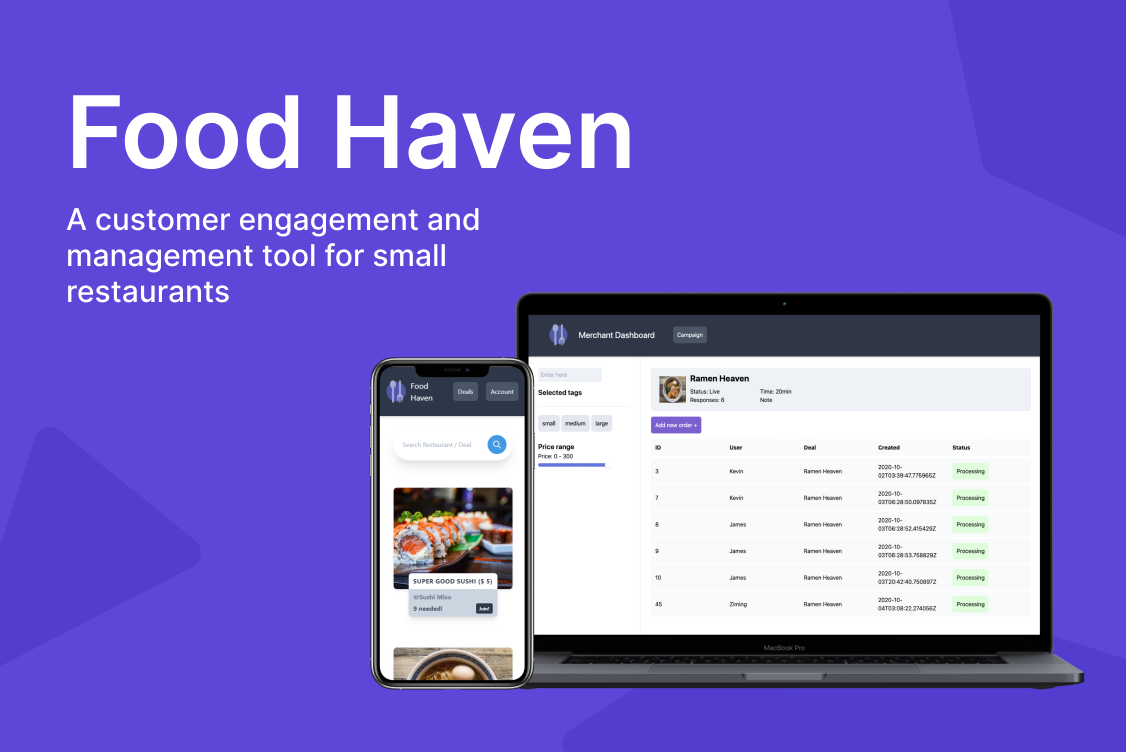
Inspiration
Unlike franchises and large restaurants, small businesses face a unique set of challenges during the pandemic. Since many aren't partnered with food delivering services, they lack an effective engagement way to engage with customers. Our app gets customers excited about new restaurants that they find, incentivizing them to share their finds throughout social media.
What it does
We built a light-weight food ordering and management system where restaurants create deals and bulk orders. Customers can only get a deal if a certain number of other customers also opt-in. For instance, a deal could be "the next 40 people who sign up for this deal get 20% off", incentivizing customers to purchase more. Opting-in to a deal does not require a payment and is simple with just a click of a button. Customers can then opt-out anytime before the deal is completed. Once enough customers opt-in, they will be automatically charged, receive a text message notification, and can choose between pickup and delivery options. Merchants will also be notified when their deal was completed, and will receive payment from their customers. We believe our light-weight and easy-access design encourages our users to continue returning to our app and finding new deals.
The pain points we wish to alleviate
- Small restaurants without a media outlet have a hard time getting publicity for special deals or offers that they have. Our app provides a platform that any restaurant can quickly sign up and gain publicity on.
- Delivery is expensive if customers were to order alone, such as Ubereats. Bulk orders helps reduce the cost of delivery, another incentive for customers to order through our app.
How we built it
We built the front-end mainly using React and Redux. Kevin and Ziming split up the work, one focusing on the merchant side dashboard and another creating the customer-side mobile app for users to browse and confirm deals. Michael built a robust back-end foundation using Python and Django. With the 2 front-facing interfaces and 1 backend, we were able to build a full-stack app that serves both customers and restaurants.
Challenges we ran into
We had a lot more ideas than we were able to implement, and it was super important for us to simplify the idea down to its core and present a viable MVP for our demo within the time frame. During this process, we needed to stay true to the exact pain point we're solving and focus on that.
Another big difficulty was combining the different components of our project together. We had 2 separate user facing interfaces with 1 backend linking both together, so it was a great challenge (and fun) to integrate all 3 into a cohesive system.
P.S. For some reason our backend went down within the last hour, so we had to modify some front-end as well as backend structure to get it to work. Pretty proud of that one.
Accomplishments that I'm proud of
Aside from our full-stack app, we're proud of our ability to work efficiently and smoothly (in different timezones!) for the past 3 days pulling this project altogether.
We're also super proud of the novel customer engagement method we came up with to pull businesses and customers closer, and we hope to continue exploring this area after IvyHacks.
What we learned
On the technical side, we learned how to integrate front-end with a back-end to form a cohesive system. We also learned tons about the challenges small business face and the restaurant management market.
What's next for Food Haven
Include account validation. Extend the app for other types of local businesses.





Log in or sign up for Devpost to join the conversation.