Inspiration
Most of what we learn still lives in places built for humans, not agents: podcasts, blog posts, talks, documentation, and newsletters. They’re full of useful techniques, but they aren’t skills an agent can pick up and apply to a specific codebase.
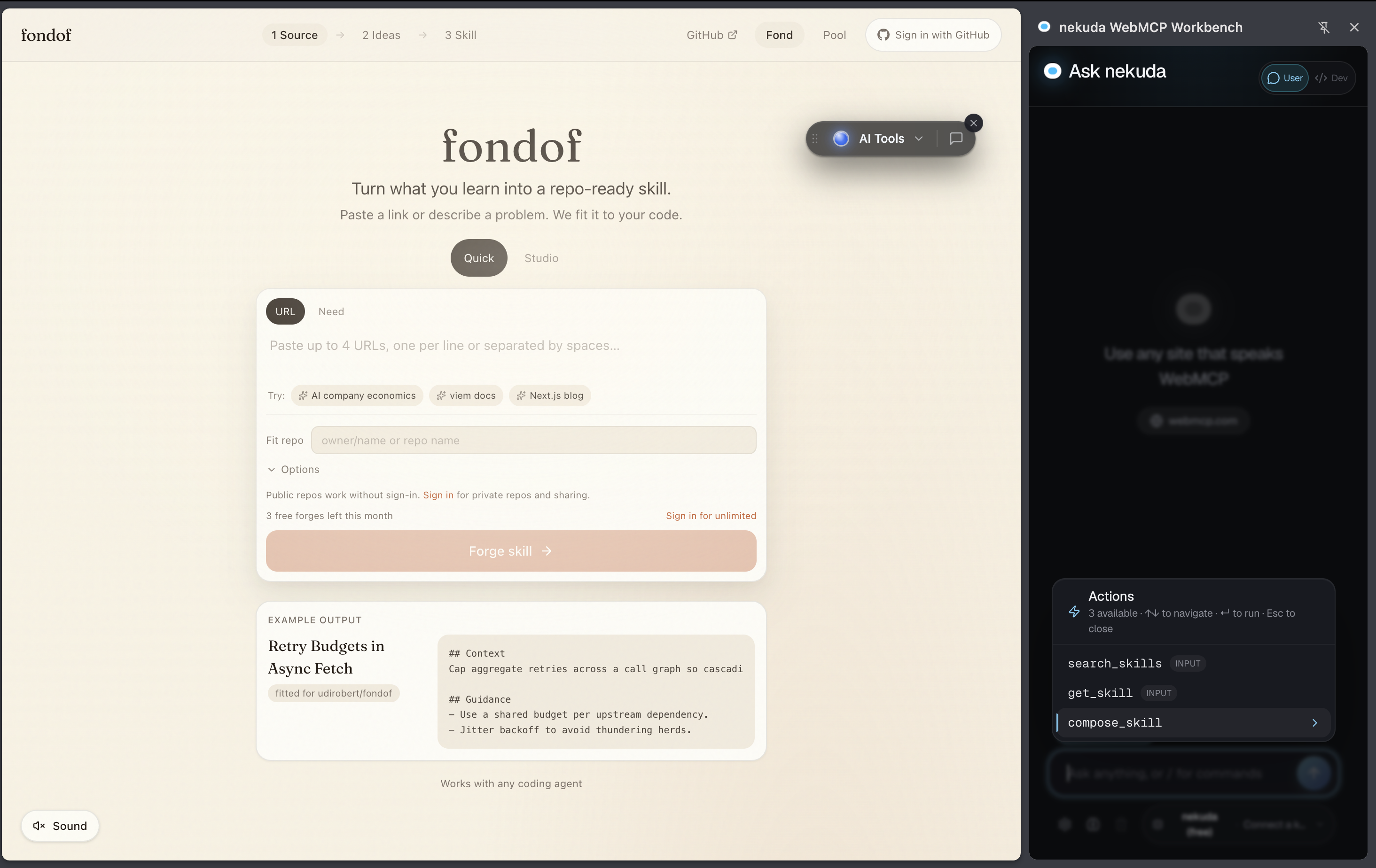
fondof gives that knowledge a second life. Give it a source URL, a stated need, or up to four sources, and it turns the underlying ideas into a concise, repo-specific skill—with attribution intact.
We also wanted to explore what an agent-native web actually feels like. With WebMCP, fondof exposes its capabilities directly to agents, so a user can stay in a conversation and say: “Find me a skill on React performance and forge one from this talk for my repo.”
What it does
fondof turns knowledge into agent-ready skills:
- Extract — pulls actionable ideas from articles, YouTube, docs, or free-text needs.
- Fit — matches those ideas to a target repo’s stack, conventions, and paths.
- Forge — creates a short, copyable skill for Cursor, Claude, Kiro, or any agent.
- Hand off — copies Markdown or creates a shareable
/s/{hash}link. - Attribute — preserves source attribution and optionally anchors provenance on Monad.
It exposes three WebMCP tools:
search_skills— search the public skill pool.get_skill— retrieve a skill by hash.compose_skill— forge a skill from URLs or a stated need.
Humans decide what they want; agents handle the extraction, discovery, composition, and formatting.
How we built it
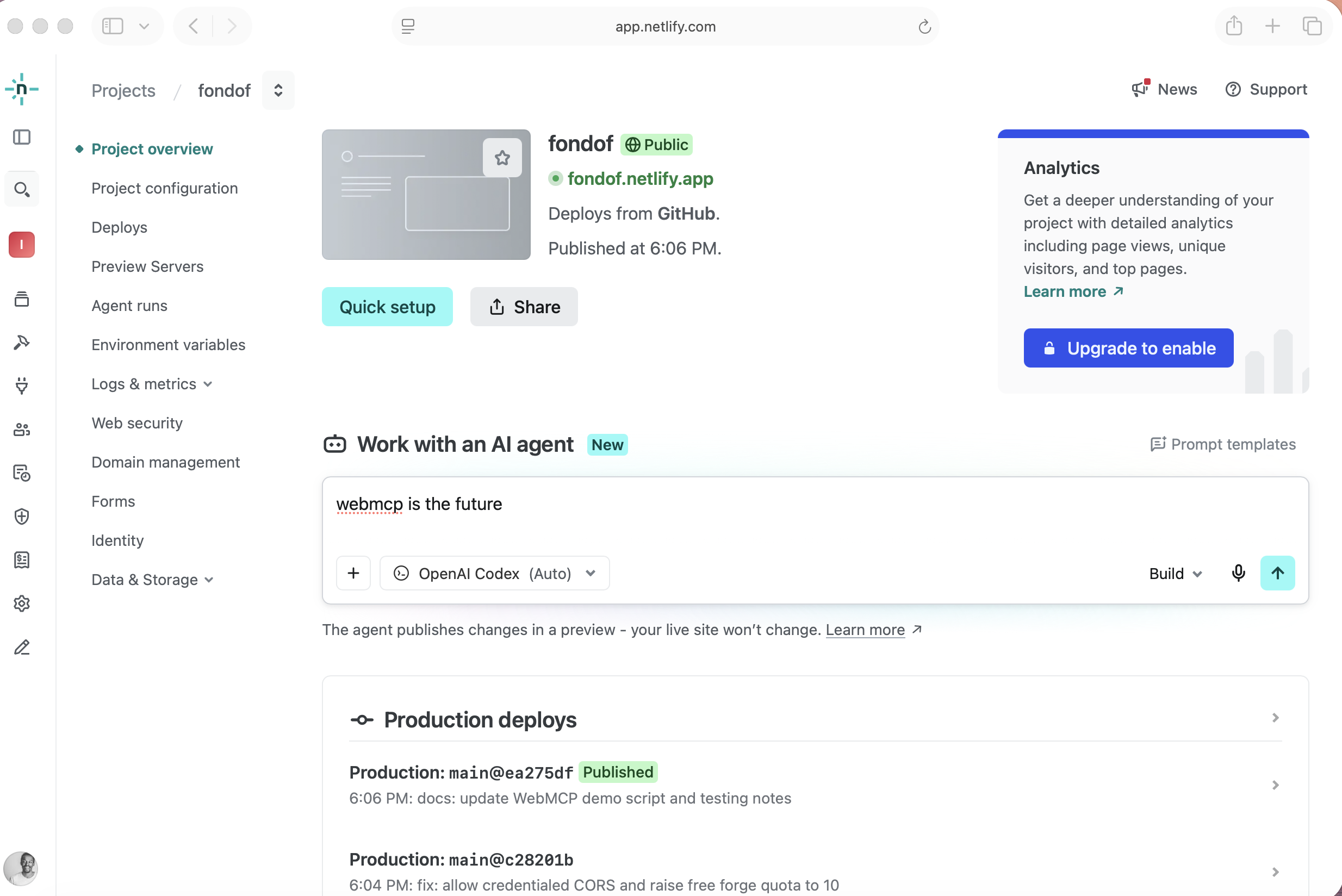
- Frontend: Next.js 16, Framer Motion, Tailwind, deployed on Netlify.
- API: Cloudflare Worker + Hono, with Durable Objects for coordination, KV for sessions, and Workers AI for LLM + embeddings.
- Ingestion: Firecrawl / Readability for articles and docs, YouTube transcripts, plus a local fallback for offline needs.
- Search & fit: Exa for semantic discovery, plus
/api/skills?q=for searching the public skill pool by topic, repo, stack, or source. - Blockchain: SkillPool on Monad testnet for optional public provenance.
- Agent layer:
webmcp-provider.tsxregisters the three tools;/.well-known/webmcpandPermissions-Policyenable discovery. - Monorepo: pnpm workspaces across
web,api,core,cli,contracts, andshared.
We also dogfooded the build process in Kiro with a spec-first trail mapping directly to the shipped code.
Challenges we ran into
- Multi-source composition: Combining up to four sources requires deduplication, merging, progress tracking, and partial-failure handling without losing the whole batch.
- Agent UX: WebMCP tools need to tell an agent not just what they do, but when to use them, what inputs they need, and how to recover from failures.
- Attribution without friction: We wanted every skill traceable to its sources without requiring wallets or sign-in for the happy path.
- Honest failures: Instead of silently swallowing bad URLs, the Studio surfaces ingest errors and
compose_skillreturns structuredsource_failures.
Accomplishments that we're proud of
- A real, deployed WebMCP implementation with three working tools, a
/.well-known/webmcpmanifest, and the correct permissions configuration. - Multi-source skill composition across up to four URLs, with per-source progress and failure reporting.
- A public skill pool with search, source-domain pages, and shareable skill pages.
- Agent discovery, retrieval, and creation as one continuous workflow.
- Honest degradation when ingestion fails, fallbacks are used, or the chain is unavailable.
- Open source and tested: MIT licensed, with 209 passing tests and a live Cloudflare Worker.
What we learned
- The browser can be the integration layer. WebMCP lets the site expose its capabilities directly to agents, without requiring a custom MCP server or separate API key.
- Search is essential for agent-native apps. If an agent can’t find an existing skill, it will re-forge what already exists.
- Attribution can become a network primitive. Sources produce skills, skills get reused and re-forged, and outcomes can eventually feed back into the pool.
- Humans + agents work best as a loop: the human decides, the agent discovers and composes, and the human stays in control.
What's next for fondof
- Creator analytics so authors can see which content became skills and where those skills were used.
- Knowledge clusters to turn the skill pool into a map of related sources, ideas, and re-forges.
- Outcome verification using PRs, screenshots, and repo deltas to measure real-world usefulness.
- Agent-to-agent challenges for contesting and re-forging skills with transparent evidence.
- A lightweight reward layer for creators and high-quality forgers, tied to usage and verified outcomes.
Built With
- cloudflare-workers
- exa
- foundry
- framer-motion
- hono
- monad
- netlify
- next.js
- react
- tailwind-css
- typescript
- viem
- wagmi
- webmcp
- workers-ai

Log in or sign up for Devpost to join the conversation.