-
-
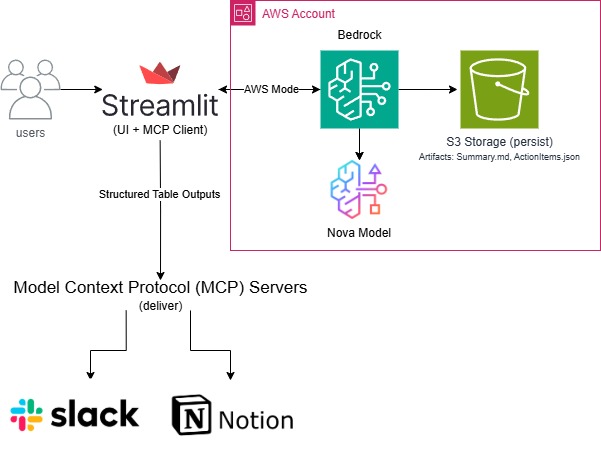
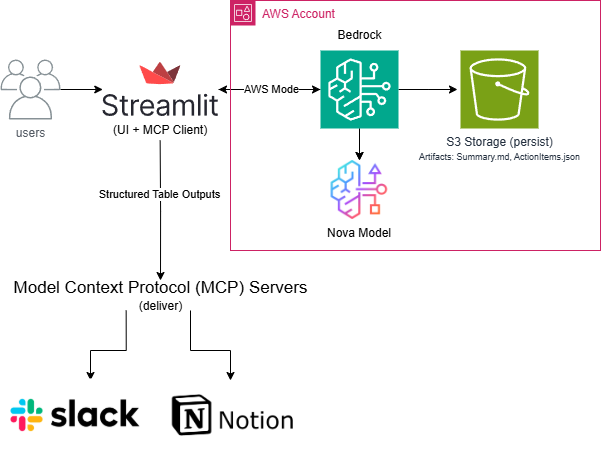
Architecture Diagram: FollowUpSync uses AWS Bedrock Nova Micro, S3, and MCP servers for autonomous integration with Slack and Notion.
Inspiration
Have you ever sat through a long meeting where decisions are made, tasks are assigned, but then... nothing happens? Action items disappear into email threads, deadlines get forgotten, and accountability vanishes.
Research shows that $37 billion is lost annually in the US alone due to ineffective meeting, and much of that ties to poor follow-ups. I wanted to solve this universal problem using cutting-edge AWS AI technology to create an autonomous system that ensures no action item ever gets lost again.
What it does
FollowUpSync is an AI-powered meeting follow-up automation system that transforms unstructured meeting transcripts into actionable tasks. The system uses Amazon Bedrock Nova Micro to intelligently extract decisions, action items with owners and due dates, and risk assessments, then automatically pushes them to Slack and Notion via Model Context Protocol (MCP) agents.
Key Features
- Intelligent Extraction: Nova Micro parses natural language dates ("next Tuesday" → "October 28th") and identifies task ownership
- Multi-Platform Delivery: FastAPI MCP servers autonomously post to Slack channels and create Notion database entries
- Artifact Generation: Automatically generates and stores structured meeting summary reports in S3
- Dual Mode Operation: Local testing mode and AWS Bedrock integration
How I built it
Built as a pipeline where users upload meeting transcripts through a Streamlit interface, Amazon Bedrock Nova Micro processes the text to extract structured data (decisions, action items, risks), then autonomous MCP agents deliver the results to Slack and Notion while storing summary artifacts in S3.
Technology Stack:
- Amazon Bedrock Nova Micro for intelligent text processing
- FastAPI MCP servers for platform integrations
- Streamlit for user interface
- Amazon S3 for artifact storage
- Python with JSON parsing and HTTP requests
Challenges I ran into
Challenge 1: MCP Server Architecture
Problem: Designing FastAPI servers that run independently while maintaining clean communication.
Solution: Created modular MCP servers with standardized endpoints and error handling for reliable integrations.
Challenge 2: Multi-Platform Authentication
Problem: Managing Slack OAuth tokens, Notion integration tokens, and AWS credentials across environments.
Solution: Implemented secure environment-based configuration with validation methods and graceful fallbacks.
Challenge 3: Date Intelligence
Problem: Getting Nova Micro to consistently parse relative dates ("next Friday", "end of month").
Solution: Built custom date parsing logic that converts relative phrases ("next Friday", "end of month") into specific YYYY-MM-DD dates using current date calculations.
Accomplishments that I am proud of
Results:
- Processing Speed: < 30 seconds from transcript to delivered tasks
- Successful Integration: Reliable delivery to Slack and Notion
- Time Savings: Significant reduction in manual follow-up work
- Automation: End-to-end pipeline from transcript to action items
Business Impact Analysis:
For a small team of 5 developers with 1 meeting per week:
- Time saved per meeting: 15 minutes of manual follow-up work
- Annual time savings: ~65 hours (5 people × 1 meeting/week × 0.25 hours × 52 weeks)
- Estimated value: $4,225-$6,500+ annually (at $65-$100/hour developer rate)
Key Benefits:
- Eliminate lost action items and missed deadlines
- Reduce manual administrative overhead
- Improve task completion rates through automated tracking
- Streamline communication across multiple platforms
What I learned
This project taught me how AWS's latest AI models can be combined with modern integration patterns to build real, scalable solutions:
1. MCP Architecture Benefits
Model Context Protocol provides:
- Clean abstraction for AI agent integrations
- Scalable server architecture for multiple platforms
- Standardized communication patterns
2. AWS SDK Integration
- Bedrock API usage with proper error handling
- S3 integration for artifact persistence
3. Real-world AI Applications
Moving beyond demos to solve actual business problems with measurable ROI.
What's next for FollowUpSync
Immediate Roadmap:
- Jira Integration: Complete the productivity tool ecosystem
- Lambda Deployment: Serverless scaling for enterprise use
- Advanced Risk Assessment: ML-powered severity classification
Long-term Goals:
- Multi-language Support: Global team collaboration
- Voice Integration: Real-time meeting processing
- Analytics Dashboard: Meeting effectiveness insights
Links
Live Demo: followupsync.streamlit.app
Video Demo: 3-minute walkthrough
Source Code: GitHub Repository
Hackathon Requirements Met
- AWS AI Agent: Uses Amazon Bedrock Nova Micro via boto3 SDK
- Autonomous Capabilities: Independent multi-platform delivery
- External Integrations: MCP FastAPI servers for Slack and Notion
- Reasoning LLM: Complex date parsing and task categorization
- Public Repository: Complete source code with documentation
- Deployed Project: Live Streamlit Cloud deployment
FollowUpSync demonstrates how AWS AI services can be combined with modern integration patterns to automate common workflow challenges. This hackathon project showcases the potential of AI agents in solving real productivity problems.
Built With
- amazon-web-services
- bedrock
- boto3
- fastapi
- json
- mcp
- notion
- oauth
- python
- rest
- s3
- slack
- streamlit


Log in or sign up for Devpost to join the conversation.