-
-
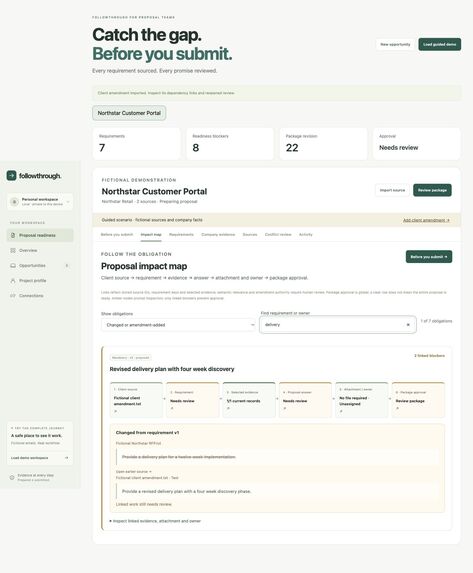
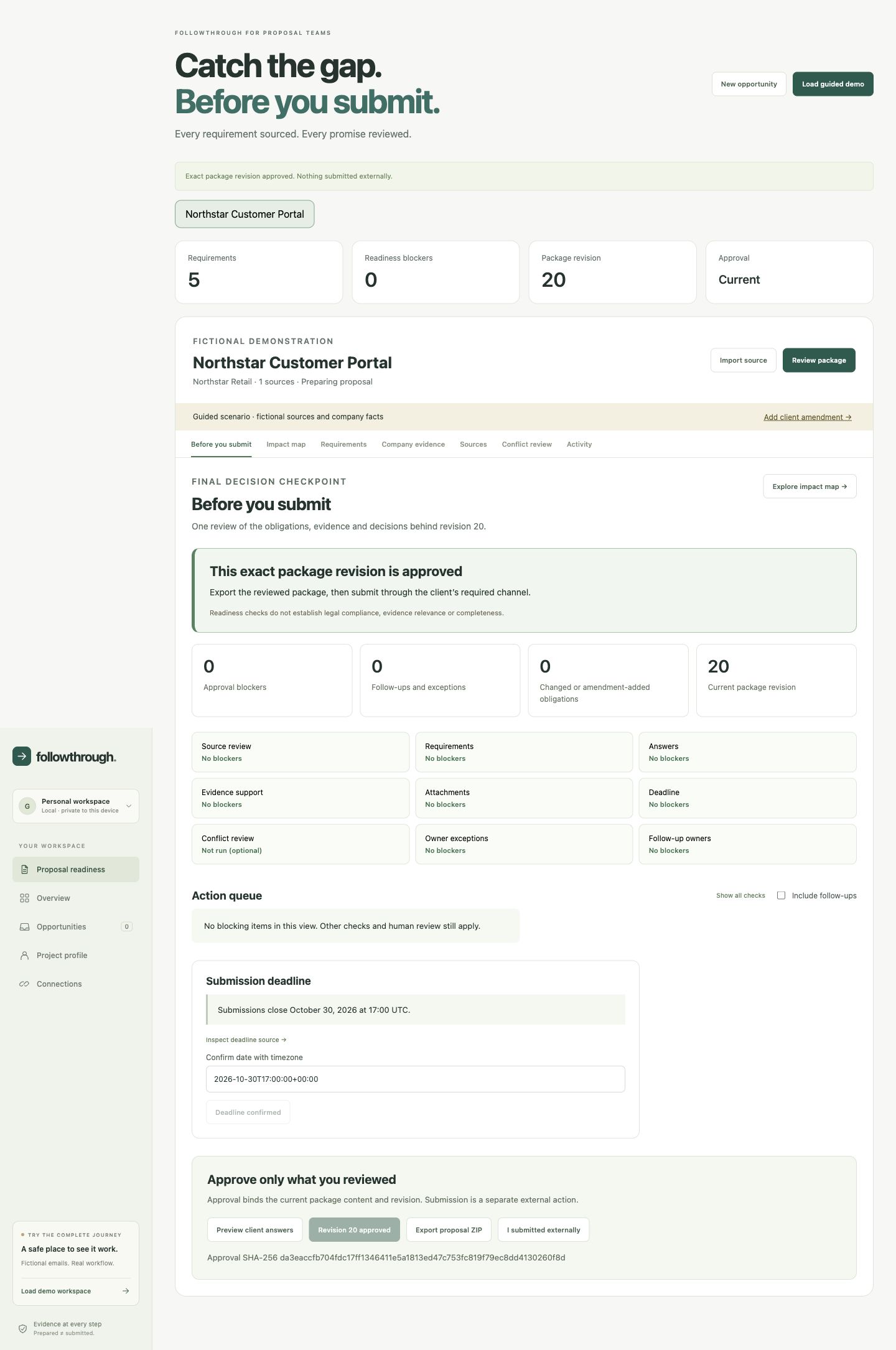
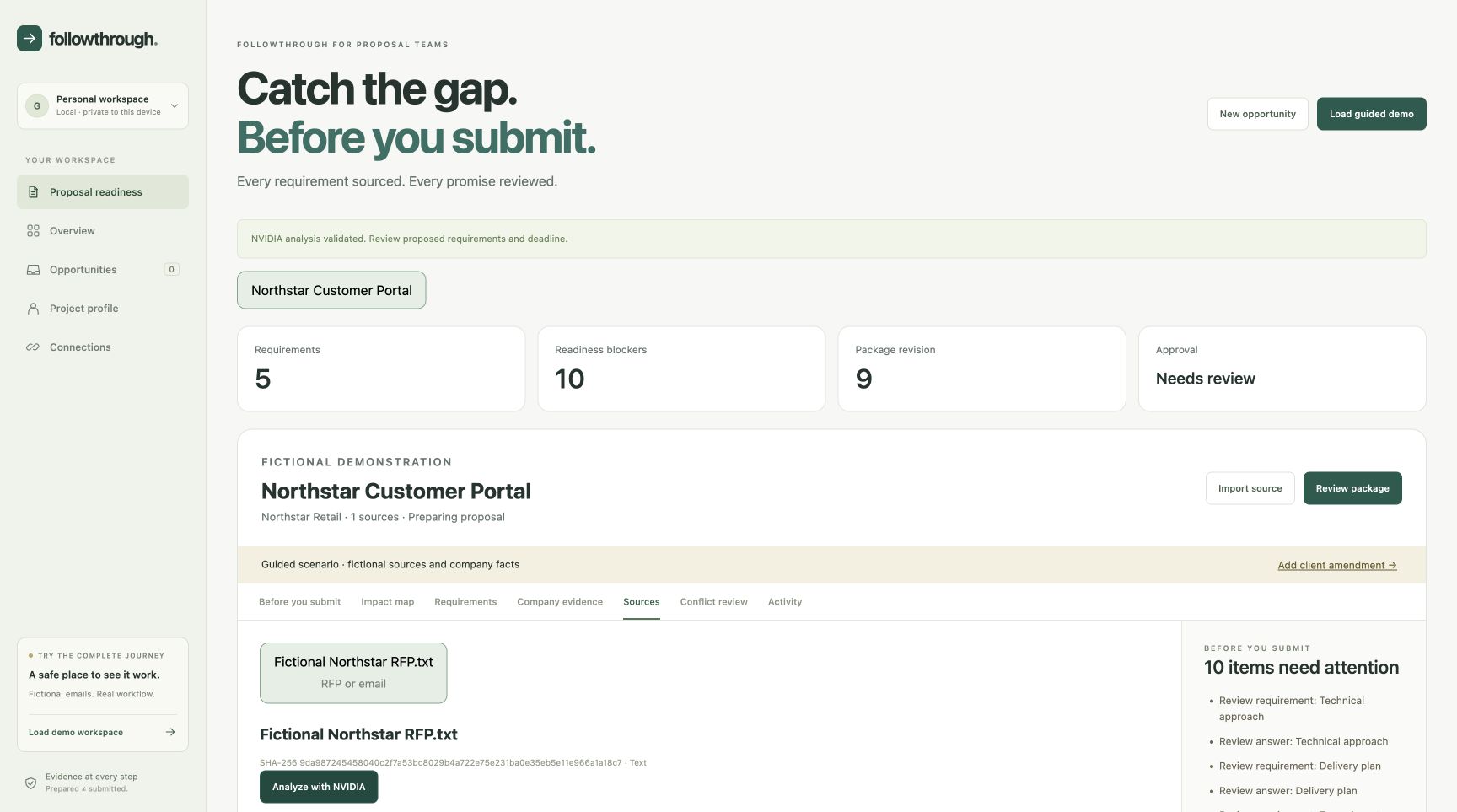
Actual FollowThrough application capture with fictional Northstar client data. Human review controls approval.
-
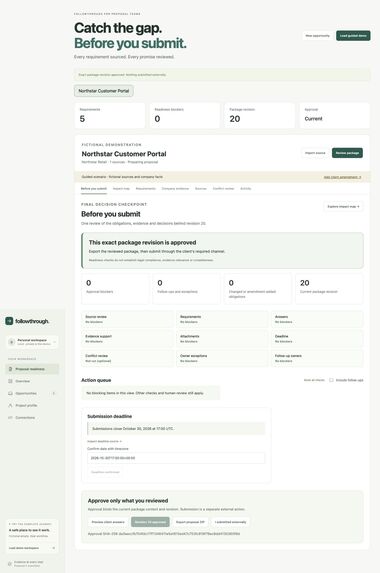
Actual FollowThrough application capture with fictional Northstar client data. Human review controls approval.
-
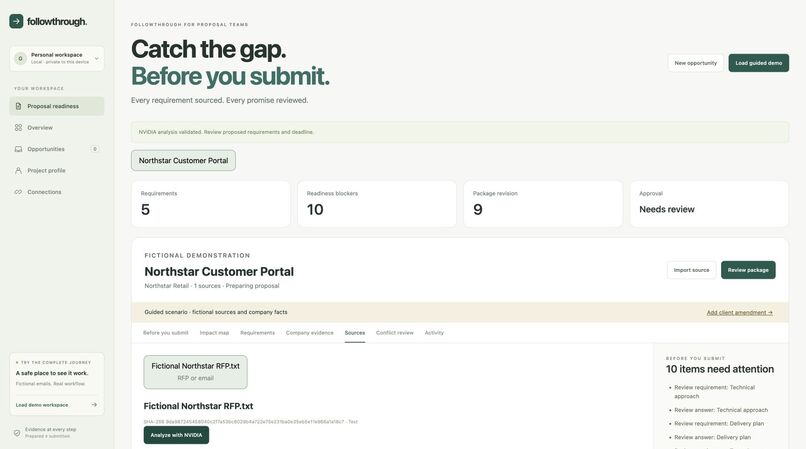
Actual FollowThrough application capture with fictional Northstar client data. Human review controls approval.
Inspiration
Small software agencies reconcile RFPs, clarification emails, company evidence and client amendments manually. A proposal can look finished while containing an outdated delivery promise, an unsupported certification claim or a missing attachment. FollowThrough is a review workspace for the person accountable for the final package.
What it does
Import selected PDF, DOCX or text sources. NVIDIA Nemotron proposes requirements and deadlines with source quotations. Approved company evidence supplies conservative draft excerpts; the owner reviews relevance and meaning. Before you submit groups blockers into requirements, answers, evidence, attachments, deadlines and optional conflict review.
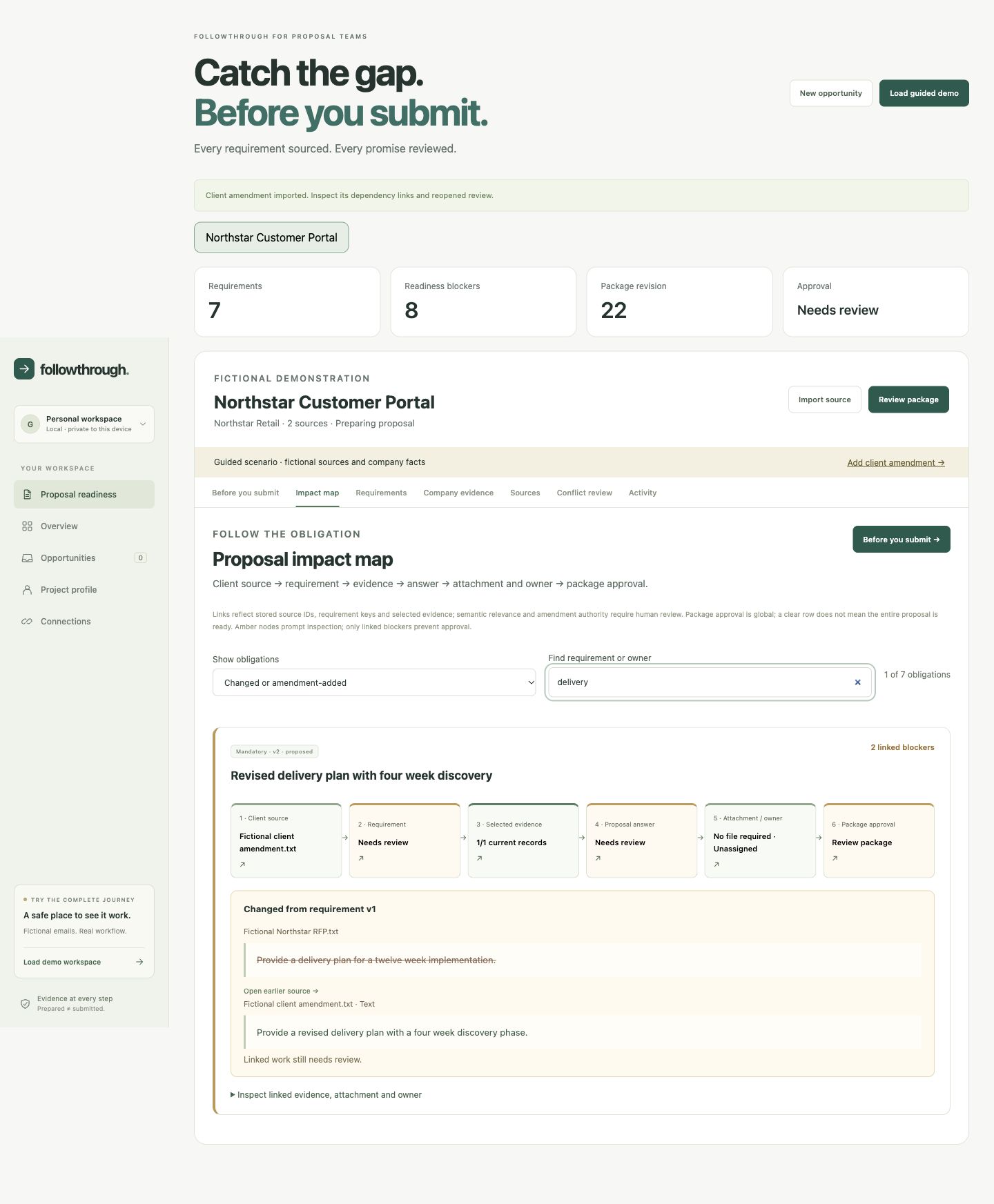
When a client amendment changes an obligation, the impact map connects source → requirement → evidence → answer → attachment/owner → package approval. Affected answers need fresh review and previous approval becomes stale. Approval binds an exact revision and content hash. Export produces a client-facing DOCX, original attachments and separate internal review material. Export, external submission, receipt evidence and client acknowledgement are different states.
How we use Nebius and NVIDIA
The full Python application makes runtime calls to Nebius Token Factory:
- NVIDIA Nemotron 3 Nano extracts source-linked requirements and assesses evidence relevance.
- Qwen3 Embedding 8B shortlists approved, unexpired evidence passages.
- NVIDIA Nemotron 3.5 Super VL transcribes scanned pages, requiring human comparison and correction before analysis.
- NVIDIA Nemotron 3 Super performs optional cited conflict review. Unresolved findings and outdated reviews block approval/export once that review is used.
The model proposes; deterministic code controls exact quote anchoring, revision safety, evidence checks, approval and export. Failed live calls never fall back to fixtures. The documented dedicated Qwen reranker returned 404 on our account, so relevance assessment explicitly uses NVIDIA chat instead.
How we built it
React/TypeScript and Vite, FastAPI, SQLite transactions, strict Pydantic schemas and bounded document parsers. The app is standalone and MIT licensed. An optional judge launcher adds invitation-gated HTTPS access, secure cookies, expiry and a persistent outbound-request allowance; it is implemented and tested but not hosted. No personal credentials are published.
Challenges and lessons
Early model responses contained extra fields, truncated JSON and incorrect character offsets. We requested structured output, disabled unnecessary thinking for Nano extraction and moved citation-offset calculation into code. Unknown or ambiguous quotations fail closed. A new precision guard withholds a proposed deadline timestamp when its quote lacks explicit year, time or timezone. This checks precision, not correct semantic interpretation; a person still confirms the deadline.
A candidate prompt produced more false positives and was rejected. Both runs, outputs and failures are public. More models or agents are not substitutes for evidence and human review.
Validation and accomplishments
Nineteen standalone automated checks passed, along with the frontend build. Tests exercise actual SQLite state, HTTP integration, stale revisions, invitation/expiry boundaries and persistent counting of failed/retried provider attempts.
On 16 author-labelled synthetic development cases, the retained prompt passed 12 complete cases, matching 18/20 labelled requirements with 18/19 labelled precision. All 19 predicted requirement quotations were source-locatable. Applying the deterministic deadline guard to those same saved outputs yields 14/16 complete cases and 16/16 deadline checks. Remaining errors include a mandatory amendment marked optional and an omitted optional attachment. These are small development observations, not held-out, independent or production accuracy. Quote validity does not establish semantic correctness. Median extraction latency in this run was 1,155 ms; actual currency cost was not measured.
Try it and understand the limits
Working test build: https://github.com/gowtham66867/followthrough/releases/tag/v0.5.0 — Python 3.11+, setup instructions and built frontend included. The guided fictional workflow runs offline; live inference requires a configured Nebius key. No free hosted live inference endpoint is provided.
Public browser walkthrough: https://gowtham66867.github.io/followthrough/ — entirely prewritten fictional results, no live AI calls, no uploads or sign-in, and state resets on refresh. It demonstrates the workflow and must not be mistaken for a hosted AI backend.
Judge guide and raw results: linked in the repository and public walkthrough. The release also contains an updated 2:24 narrated montage of actual application captures. The submission video is the updated 2:24 v0.5 narrated montage, with live-inference captures, the impact map, reopened approval and evaluation limits. It is not a continuous screen recording.
This is a single-owner prototype, not a multi-tenant production service or a legal-compliance guarantee. Gmail OAuth is optional and unverified with customer credentials. Receipt authenticity is not independently verified. No real client documents are included. No customer time savings, revenue or contract-win improvements have been measured.
What's next
Permissioned agency pilots, independently labelled evaluation, stronger semantic-retrieval measurement and restricted live judge hosting. A pilot protocol is included, but no customer results have been invented. All demonstrated work and updates were built during the hackathon submission period.
