-
-
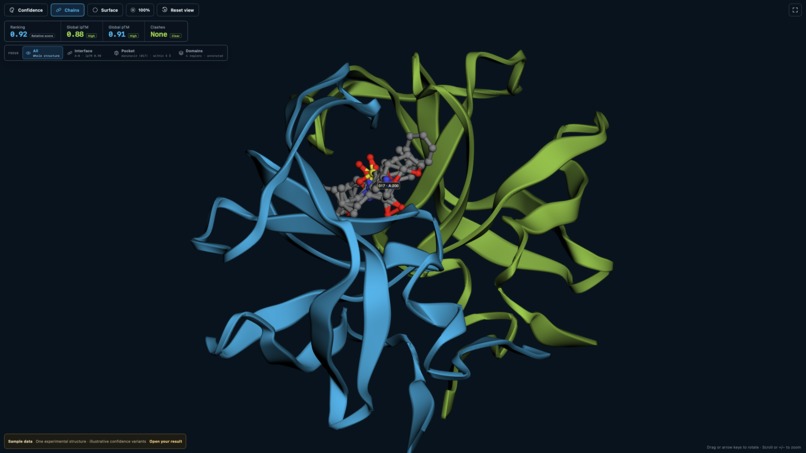
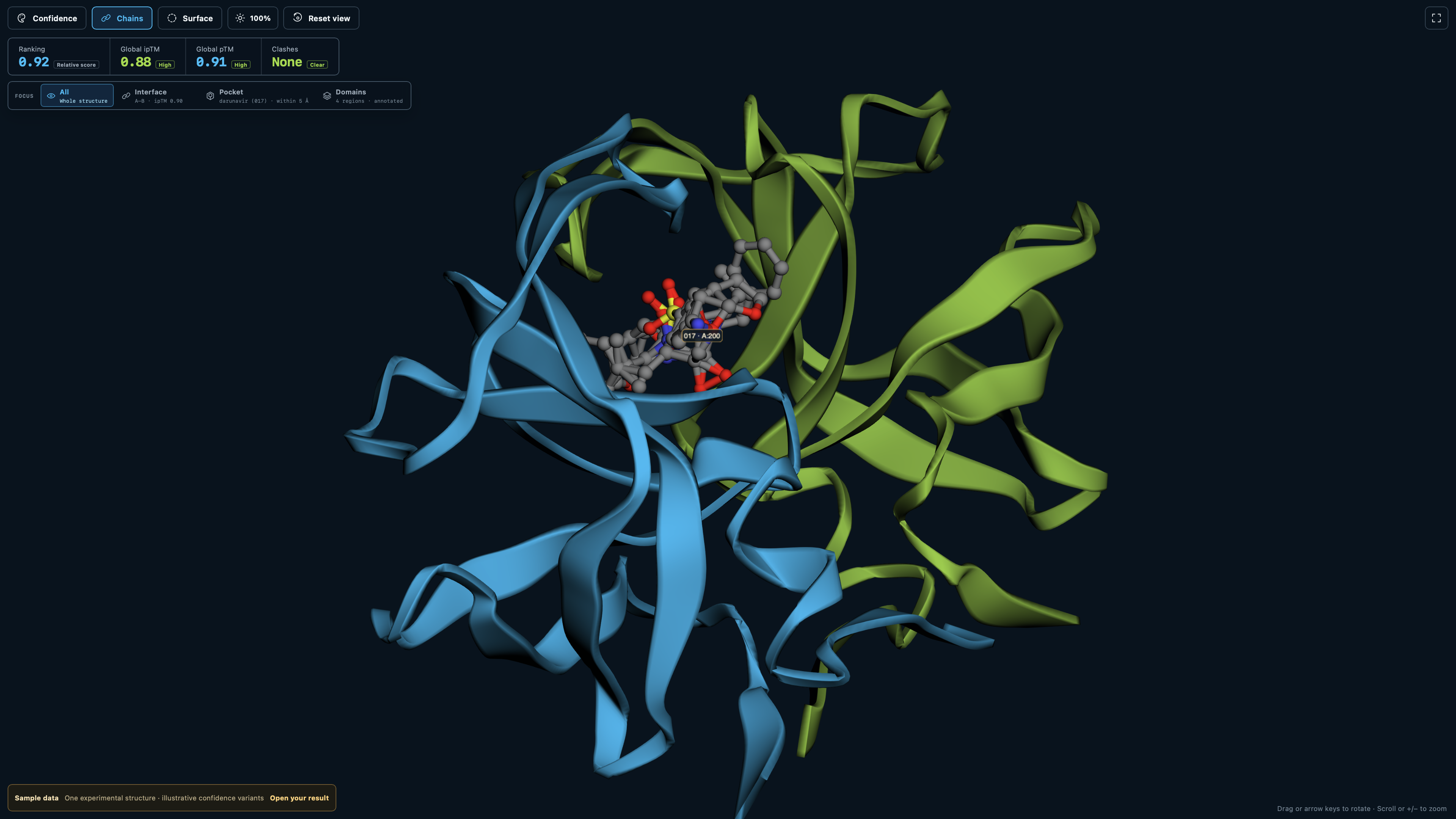
3D Structure
Inspiration
AlphaFold 3 produces rich structural and confidence outputs, but reviewing them still involves switching between a downloaded result folder, a molecular viewer, summary JSON files, and a separate predicted aligned error (PAE) plot.
The challenge is not only displaying those files. Researchers must keep every interpretation tied to the correct prediction model, chain pair, residue range, confidence metric, and scientific caveat. FoldLens was created to turn that fragmented review process into one coherent, evidence-linked workflow.
What it does
FoldLens opens an AlphaFold 3 ZIP, result folder, .cif/.mmcif structure, or matching confidence JSON files directly in the browser. It automatically matches prediction samples with their confidence data, renders the molecular structure, and lets users compare ranking score, ipTM, pTM, and clash status across models.
Users can rotate and inspect the 3D structure, switch between chain and confidence coloring, enable molecular surfaces, focus on interfaces or predicted regions, and explore the PAE heatmap without losing model context.
Selecting a PAE region links the matrix selection to the corresponding chains and residue ranges in the 3D workspace.
Ask FoldLens converts the active prediction and selection into a compact deterministic fact set. GPT-5.6 receives only those facts and returns a concise, schema-validated interpretation with evidence actions such as Show interface or Show residues.
Raw CIF and JSON files, atomic coordinates, and sequences are not uploaded to the server. If live GPT-5.6 analysis is unavailable, FoldLens returns a deterministic local confidence brief using the same response structure and labels the fallback clearly.
No account or installation is required to try the public demo.
How we built it
FoldLens uses React, TypeScript, Vite, Express, 3Dmol.js, fflate, Zod, and the OpenAI Responses API.
File parsing, sample matching, molecular visualization, and PAE interaction run locally in the browser. The browser derives a schema-limited AnalysisFacts object containing only the confidence metrics, chain IDs, residue ranges, PAE summaries, and notices currently visible in the workspace.
The Express API keeps the OpenAI API key server-side, validates request sizes and shapes, rate-limits the public demo, and uses Zod Structured Outputs to validate GPT-5.6 responses before they reach the interface.
Vercel serves the public frontend and same-origin proxy endpoints. Render hosts the Express backend and OpenAI integration, keeping the API key out of the browser and the public Vercel environment.
The bundled sample uses the experimental PDB structure 1NVV. Its confidence values are illustrative and are labeled as sample data throughout the interface.
How we used Codex and GPT-5.6
Codex was our iterative engineering and product-design partner throughout the project. It helped turn usability audits into working product flows, implement and test the AlphaFold file matcher and PAE interactions, compare design concepts with the rendered application, and expand regression coverage around scientific edge cases.
Codex also helped investigate responsive layout issues, improve evidence-linked actions, validate desktop and mobile workflows, and prepare the application for public deployment through GitHub, Vercel, and Render.
GPT-5.6 powers FoldLens’s constrained interpretation layer. It receives only deterministic facts derived from the active prediction and PAE selection. Its schema-validated responses must ground evidence in the supplied confidence metrics, chains, and residue ranges.
The key human decisions were to keep raw scientific files local, make every AI statement traceable to visible evidence, label illustrative sample data explicitly, and prefer honest scientific limitations over unsupported biological conclusions.
Challenges we ran into
- Reconciling several AlphaFold output naming layouts without mixing prediction models or duplicated files.
- Mapping PAE matrix indices back to the correct chains and residue ranges.
- Keeping the 3D structure, confidence metrics, model selection, and PAE state synchronized.
- Preserving responsive molecular and heatmap interactions across desktop and mobile layouts.
- Making an AI explanation useful without allowing unsupported biological, therapeutic, or experimental claims.
- Building an honest demonstration from an experimental PDB structure while clearly separating it from illustrative confidence values.
- Keeping the OpenAI API key secure while providing a no-account public demo.
Accomplishments that we're proud of
- A polished local-first workflow from AlphaFold result import to evidence-linked interpretation.
- Automatic matching of structures, summary confidence files, and full PAE data.
- Interactive links between PAE selections, chains, residue ranges, and the 3D structure.
- Strict separation between raw scientific files, deterministic facts, and GPT-5.6 output.
- Schema-validated AI evidence actions that reference only supplied scientific facts.
- An explicit deterministic fallback instead of hiding API or validation failures.
- A no-account public demo with live GPT-5.6 analysis.
- 40 automated tests covering parsing, confidence analysis, exports, core UI, rate limiting, and safe API fallback behavior.
- Desktop and mobile layouts that preserve the same scientific review loop.
What we learned
In scientific tools, the highest-value AI behavior is often not generating more conclusions. It is shortening the path from a question to the exact evidence, uncertainty, and caveat that should be inspected next.
Constrained AI can be more useful than an open-ended chatbot when its inputs are deterministic, its outputs are validated, and every action remains connected to visible evidence.
We also learned that privacy and usability can reinforce each other. Keeping raw scientific files in the browser reduces unnecessary data transfer while making the boundary between source evidence and AI interpretation easier to understand.
What's next for FoldLens
- Bidirectional residue-level synchronization between PAE selections and direct 3D picks.
- Native
.zstdecompression for compressed AlphaFold outputs. - Side-by-side structural alignment metrics across prediction samples.
- Shareable review annotations that remain separate from source result files.
- Additional evidence adapters for experimentally validated annotations.
- Persistent team review sessions with explicit provenance for every comment and AI-generated interpretation.
Built With
- 3dmol.js
- alphafold3
- codex
- gpt-5.6
- react
- render
- typescript
- vercel


Log in or sign up for Devpost to join the conversation.