-
-
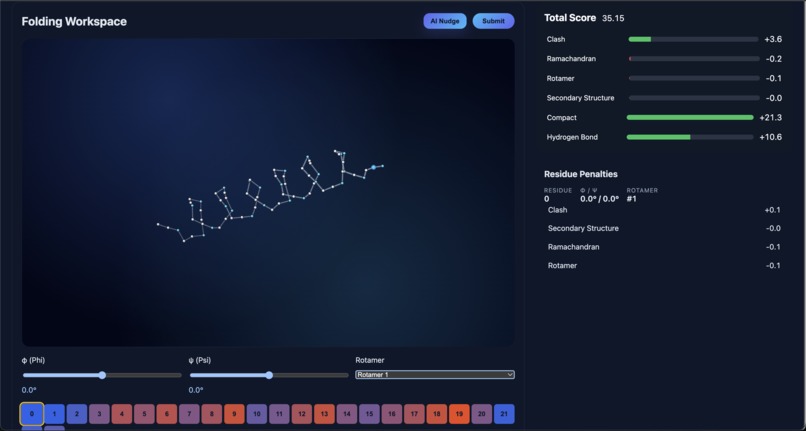
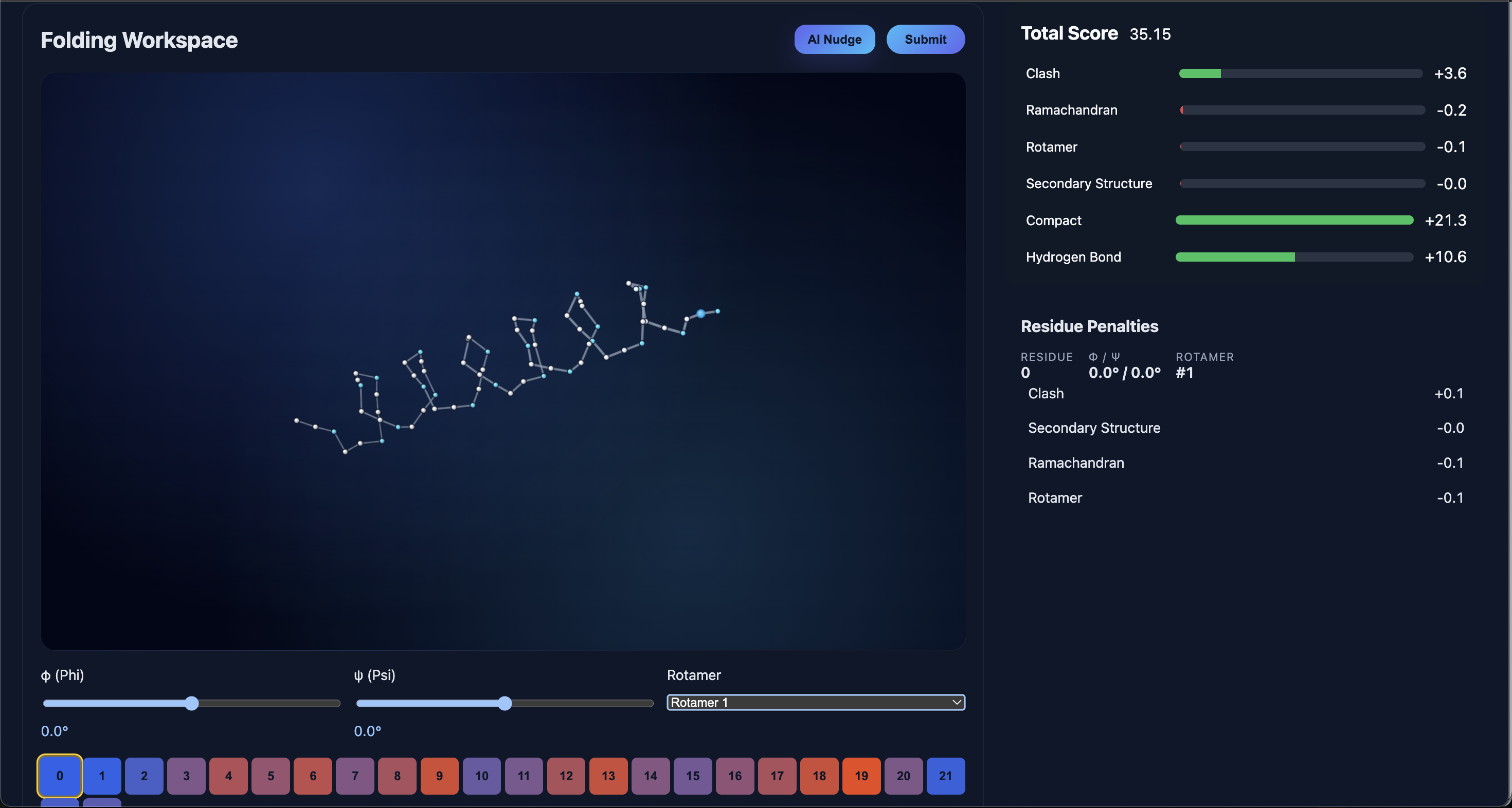
Where you play around with angles for protein folding!
-
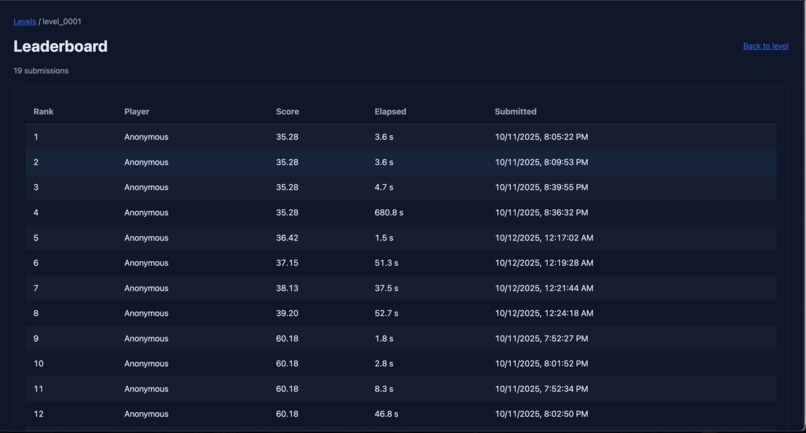
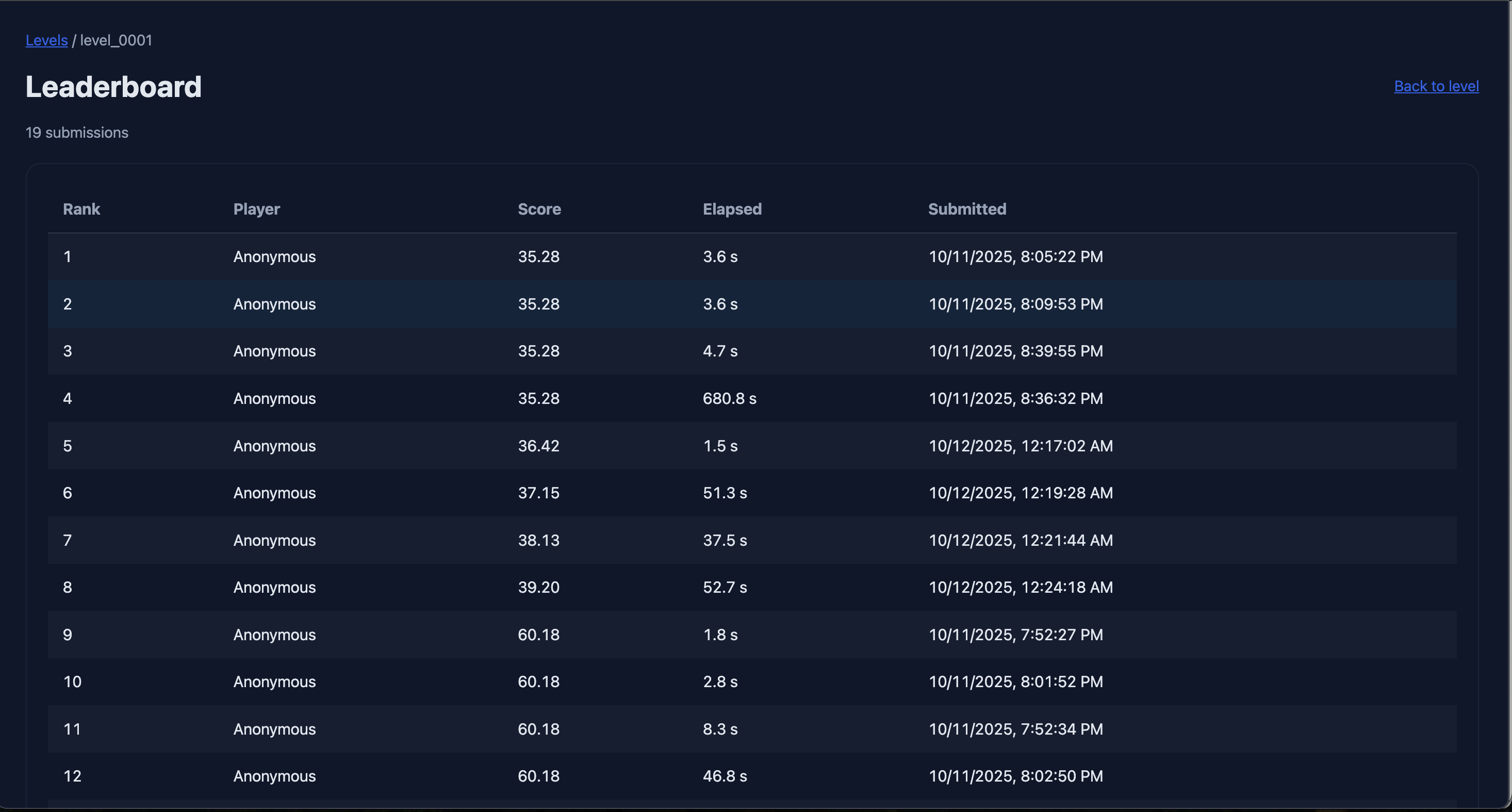
Leaderboard for lowest (best) score
-
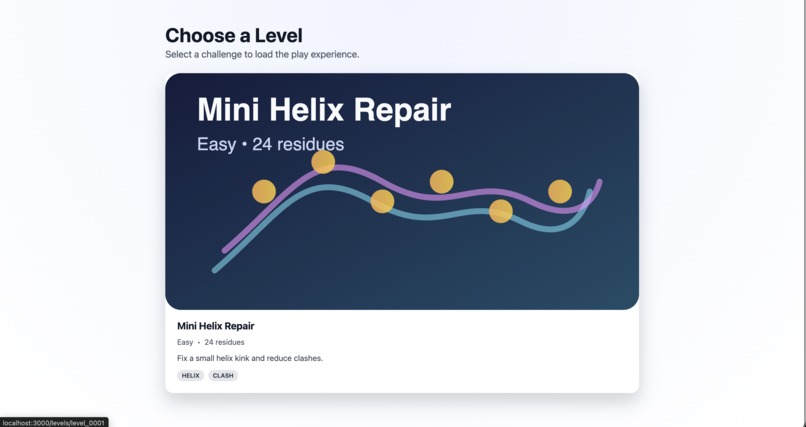
Level selection

Inspiration
FoldIt showed how crowdsourcing and gamification could advance science — I wanted to reimagine that concept with modern AI and web tech, making protein folding more interactive, educational, and ML-driven.
What it does
FoldForge lets users visualize and manipulate protein structures in 3D, edit torsion angles (φ, ψ, χ), and receive real-time feedback from physics-based scoring and ML models that predict optimal folding states.
How we built it
Built with Next.js, TypeScript, and Three.js for 3D visualization. Backend powered by FastAPI to handle protein coordinate parsing, scoring functions, and ML inference. I implemented per-residue scoring, rotamer analysis, and local recomputation for fast updates after edits.
Challenges we ran into
Getting protein geometry updates to reflect φ/ψ/χ edits in real time was complex. Integrating machine learning predictions with live rendering and ensuring numerical stability in bond angles required deep debugging and optimization.
Accomplishments that we're proud of
I built a fully functional FoldIt-style interface from scratch, complete with live backbone editing, ML-guided folding, and accurate biophysical scoring — all within a web browser. It merges science, interactivity, and AI in a single tool.
What we learned
I deepened my understanding of protein geometry, molecular coordinate systems, and how ML can augment human intuition in complex biophysical problems. I also learned how to connect scientific computation with modern frontend frameworks.
What's next for FoldForge
Next, I plan to add AlphaFold-style embeddings, real-time energy landscape visualization, and a community leaderboard to crowdsource optimal folds — turning FoldForge into a modern, open platform for interactive protein design.
Built With
- and-next.js-(react)-on-the-frontend
- biopython
- fastapi
- next.js
- numpy
- powered-by-numpy-and-biopython-for-structural-calculations-and-pytorch-for-machine-learning?based-folding-guidance.-data-is-stored-in-supabase
- python
- pytorch
- residue-coordinate-parsing
- supabase
- talwind
- three.js
- typescript
- using-three.js-for-3d-protein-visualization-and-tailwind-css-for-styling.-the-backend-runs-on-fastapi
- with-deployment-handled-through-vercel-(frontend)-and-render/railway-(backend).-all-apis-are-custom-built-to-support-live-scoring


Log in or sign up for Devpost to join the conversation.