Inspiration
I have always dreamed of becoming a scientist since I was young. Bio work is one of the most cutting edge parts of science and potentially what can lead to the end of all disease so naturally I’m interested in that area. The fusion of biology and technology has always fascinated me.
To learn about all of this I would have had to spend time in collage or long-term courses. A lot of knowledge is required before you can get to work on this area of biotech.
Sadly I had to work to support my family and could not spare the time to learn nor the amount of money required to be allocated towards this endeavour.
But now thanks to MeDo and putting together a hackathon to develop something cool, useful and fun I had to opportunity to build a platform to become that scientist.
What it does (ok, hold off your horses as this is a long bit)
FoldCraft is a free, browser-based learning product that takes someone with no biology background and walks them, in stages, from "I have no idea what AlphaFold does" to "I have a falsifiable hypothesis about a novel protein I designed, and I've published it."
For the small fraction of users who go all the way, the final step is sending their design to an actual cloud laboratory and getting back real experimental data on whether their simulated prediction held up in physical reality.
The product is structured as a vertical, with each layer making the next one make sense:
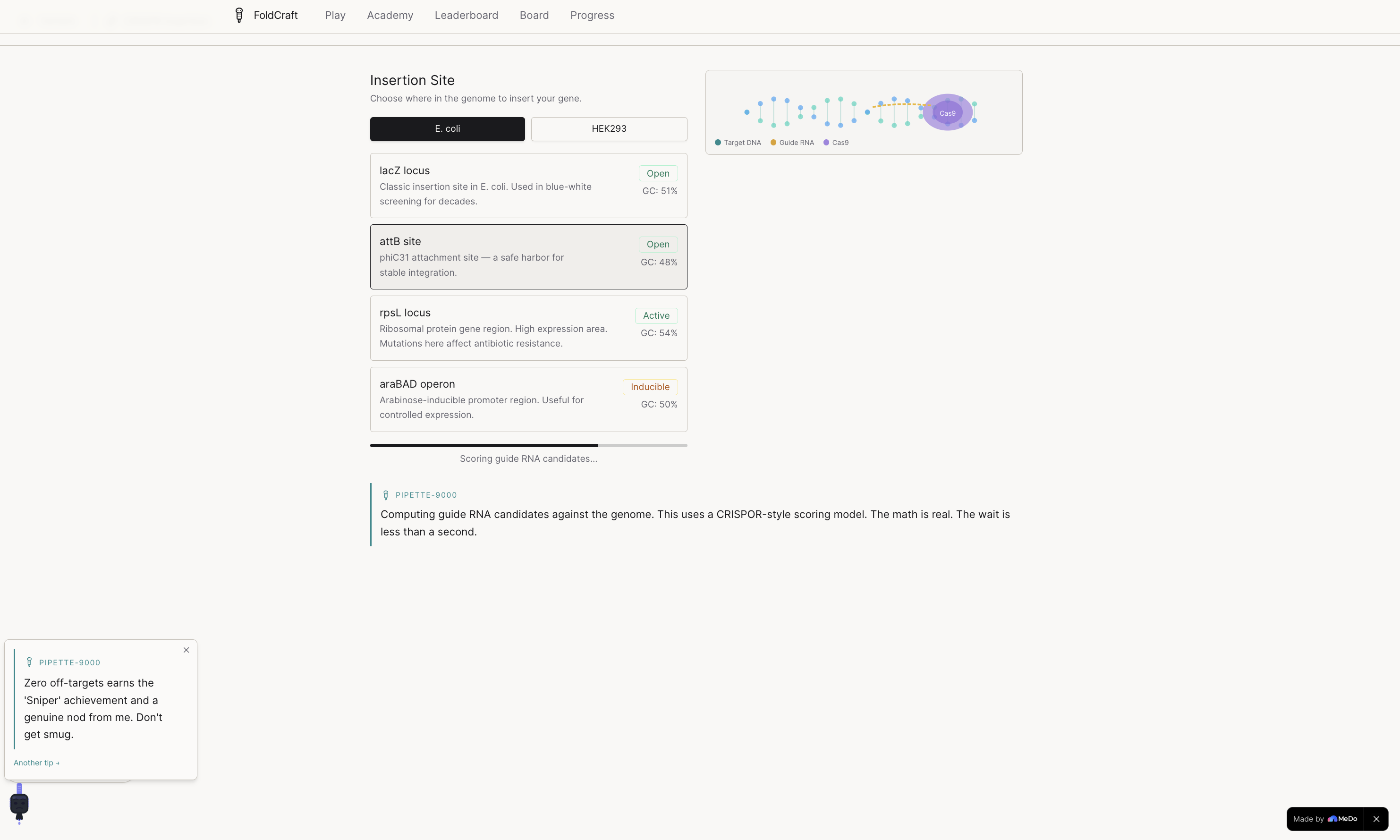
- The walkthrough tutorial (Mission 0) is the on-ramp. A new user spends about five minutes following the historical story of how a real protein: wild-type GFP, the green fluorescent jellyfish protein was redesigned into superfolder GFP in 2006. They watch every step of the loop fire with pre-known answers: someone chose the mutations, a model predicts the resulting structure, CRISPR delivers the gene to a bacterial cell, and the cell glows. By the end they've seen what success looks like, and they've absorbed the product's central pedagogical move that AI models like AlphaFold predict protein structures but don't design them; design is a separate step done by different tools or by humans.
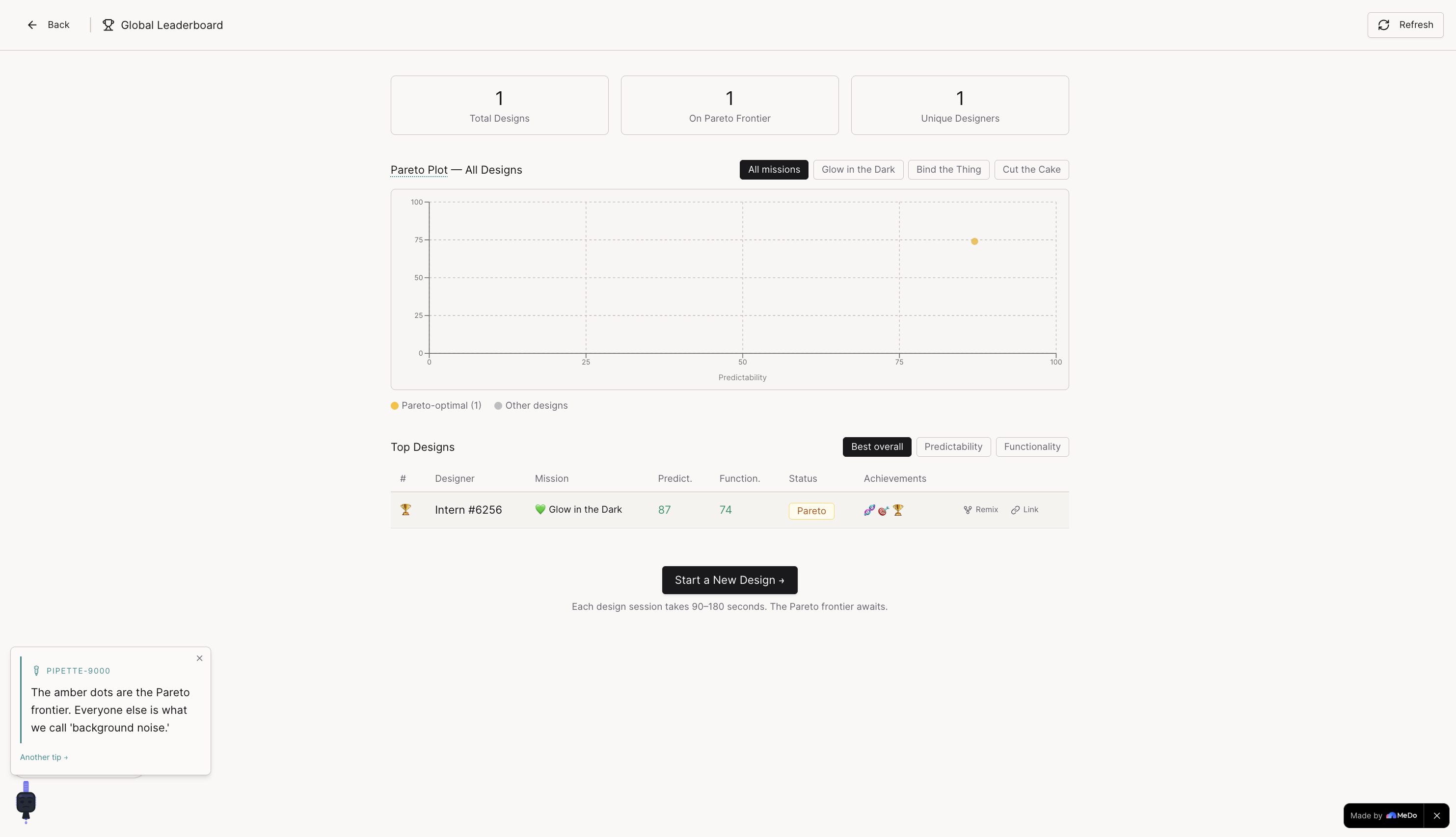
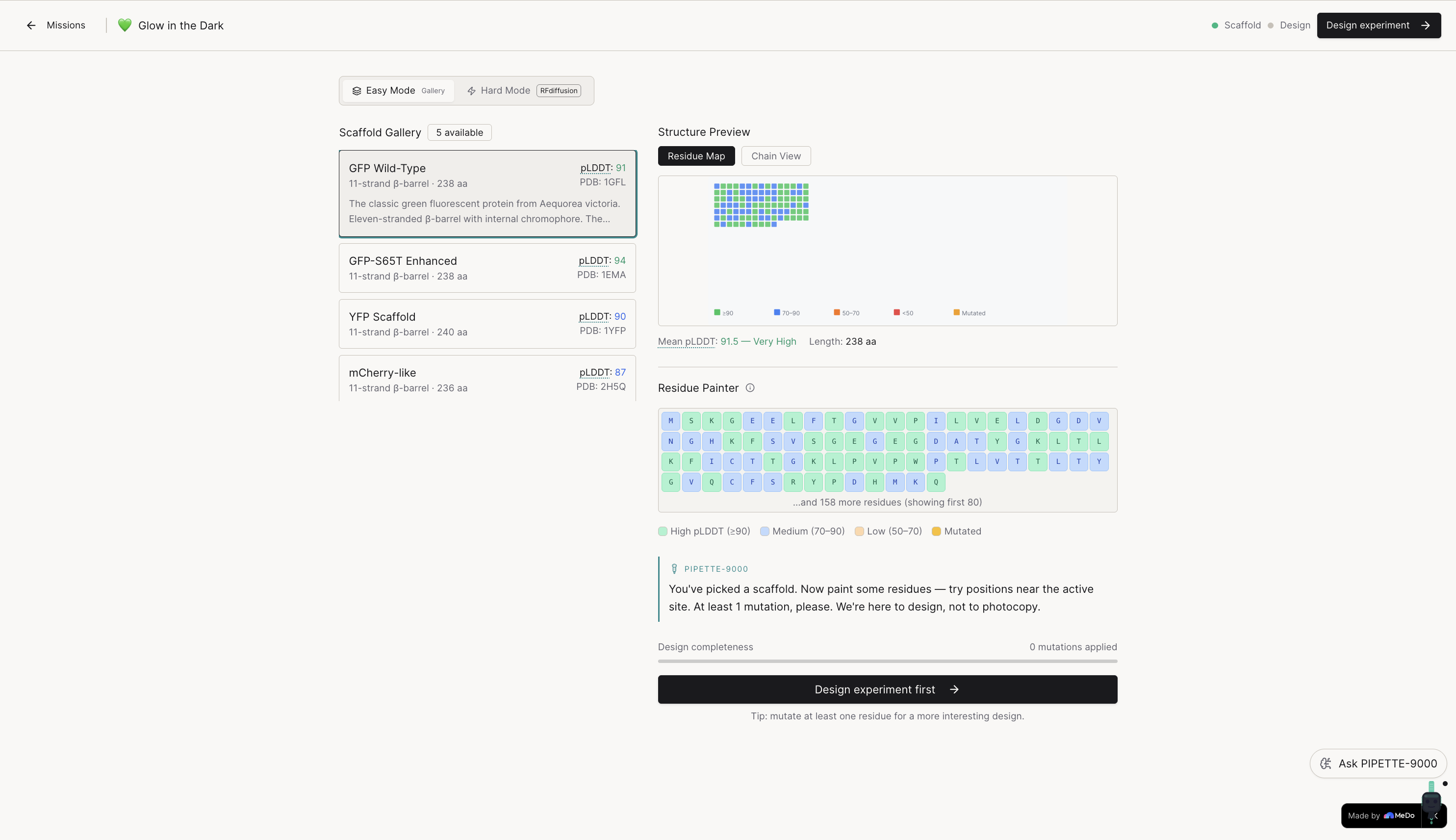
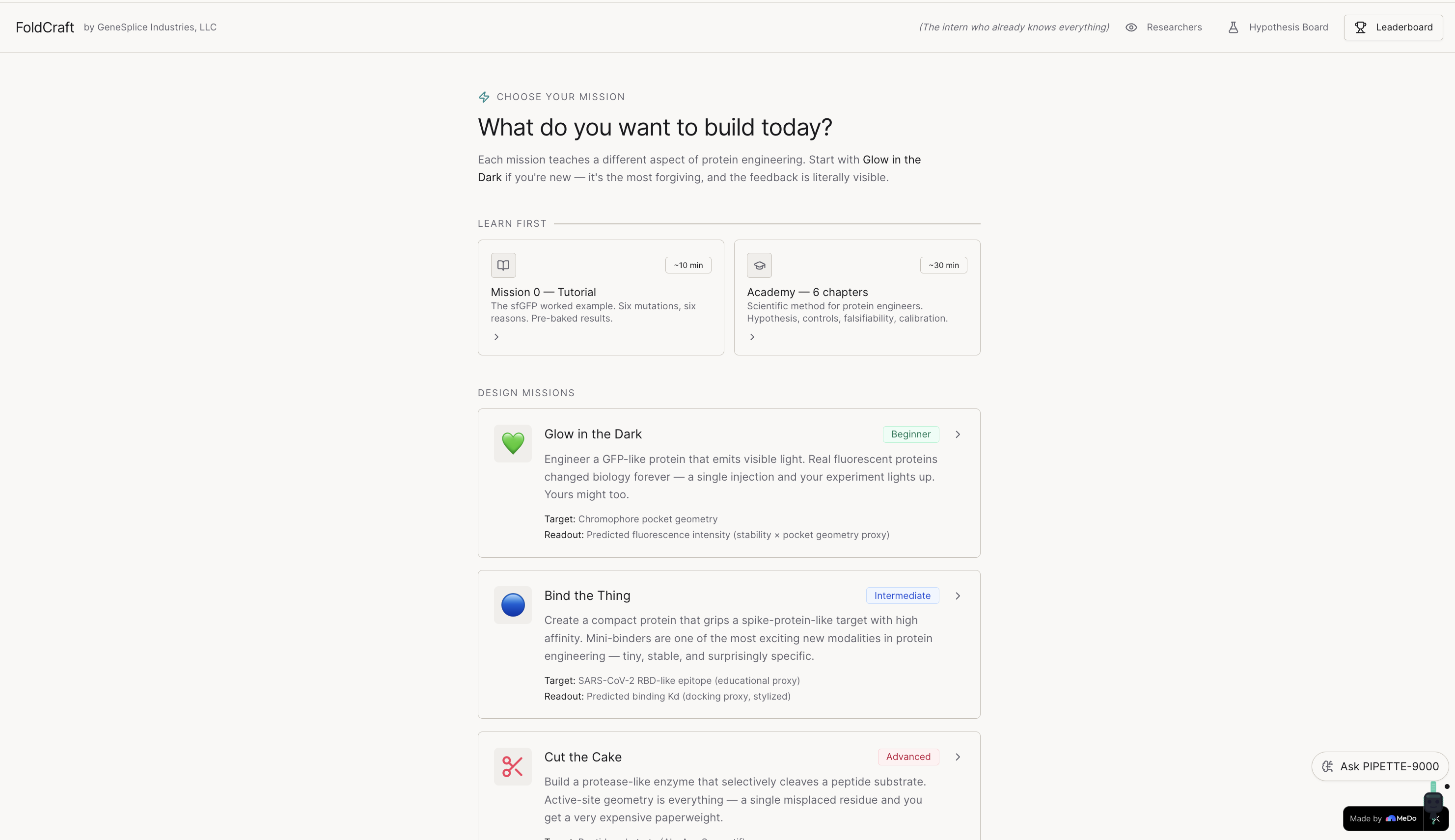
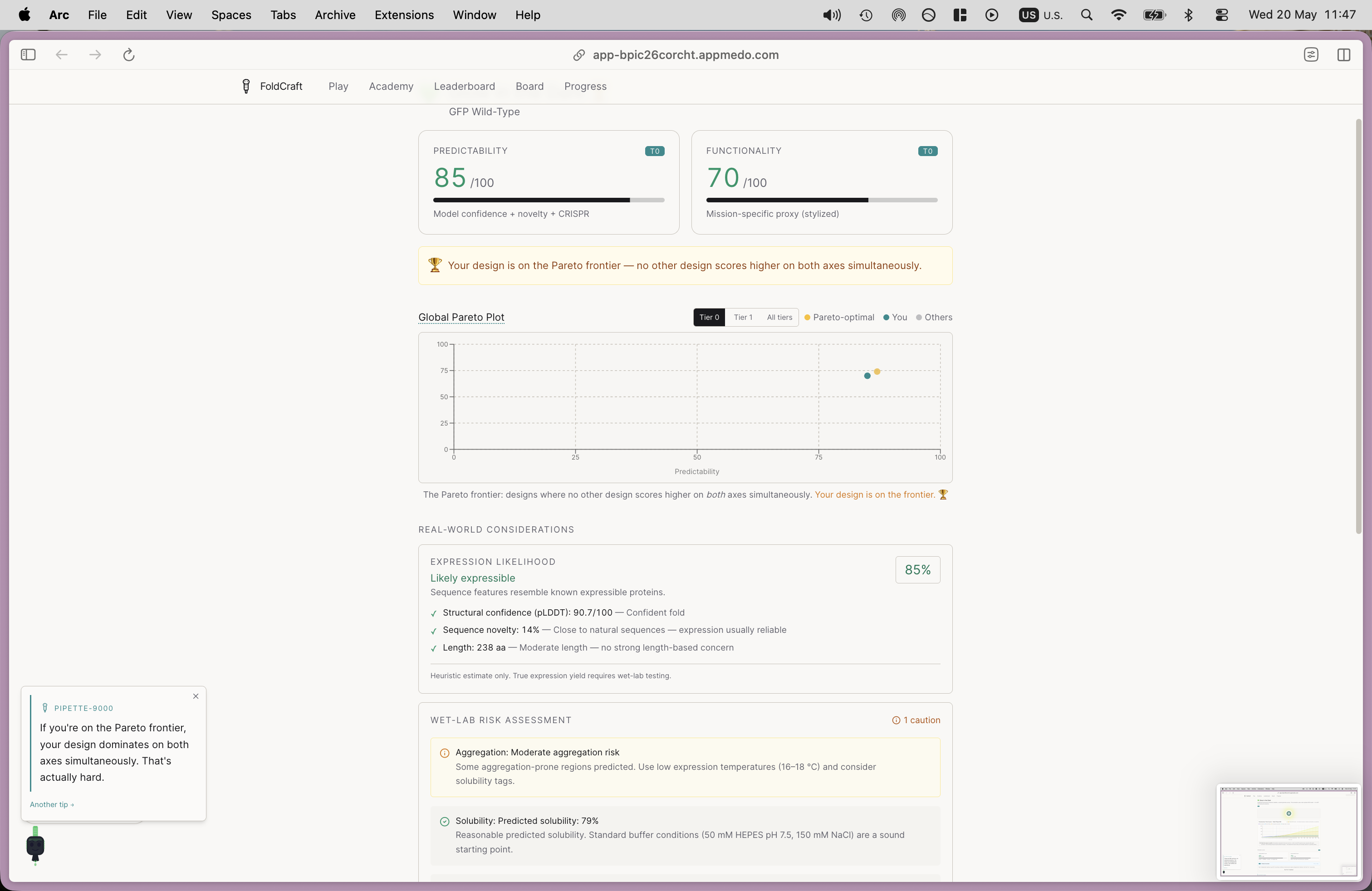
- The three launch missions (Glow, Bind, Cut) are where users design their own proteins. Each mission has a tractable goal make a cell glow brighter, make a protein bind to a target, make a CRISPR enzyme cut more precisely and a real scoring system. Designs are scored on two axes: Predictability (does the design behave the way the model claims it will?) and Functionality (does it actually do the intended thing?). The leaderboard is a 2D Pareto frontier because the central lesson is that being right and being right about how right you are are different skills, and both matter.
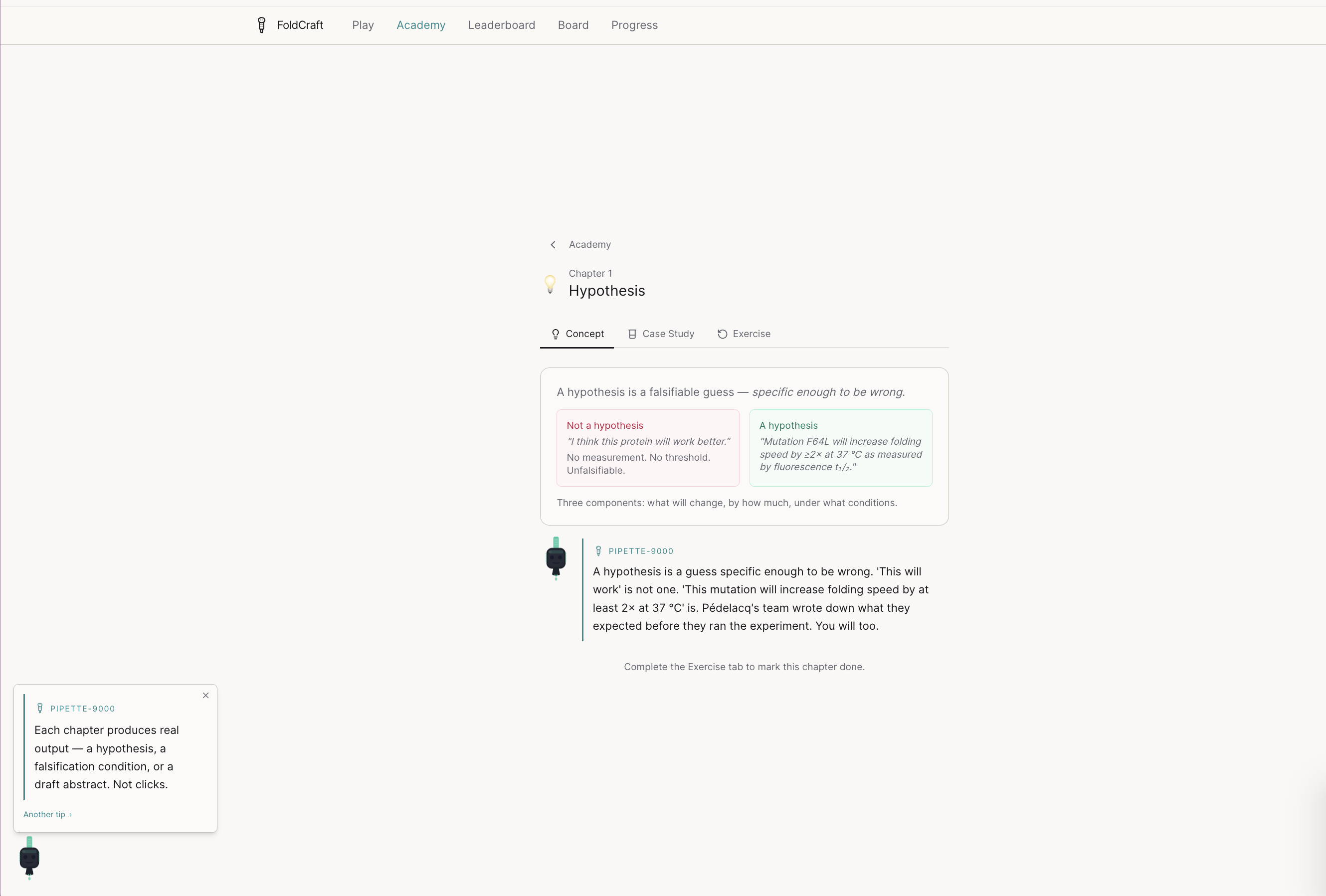
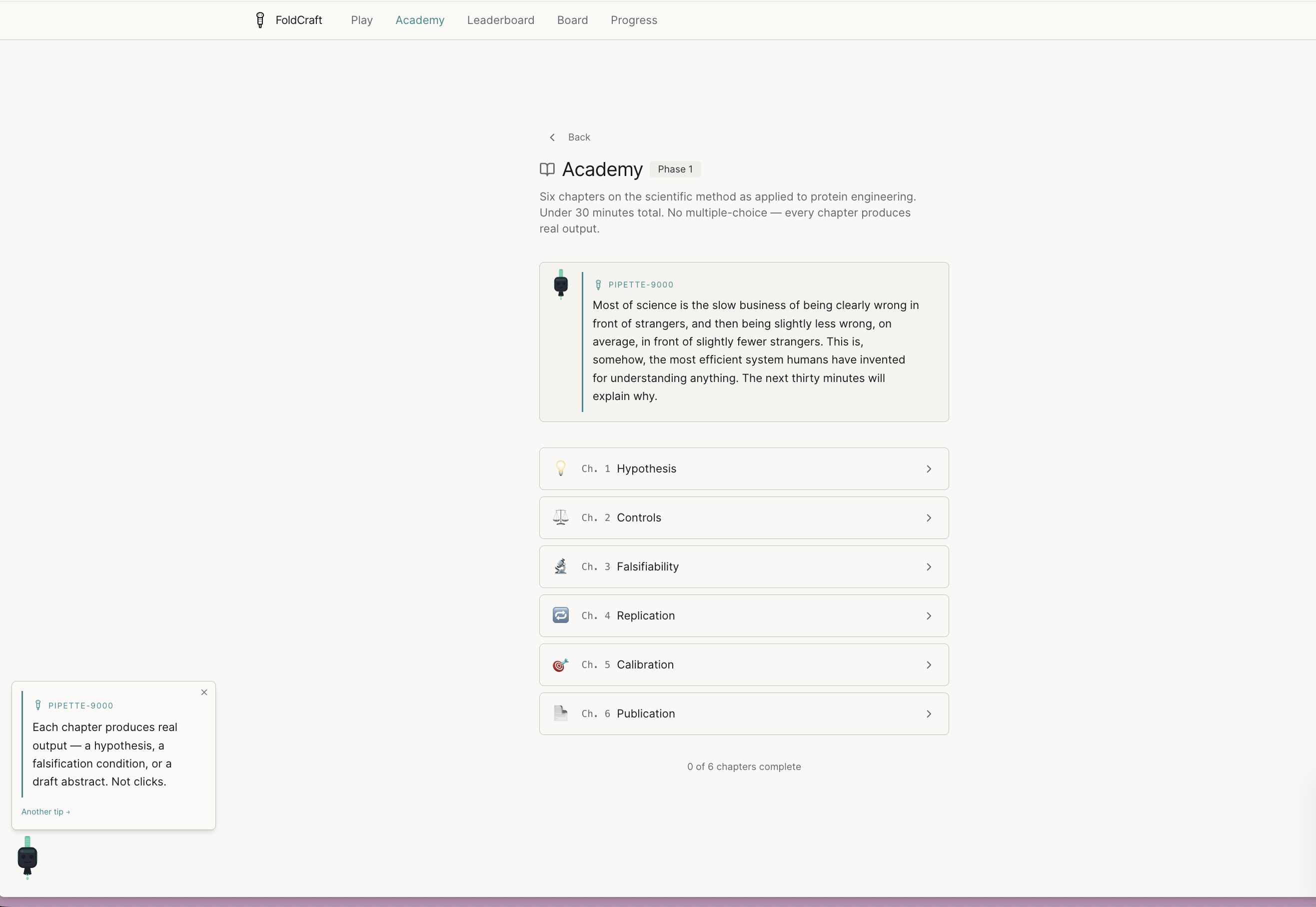
- Academy Mode is a separate area teaching the scientific method as it applies to protein engineering. Six short chapters cover hypothesis, controls, falsifiability, replication, calibration, and publication, each anchored to a real protein-engineering case study. The Academy isn't required to play the game but every score and concept the game uses has a chapter that explains it, and PIPETTE-9000 (the sarcastic AI lab-assistant character who narrates the product) suggests relevant chapters when the user is struggling.
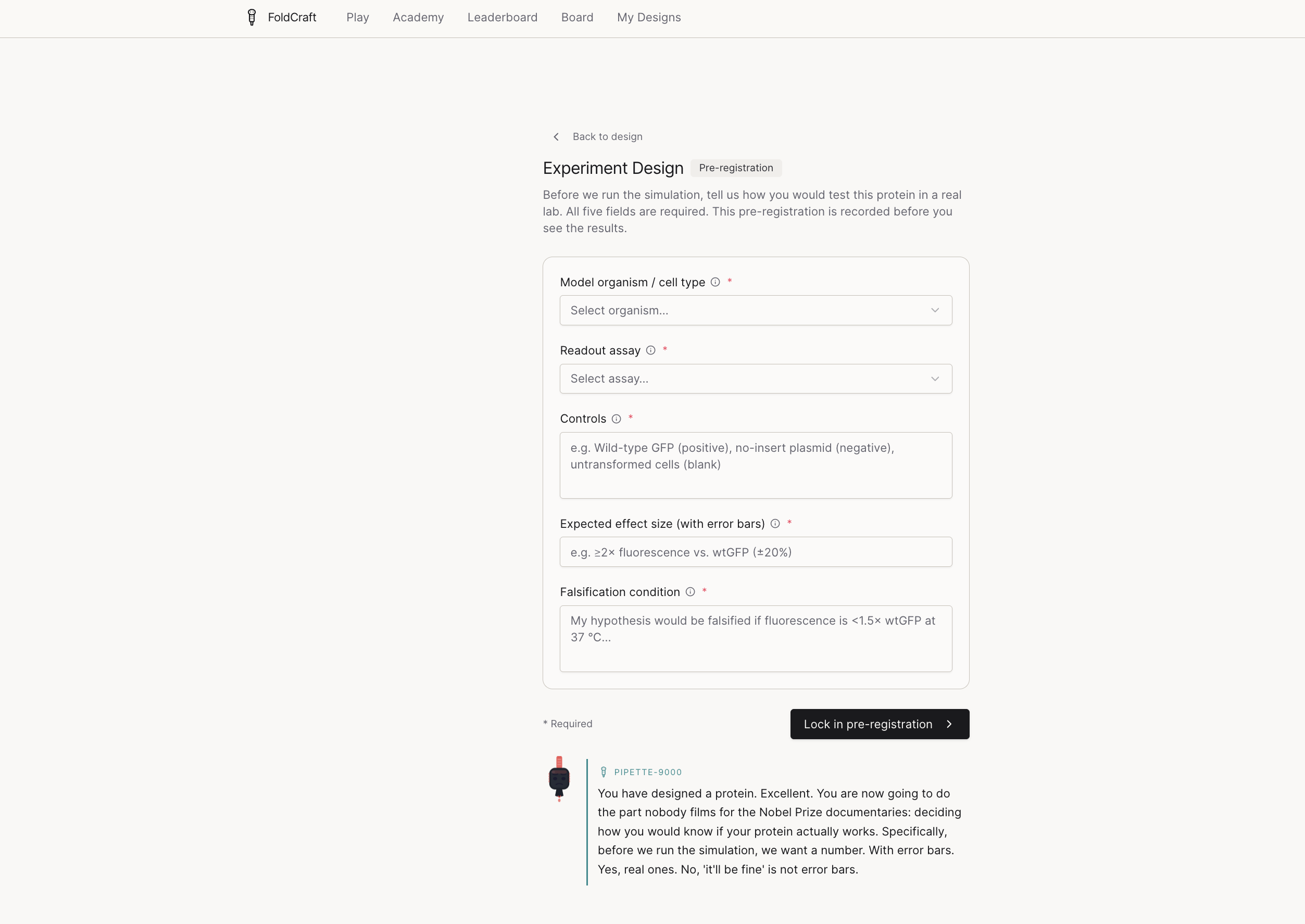
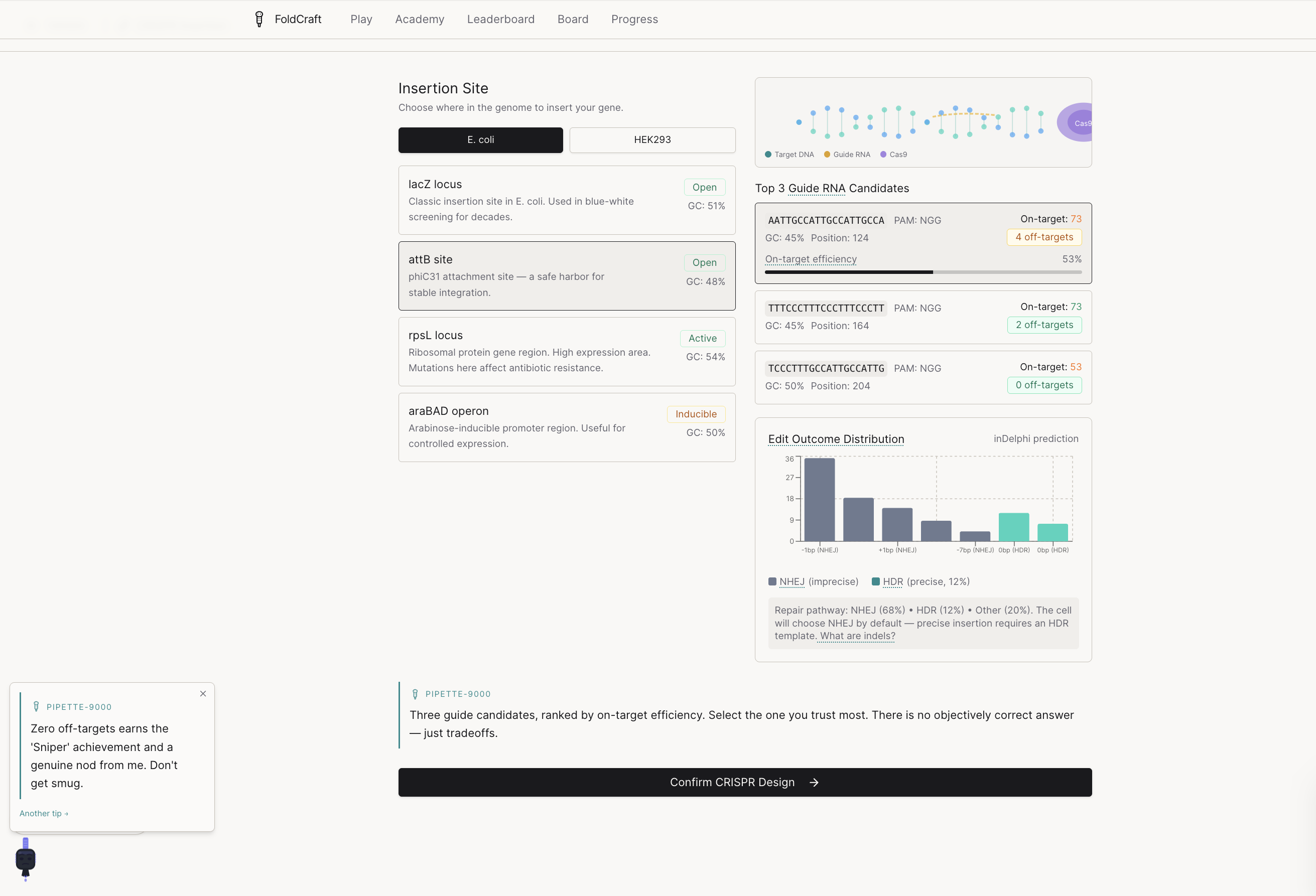
- The Experiment Design step sits between protein design and validation in the game loop. Before the user can run a simulation, they have to specify how they would test their protein in reality what cell type, what assay, what controls, what effect size they expect. This is the structural complement to the Academy: where Academy explains the method, this step requires the user to use it. Predictions made here are locked in before the simulation runs, which makes the user's calibration measurable and feeds the calibration leaderboard axis.
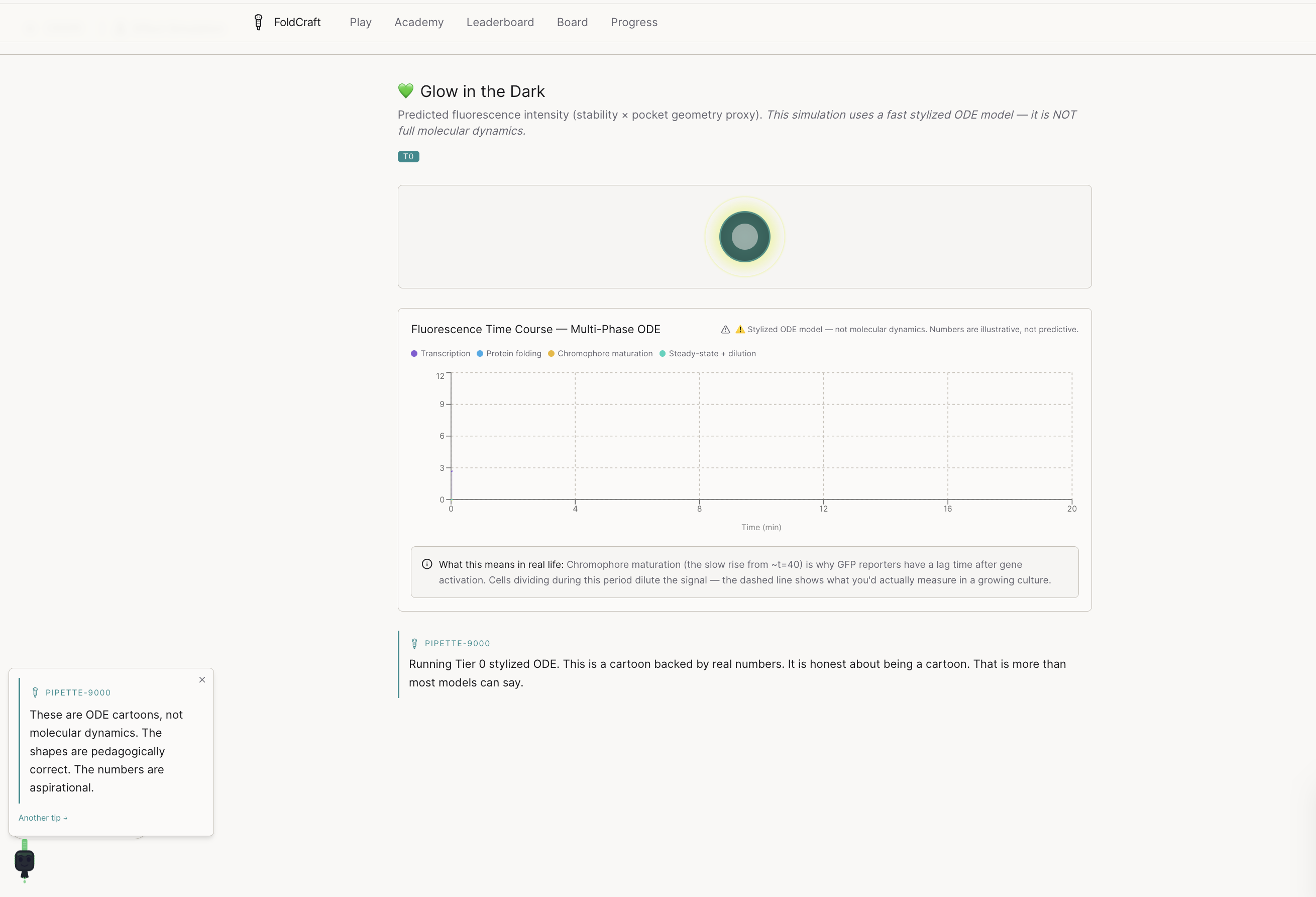
- The simulation
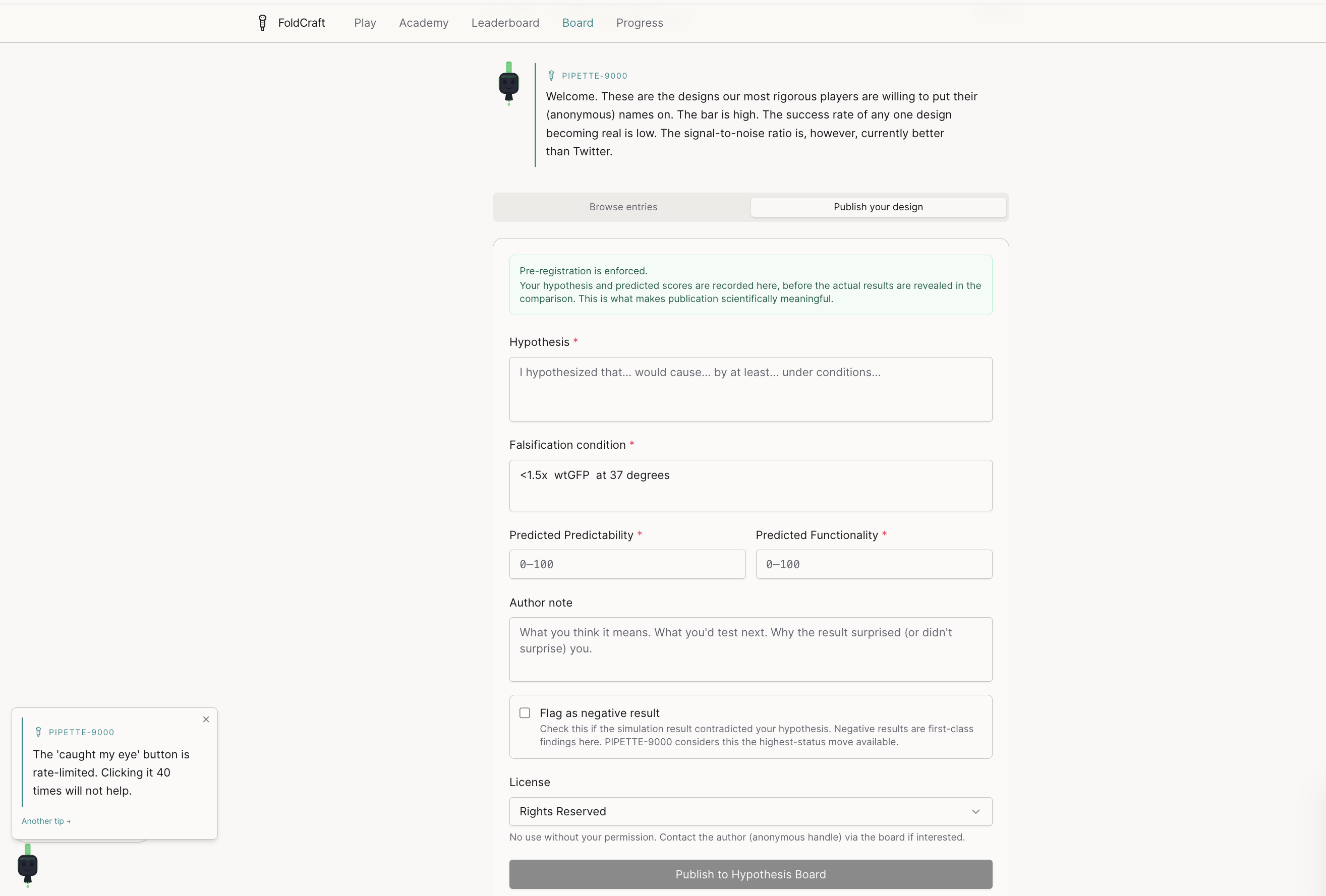
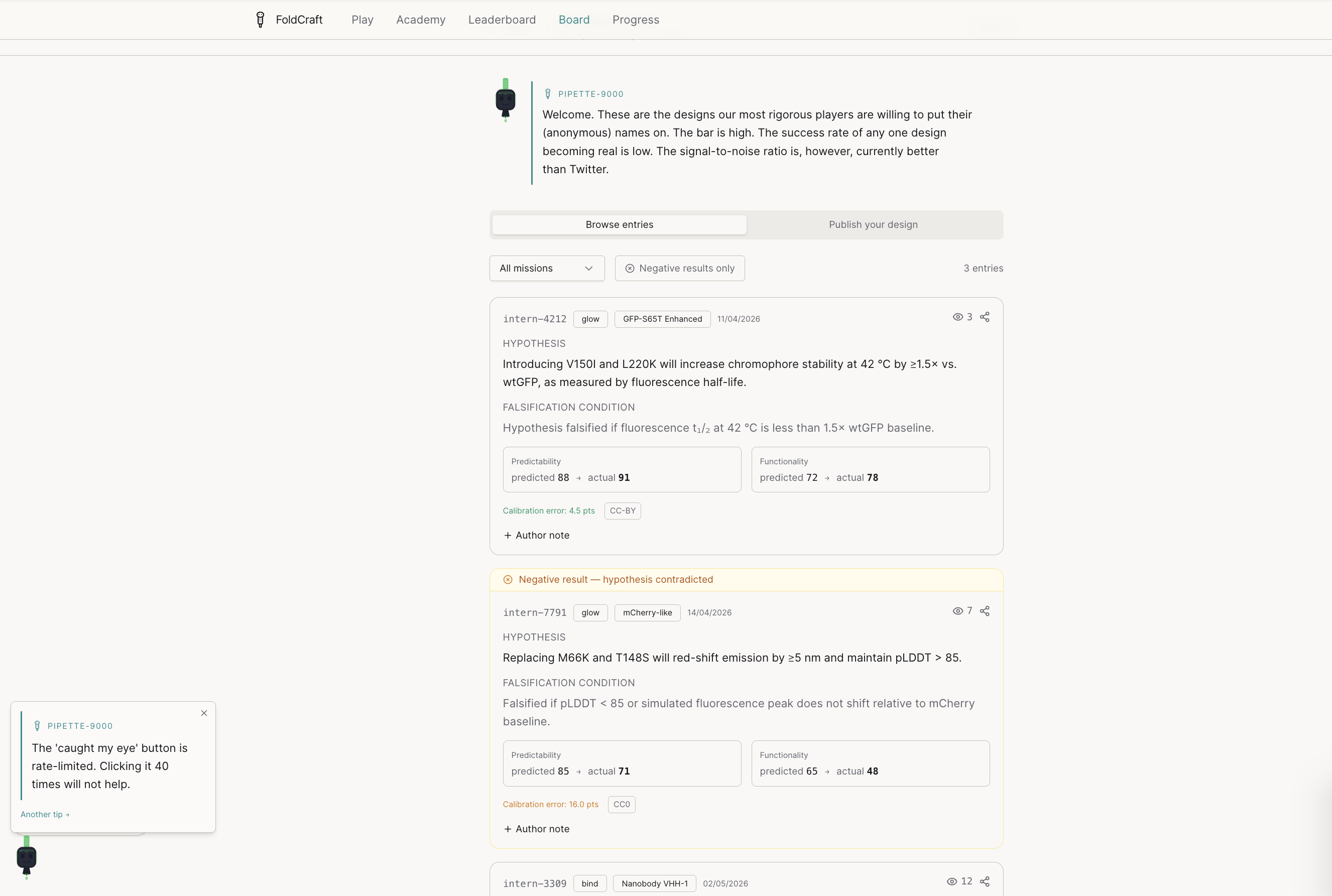
- The Hypothesis Board is where users publish frontier-quality designs. Each publication includes the design itself, the user's pre-registered hypothesis, the falsification condition they set, the simulated results, an author note, and a license they choose. Negative results where the simulation contradicted the user's hypothesis are first-class citizens, given their own browse view and celebrated by PIPETTE-9000 as the highest-status move available. Nothing about the Hypothesis Board promises anyone is reading; it's a venue, like bioRxiv, not a guarantee. Stricter biosecurity screening runs before any publication.
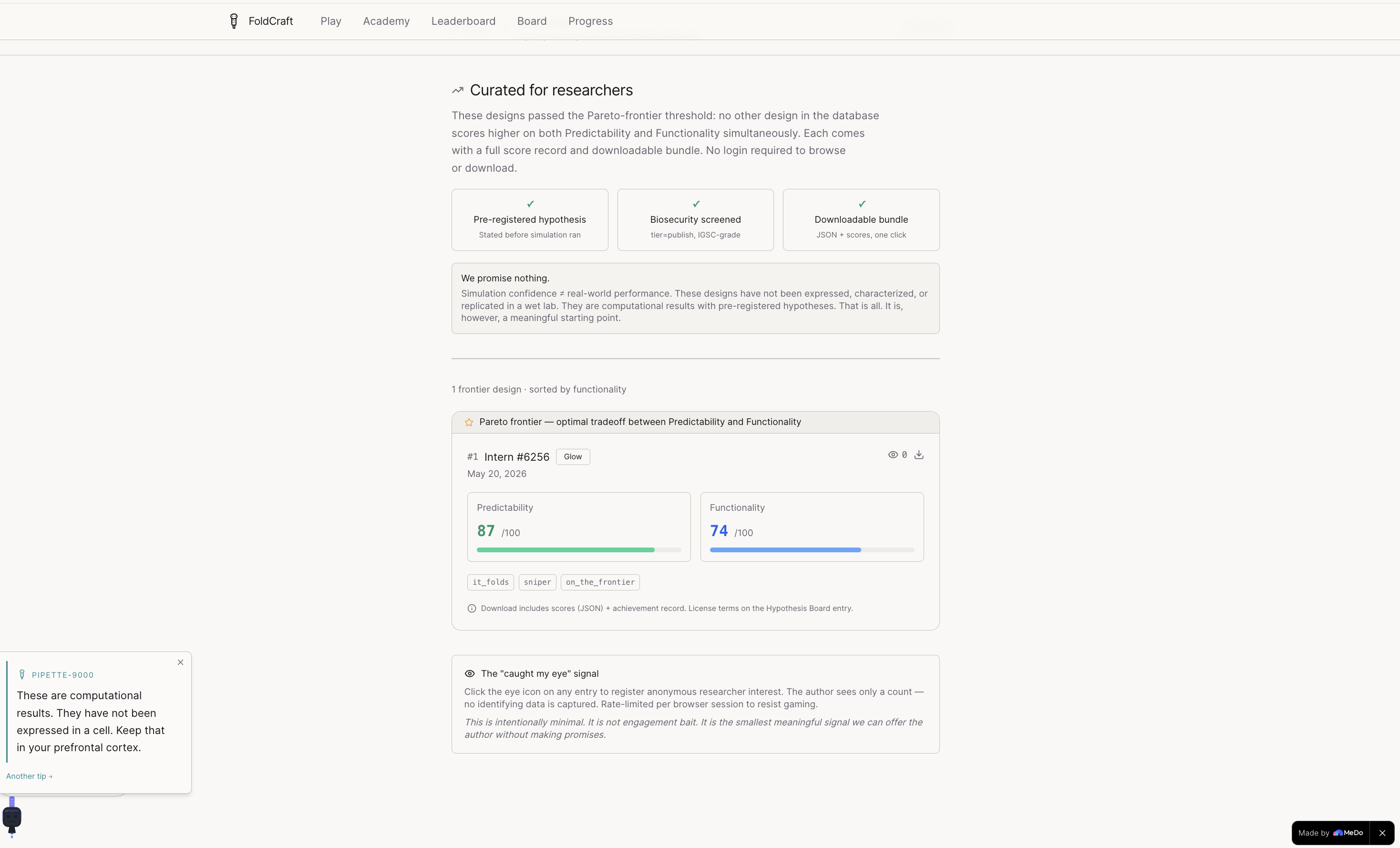
- The Researchers Landing Page is a filtered view of the Hypothesis Board built for working scientists who want to scan for interesting designs. Same data, professional layout, stricter automatic filters (frontier-only, novel, well-calibrated, with substantive author notes). No accounts required to browse. Researchers can leave a single signal an anonymous "this caught my eye" badge that the author sees, but there are no claims, no promises, no engagement bait. The success rate is honestly disclosed: most published designs will not be read by anyone in particular, and that's fine it's how science works.
- The "Take to a Real Lab" exit ramp is the inflection point that turns FoldCraft from a teaching tool into something more. Users with eligible designs frontier, novel, well-calibrated, biosecurity-cleared at the highest tier can pay (or apply to a sponsored pool) to have their design physically synthesized and tested at a cloud lab partner like Ginkgo, Emerald, or Strateos. About eight weeks later, raw data arrives, and the Reality Check section on the user's entry shows the gap between what the simulation predicted and what actually happened. That gap is the single most important thing the entire product teaches: AI predictions about biological systems are useful, but reality is the only judge that matters.
The pipeline, in order
- Generation. RFdiffusion produces a candidate protein backbone; ProteinMPNN designs an amino-acid sequence onto it. Both are current-generation methods. A pre-baked scaffold library is available for the fast path; live generation is available when the user wants depth over speed.
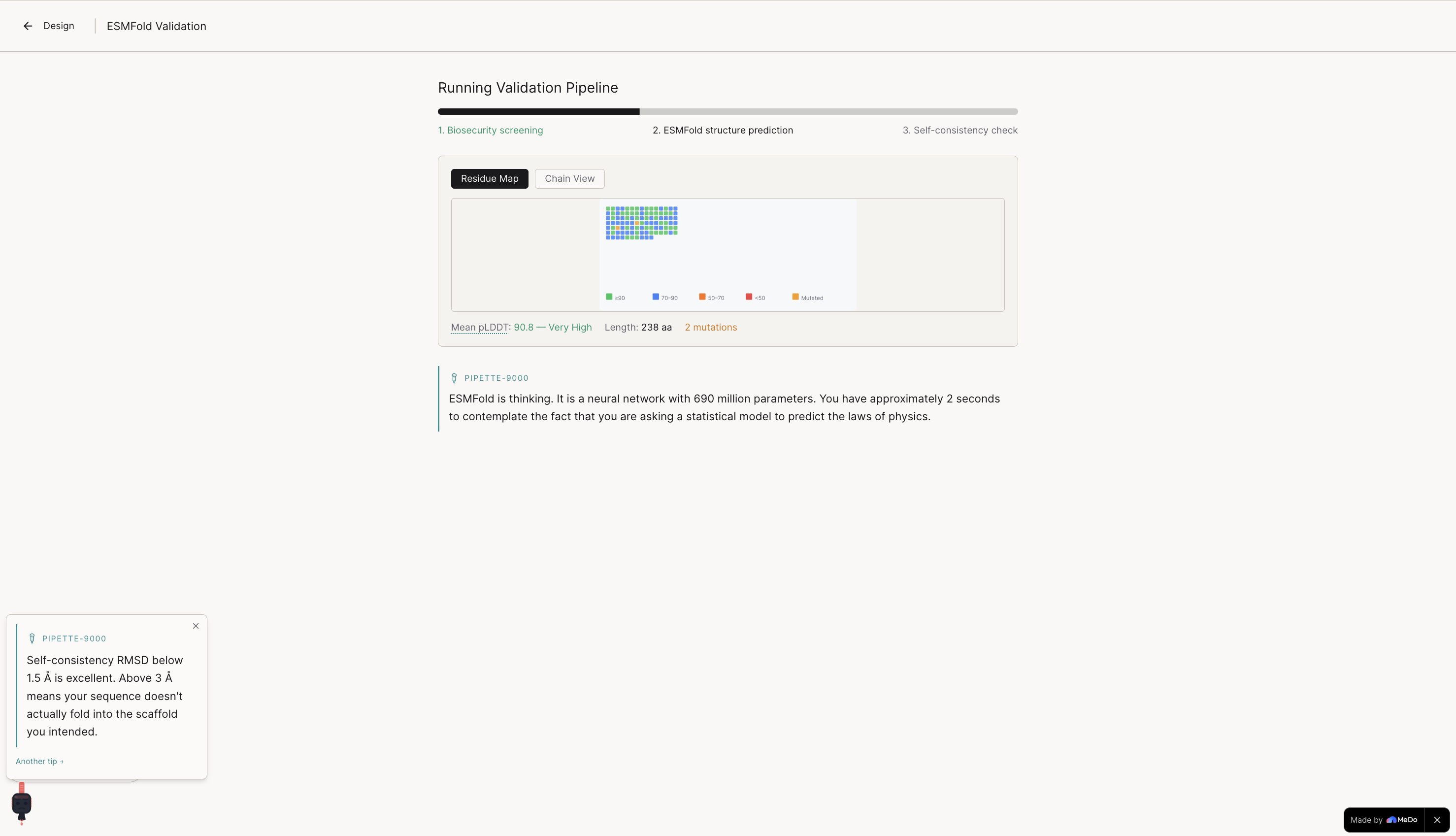
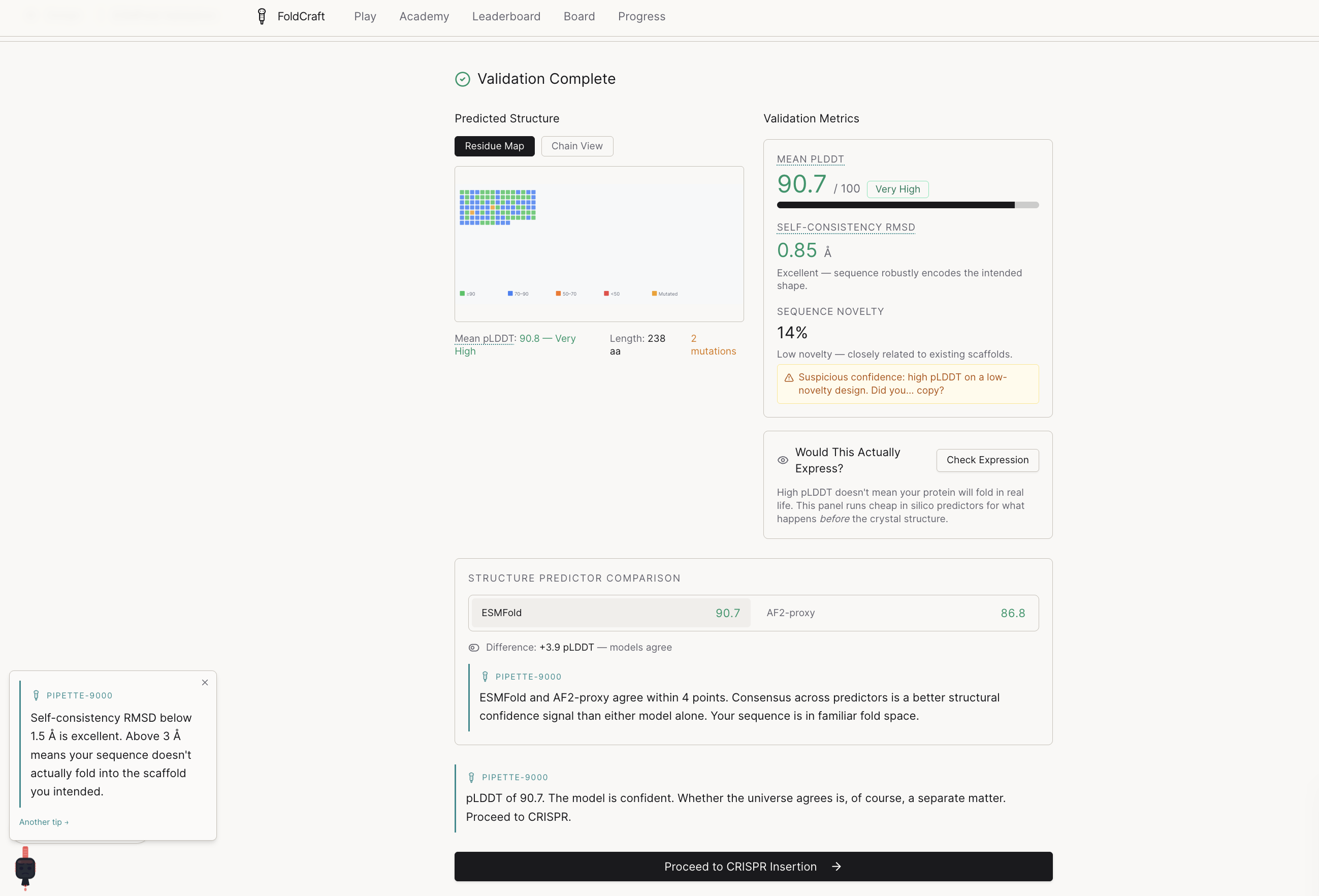
- Validation. ESMFold (default, fast) or AlphaFold2 (slower, higher fidelity) predicts what structure the designed sequence actually folds into. The two predictors disagree sometimes; the app makes the disagreement visible rather than hiding it. This is one of the better teaching moments the product offers.
- Academy. Before the user can simulate, they work through a short module explaining the specific assay this mission uses — what it actually measures, how a wet lab would set it up, what the controls look like, what counts as a positive result. The Academy is the "here's how the method works" half of the lesson.
- Experiment Design. The structural complement to the Academy. Before the simulation runs, the user has to specify how they would test the protein in reality: what cell type, what assay, what controls, what effect size they expect. Predictions made here are locked in before the simulation reveals anything. This is what makes the user's calibration measurable.
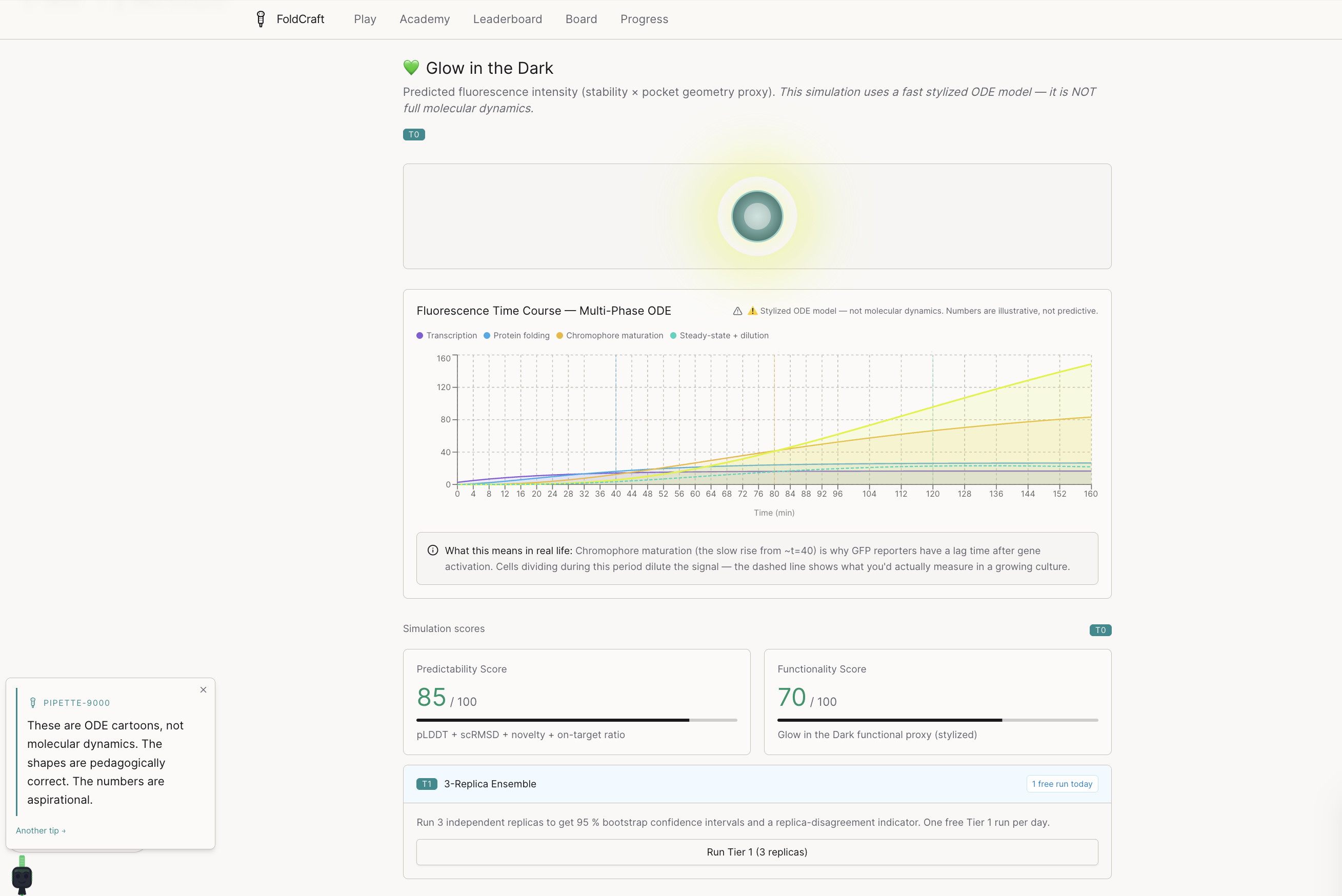
- Effect simulation. A mission-specific functional model runs:
- Glow — fluorescence proxy
- Bind — binding-affinity estimate
- Cut — Cas9 cut-rate model
- Stabilize — ΔΔG estimate (FoldX or ESM-IF)
- Sense — dose-response curve
- Transport — ion-gradient ODE
- These are stylized: 10-line ODEs and published proxies, not full molecular dynamics. The intuition taught is the same; the cost is roughly one ten-thousandth.
- Scoring. Two canonical axes, visualized as a Pareto frontier:
- Predictability — did the design behave as the model said it would?
- Functionality — did it actually do the intended thing? A separate Calibration ranking sits alongside the Pareto leaderboard. It measures how close the user's locked-in Experiment-Design predictions came to the simulated outcome. A user can be a good designer, a well-calibrated forecaster, or both. The product treats those as distinct skills worth tracking.
How we built it
We built this by a lot of research and spending a lot of time in the idea phase. Went through many iterations of the idea before getting to this final one. I read the capabilities of MeDo, and watched all videos in the YouTube channel for how to prompt better. Set in using PRDs would be the best way to build a complex system (even if only a part of it). The way I prompted MeDo to build this is by a base PRD.md defining an initial upgrade path in the initial PRD.md. Then continue prompting via PRD-1.md, PRD-2.md, etc. as the upgrade paths. Finally used one of the PRDs.md which would be PRD-polish.md to fix UI errors and give a better experience to the user.
Challenges we ran into
Lack of knowledge. I know how to build computer systems but not how to build biotechnology computer systems, which are a whole different area. Also, this was a whole learning experience for me in protein folding. Simulation for biotechnology (protein development) is very limited. CRISPR functionality is well documented in certain areas but not documented very well to be used in a programmatic simulation. My credits kept disappearing. I had 370 credits that were gone out of the blue. Then came back ( I guess the system that calculates tokens/credits runs separately) but had to wait a long while for this.
Accomplishments that we're proud of
The platform showcases more functionality than anticipated. I was under the assumption I would have to do a lot of corrective work based on my experience with other builder platforms like Replit. Replit chose to allow multiple plan items a la kanban to solve this while your application solves it by fixing things proactively.
Because of that limitation I thought I wouldn’t get to the leaderboard, the partner side of the app, the learning part of the app, and barely thought I would get to the main core functionality done as it was rather ambitious (see the ## What it does section for a full-list of capabilities).
Also I wanted to stress the platform to see how much I could get out of it. The results of which I’m very positively surprised with.
What we learned
A lot! From the understanding of what Alphafold is to its capabilities. And what AlpahFold2 does. Initially I thought it could predict and could be used as the main algorithm to predict new proteins. Turns out it is a validator of the correctness of the structure. Given that I still think it could be ported to predict if used in reverse but alas there wasn’t time to test/try that.
In the current architecture, that my idea was so ambitious I could only get to do a vertical slice of what I wanted. And by this I mean the prediction (and simulation) of phenotypic effects has no way to be done with our current level of technological development.
I learned a lot about the limitations of simulators in the biotech space and that most AI/LLMs are not capable of producing real results in this area. Turns out predicting the next token is not so good to predict the next sequence (in biology).
Also, after building the app I learned a lot about what I wanted to learn; protein discovery by small mutations.
What's next for FoldCraft - edge bio lab and simulation
- Better simulations, using one of the following
- Mol* or 3Dmol.js for in-browser protein rendering
- NGL Viewer for embedded structure views
A custom Three.js/D3 layer for the cellular "effect”, a cartoon or a closer-to-real-life simulation per cell, or per bacteria type.
More functionality
General phenotypic effect prediction not functional in this app.
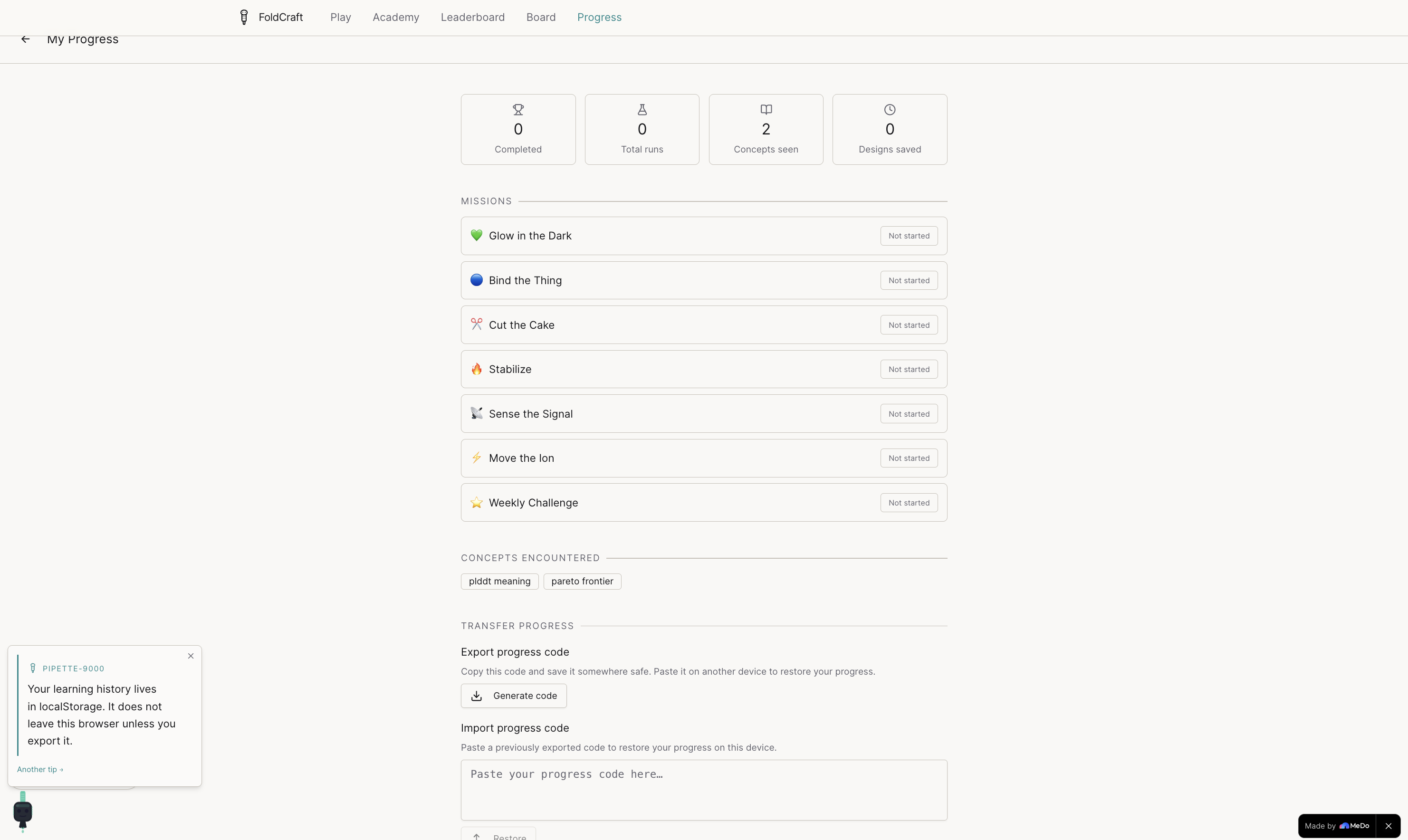
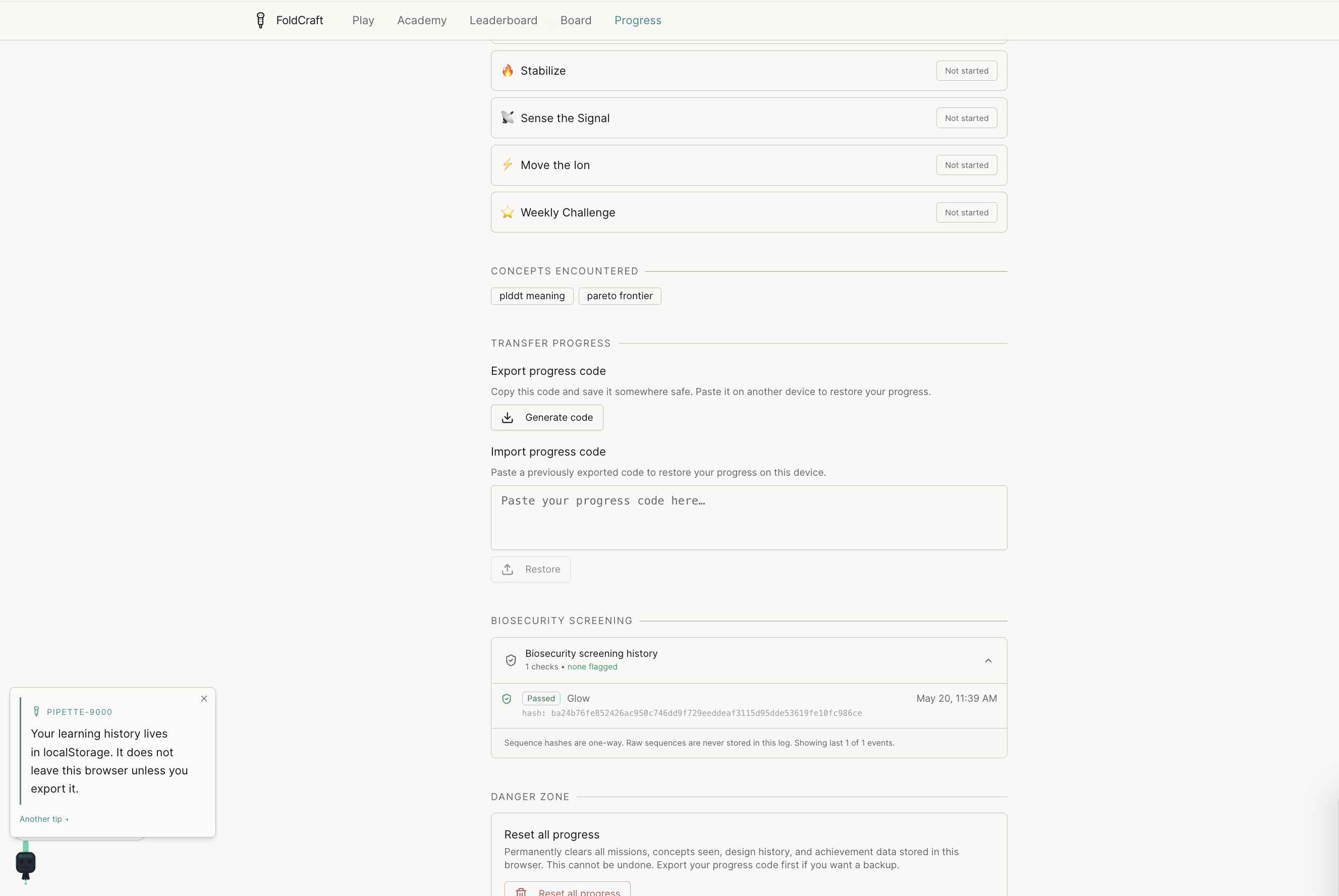
Real accounts (Phase 5 - anonymous + portable progress code is enough for now)
Wet-lab synthesis ordering (Phase 4 - needs the biosecurity escalation first)
Per-submission molecular dynamics (Phase 3, finalists only)
General phenotypic effect prediction (not functional in this app and genuinely not possible at any scale; mission-scoped proxies only. Will try to figure out how to do this.)
Roasting failed designs for comedy (brand voice rule #3)
Better learning paths More learning paths, and better curated. Potentially using a platform embedded in the application. Learn at point; right now you can learn before, and during. You can ask questions but you need to be proactive in asking them. We want to know the user and their knowledge level so we can add progressive complexity of learning as the user uses the platform more and more.
Assess path to fix or path to improve on the following:
High pLDDT ≠ a real protein. Confident structure prediction says nothing about expression, solubility, aggregation, or in vivo folding. Partially solved with in-vivo/lab
"Functional" is much harder than "structural." Function prediction is decades behind structure prediction. Restrict functionality to narrow categories with computable proxies.
CRISPR is cell-context-dependent. Chromatin state, cell cycle, delivery method, and repair pathway availability dominate real outcomes. This is not captured in the current simulator. Potentially capturable in an upgrade.
Compute and latency. Most of the models like RFDiffusion, ESMFold needs a GPU. Connecting
Licensing. AF2/AF3 weights have non-commercial restrictions for some uses read the licenses before monetizing. Confidence: 0.85, verify before launch.
Biosecurity / dual-use. A tool that rewards users for designing functional novel proteins crosses into territory the IBBIS biosecurity guidelines care about. At minimum: screen designs against pathogen/toxin databases (e.g., the IGSC consortium offers screening hooks), block toxin scaffolds, and don't expose raw RFdiffusion conditioning to unbounded user input.
The "predictable" / "functional" tension. The most predictable proteins are minor variants of known ones; the most novel are the least predictable. Your scoring should reward this trade-off explicitly that's actually where the game lives.
Effect simulation this is your weakest link, be honest about it
Molecular: docking (DiffDock, AutoDock Vina) for binding affinity; short MD (OpenMM) for stability minutes to hours, not seconds Pathway/cell: Boolean networks or small ODE models for specific pathways (e.g., MAPK, p53). Tellurium or CellCollective are tractable Phenotype: essentially unsolved in general. You'll need to constrain to a narrow domain (e.g., "fluorescence intensity," "growth rate in defined media," "binding to receptor X")
- Infrastructure: Hosting / compute cost ceiling, especially newly pressing because live RFdiffusion Biosecurity database access path.
- Funding / economic model.
- Wet-lab partner shortlist (still Phase 4, but the Tier 5 honesty surfaces start informing the partner conversation now).
- Accessibility the pLDDT rainbow palette is still colorblind-hostile. The diagnostic UI should address that mistake. Other accessibility improvements as voice-over, etc. Accessibility shouldn’t be a limitation for people to learn.

Log in or sign up for Devpost to join the conversation.