-
-
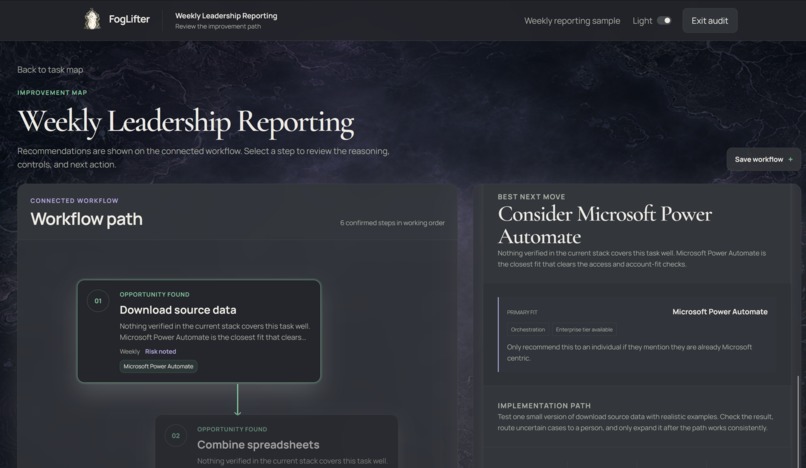
WorkflowMap
-
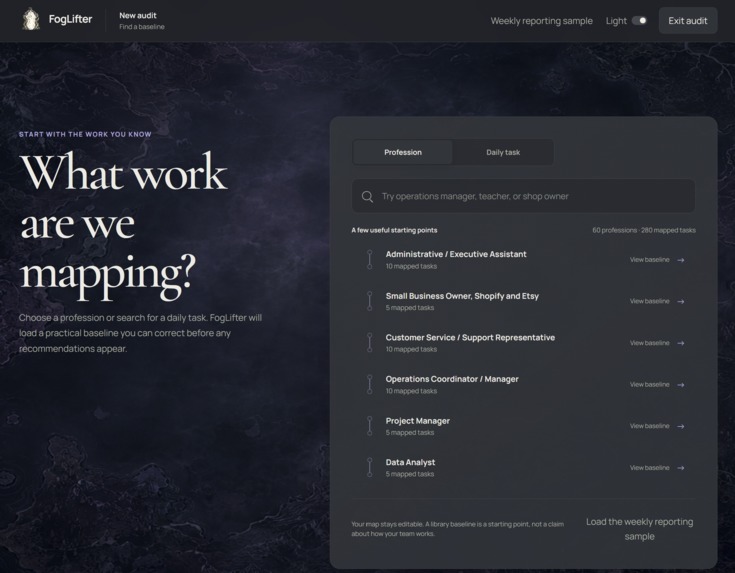
AuditSection
-

HomePageLight
-

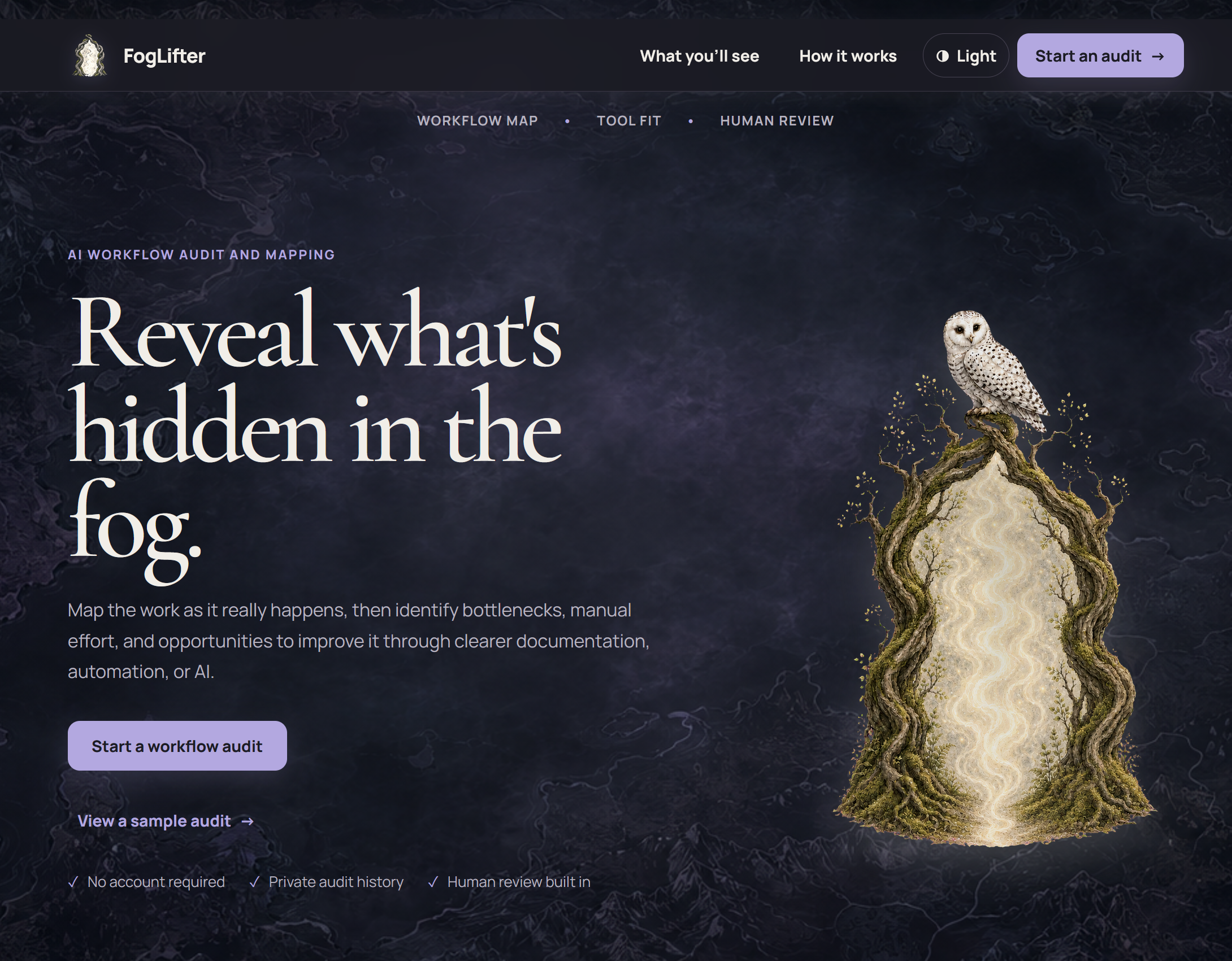
HomePageDark
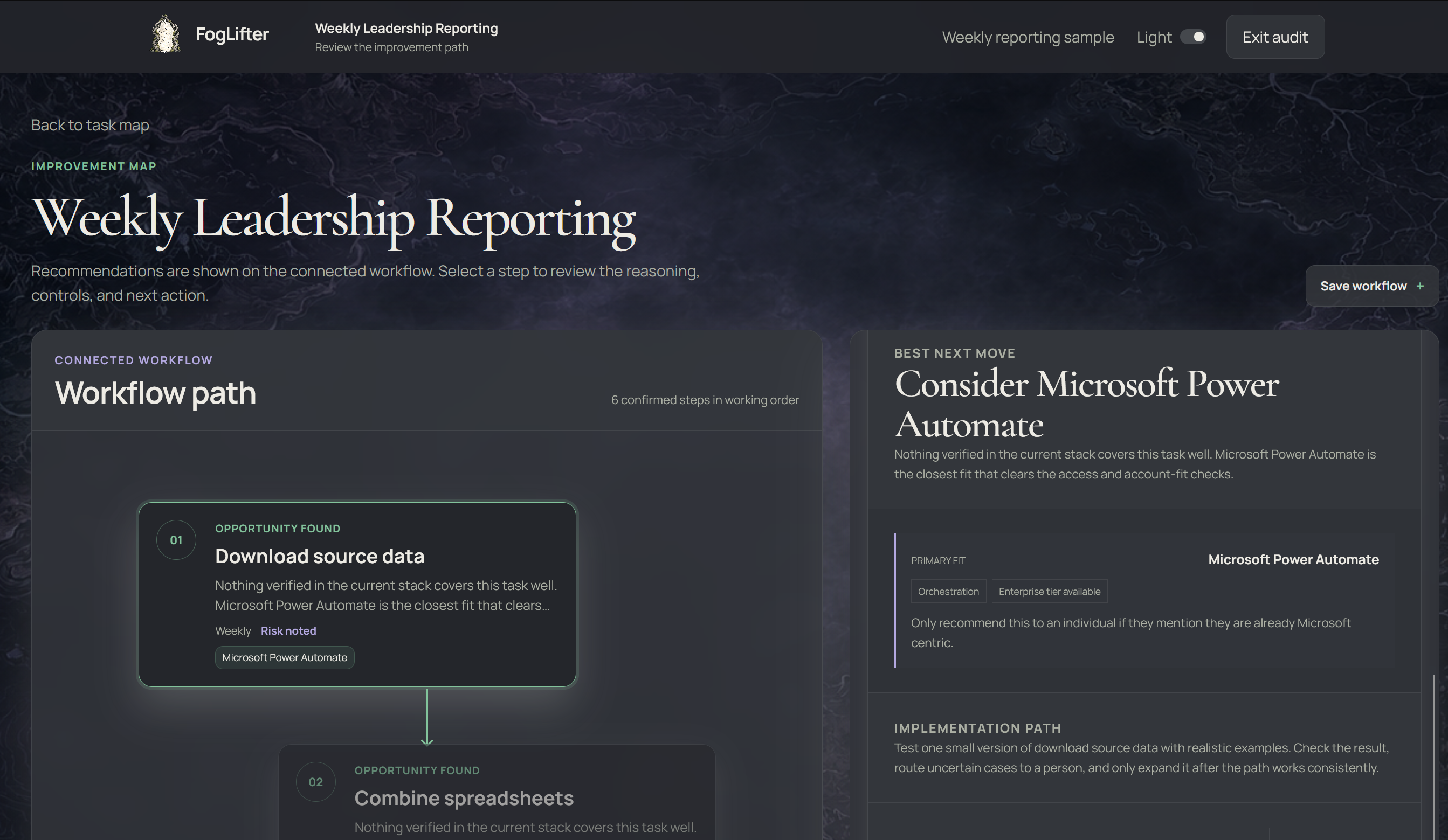
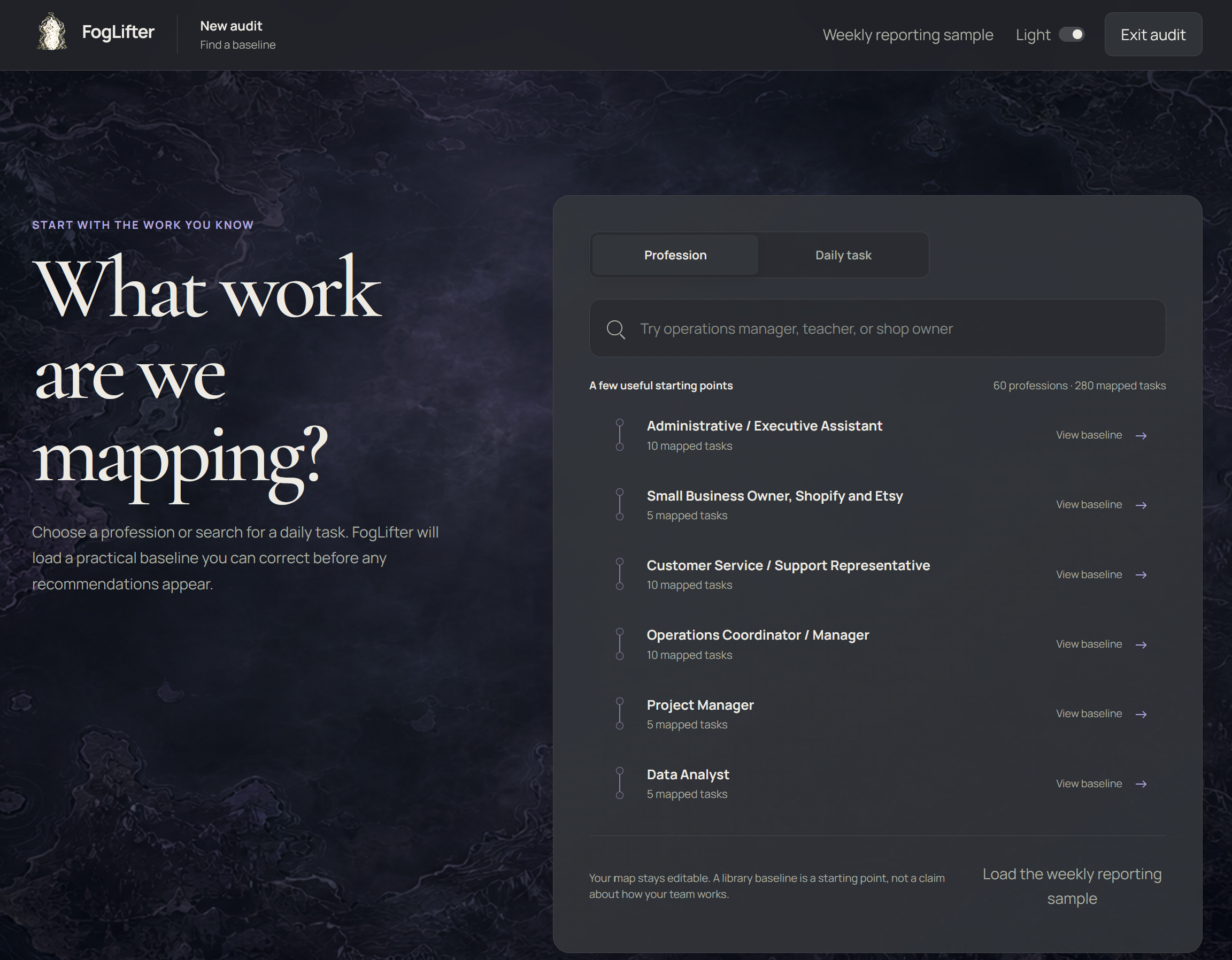

Inspiration
Most workflows are invisible. The real process lives across people, spreadsheets, inboxes, and undocumented decisions, not inside a single tool. FogLifter makes these steps visible so teams can improve their work intentionally instead of guessing.
The concept grew from challenges I encountered while helping integrate AI, along with experiences shared by peers navigating similar transitions. Engineering teams did not always have visibility into how other teams work day-to-day. Those insights helped shape FogLifter’s workflow taxonomy and its core idea: revealing processes one step at a time, like a cartographer clearing fog from a map.
What it does
FogLifter turns any workflow into an editable map. Users can search a library of 60 roles and 280 mapped tasks or describe their own process. They start with a prefilled baseline instead of a blank page, select their current tools, and refine the steps on a connected map.
FogLifter then builds an improvement view. It checks the existing tool stack first, separates process fixes from software gaps, and adds required human oversight to every recommendation. Users can inspect any step in a detail panel, print the map, or save it as a PDF.
The sample workflow covers a standard weekly reporting process: gathering data, combining spreadsheets, validating totals, building charts, drafting a summary, and sharing the final report.
How we built it
FogLifter runs on React 19, TypeScript, Zustand, Vinext/Vite, CSS, server routes, the OpenAI Responses API, and optional Supabase persistence. It is deployed on OpenAI Sites.
Research: Gemini mapped common professions, recurring tasks, and standard software to build our library of 60 roles, 280 tasks, 5 productivity foundations, and 42 tools.
Design & Assets: Flo the mascot, category icons, and theme backgrounds were created using ChatGPT's image tools, then refined to match the app's aesthetic.
Engine & Logic: A deterministic engine ranks recommendations based on category fit, account type, current software, and process-first rules.
Dynamic Baselines: When a role is missing from the library, GPT-5.6 generates a structured, editable baseline. The AI does not pick tools—that remains strictly with the deterministic engine.
Engineering: Codex served as our primary partner for architecture, UI, recommendation logic, Supabase integration, testing, debugging, deployment, and documentation.
Each tool had a single job: Claude for early brainstorming, Gemini for research, ChatGPT for visual assets, Codex for engineering, and GPT-5.6 for runtime baselines. All decisions on scope, taxonomy, and visual direction remained human-led.
Challenges we ran into
Turning messy descriptions into a consistent editable structure. Keeping recommendations useful without treating every task as an AI opportunity. Applying tool exclusions even as inputs change. Keeping the map usable across desktop, mobile, the detail panel, and print. Cutting features that looked good but weren't grounded, to ship something smaller and more credible.
Accomplishments that we're proud of
A complete journey from role search to a prefilled workflow map and reviewed improvement plan. Includes a structured GPT 5.6 fallback for missing roles and tasks, deterministic recommendations that respect the existing technology stack, and required human oversight. The experience also includes accessible editing, responsive design, readable PDF exports, automated testing for data integrity, API behavior, rendering, and secret safety, plus a public demo and MIT-licensed repository.
What we learned
Adding AI works best when people first understand their existing processes. I found that separating baseline generation from recommendation logic made FogLifter more trustworthy, predictable, and easier to improve than relying on one model to create the entire plan.
What's next for FogLifter
Expand and review the role, task, and tool library. Add provenance links and governance controls. Persist full workflow maps with user-controlled retention. Add collaborative review and version comparison. Test recommendation quality against expert-labeled scenarios.
Built With
- chatgpt
- codex
- css
- gemini
- gpt-5.6
- json-schema
- node.js
- openai-ap
- openai-responses-api
- openai-sites
- pnpm
- postgresql
- react
- react-19
- supabase
- typescript
- vinext
- vite
- zustand

Log in or sign up for Devpost to join the conversation.