-
-
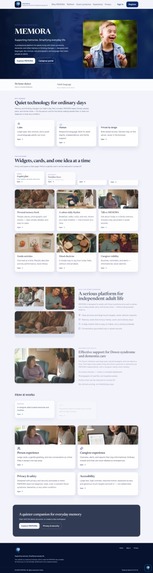
MEMORA — Website Prototype for Memory Support and Compassionate Care
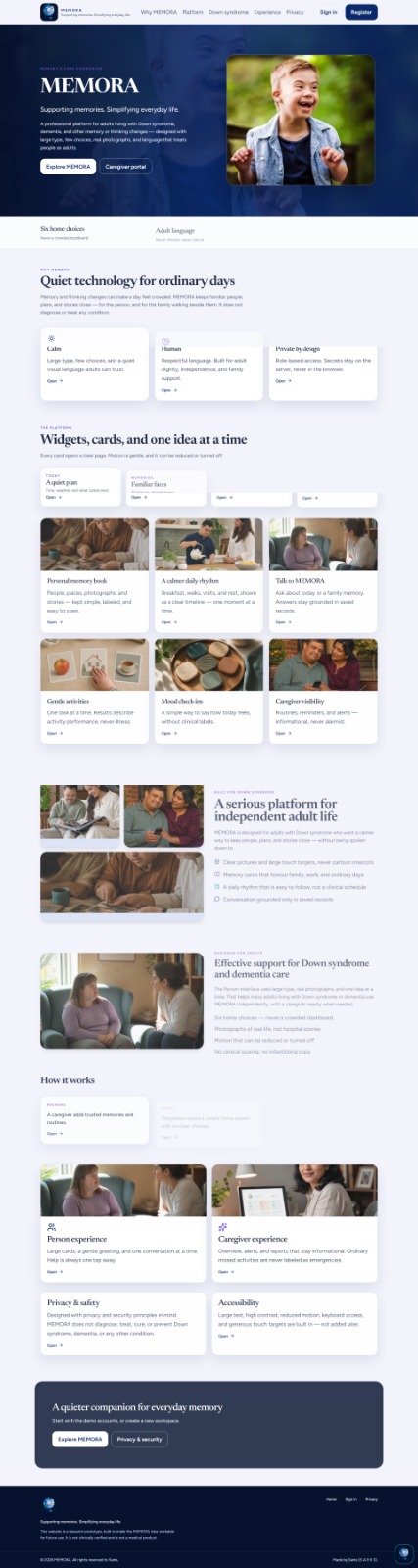
About MEMORA
Inspiration
Memory and thinking changes can make ordinary daily activities feel overwhelming—not only for the person experiencing them, but also for the family members and caregivers supporting them. Familiar faces, important plans, meaningful stories, and everyday routines can become harder to keep track of.
We created MEMORA around a simple belief: technology should make daily life feel more manageable without taking away a person's dignity or independence.
Instead of designing another clinical-looking application, we envisioned a calm, respectful digital companion that keeps meaningful memories, familiar people, and everyday plans close at hand.
What It Does
MEMORA is a memory and care companion concept designed to support people experiencing memory or thinking changes and the families walking alongside them.
Its design focuses on three principles:
- Calm: Large, readable text, simple navigation, and fewer choices help make the experience easier to approach.
- Human: Respectful language and an adult-centered design prioritize dignity, independence, and personal connection.
- Private by Design: Privacy-conscious architecture and role-based access are intended to protect personal information and distinguish access according to user roles.
MEMORA is intended to complement human care, not replace family relationships, professional support, or medical advice. It does not diagnose or treat any condition.
How We Built It
We approached MEMORA as a human-centered technology project, beginning with the experience of the people who would use it rather than starting with features alone.
The prototype is organized around a quiet visual language, accessible reading experiences, clear navigation, and dedicated guidance for calm design, human-centered interaction, and privacy. Our technical direction emphasizes a maintainable web experience and privacy-conscious handling of sensitive personal information.
As we develop the project further, our goal is to explore conversational assistance and appropriate integrations with technology that can make everyday support more accessible.
Challenges We Faced
One of our main challenges was balancing useful functionality with simplicity. An application intended for people experiencing memory difficulties should not overwhelm them with complex menus, excessive information, or unnecessary notifications.
We also had to consider how to create a welcoming experience for adults without making it feel childish or overly clinical. Privacy presented another important challenge because personal memories and family information deserve careful protection.
These considerations shaped our emphasis on clarity, dignity, and privacy as core design principles rather than features added at the end.
What We Learned
MEMORA reinforced an important lesson: meaningful technology is not always about adding more features. Sometimes, the greatest value comes from reducing friction, communicating clearly, and respecting the person using the product.
Accessibility is more than larger text, and privacy is more than a policy page. Both must influence how a product is designed and built.
What's Next
Our vision is to evolve MEMORA into a dependable, accessible companion that helps people stay connected to their memories, routines, and loved ones. We also aim to explore suitable assistive technologies and integrations while keeping usability, consent, privacy, and human dignity at the center.
**MEMORA — Quiet technology for meaningful memories, everyday
Built With
- accessibility
- amazon-alexa
- assistive-technology
- context-protocol-(mcp)aws-react
- css
- html
- human-centered-design
- javascript
- model-context-protocol-(mcp)
- node.js
- privacy
- typescript
- vite


Log in or sign up for Devpost to join the conversation.