-
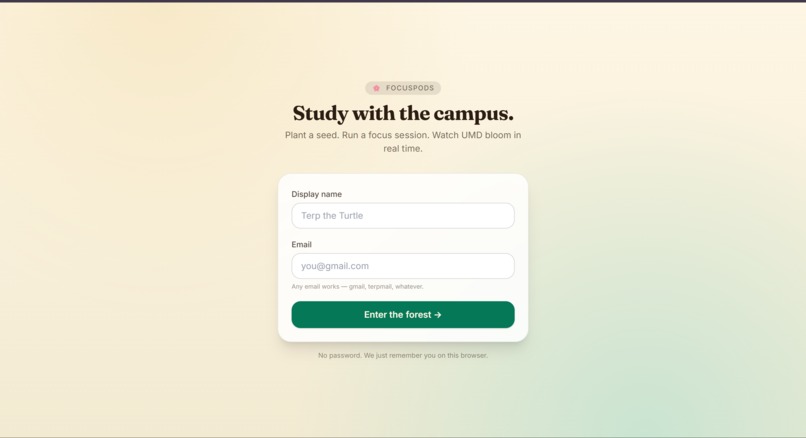
Login page
-
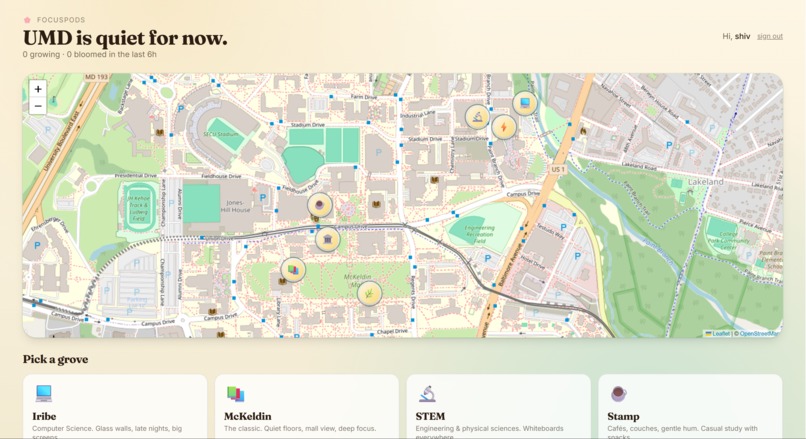
Find your network!
Inspiration
When I started my master’s at UMD in a new country, I realized I had left behind two things I needed way more than I expected:
- My precious AirPods.
- My beloved study friend group back home.
And honestly, both losses hurt.
Back home, studying was not just about discipline. It was about people showing up, sitting beside each other, encouraging each other, and silently keeping each other accountable. Sometimes, you do not need someone to teach you. You just need someone next to you also trying.
At UMD, I found a secret study spot on campus. If you know me, you will probably find me there. I made it my spot. Good chair, decent lumbar support, familiar corner — perfect setup. But even then, I realized it was missing something: the feeling of studying with a peer.
Then one day, another student started showing up around the same time. We did not know each other, but one day we smiled. That tiny moment felt oddly rewarding, like, “Yes, we are both here. We are both trying. We got this.”
That was the emotional seed for FocusPods.
Campus can also get noisy. If I go back to my room, it gets too isolating, and I end up lying to myself: “I’ll study better if I sit on my bed.” I will not. I know myself. I need campus. But without my precious AirPods and ANC, noisy spaces become rough.
So we asked: what if focus support did not have to depend only on expensive hardware or already having a study group?
What it does
FocusPods turns UMD into a living study support network.
It makes the most underrated academic support — peer accountability — accessible through campus study groves, blooming progress, and focus tools for noisy spaces.
Students can:
- Join approximate UMD study groves like Iribe, McKeldin, Stamp, or STEM
- Set a study goal before starting a session
- Study alongside others without needing to know them first
- Watch campus groves bloom as students complete sessions
- Use calming study soundscapes
- Use adaptive lecture-audio modes built for noisy campus environments
FocusPods does not show exact live locations. No creepy tracking. No “here is the exact human sitting behind the third pillar in McKeldin.” It only shows approximate campus zones, so students can feel connected without feeling watched.
How we built it
We built FocusPods as a UMD-only web app with three main flows:
Join Forest
Students choose a campus grove, enter a study goal, start a focus session, and contribute to the grove’s bloom progress.Start Focus Session
Students can use adaptive lecture-audio modes designed for real campus spaces like cafés, lounges, buses, dorm common rooms, and shared study areas.Forest Music
Students can start a calm study session with soft focus soundscapes and a timer.
The app uses a garden metaphor because gamification makes everything better. Come on — who has not been emotionally invested in Clash of Clans, The Sims, or some farming game at least once?
In FocusPods:
- A goal starts as a seed
- A session grows the plant
- A completed session makes it bloom
- More completed sessions make the campus grove come alive
We kept the interface soft, minimal, and non-overstimulating. The goal was for the app itself to feel calm — not like another dashboard screaming for attention.
Challenges we ran into
The biggest challenge was scope. FocusPods could easily become five different products wearing one hoodie: a social app, an audio tool, a map app, a study timer, and a gamified productivity platform.
We had to keep cutting until the core became clear:
FocusPods is about peer accountability and focus support on campus.
Another challenge was privacy. Exact location sharing can feel creepy very quickly, especially on a campus map. So we intentionally designed around approximate UMD zones instead of live user pins.
We also had to be honest about the audio feature. A web app cannot magically turn ordinary earbuds into premium ANC earbuds. As much as I wish it could bring back my AirPods spiritually, it cannot. Instead, we focused on adaptive audio enhancement, calming soundscapes, and focus modes that make studying in noisy spaces more manageable.
Accomplishments that we're proud of
We are proud that FocusPods came from a real student feeling: trying to study in a new place, missing your people, needing accountability, and still wanting to show up.
Instead of building just another productivity timer, we built around the idea that academic support is also social. The app makes invisible study effort visible through blooming groves, while keeping the experience calm, private, and student-friendly.
We are also proud of the framing. FocusPods is not about tracking students or forcing people to socialize. It is about creating the quiet comfort of “someone else is here with me,” even before you have found your people.
What we learned
We learned that the strongest version of FocusPods was not just about audio, maps, or gamification. It was about equity.
Some students naturally find study groups and accountability partners. Others, especially international students, first-gen students, commuters, and transfer students, may not have that network right away.
We also learned that good product design means knowing what not to build. By removing exact tracking, avoiding overclaims about noise cancellation, and keeping the interface minimal, the idea became clearer and stronger.
And personally, we learned that sometimes a tiny smile from another student in a study spot can become a whole product idea.
What's next for FocusPods
Next, we want to make FocusPods more real for UMD students by adding:
- UMD email verification
- More campus study zones
- Real-time grove activity
- Better bloom and progress animations
- More focus soundscapes
- Improved adaptive audio modes
- Anonymous peer check-ins
- Personal garden history and study streaks
Long term, FocusPods could help campuses understand where students study, when they need support, and how to make academic spaces feel more connected — without compromising student privacy.
The dream is simple: no student should have to study alone just because they have not found their people yet.
Built With
- and-lowdb-to-power-the-umd-study-groves
- anthropic-claude-api
- built-with-react
- campus-map
- express.js
- framer-motion
- leaflet.js
- lowdb
- node.js
- react
- realtime-blooms
- socket.io
- tailwind-css
- typescript
- vite
- web-audio-api

Log in or sign up for Devpost to join the conversation.