-
-
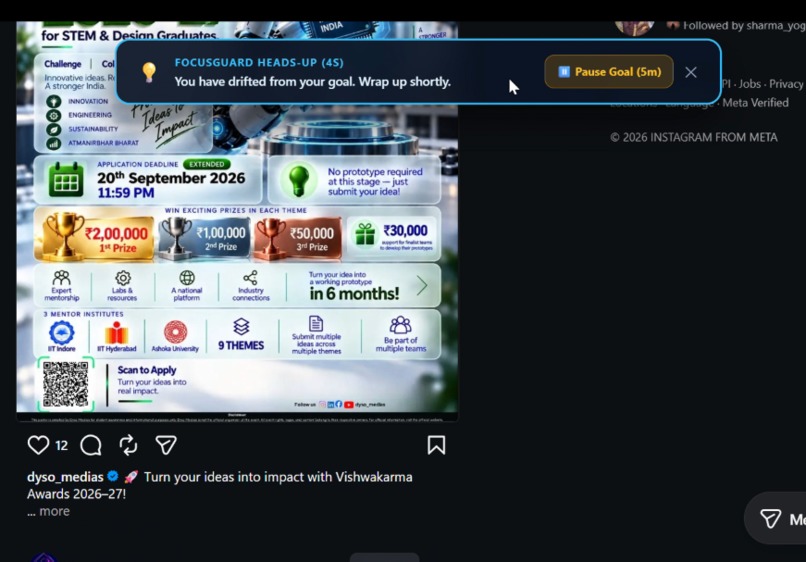
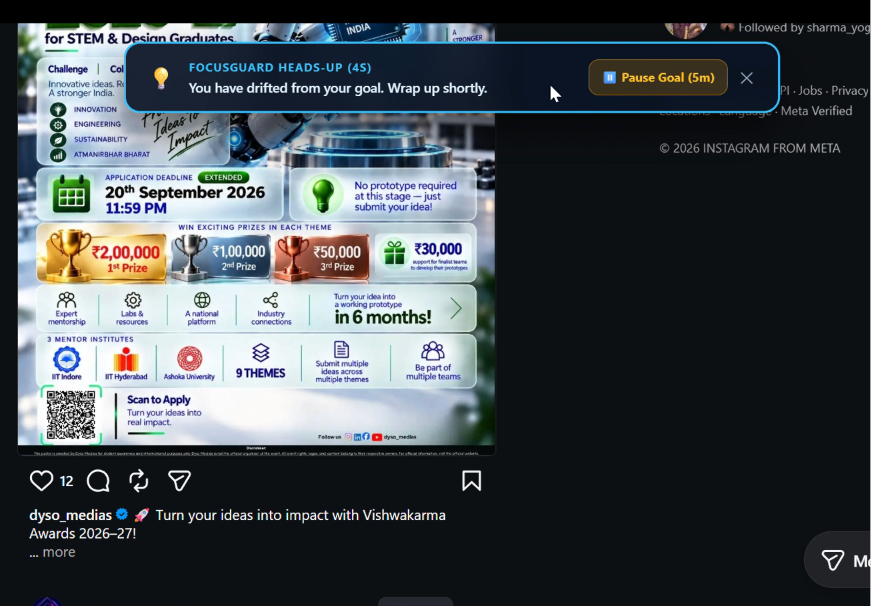
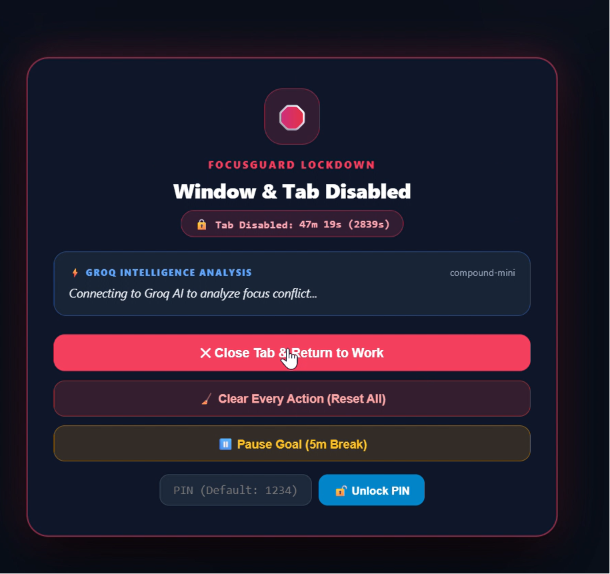
Alert while using insta during focus session
-
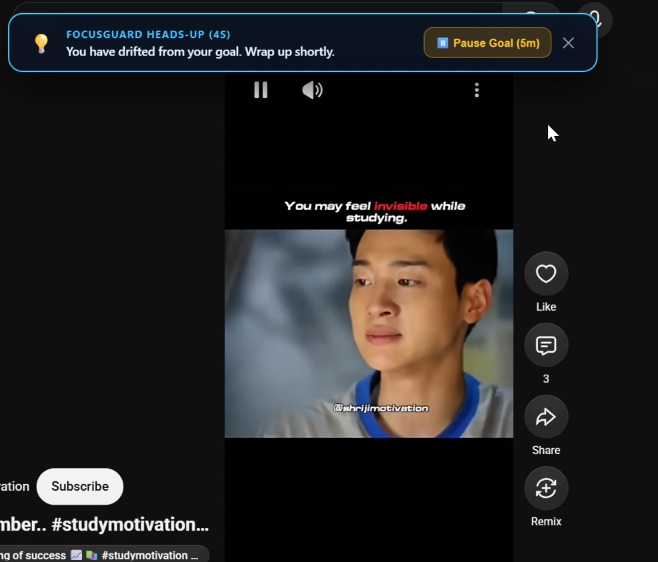
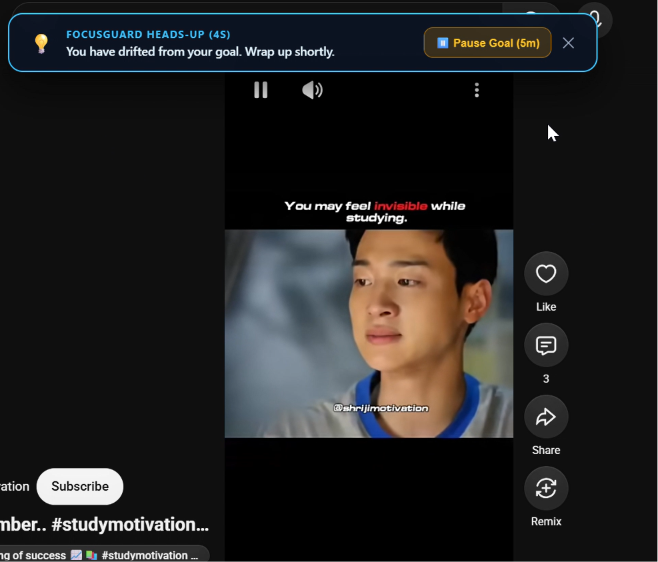
alert while watching shorts during focus session
-
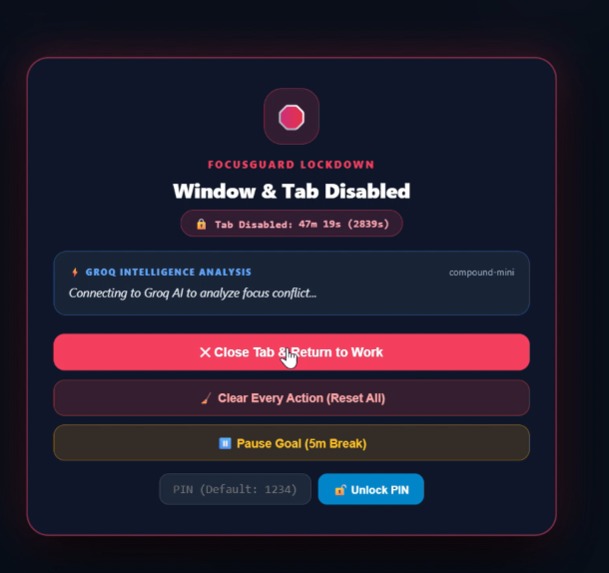
intervention alert
-
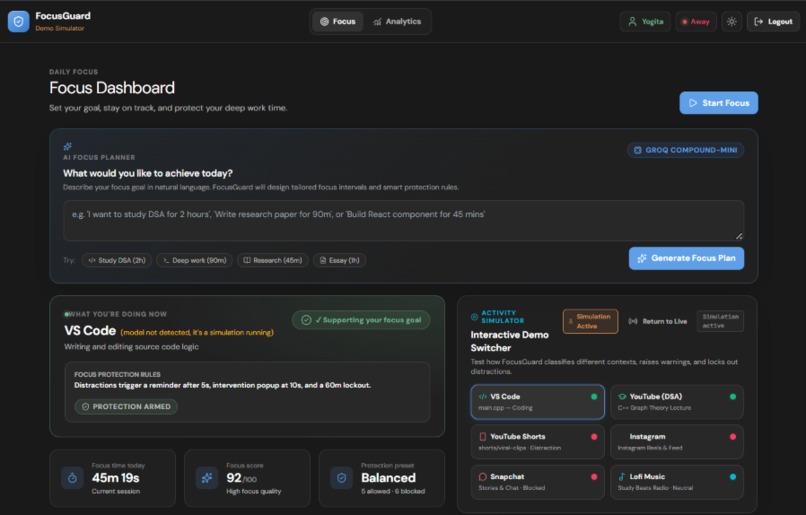
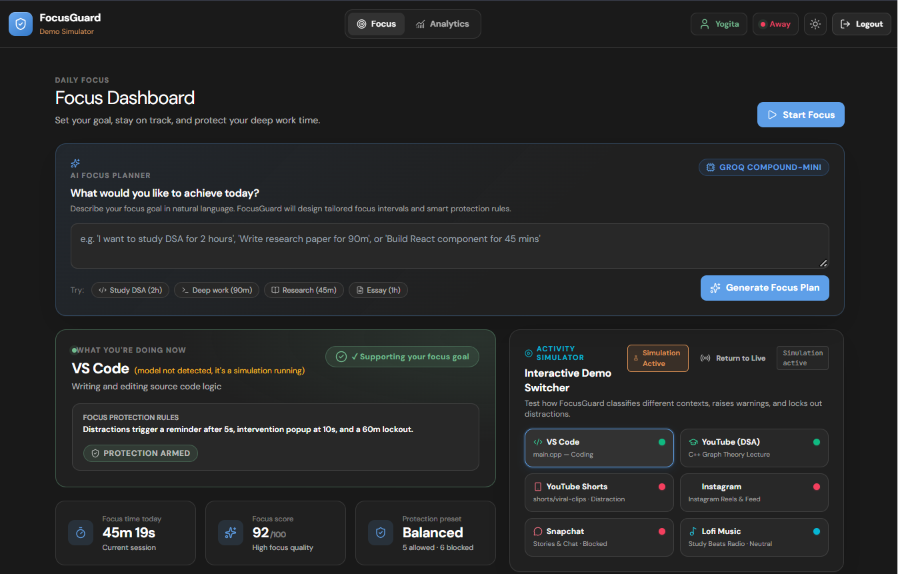
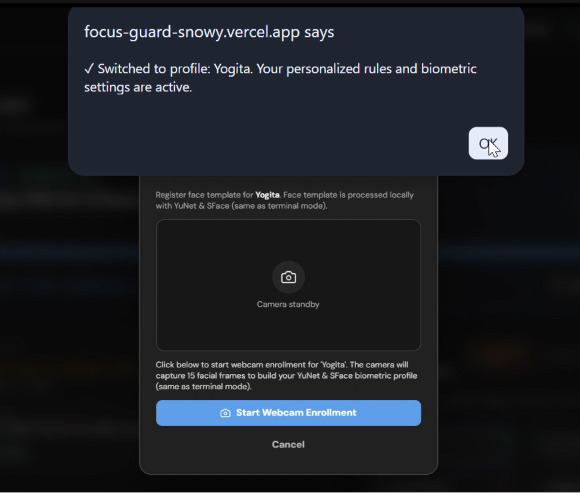
dashboard with user login and face enrolled
-
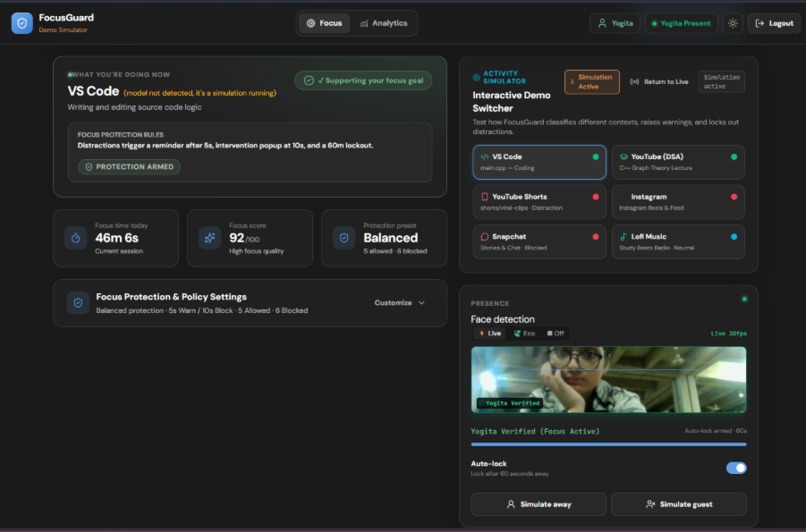
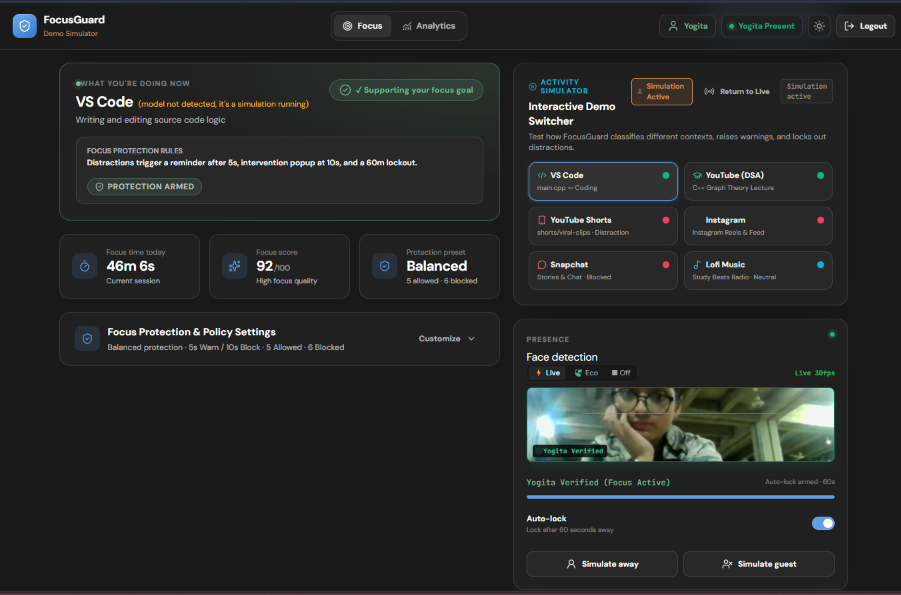
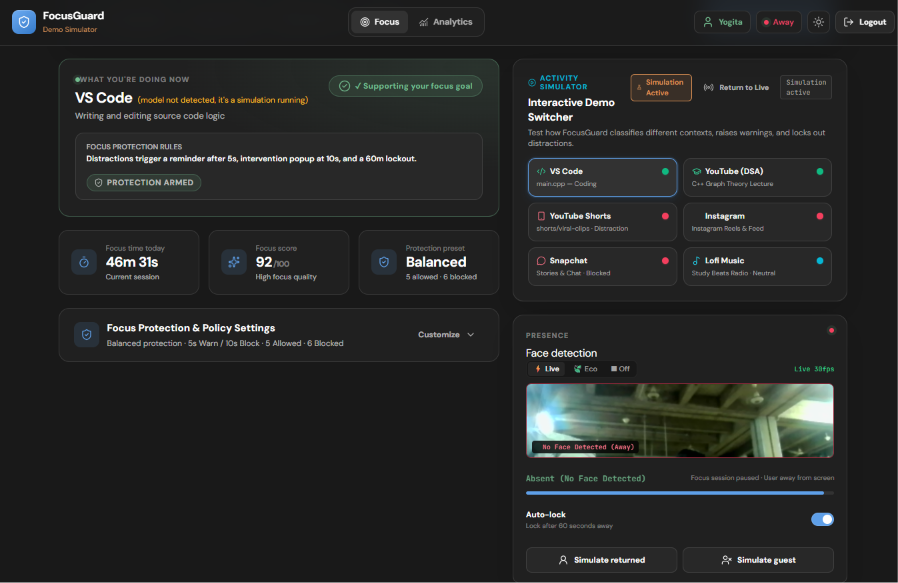
user detection : status active
-
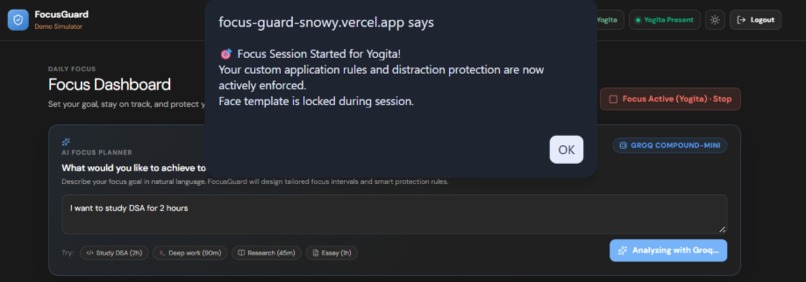
user login
-
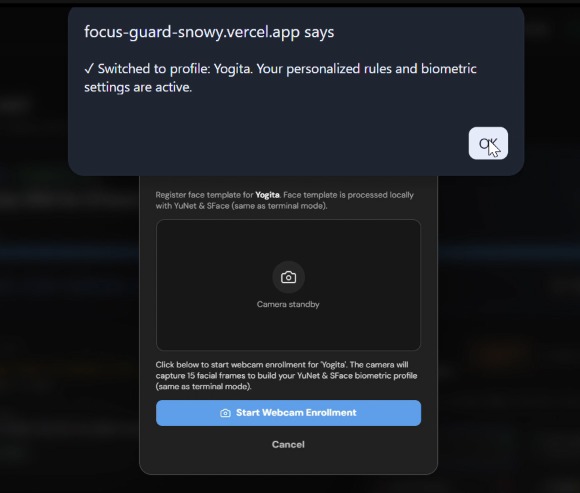
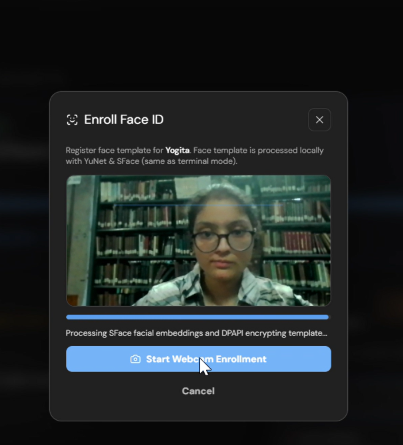
enrolling of the face
-
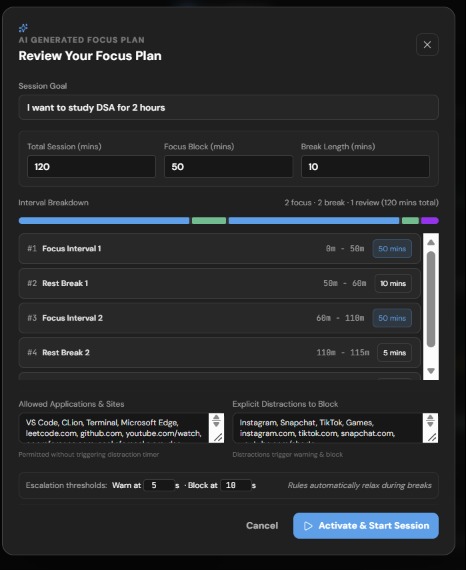
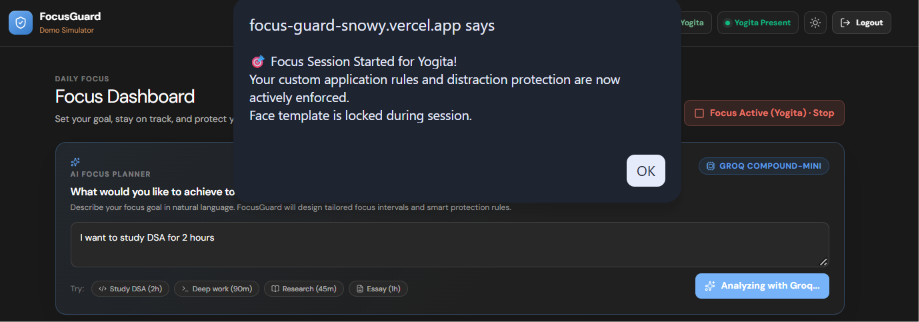
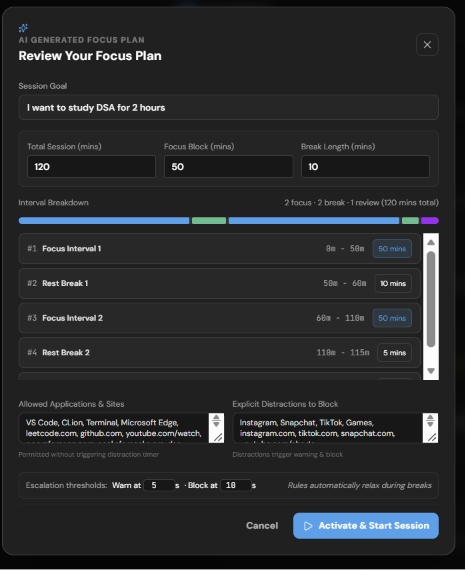
setting up of the goal
-
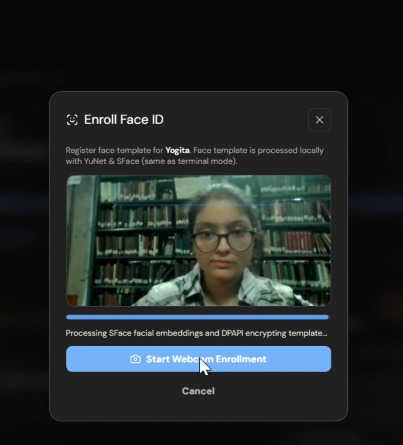
face id enrolled
-
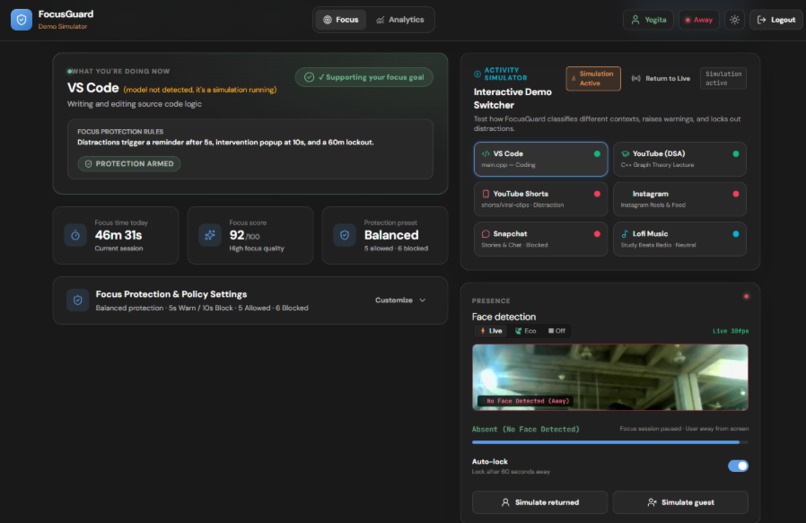
detection when user is away
Inspiration
In an era of relentless notifications, infinite scrolling feeds, and multitasking overload, staying focused is harder than ever. Most website blockers and productivity apps share the same fundamental flaws:
- They are trivial to bypass: A simple shortcut, incognito window, or process kill disables them.
- They lack physical awareness: They don't know whether you are actively sitting at your desk, daydreaming, or if someone else has sat down at your workstation.
- They rely on crude domain blocklists: They cannot differentiate between reading documentation on Reddit or watching gaming clips, nor do they understand visual desktop context. We built FocusGuard to reinvent distraction management as an intelligent, biometric-anchored guardian for your workstation. FocusGuard pairs low-level OS telemetry with on-device computer vision and multimodal AI—ensuring that you only unlock your deep-work environment with your own face, and gently steering you back on track whenever you drift away.
What it does
FocusGuard is a high-performance, two-tier productivity and biometric workstation security suite that:
- Biometric Face ID & Lock Screen Gate: Gates monitoring and desktop enforcement behind local facial recognition. On launch, a custom Win32 dark-mode lock screen requires biometric verification before granting focus privileges.
- Presence Auto-Lock: Periodically probes the camera for user presence in under (150\text{ ms}). If you step away from your desk for over 60 seconds (or lock Windows), FocusGuard instantly engages security lock mode and pauses tracking.
- Anti-Spoofing Liveness Defense: Analyzes multi-frame landmark micro-movements and Eye Aspect Ratio (EAR) fluctuations to reject static photos, phone displays, and prerecorded video replays.
- Real-Time Multi-Browser URL Sniffing: Uses Windows UI Automation (
IUIAutomation) to inspect the active tabs of Microsoft Edge, Google Chrome, Brave, and Mozilla Firefox in real time without requiring browser extensions (though a companion extension is also available). - 3-Tier Distraction Escalation Engine:
- ⚠️ 2s Warning: Gentle notification nudge.
- 🚨 7s Strong Alert: Persistent visual toast and audio cue.
- 🛑 10s Intervention: Automatically minimizes distracting windows and locks out unproductive workflows.
- Multimodal Visual AI (Qwen 2.5-VL / Gemma 3): When URLs or window titles are ambiguous, FocusGuard captures the screen via high-speed DirectX duplication (
dxcam) and uses local visual LLMs to determine whether your activity aligns with your active goals. - Zero-Cloud, Privacy-First Architecture: 100% on-device. No camera feeds or screenshots ever leave the machine. Biometric templates are stored as 128-dimensional mathematical vectors encrypted with Windows DPAPI.
How we built it
FocusGuard was engineered with a hybrid, two-tier architecture prioritizing native performance and modern AI capabilities:
1. High-Performance C++17 Daemon (focusguard_monitor)
- Compiled with CMake and Ninja using modern C++17.
- Directly hooks into Win32 APIs (
PROCESS_QUERY_LIMITED_INFORMATION,QueryFullProcessImageNameA) to capture active process state in microseconds. - Utilizes COM-based Microsoft UI Automation to extract real-time URL bar strings across top Chromium and Gecko browsers.
- Manages the state machine: $$\text{LOCKED} \xrightarrow{\text{Face ID / PIN}} \text{AUTHENTICATING} \xrightarrow{\text{Success}} \text{UNLOCKED} \xrightarrow{\text{Absence } > 60\text{s}} \text{LOCKED}$$ ### 2. Python Vision & Biometric Bridge
- Face Detection: Powered by OpenCV YuNet (
face_detection_yunet_2023mar.onnx), performing ultra-fast face bounding and 5-point facial landmark extraction in < 10 ms on CPU. - Feature Extraction: Powered by OpenCV SFace (
face_recognition_sface_2021dec.onnx), mapping facial geometry into a normalized 128-dimensional hypersphere (u ∈ ℝ¹²⁸). - Matching Metric: We compute Cosine Similarity between enrolled template (u) and live sample (v):
$$ S_C(\mathbf{u}, \mathbf{v}) = \frac{\mathbf{u} \cdot \mathbf{v}}{|\mathbf{u}|_2 |\mathbf{v}|_2} \ge 0.363 $$
Matches are authenticated when Cosine Similarity ≥ 0.363 (SFace verification threshold).
- Liveness & Anti-Spoofing: Calculates multi-frame landmark dispersion and Eye Aspect Ratio (EAR):
$$ \text{EAR} = \frac{|p_2 - p_6|_2 + |p_3 - p_5|_2}{2|p_1 - p_4|_2} $$
Matches are authenticated when Cosine Similarity ≥ 0.363 (SFace verification threshold).
- Liveness & Anti-Spoofing: Calculates multi-frame landmark dispersion and Eye Aspect Ratio (EAR):
$$ \text{EAR} = \frac{|p_2 - p_6|_2 + |p_3 - p_5|_2}{2|p_1 - p_4|_2} $$
Ensures natural blinking and 3D micro-movement before confirming identity.
- Hardware-Backed Encryption: Biometric arrays are encrypted via Windows Data Protection API (
CryptProtectData), tying the template directly to the active Windows user account. - Visual Understanding: Local multimodal inference with Qwen 2.5-VL (3B) and Gemma 3 via Ollama for semantic screen classification. ### 3. Glassmorphic Web Dashboard & Policy Studio
- Real-time distraction radar with animated escalation states.
- Policy customization (Whitelist/Blacklist, strict exam mode, dev mode).
- Real-time activity simulator and productivity analytics.
Challenges we ran into
- Sub-Second Biometric Verification without GPU Hogging: Running neural models on consumer laptops while users are actively working requires near-zero overhead. We transitioned from bulky deep learning frameworks to lightweight ONNX models (YuNet + SFace) executed natively via OpenCV's DNN backend, bringing face detection down to sub-10ms on CPU.
- Preventing Spoof Attacks with Standard Webcams: Without specialized TrueDepth or IR sensors, software-only anti-spoofing is notoriously difficult. We implemented temporal micro-variance tracking of facial landmarks and EAR calculations across 20-frame buffers to cleanly reject static paper and smartphone screen presentations.
- Low-Overhead Win32 UI Automation: Calling UI Automation on the primary monitoring thread initially created subtle UI micro-stutters in third-party browsers. We resolved this by decoupling process polling, UI Automation tree walking, and policy actions across isolated worker threads with thread-safe atomic flags.
- Zero-Trust Biometric Security: Storing photos or raw video on disk is unacceptable for privacy. We engineered a strict discard pipeline: frames exist only in transient RAM, and only normalized floating-point embeddings are encrypted using OS-level DPAPI keys.
Accomplishments that we're proud of
- Lightning Fast: Sub-10ms face detection and sub-150ms presence verification running purely on consumer CPUs.
- Ironclad Privacy: Absolutely zero telemetry, zero cloud calls, and zero retained camera images.
- Robust Hybrid Engineering: A seamless bridge between a low-level C++17 Win32 monitoring daemon and an intelligent Python AI engine via a local JSON-RPC/HTTP micro-API.
- Smooth User Experience: A beautiful, non-intrusive distraction escalation workflow that balances user empathy (warnings) with resolute enforcement (auto-minimization).
What we learned
- Mastered low-level Windows UI Automation and process introspection using Win32 C++.
- Gained deep practical knowledge in biometric embedding spaces, cosine similarity thresholds, and computer vision anti-spoofing techniques.
- Explored local small multimodal models (Qwen 2.5-VL / Gemma) for real-time semantic desktop understanding.
- Learned how to implement hardware-bound OS encryption with Windows DPAPI to safely store sensitive mathematical vectors.
What's next for FocusGuard
- Cross-Platform Parity: Porting the background daemon to macOS (via
CoreGraphics& Quartz) and Linux (via Wayland/X11). - NPU Acceleration: Leveraging Windows DirectML and Intel/Qualcomm NPU runtimes for zero-CPU background inference.
- Calendar & Deep-Work Goal Integration: Automatic session scheduling synced with Google Calendar and Notion tasks.
- Posture & Ergonomics Alerting: Extending the YuNet facial landmark pipeline to monitor neck strain and screen distance during prolonged focus sprints.
Built With
- artificial-intelligence
- biometrics
- c++
- chrome
- cmake
- computer-vision
- cryptography
- css3
- cybersecurity
- directx
- dpapi
- gemma
- html5
- javascript
- liveness-detection
- machine-learning
- ollama
- onnx
- opencv
- python
- qwen2.5-vl
- rest-api
- ui-automation
- win32-api


Log in or sign up for Devpost to join the conversation.