-
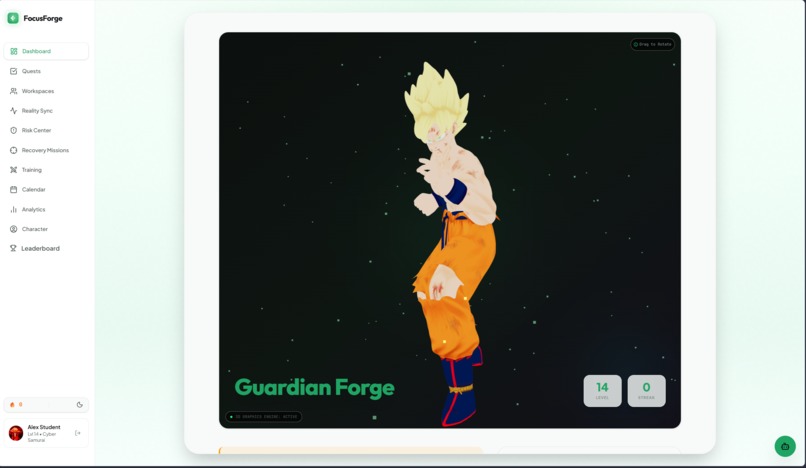
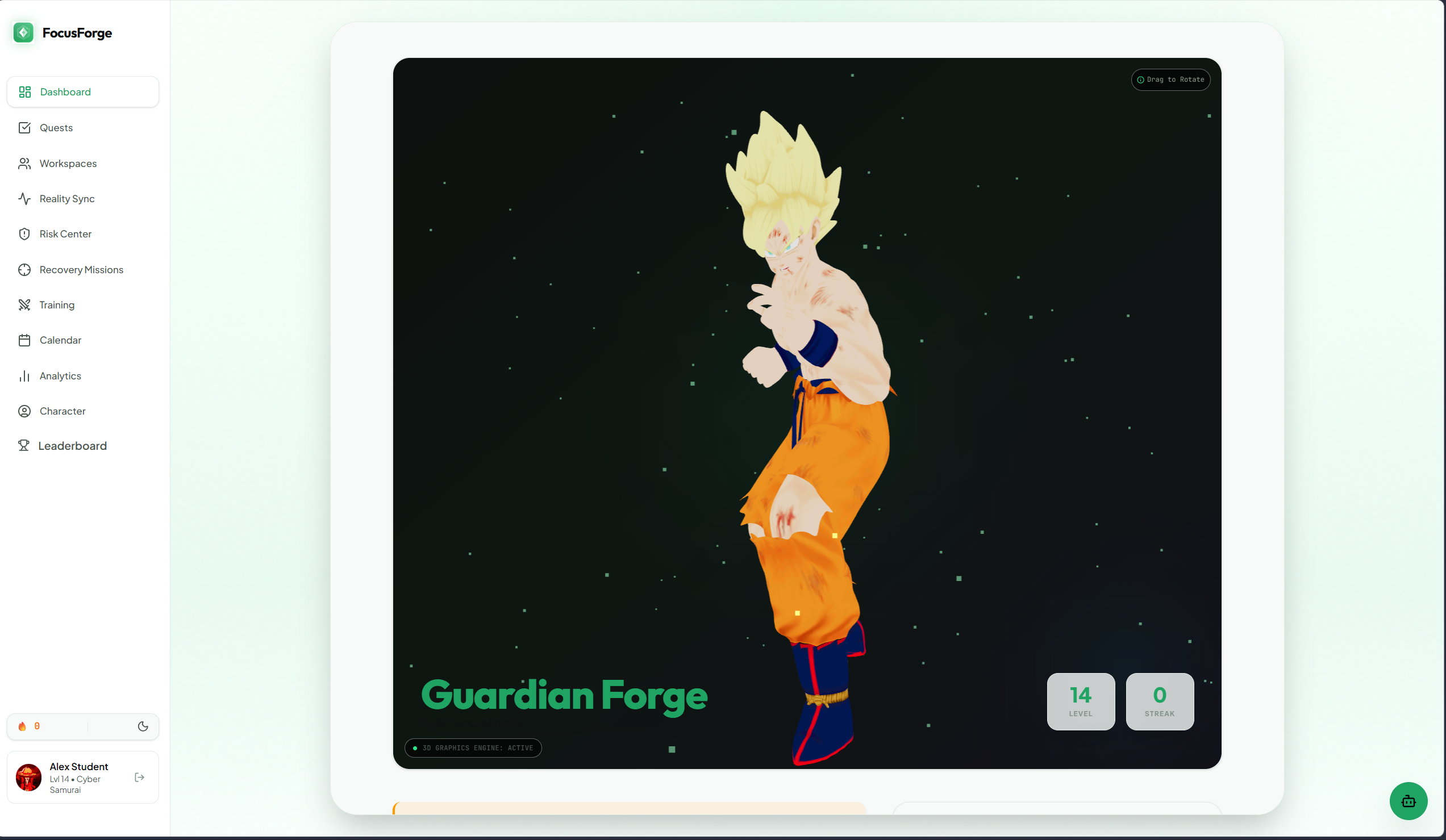
Dashboard
-
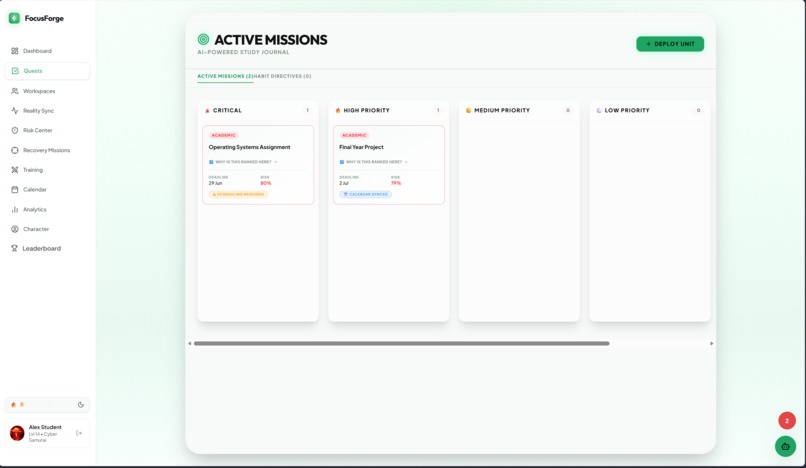
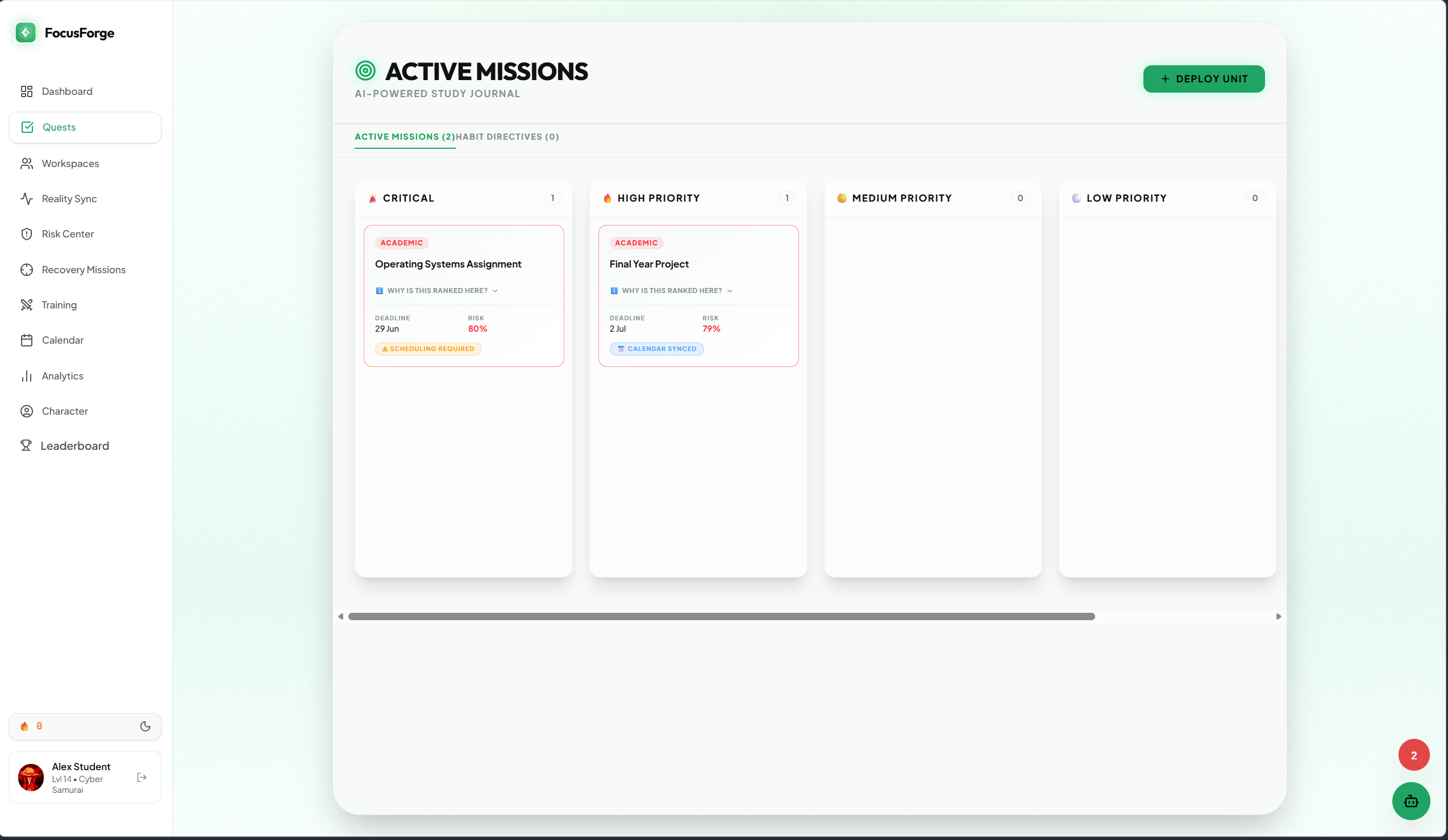
quests
Inspiration
We’ve all had days where we create a perfect to-do list in the morning, feel productive for a while, and then realize at the end of the day that the important things were never completed.
Most productivity apps stop at “What do you plan to do?” They give us task lists, calendars, reminders, and timers — but they rarely ask the more important question:
“Did reality actually match the plan?”
That gap between planned work and actual execution became the inspiration for FocusForge.
We wanted to build a productivity system that doesn't simply help people create more plans. Instead, it helps them understand when they're falling behind, identify what is at risk, and recover intelligently before a missed commitment becomes a missed deadline.
That led us to FocusForge — an AI-powered, gamified productivity companion built around one idea:
Turn plans into progress.
What it does
FocusForge combines productivity, AI, analytics, and gamification into one system.
🎯 Smart Task Management
Users can create tasks and organize their work based on priority, deadlines, and progress.
🔄 Reality Sync
FocusForge compares planned progress with actual progress.
Instead of assuming that a completed task means the plan worked, the system continuously looks at execution and identifies gaps between what was expected and what actually happened.
🚨 Risk Center
When tasks start falling behind, FocusForge identifies potential risks and highlights commitments that may be missed.
This changes productivity from simply tracking failure after it happens to recognizing problems early.
🛠️ Recovery Missions
When something goes off track, the system doesn't just show a warning.
It generates a recovery path — helping users decide what should be done next to get back on schedule.
🤖 AI Command Center
The AI assistant acts as a productivity companion that can help users understand their workload, plan actions, and make decisions based on their current situation.
⏱️ Focus Timer
A built-in focus/Pomodoro system helps users turn plans into actual execution.
🎮 Gamification
Productivity becomes a progression system through:
- XP
- Levels
- Streaks
- Missions
- Character progression
- Reliability scoring
- Leaderboards
The goal isn't simply to complete the most tasks.
It's to become more reliable at doing what you commit to.
How we built it
FocusForge was built as a modern web application using React, TypeScript, Vite, Firebase, and Gemini-powered AI capabilities.
The application is organized around several core engines:
Reality Sync Engine → Risk Engine → Priority Engine → AI Planner → Execution Layer → Motivation Layer
The Reality Sync Engine tracks the difference between planned and actual progress.
The Risk Engine analyzes deadlines, progress, and incomplete work to identify tasks that are becoming risky.
The Priority Engine helps determine which work deserves attention first.
The AI Planner then uses this context to generate a practical recovery plan instead of giving generic productivity advice.
On top of these systems, we built the execution layer with the Focus Timer and task workflow, followed by a gamification layer that turns consistent execution into XP, levels, streaks, and character progression.
We used Firebase for authentication and cloud data storage, while the frontend provides a responsive dashboard containing task management, calendar scheduling, analytics, risk monitoring, recovery missions, and AI interactions.
Challenges we ran into
1. Building something beyond another to-do list
The biggest challenge was deciding what actually makes FocusForge different.
Adding an AI chatbot to a task manager would have been easy, but it wouldn't solve the real problem.
We therefore focused the product around the planned-vs-actual execution gap and designed the rest of the system around it.
2. Turning productivity data into useful decisions
Having task data is one thing. Making meaningful decisions from it is another.
We had to think about how deadlines, progress, priorities, missed tasks, and available time should interact so that the system could identify risk without overwhelming the user.
3. Designing AI that is actually useful
We didn't want AI responses that simply sounded intelligent.
The AI needs to understand the user's current workload and provide actionable guidance — particularly when something goes wrong.
This pushed us toward contextual AI workflows instead of treating the AI as a standalone chatbot.
4. Balancing productivity with gamification
Gamification can easily become distracting.
We wanted XP, levels, streaks, missions, and character progression to reinforce productive behavior rather than turn productivity itself into another game to constantly manage.
5. Building a large feature set without making the interface overwhelming
FocusForge contains many different systems — tasks, calendar, AI, risk detection, recovery planning, analytics, focus sessions, and gamification.
Designing an interface where these features feel like one coherent product rather than separate tools required many iterations.
Accomplishments that we're proud of
We're especially proud that FocusForge evolved beyond a traditional productivity dashboard into a system centered around execution reliability.
Some of the things we're most proud of are:
- Building a complete AI-powered productivity platform rather than a single-feature prototype
- Creating the Reality Sync concept for comparing plans against actual execution
- Designing the Risk Center to identify problems before deadlines are missed
- Creating Recovery Missions that turn setbacks into actionable next steps
- Integrating AI into the actual productivity workflow instead of keeping it as a separate chatbot
- Building a gamification system around consistency and reliability
- Combining task management, calendar scheduling, focus sessions, analytics, AI, and progression into one experience
- Creating a polished interface designed to feel more like a productivity game than a traditional task manager
Most importantly, we're proud of the idea behind the product:
Productivity shouldn't only measure what you planned. It should measure how reliably you turn those plans into reality.
What we learned
Building FocusForge taught us that the hardest part of an AI product isn't simply integrating an AI model.
The real challenge is designing the system around the AI.
We learned how important context is when generating useful AI recommendations. A generic suggestion is easy to generate, but a recommendation based on deadlines, incomplete tasks, priorities, and actual execution is much more valuable.
We also learned that productivity is highly dynamic.
A plan that looks perfect in the morning can become unrealistic a few hours later. A useful productivity system therefore needs to adapt instead of forcing the user to follow a plan that no longer makes sense.
Another major lesson was that gamification works best when it reinforces meaningful behavior. XP and streaks are more valuable when they represent consistency and reliability rather than simply rewarding users for clicking “complete.”
Most importantly, we learned to think of productivity as a feedback loop:
$$ Plan \rightarrow Execute \rightarrow Measure \rightarrow Detect Risk \rightarrow Recover \rightarrow Improve $$
That feedback loop became the foundation of FocusForge.
What's next for FocusForge
FocusForge is still evolving, and there are several directions we want to explore next.
🧠 More Personalized AI
Over time, FocusForge could learn each user's execution patterns and make increasingly personalized recommendations.
Instead of simply asking “What should I do next?”, the system could understand when, how, and under what conditions the user works best.
📈 Predictive Productivity
We want to move from detecting current risk to predicting future problems.
For example, FocusForge could identify that a project is likely to miss its deadline several days before the user realizes it.
🔗 More Integrations
Future versions could connect with external calendars, GitHub, task-management platforms, communication tools, and other productivity services so that Reality Sync can work with real-world activity automatically.
👥 Team Reliability
The reliability concept could also extend beyond individuals.
Teams could use FocusForge to understand project execution, identify bottlenecks, and recover delayed work while maintaining individual accountability.
📱 Native Mobile Experience
A dedicated mobile application would make FocusForge available throughout the day, with notifications, quick task capture, voice interaction, and real-time recovery suggestions.
🤖 A More Autonomous AI Productivity Agent
Our long-term vision is for FocusForge to become more than an assistant that waits for commands.
We want it to become an execution partner that understands commitments, notices when reality is changing, recommends what to do next, and helps users consistently finish what matters.
FocusForge isn't about creating the perfect plan.
It's about becoming better at keeping the plans that matter.


Log in or sign up for Devpost to join the conversation.