Inspiration
Modern work is often scattered across notes, messages, calendars, documents, and task managers. Even when people know what they need to do, they can still lose time deciding where to start, which task matters most, and how to turn large goals into manageable actions.
We created FocusFlow AI to reduce that friction. Our goal was to build a simple AI productivity assistant that transforms unstructured thoughts, tasks, and deadlines into a clear daily plan.
What It Does
FocusFlow AI helps users:
Capture tasks, notes, deadlines, and ideas in natural language Turn large or unclear goals into smaller actionable steps Prioritize work based on urgency, importance, and estimated effort Generate a realistic daily schedule Summarize the most important tasks for the day Reorganize plans when priorities or deadlines change Keep users focused on the next meaningful action
For example, a user can enter:
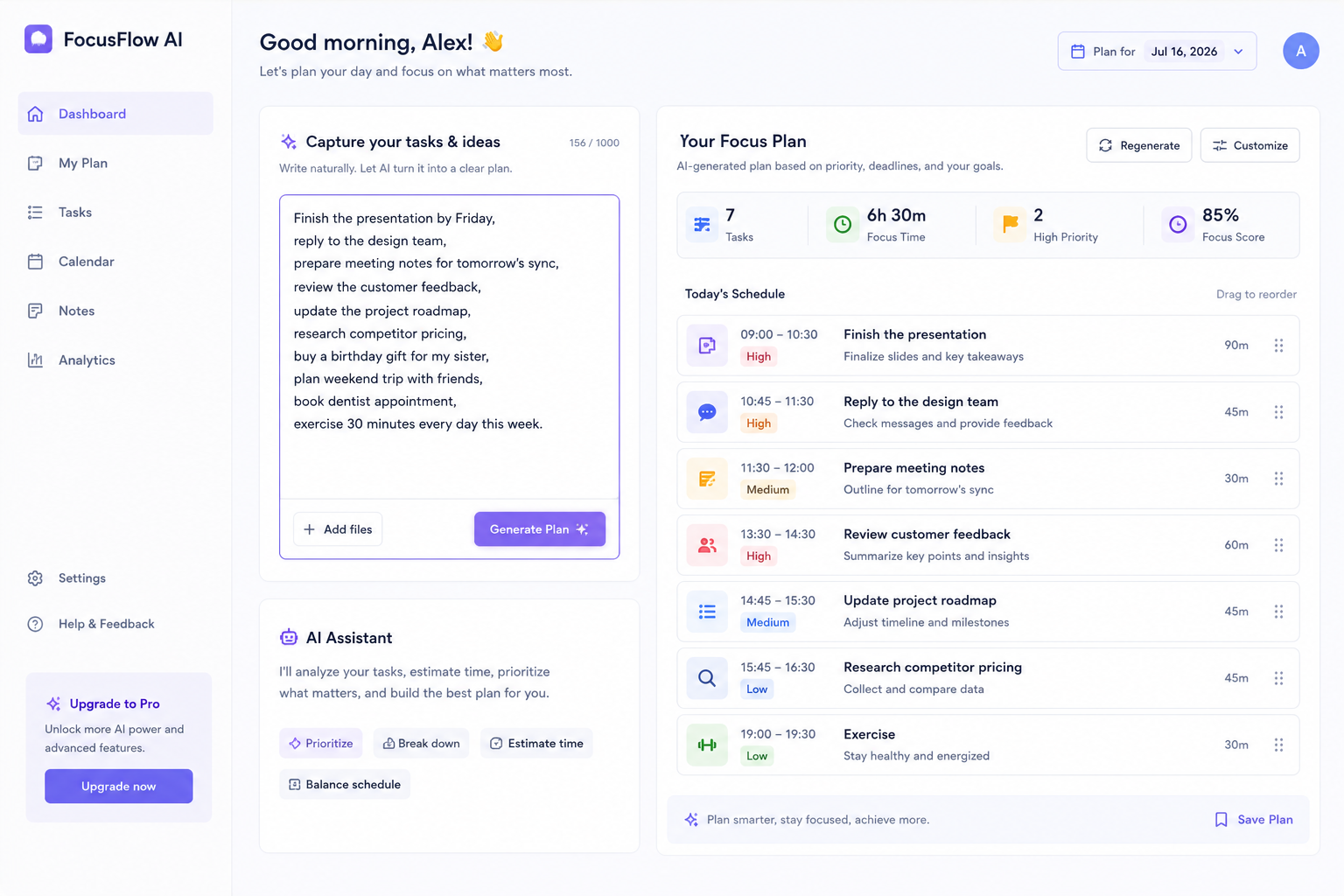
Finish the presentation by Friday, reply to the design team, prepare meeting notes, and review the customer feedback.
FocusFlow AI analyzes the request, identifies separate tasks, assigns priorities, and produces an organized action plan.
How We Built It
We built FocusFlow AI as a lightweight web application with a simple task-entry interface and an AI-powered planning workflow.
The frontend was created with Next.js, React, TypeScript, and Tailwind CSS. The application sends the user's notes and tasks to an AI planning layer powered by the OpenAI API.
The planning workflow processes the input in several stages:
Extract individual tasks from unstructured text Detect deadlines, dependencies, and urgency Estimate task complexity and required effort Rank tasks by priority Generate a structured and readable daily plan Allow the user to revise or regenerate the plan
We used structured JSON output to keep the generated plans consistent and easy to display in the interface. User data and saved plans can be stored with Supabase, while the application can be deployed through Vercel.
We also used Codex during development to help prototype components, debug application logic, improve prompts, and accelerate iteration.
Challenges We Faced
One of the biggest challenges was turning vague user input into a useful plan. People often describe tasks without clear deadlines, durations, or priorities. The system needed to make reasonable suggestions while avoiding overly rigid assumptions.
Another challenge was balancing ambition with realism. An AI assistant can easily create a schedule that looks organized but includes too many tasks. We addressed this by considering task effort, available time, urgency, and dependencies before creating the final plan.
We also worked on making the AI output predictable. Free-form responses were difficult to display consistently, so we designed a structured response format for task names, priorities, estimated durations, explanations, and recommended next actions.
What We Learned
This project taught us that useful AI productivity tools require more than generating text. The quality of the experience depends heavily on:
Clear prompt design Structured outputs Thoughtful task-prioritization rules Fast user feedback loops Simple and understandable interfaces Giving users control over AI-generated decisions
We also learned how Codex can support rapid development by helping with code generation, debugging, refactoring, and documentation.
Accomplishments We Are Proud Of
We are proud that FocusFlow AI can transform a messy paragraph into a practical, organized plan within seconds.
We also created a workflow that explains why tasks receive certain priorities, making the recommendations easier to understand and adjust. The project demonstrates how AI can reduce planning overhead and help users begin meaningful work more quickly.
What's Next
Our next steps include:
Calendar integration Recurring tasks and reminders Team collaboration features Personalized productivity preferences Automatic schedule adjustments Progress tracking and weekly summaries Voice-based task capture Integrations with email and project-management tools
Our long-term vision is for FocusFlow AI to become a personal planning layer that helps users move smoothly from ideas to action.
Built With
- codex
- css
- github
- html
- javascript
- next.js
- node.js
- openai
- postgresql
- react
- supabase
- tailwind
- typescript
- vercel

Log in or sign up for Devpost to join the conversation.