-
-
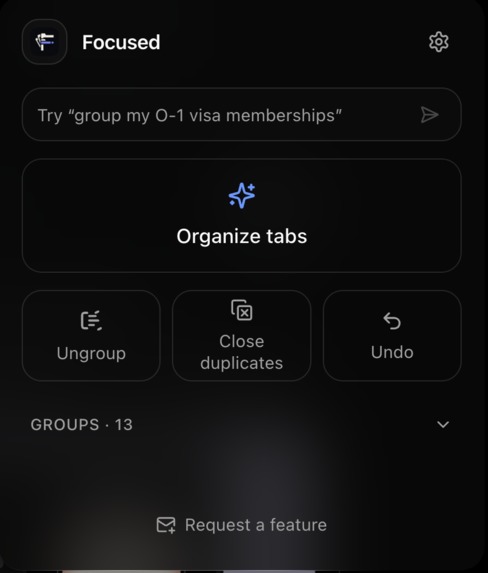
What the extension window looks like
Why I made this
At any given moment I have somewhere between 20 and 40 browser tabs open. It got annoying. I was burning real time going back and forth trying to work out which tab had what, where the audio was coming from, or where I'd saved that one thing I needed for later.
Then I noticed I'd started leaving tabs open on purpose, as a sort of memory state, stuff to come back to later. So I was paying for that memory in navigation time, every single day. I wanted a fix I had full control over the UX of, which meant building it myself.
How it works
Click a button on the extension. It reads every open tab, works out what you were doing, and groups everything by intent.
It's really smart - Ten Twitter tabs won't collapse into one "entertainment" pile. The research thread you had open goes to research. The self-improvement essay goes to a self-improvement group. Same site, different jobs, different groups.
You can also just talk to it:
- Forgot which hotel you liked? Describe it. Mine was "the one under $200 a night" and it found the tab out of 20 other hotel tabs.
- Twenty LinkedIn profiles open for investor research and no memory of which name is which? Describe what you remember and it opens the right one.
- Export your usage and history as a .md file, drop it into ChatGPT or Claude, and find out where your attention actually went last week.
Plus stashing with resume briefs, merging windows, duplicate cleanup, undo, and spend caps. Runs on your own API key or fully local, so nothing ever touches any server.
How I built it
React 19, TypeScript, Tailwind v4, Vite. A dependency-free Manifest V3 service worker, split out of one 2,090-line file into 12 modules. 124 tests across 17 files.
I ran GPT-5.6 Codex and Claude in parallel Conductor workspaces the whole way: 24 workspaces, 42 sessions, ten merged branches. Codex built the multi-provider platform in a single thread, 83 tool calls, one commit, 1,706 additions. Then I pointed a max-reasoning Codex audit at my rushed hackathon code, and the hardening plan it wrote took the project from zero tests to 94.
I got some feedback - What users said
Every single person I showed this to said they needed it and that it would save them hours. Then they told me what was broken, and each fix shipped:
- Didn't like the groups it made → undo feature + custom instructions for personalisation
- Four windows open at once → ability to merge windows
- Too lazy to click the button → smart trigger based auto-sort once you cross a tab count threshold/time
- Browser eating their RAM → per-group RAM usage, so you can see what to close
What I learned
Building this was fun, I already got 30 users and I haven't even posted about it online yet. It's just practical and useful, so it's always a good idea to scratch your own itch - Using this over the week has already saved me a couple of hours. while building - two agents with tests and PRs as the boundary beat either agent alone. The Codex review of the command engine caught an incognito metadata leak, an error-reporting bug, and broken cascade timing before any of it merged. I'd never have caught that reading the diff myself.
What's next
Chrome Web Store release, session memory so it becomes self evolving, making api keys optional and turning this into a subscription access.
Built With
- 5
- 5.5
- 5.6luna
- 5.6sol
- codex
- conductor
- fable
- openai


Log in or sign up for Devpost to join the conversation.