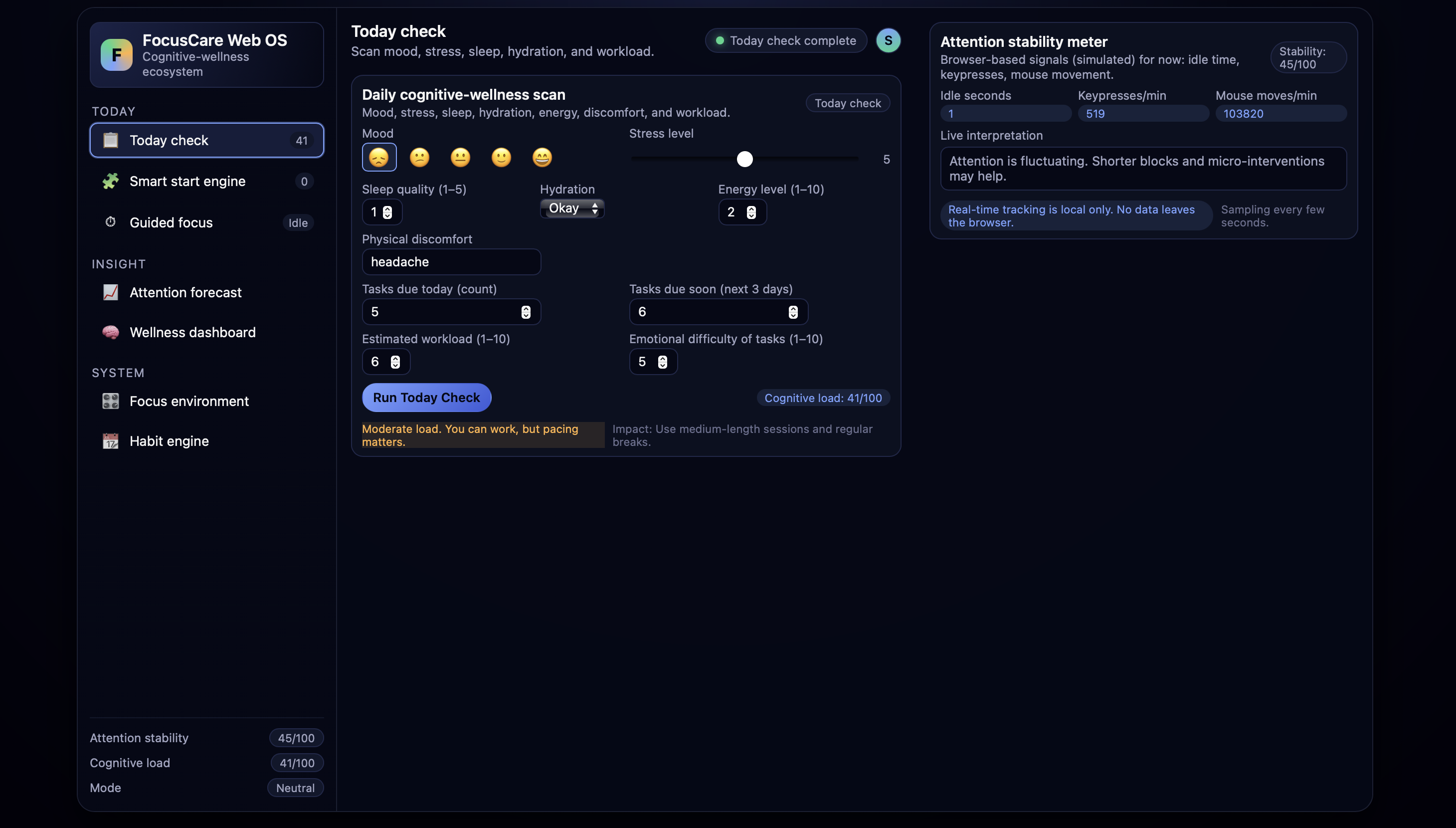
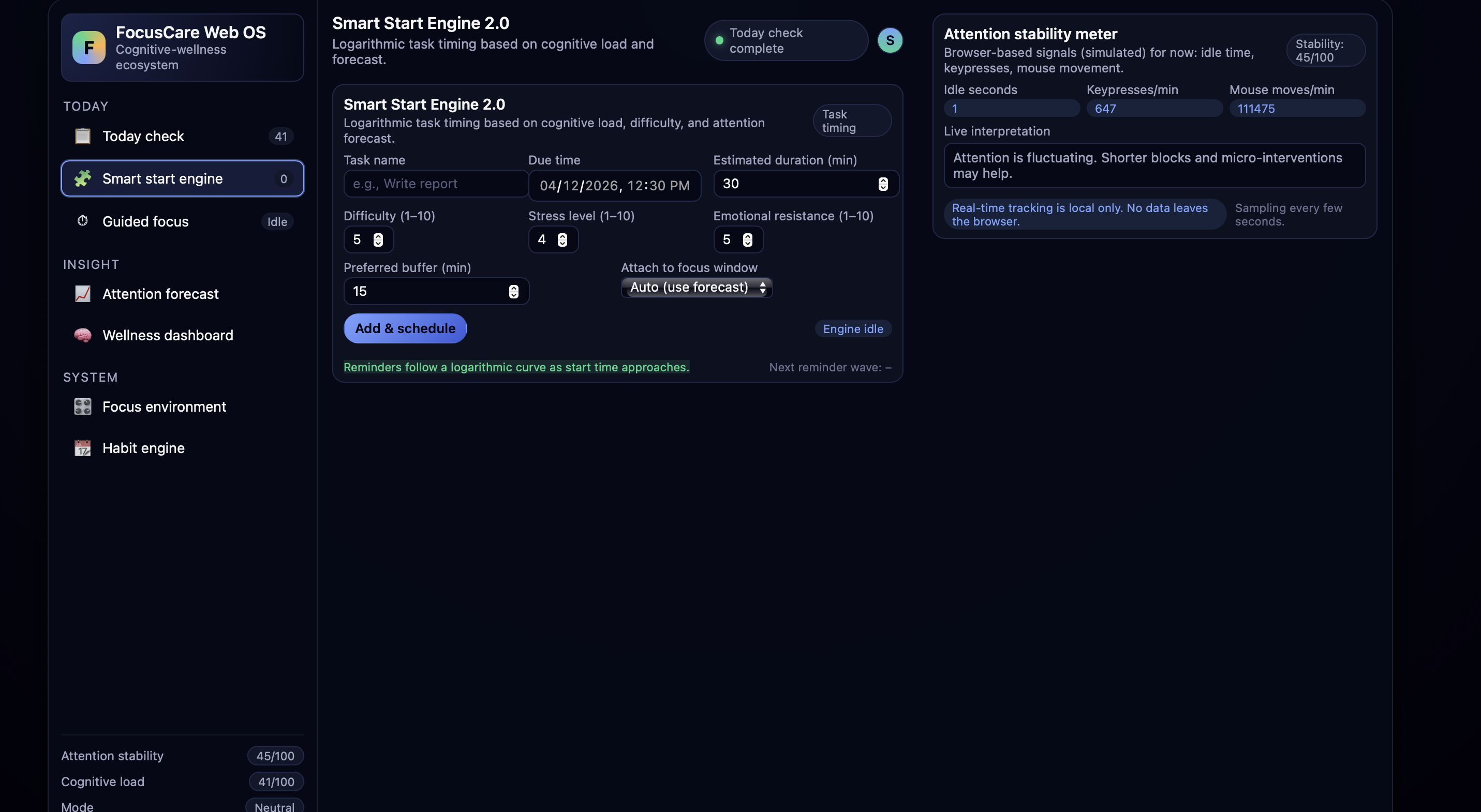
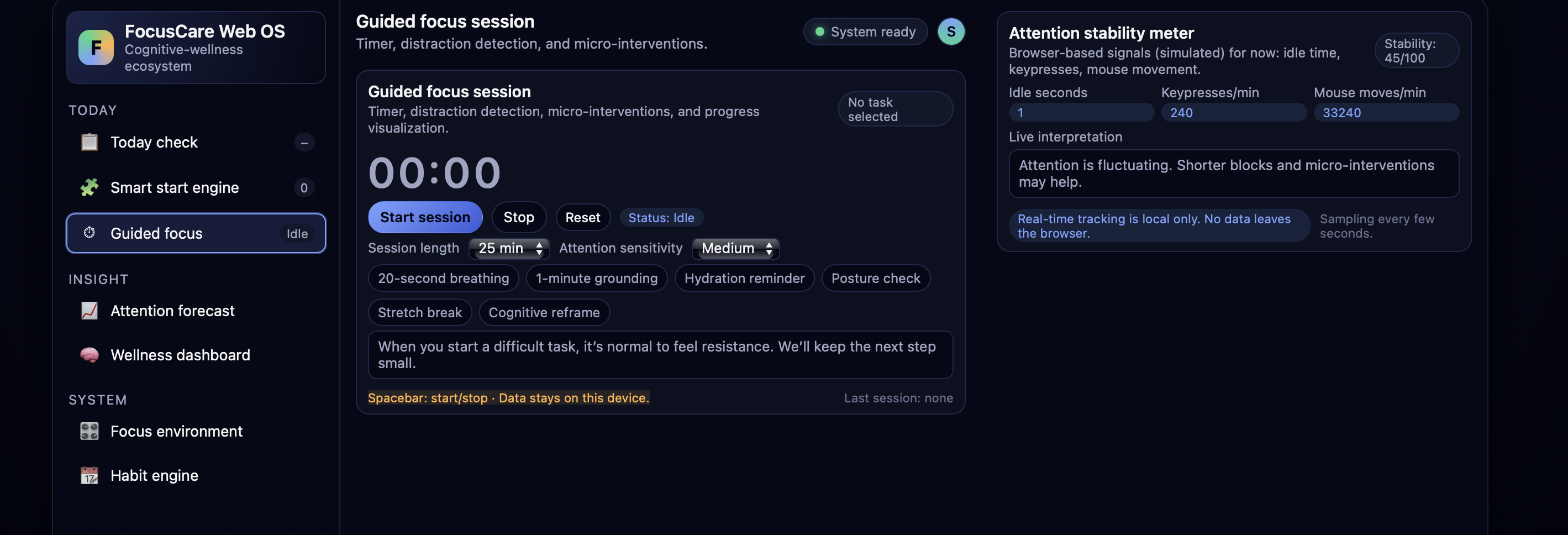
Inspiration FocusCare grew out of the realization that attention isn’t just about productivity—it’s about mental health. Many people struggle with stress, overwhelm, and task‑avoidance, but most tools only track time or create lists. We wanted something that understands how mood, sleep, stress, and emotions shape the ability to focus. That idea became the foundation for a full cognitive‑wellness operating system. What it does FocusCare helps users understand their mind and build healthier attention habits. It performs a daily wellness scan, predicts focus windows, schedules tasks intelligently, tracks real‑time attention signals, and offers supportive micro‑interventions when stress or distraction rises. It adapts the environment, guides focus sessions, and provides insights that connect wellness to attention. How we built it We built FocusCare as a browser‑based web app using HTML, CSS, and JavaScript. The system is organized into modules: a daily cognitive‑wellness scan, a Smart Start Engine for task timing, an attention‑tracking layer, guided focus sessions, adaptive environment controls, and a long‑term habit engine. Each module communicates with the others to create a unified, OS‑like experience. Challenges we ran into One challenge was turning complex psychological ideas—like cognitive load, emotional resistance, and attention drift—into simple, friendly interactions. Another challenge was designing an interface that feels intelligent without overwhelming the user. Building real‑time attention tracking in the browser and coordinating all the moving parts of the OS also required careful planning. Accomplishments that we're proud of We’re proud that FocusCare feels supportive instead of stressful. The daily scan, adaptive environment, and micro‑interventions work together in a way that feels personal and emotionally aware. We’re also proud of the Smart Start Engine, which schedules tasks based on cognitive load and attention patterns. Most of all, we’re proud that the system treats attention as a health metric, not a moral judgment. What we learned We learned how closely attention is connected to wellness—sleep, stress, hydration, and emotions all play a role. We also learned how to design a large, multi‑panel interface that feels like a mini operating system. Building FocusCare taught us how to combine behavioral science with interactive design in a way that feels human and helpful. What's next for FocusCare Next, we plan to add more advanced attention‑forecasting models, deeper emotional‑pattern insights, and personalized intervention recommendations. We want to expand the habit engine, improve the adaptive environment, and eventually build a mobile version. The long‑term goal is to turn FocusCare into a full cognitive‑wellness platform that helps people build healthier attention habits over time.
Built With
- activity
- api
- apis
- audiocontext
- browser
- css3
- date
- html5
- javascript
- localstorage
- mouse
- time

Log in or sign up for Devpost to join the conversation.