-
-
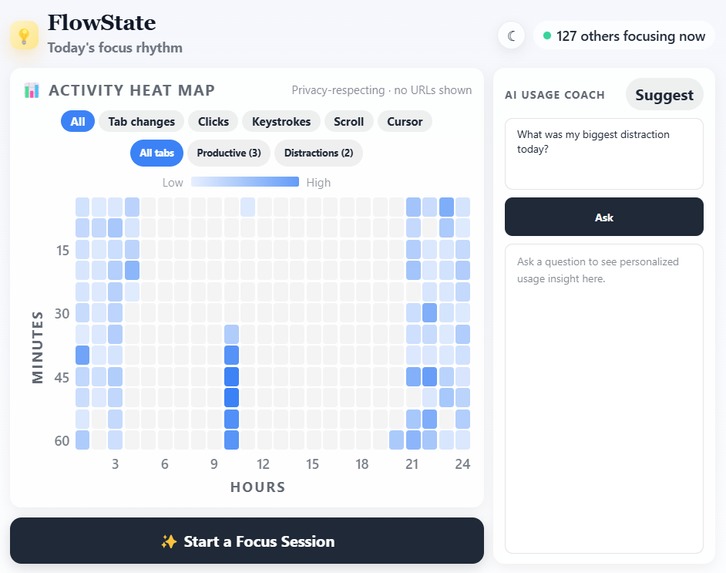
Activity Heatmap + AI Assistant
-
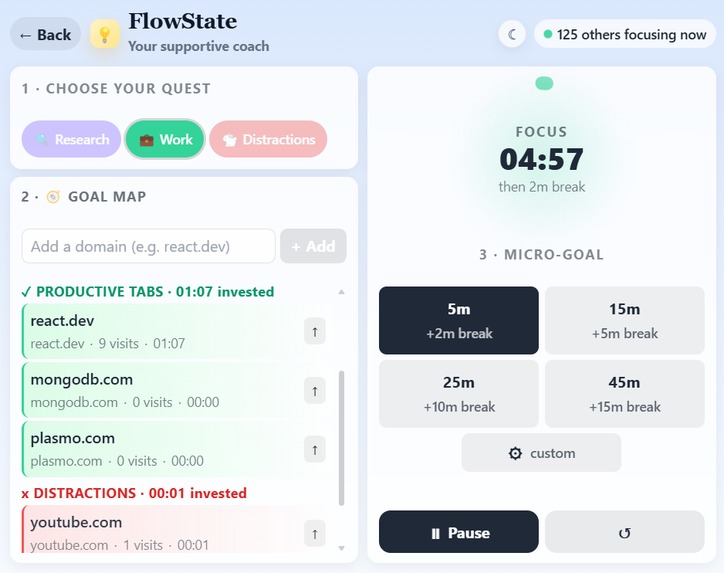
Quest, domain, and Pomodoro manager
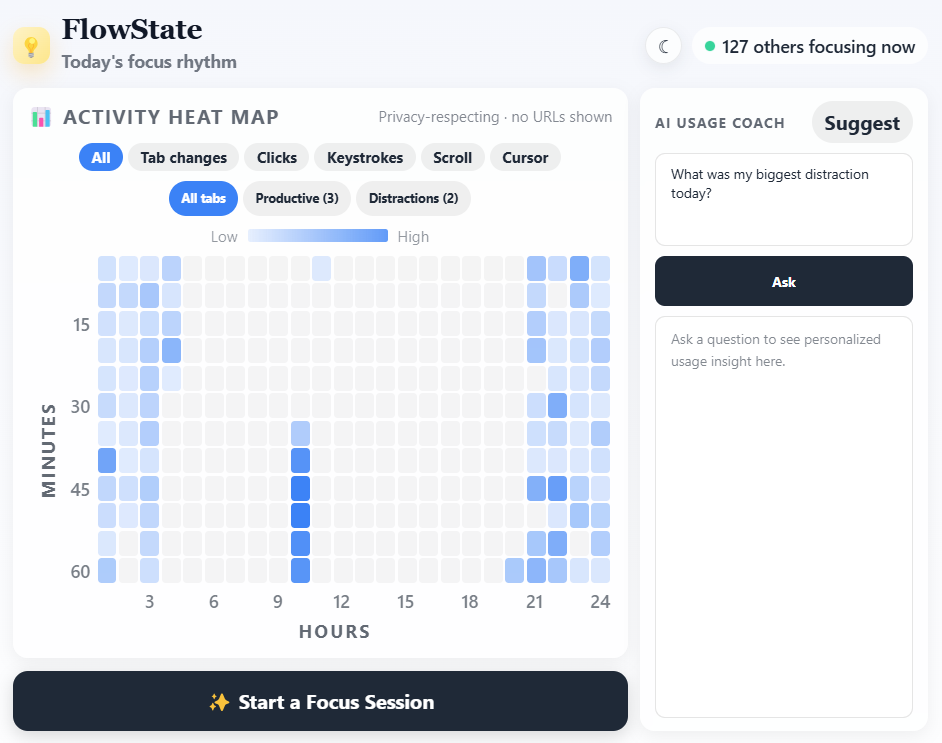
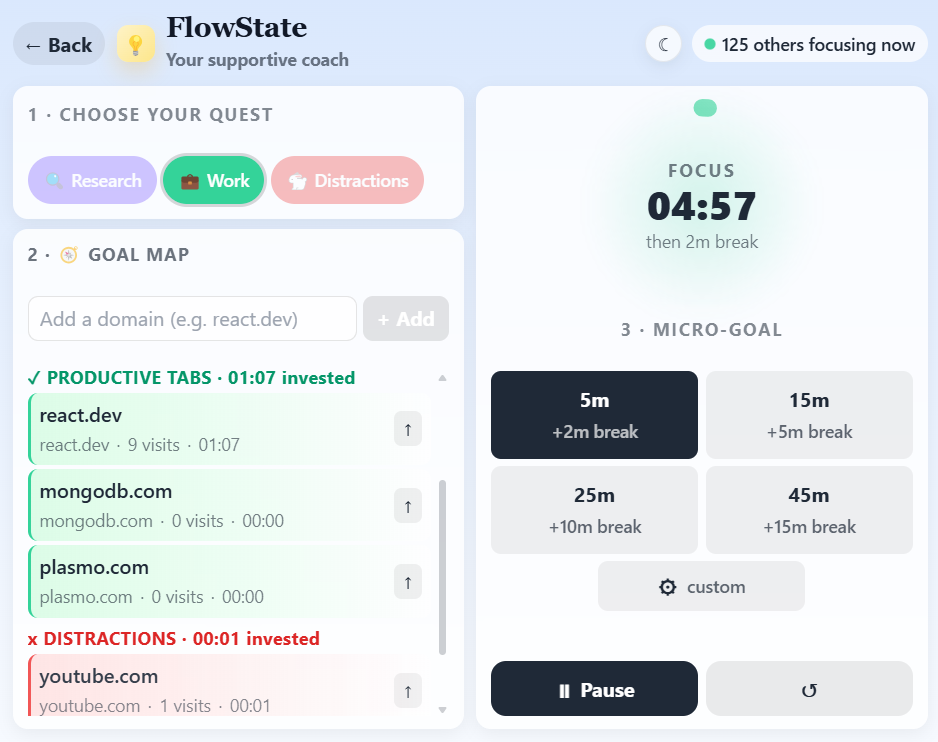
Inspiration
Modern digital environments are designed to compete for attention. For people with ADHD, even a small distraction can turn into hours of lost productivity due to attention drift, tab switching, and time blindness. We noticed that most productivity apps rely on timers, self-reporting, or blocking websites, but they don’t actually understand how users behave online.
We wanted to build a smarter system that passively understands focus patterns in real time and helps users become more aware of their distractions without feeling judged or restricted. Our goal was to create a supportive AI productivity coach that helps users reclaim attention in a world built to distract them.
What it does
FlowState is an AI-powered Chrome extension and analytics dashboard designed to help ADHD users stay focused and better understand their productivity habits.
The extension tracks behavioral signals such as:
active tabs and domains tab switching history time spent per tab clicks, scrolling, and keystroke activity idle time and focus changes
The system aggregates this activity data and uses AI to detect distraction loops, attention drift, and productivity trends.
FlowState provides:
productivity analytics dashboards activity heatmaps focus vs distraction tracking AI-generated insights and summaries personalized focus recommendations natural language productivity questions like: “What distracted me most today?” “When am I most focused?” “How productive was I this week?”
How we built it
We built FlowState using:
Plasmo + React for the Chrome extension and dashboard UI FastAPI + Python for backend APIs and data processing MongoDB Atlas for storing behavioral activity logs Gemini API for AI-generated productivity insights Backboard for long-term behavioral memory and context persistence
The browser extension collects activity data every minute and sends aggregated summaries to the backend as JSON. The backend processes activity logs and generates analytics such as:
productivity metrics distraction frequency focus heatmaps category-based usage trends
The AI layer analyzes both recent activity and historical behavior patterns to generate personalized recommendations.
Challenges we ran into
One of the biggest challenges we faced was integrating multiple systems together in a short hackathon timeframe. Since our project involved a browser extension, backend APIs, AI integrations, and a database pipeline, debugging interactions between components was difficult.
We also encountered several merge conflicts while multiple team members were working on different parts of the extension and dashboard simultaneously. Coordinating frontend and backend changes became increasingly challenging as features evolved quickly.
Another major challenge was getting browser tracking to work reliably. Initially, the application only tracked activity while the extension popup was physically open. We discovered that the popup lifecycle was limiting our tracking system, so we implemented a background service worker to continue collecting browser activity even when the popup was closed.
We also spent time solving issues around domain and goal mapping. Since we categorize websites into productivity groups like work, school, or entertainment, we needed a scalable way to store and process domains while connecting them to user goals and analytics.
Finally, integrating AI APIs and behavioral analytics together required significant debugging and experimentation to ensure the generated insights actually reflected meaningful user behavior instead of noisy activity data.
Accomplishments that we're proud of
We are proud that we built a full end-to-end system that combines:
browser activity tracking backend analytics AI-generated productivity coaching behavioral memory interactive dashboards
We’re especially proud that the project focuses on accessibility and neurodivergent users in a positive and supportive way rather than using punishment-based productivity systems.
Some features we’re most proud of include:
real-time activity tracking productivity heatmaps AI-powered focus summaries behavioral analytics dashboards natural-language productivity insights
We also successfully integrated multiple sponsor technologies into a cohesive product experience.
What we learned
Through building FlowState, we learned:
how difficult behavioral analytics can be in real-world environments how to architect browser-extension-to-backend pipelines how to design scalable activity logging systems how AI memory systems can improve personalized recommendations the importance of ethical data collection and transparency
We also learned how much modern productivity tools fail to account for neurodivergent users and how impactful thoughtful design can be.
What's next for FlowState
In the future, we want FlowState to evolve into a full AI productivity companion.
Some future goals include:
real-time intervention systems adaptive focus coaching cross-device tracking mobile integration calendar/task integrations smarter distraction prediction models personalized ADHD productivity modes collaborative productivity analytics for teams and students
We also want to improve our AI models so FlowState can proactively recognize burnout, hyperfocus, and unhealthy work patterns while continuing to prioritize privacy and ethical design.
Ultimately, our vision is to create technology that helps people understand their attention instead of exploiting it.


Log in or sign up for Devpost to join the conversation.