-
-
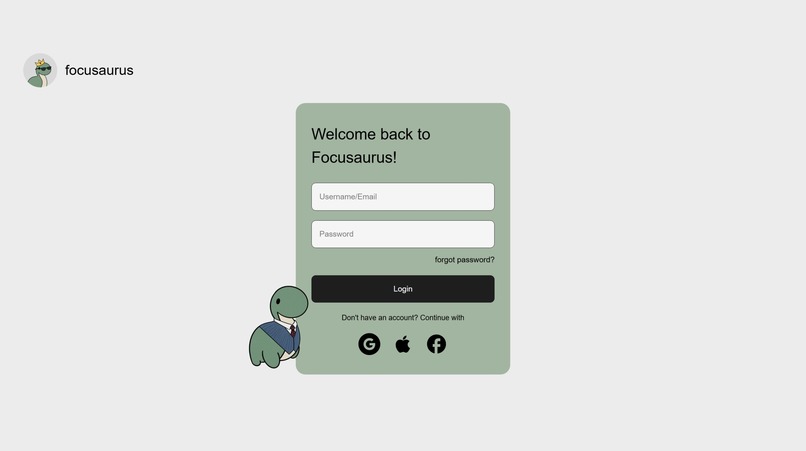
Login Page
-
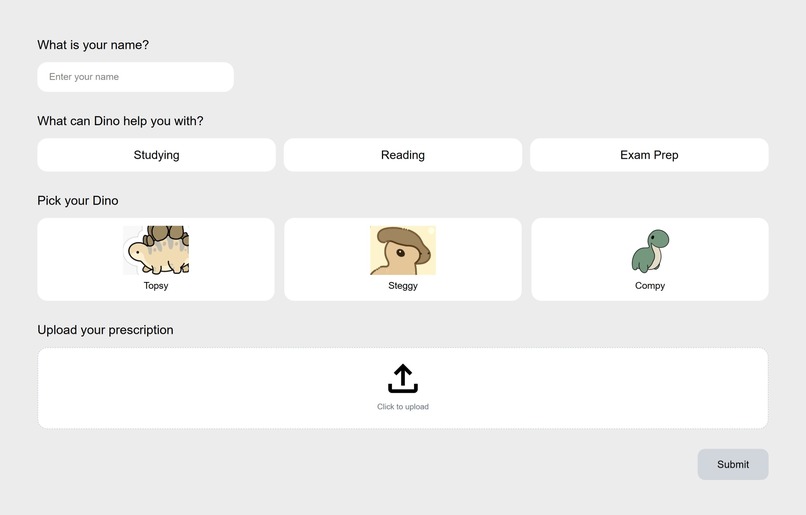
User Profile Page
-
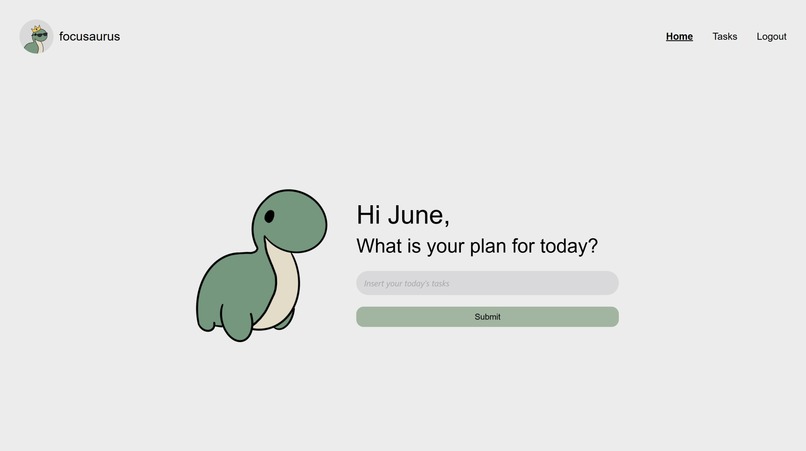
Task Input Page
-
Subtasks Page
-
Focus Mode Page
-
Subtask Completion Page
-
Report Page


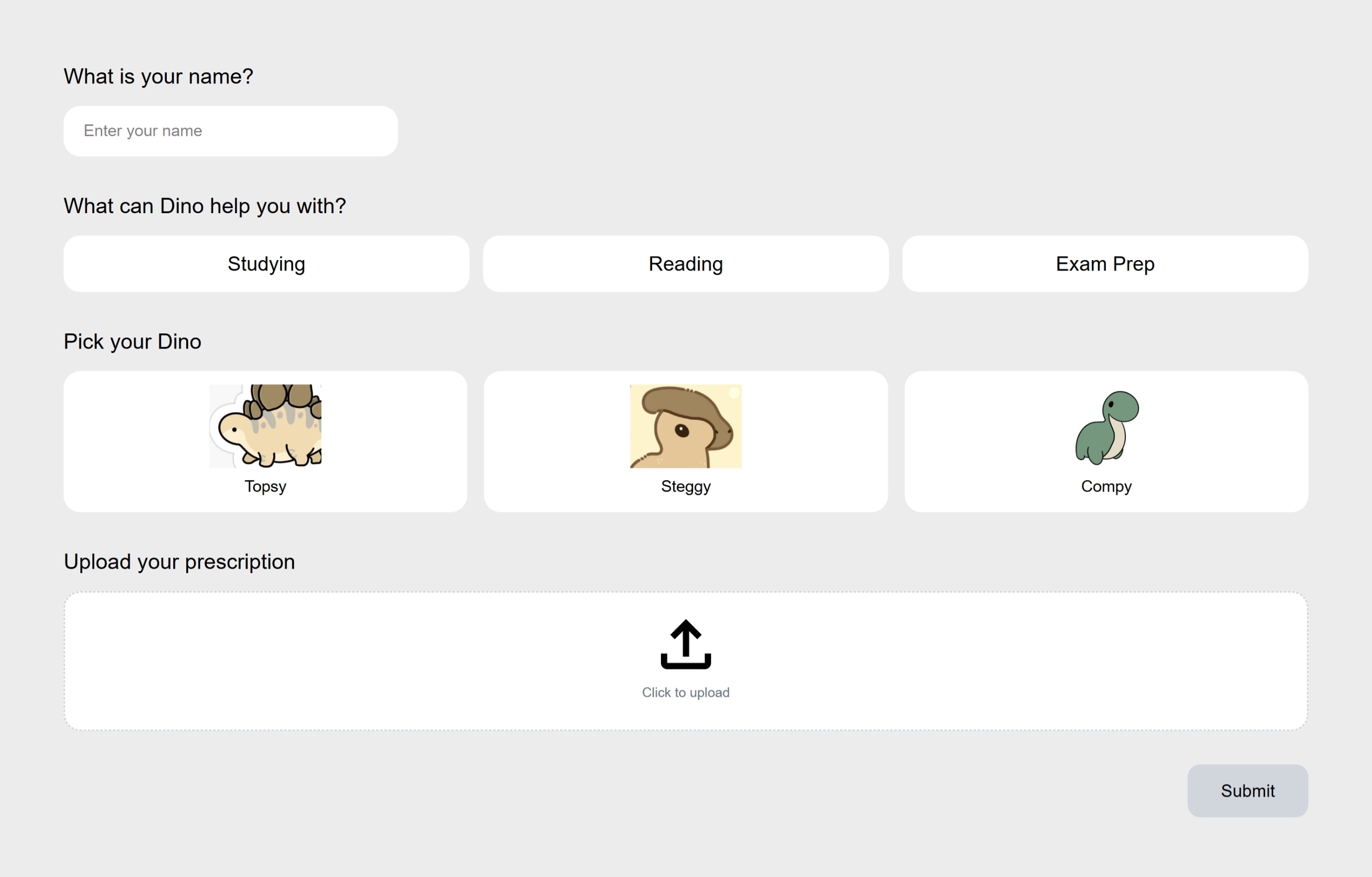
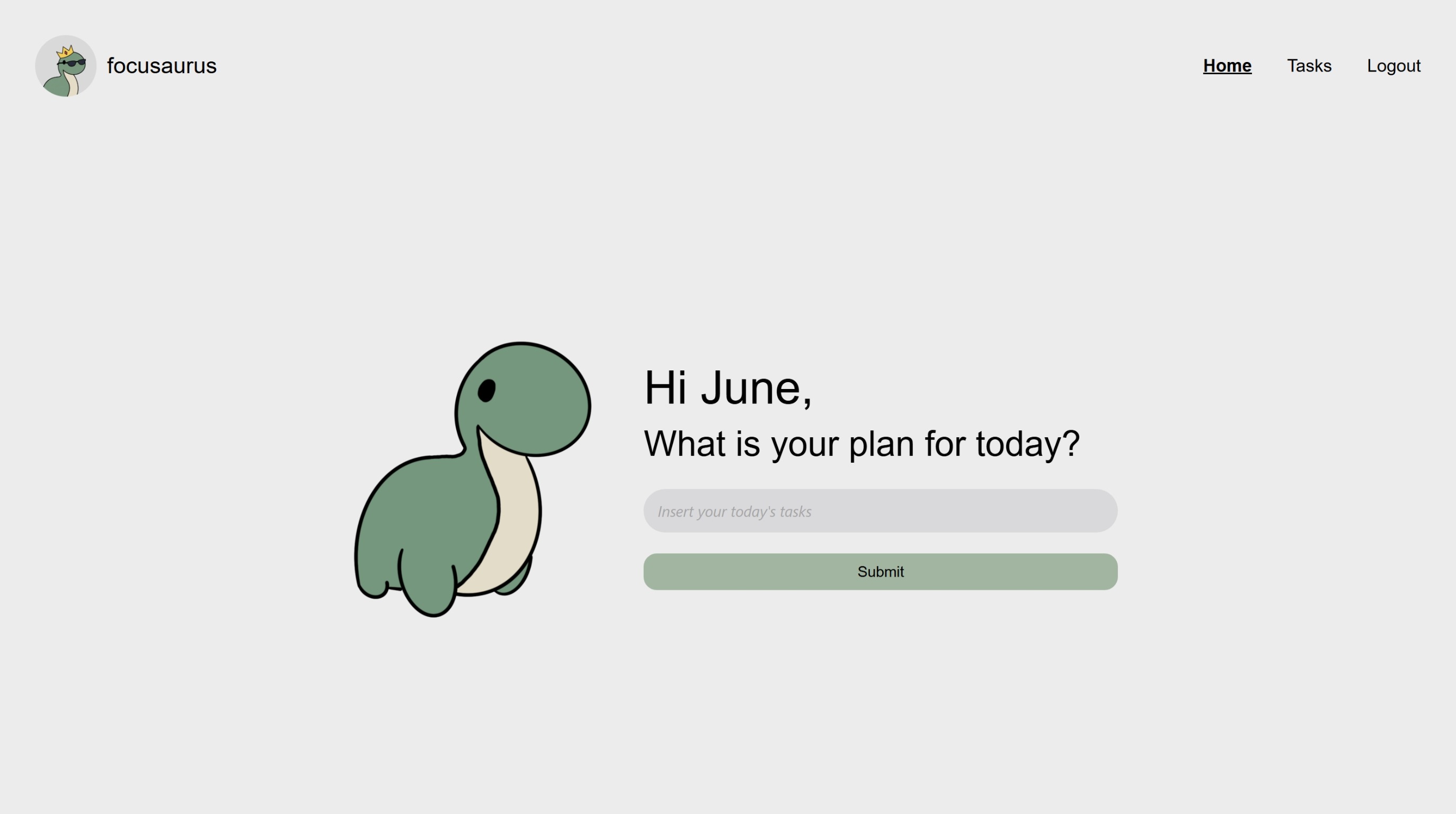
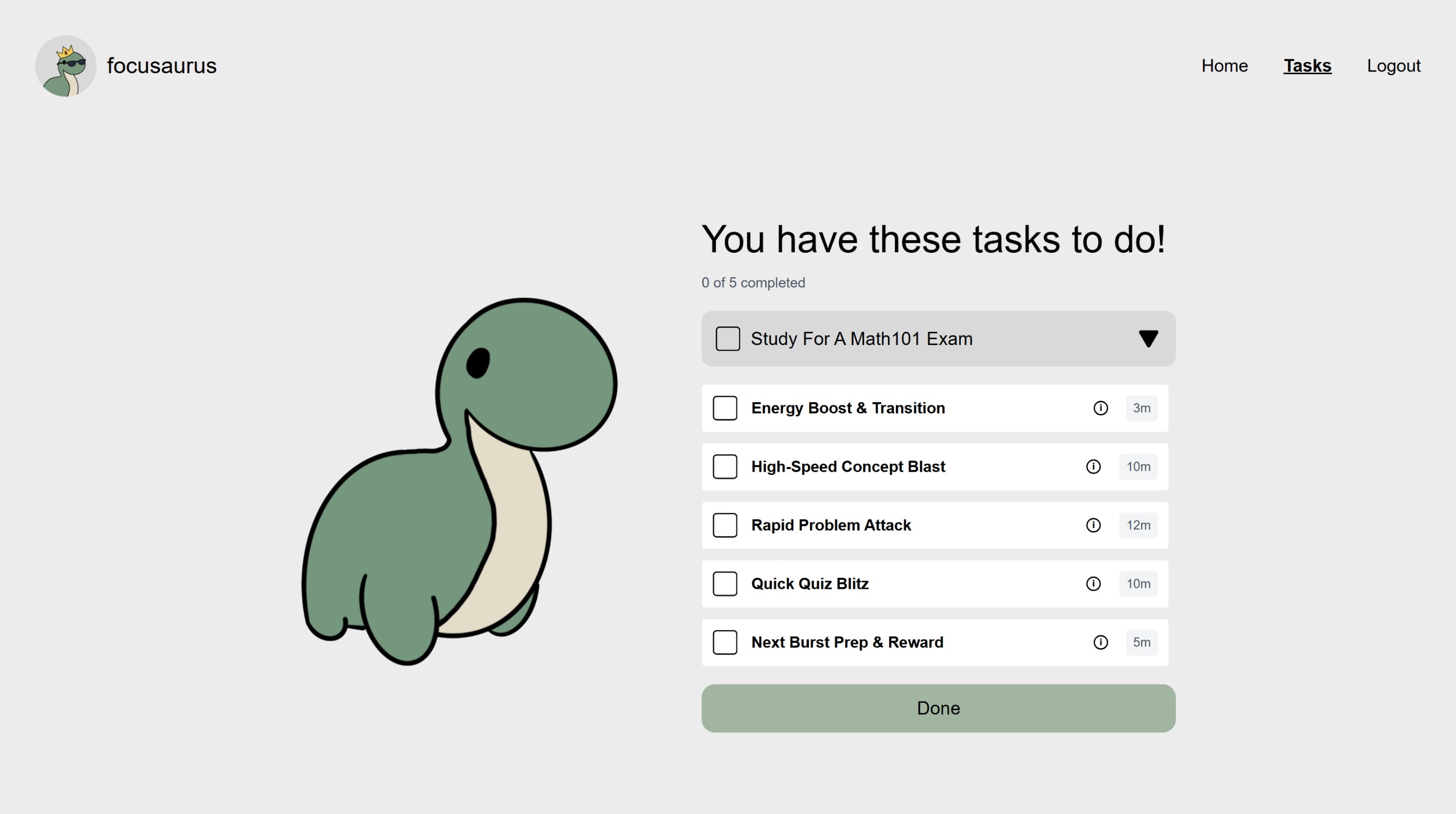

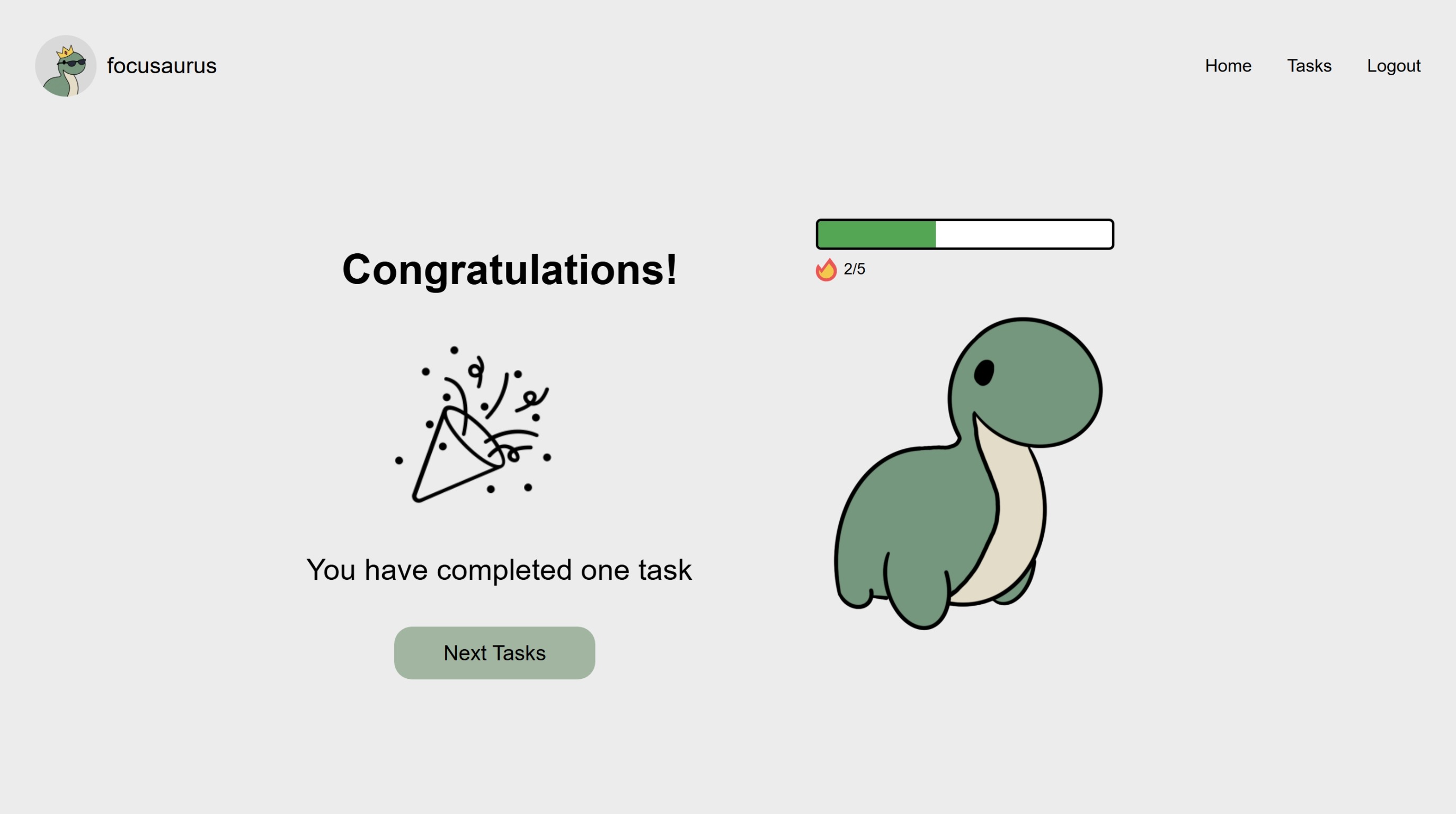

Inspiration
Students with Attention Deficit Hyperactivity Disorder (ADHD) often know what they should do but struggle with starting. When tasks pile up, everything feels equally urgent, which leads to overwhelm, procrastination, and lost time.
We were inspired by this everyday experience: staring at a long list of tasks while your brain freezes. Traditional productivity apps assume people simply need better organization, but ADHD users often need support for executive dysfunction, time blindness, and motivation. Focusaurus was built to become a focus companion, not just another to-do list.
What it does
Focusaurus is an AI-powered focus assistant designed specifically for ADHD students.
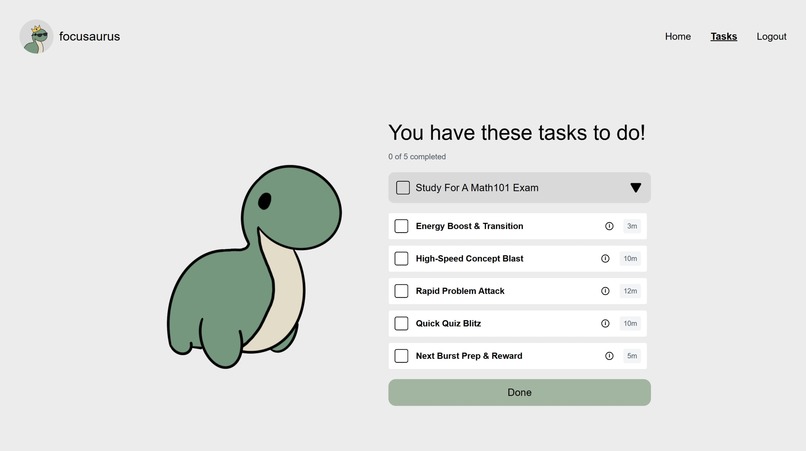
- Break down large goals into small, manageable tasks using AI
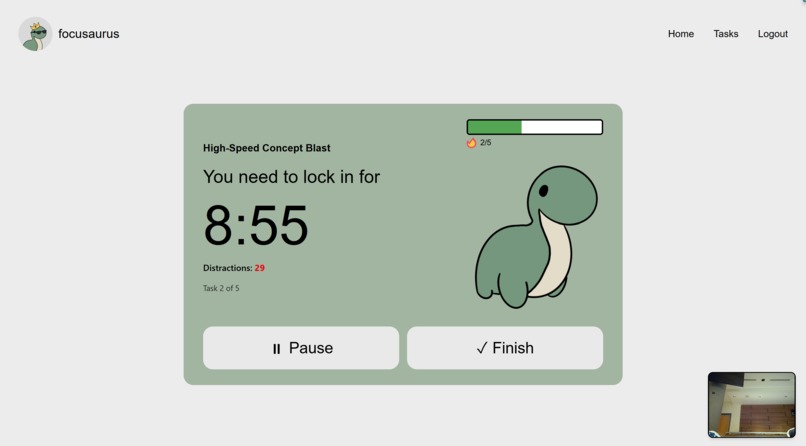
- Run structured focus sessions with timers
- Detect distractions tracks how many times the user has been distracted with the help of webcam tracking
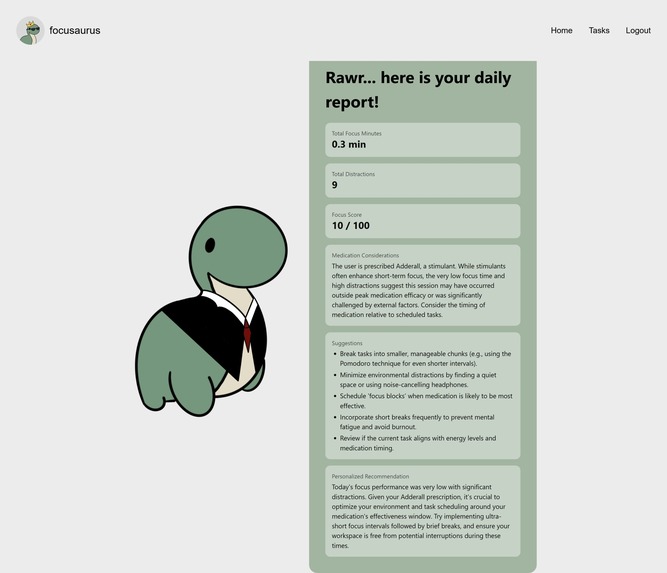
- Track focus performance and generate AI focus reports
- Provide personalized productivity suggestions
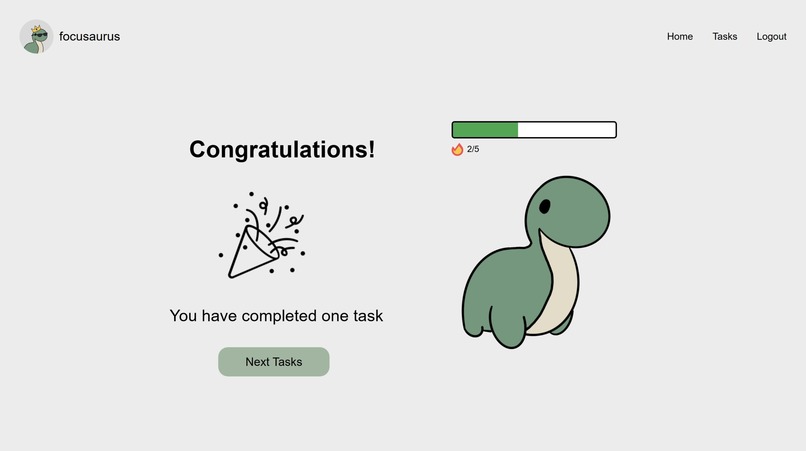
This web app makes progress rewarding, users grow a baby dinosaur into a graduating dinosaur as they complete tasks, turning productivity into a motivating journey.
How we built it
Frontend: React / TypeScript, Vite, Figma-generated UI components
Backend: Python / Node backend for task generation, AI API
Challenges we ran into
First off, we struggled with translating user pain points into functionalities, as we needed to build features that reduce overwhelm instead of adding complexity, avoid distracting interfaces, and keep interactions extremely simple.
During the hacking process, one of our biggest challenges was integrating the front-end with the back-end and ensuring that data flowed smoothly between the user interface and the AI-powered features. We also faced significant challenges integrating the computer vision model into our application, making sure it worked reliably within our system to provide an intuitive user experience.
Accomplishments that we're proud of
We’re proud that Focusaurus is not just a productivity tool but a psychological support system, which ADHD students could actually see themselves using.
Our biggest achievements include:
- Building a full AI task breakdown system that helps students turn overwhelming assignments into manageable steps
- Integrating a computer vision model that detects distractions through users’ facial cues and upper-body movements during focus sessions
- Creating focus sessions with real-time distraction tracking and feedback
- Designing a reward system that visualizes progress and reinforces motivation
- Turning a complex mental health challenge into an intuitive, supportive user experience
What's next for Focusaurus
In the future, we plan to expand Focusaurus into a supportive focus network for students with Attention Deficit Hyperactivity Disorder, allowing users to join shared focus sessions and motivate each other through accountability.
We also want to improve our distraction detection system, enabling the app to detect when users switch to distracting platforms such as Instagram and gently remind them to return to their focus session.
Over time, Focusaurus will also introduce smarter AI personalization, learning users’ focus patterns and recommending optimal study sessions and break lengths to support sustainable productivity habits.
UBC CS Project Hub Questions
Why we are interested in the incubation program
Focusaurus was born from a simple but powerful idea: helping students navigate the everyday challenges of academic life. At UBC, we’ve seen friends and peers face the unique hurdles of ADHD struggles that often go unnoticed and unsupported. Our drive comes from a desire to empower our community, but it is also rooted in a broader reality that research, including a study of 8,300 U.S. children, suggests that social media use may be linked to rising ADHD diagnoses.
We see Focusaurus as more than just an application. We aim for it to be a reliable, long-term companion for users, guiding them through the complexities of focus, organization, and well-being. Our goal is to move beyond proof-of-concept and create a tangible, positive impact in users’ daily lives turning small daily victories into lasting success.
Through the incubation program, we hope to further develop Focusaurus by:
- Expanding its reach to support a broader community of people with ADHD
- Improving the reliability of our AI and computer vision systems
- Validating our design decisions with real users to ensure the app reduces overwhelm rather than adding complexity
- Ensuring the integrity and security of sensitive datasets, including medical prescriptions and webcam feeds used for AI model inference
What we hope to learn through the CS Project Hub
At the CS Project Hub, we are particularly interested in learning how to turn an early-stage prototype into a scalable and user-centered product. We hope to gain mentorship and experience in:
- Product development and iteration
- Conducting meaningful user research
- Designing scalable system architecture
- Using AI responsibly in tools that relate to mental health and productivity
- Building a sustainable roadmap based on real user feedback
- Maintaining robust security for sensitive user data, specifically prescriptions and webcam inputs, during AI processing.
Ultimately, we hope the program will help us transform Focusaurus from a hackathon project into a polished and impactful platform that genuinely supports students struggling with focus, motivation, and executive dysfunction.


Log in or sign up for Devpost to join the conversation.