My patients inspired me to care about health literacy. So many told me stories about how their health care providers did not explain anything about their surgery or a health condition they experienced. It was clear that providers' failure to inform patients about their health condition or surgery impeded the patients' ability to feel confident in their ability to impact their own health and to take the necessary steps to do so.
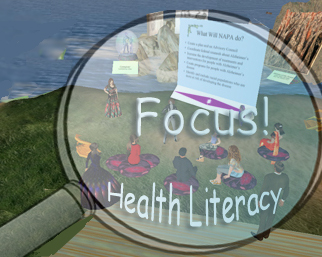
Our target users are students in the health professions who are enrolled in an academic degree program anywhere in the world. HCP students must fully understand the many aspects of health literacy at the consumer, provider, facility, and systems level. But, understanding is not enough. Reading about or hearing a lecture or seeing a video about health literacy is not enough. HCPs must be equipped apply this knowledge to the people, families, and populations they serve. This requires active learning, repeated practice, and direct interaction with consumers in real time. Focus! Health Literacy will develop and provide active health literacy training for students in health professions using a dynamic virtual venue. The training will take place within the virtual world of Second Life, the largest 3-D computer environment where people interact in real time.
Focus! Health Literacy will provide a supervised interprofessional learning environment where students in the health professions apply and refine health literacy knowledge and skills by interacting directly with consumers in Second Life. The project builds on an already established project-based learning model used successfully in Second Life for the past 6 years. The Project Steering Committee for Focus! Health Literacy has experts in health literacy from fields including medicine, nursing, pharmacy, and public health that have committed to provide input from their respective disciplines to inform the content.
Students will work with Faculty facilitators who will guide them in health literacy principles and help them create presentations, wikis, videos, and other learning media within interprofessional teams. Peers and faculty facilitators will then help the students to refine their initial educational media and get ready to present the media to consumers within Second Life. The Virtual World Education Facilitator will arrange venues for consumer participants to review the students' media and provide feedback. Following the review, students will reflect on the strengths and challenges of their performance and the media they produced and develop strategies for improving future development.


Log in or sign up for Devpost to join the conversation.