-
-
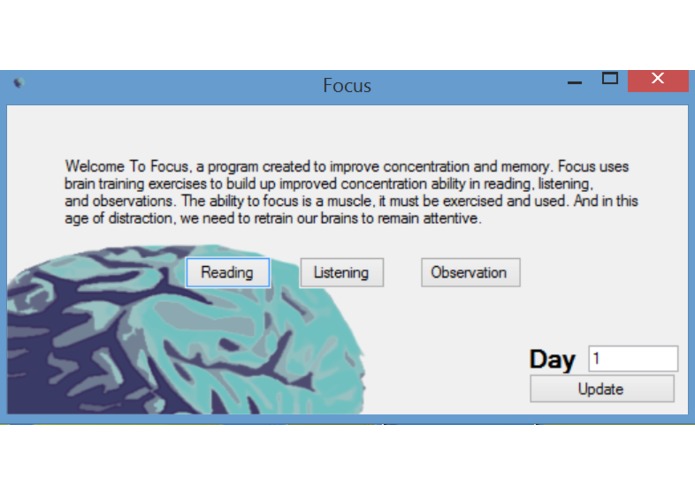
Main Window
Inspiration
I, like many people, have difficulty concentrating. Medication for attention difficulties is often times ineffective if begun in adulthood when ADHD is caught late, and tends to have harsh side effects. Medication alone is generally not enough even when it is effective; a combination of cognitive behavioral therapy and medication has been proven to be the most effective. Mindfulness needs to be trained, and we can use technology to retrain ourselves to be attentive to reading, listening, and observation. With progressively increased exposure expectations to content in small chunks, focus can be trained step by step over time, improving after continuous use.
What it does
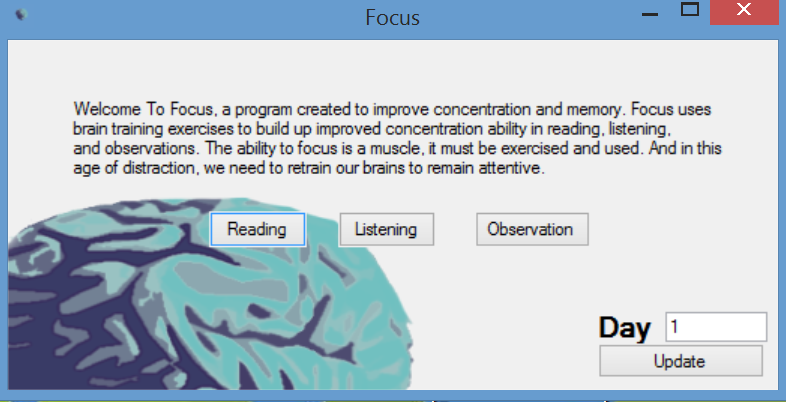
There are 3 modes: Reading, listening, and observation. In reading mode, the user is exposed to text that flashes across the screen for a designated time period based on the number of days the program has been used. This time period increases slightly with each day. The user must stay attentive and can not drift into thoughts nor divert their eyes, because the text flashes fast enough where if attention is not given for the entirety of the time period, the words are replaced by the next word and the user would not be able to grasp the concept of the sentence. Listening mode is similar, but instead of words appearing on the screen, it is an exposure to an open source audiobook for the given period of time. This has the intention of helping students to learn to concentrate during lectures. The third mode is observation, which has the user look at an image for a designated amount of time, then quizzes the user on content of the image. This trains attentiveness to observation as well as tests short term memory.
How I built it
C#
Challenges I ran into
It definitely does not have as many features, modes, or the amount of content I wanted to incorporate it, but, for a 24-hour hackathon, the demo does its purpose to show the basic functioning.
Accomplishments that I'm proud of
I made it and it works!
What I learned
How to use multiple classes to interact and pass data to each other in c#, creating a project that opens multiple different forms, using a timer for form events, and saving output to a text file for long term storage.
What's next for Focus
Scientific studies to determine if attentiveness and short-term memory is actually improved over time through use of this application. Even though in theory, it may work, real scientific evidence needs to be found before any claims can be made, and this will tell us how much it may improve focus as well.

Log in or sign up for Devpost to join the conversation.