-
-
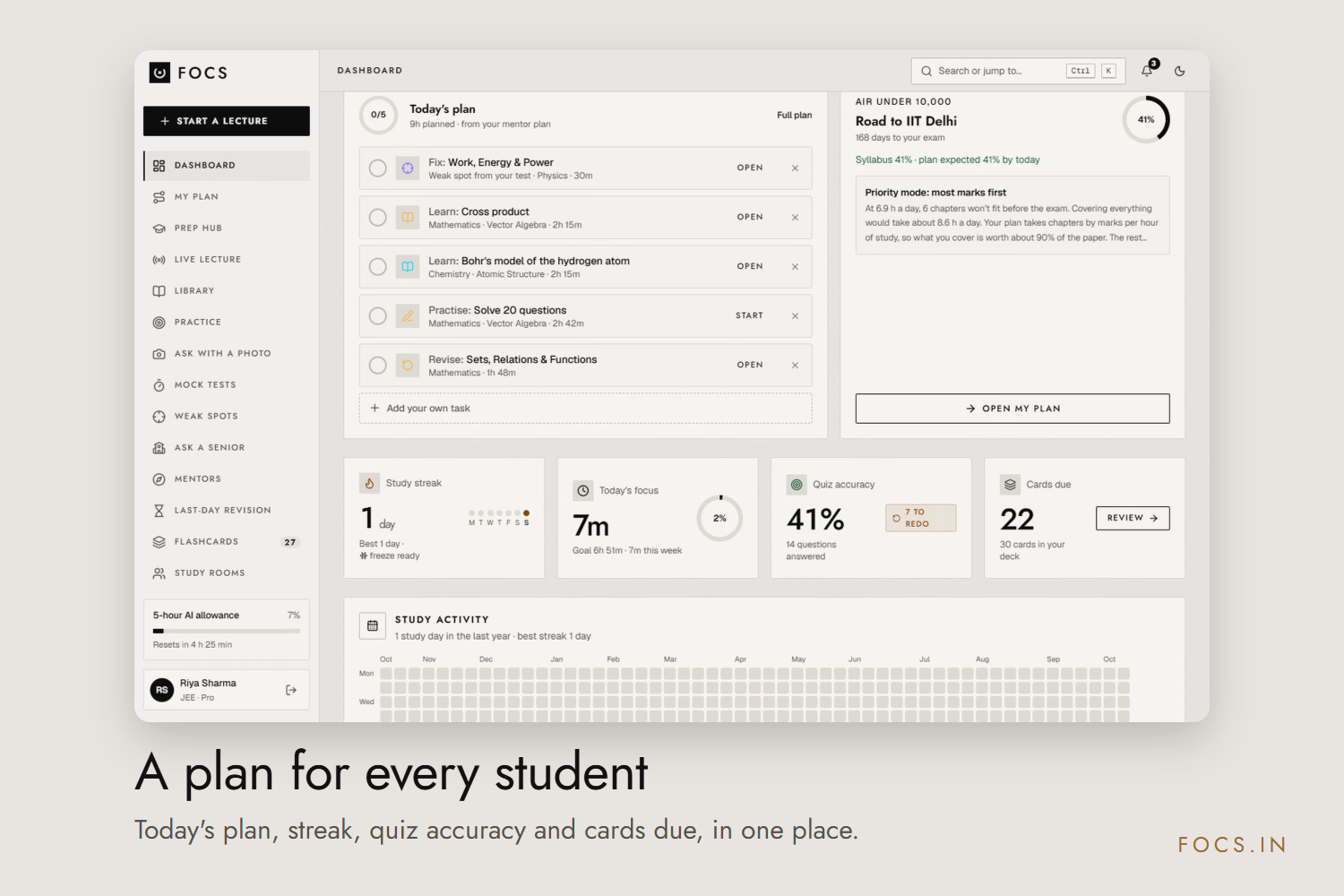
7-dashboard
-
2-sure-guessing
-
6-confusion-map
-
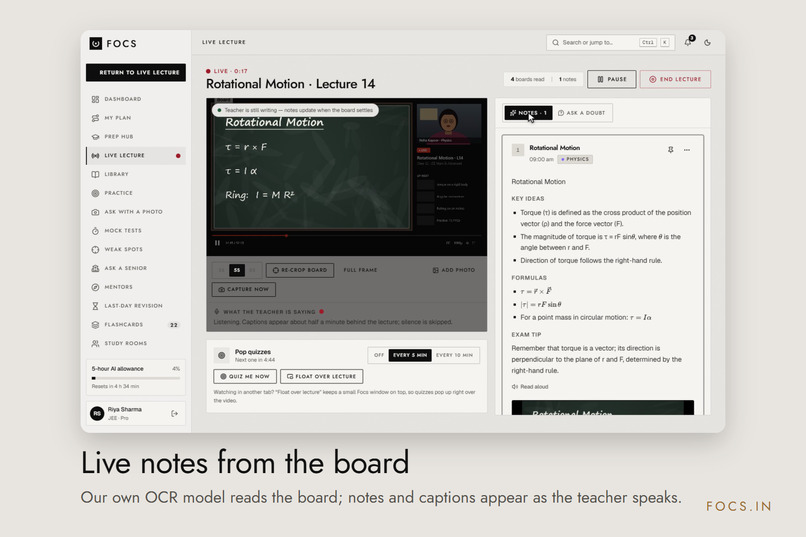
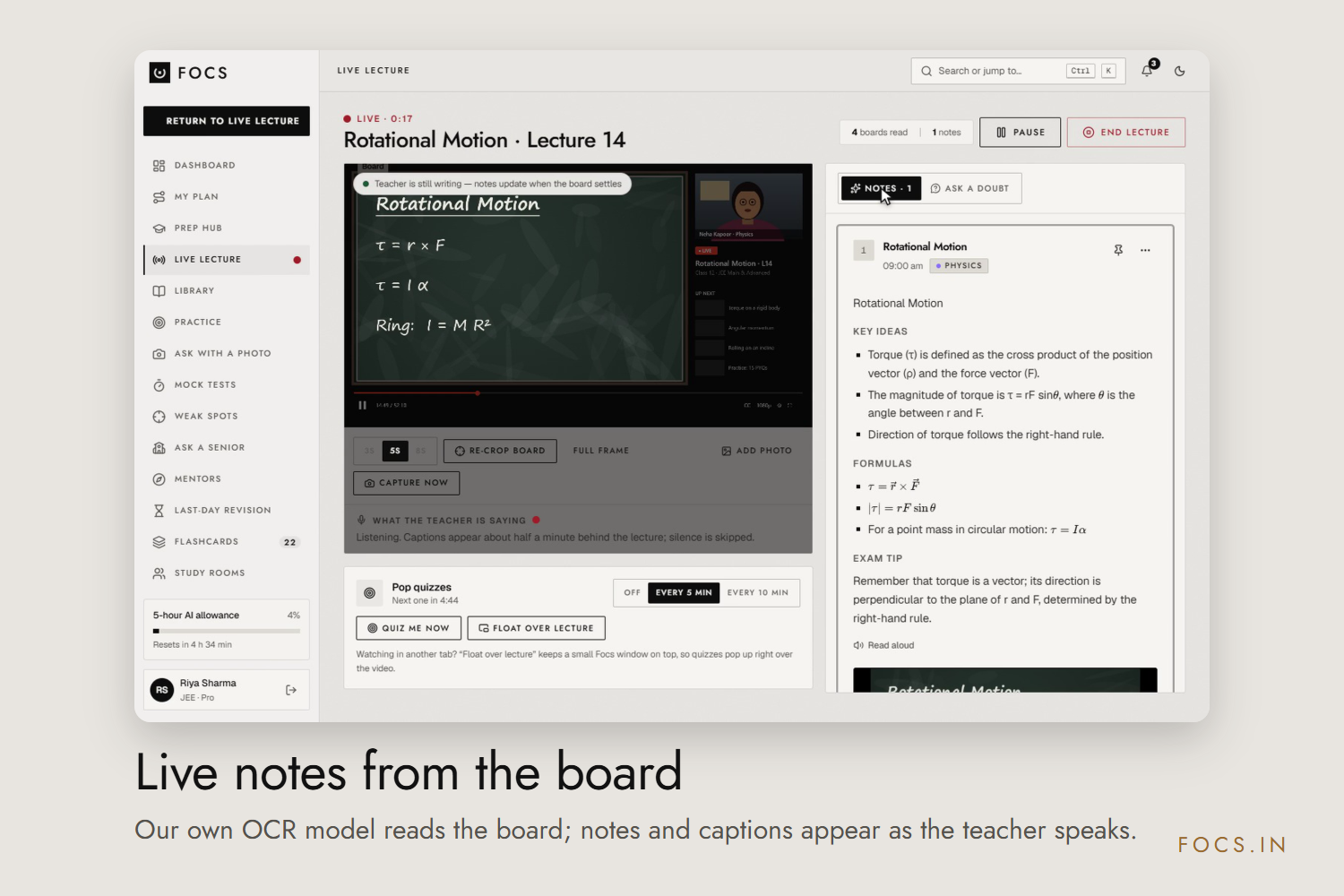
1-live-notes
-
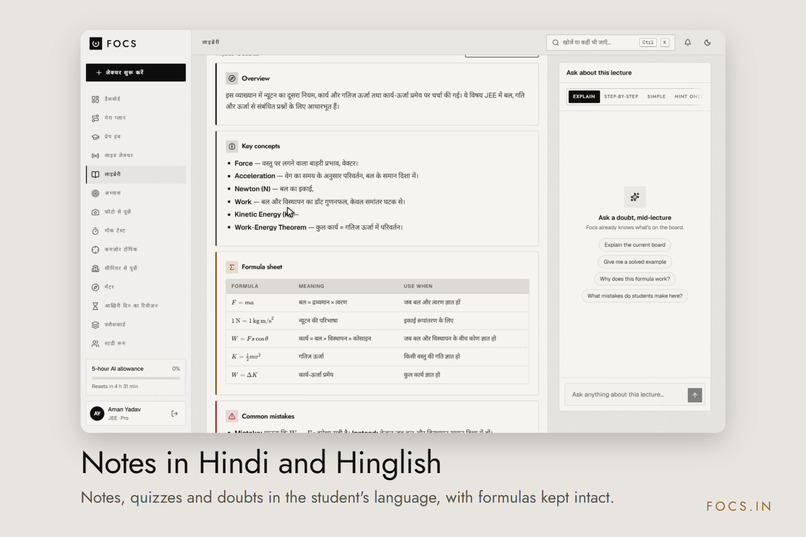
4-hindi
-
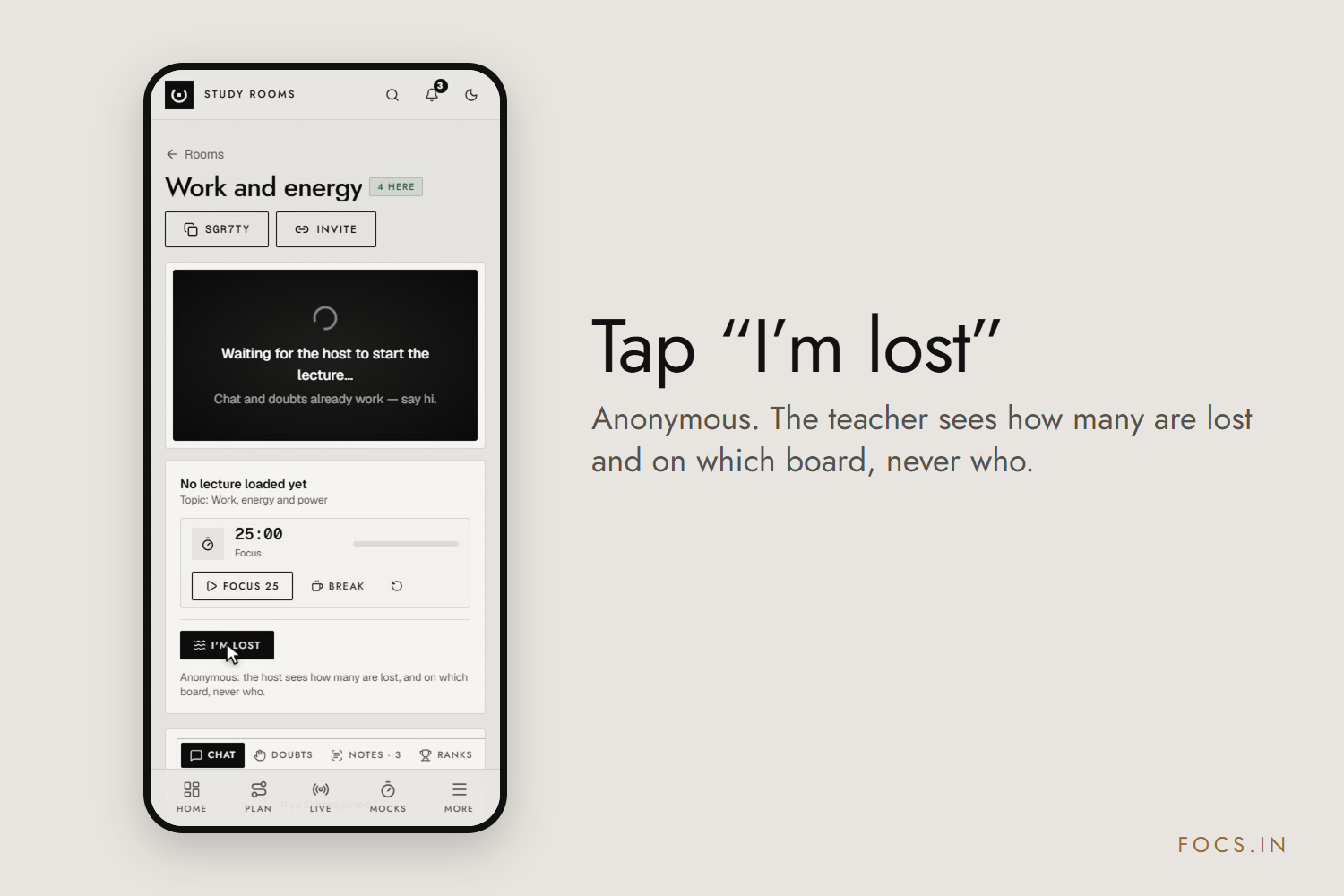
5-phone-lost
-
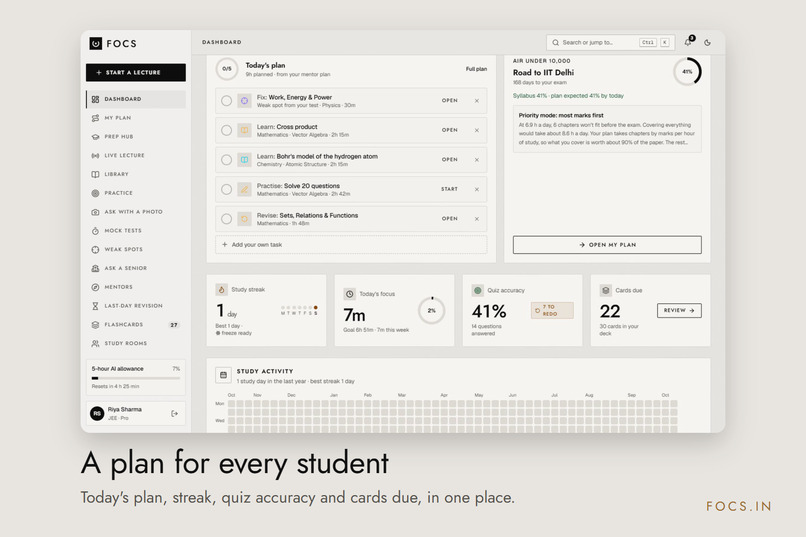
3-blind-spots
Inspiration## Inspiration
A lecture moves at the teacher's speed and in the teacher's language. One teacher, one board, 200 students, and zero questions asked. The board moves on before you finish copying. The lecture is in English, but many students think in Hindi. And the student who is lost stays silent, so the teacher never finds out which board lost the class.
Every year about 14 lakh students sit JEE Main, 23 lakh sit NEET and 13 lakh apply for UPSC, and most of them learn from lectures. We wanted to fix both directions of the gap: carry the lecture to the student, and carry the confusion back to the teacher.
What it does
FOCS is an AI study companion built around four lanes:
- Speed: our own OCR model reads the board, and the teacher's voice is captioned. Live notes and captions appear as the teacher speaks, so students stop copying and start understanding.
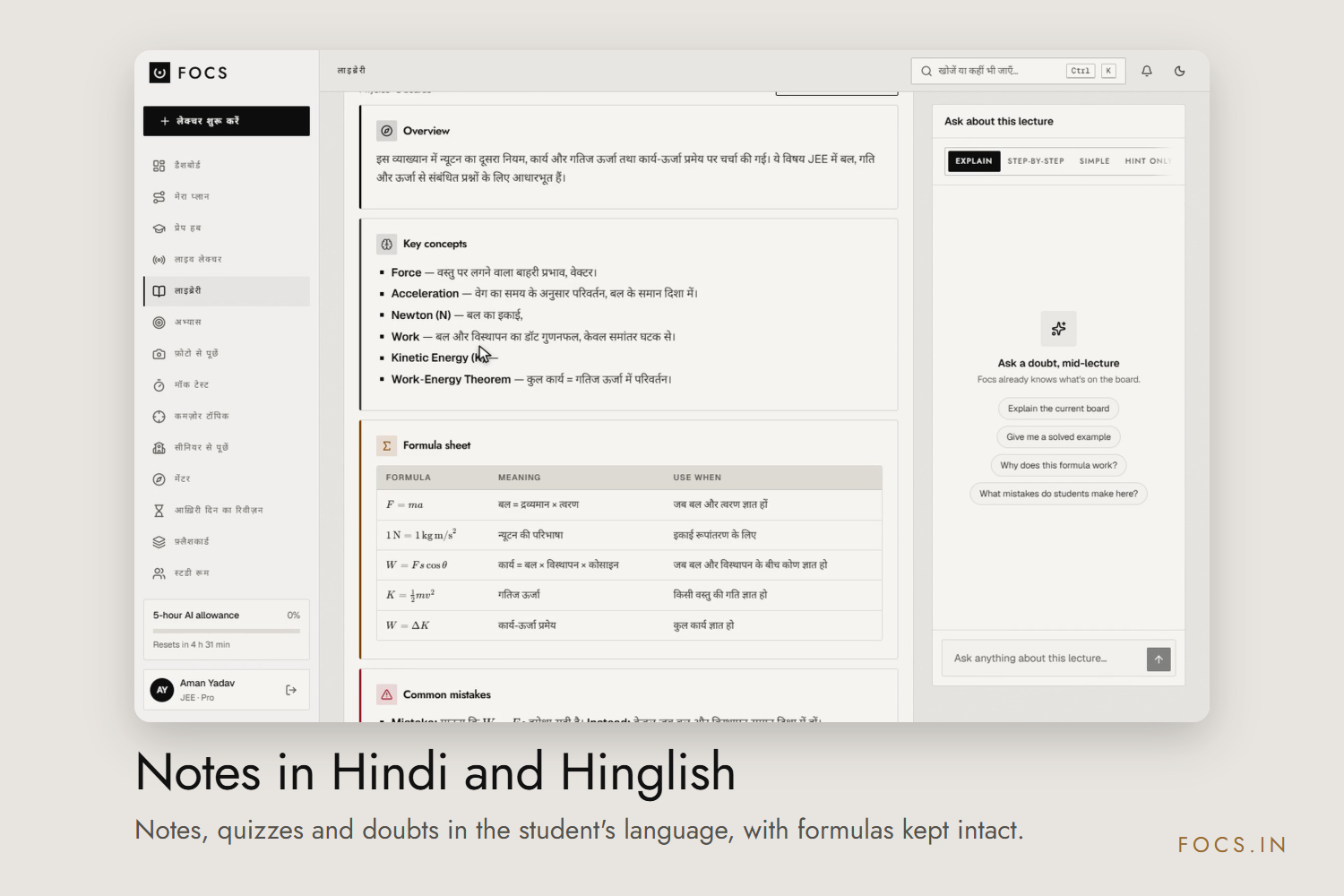
- Language and ability: notes, quizzes, flashcards and doubts in Hindi or Hinglish, with every formula checked so it stays unchanged. Read-aloud and an accessibility mode help students who are hard of hearing or have low vision.
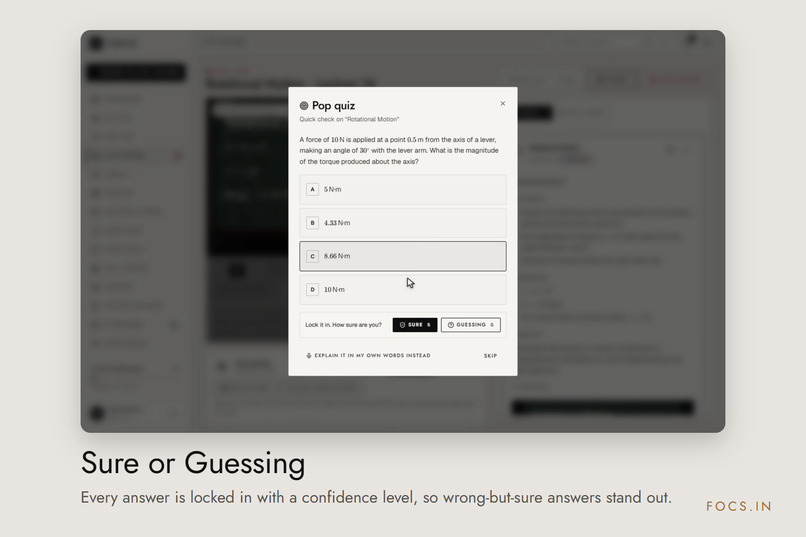
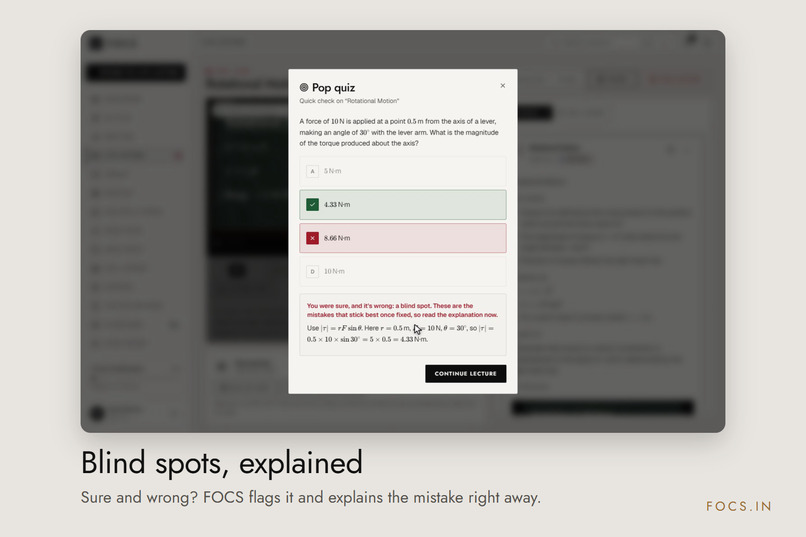
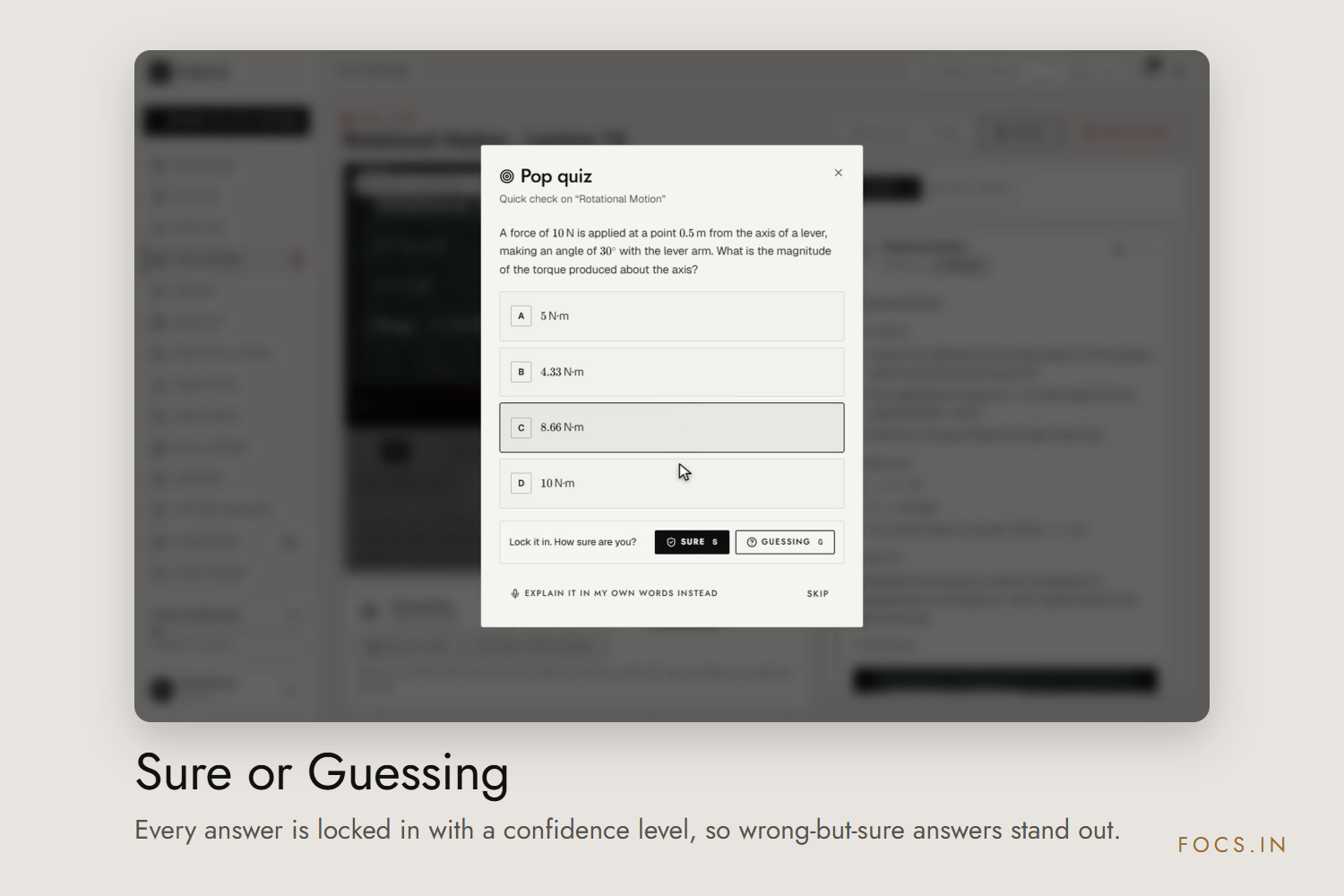
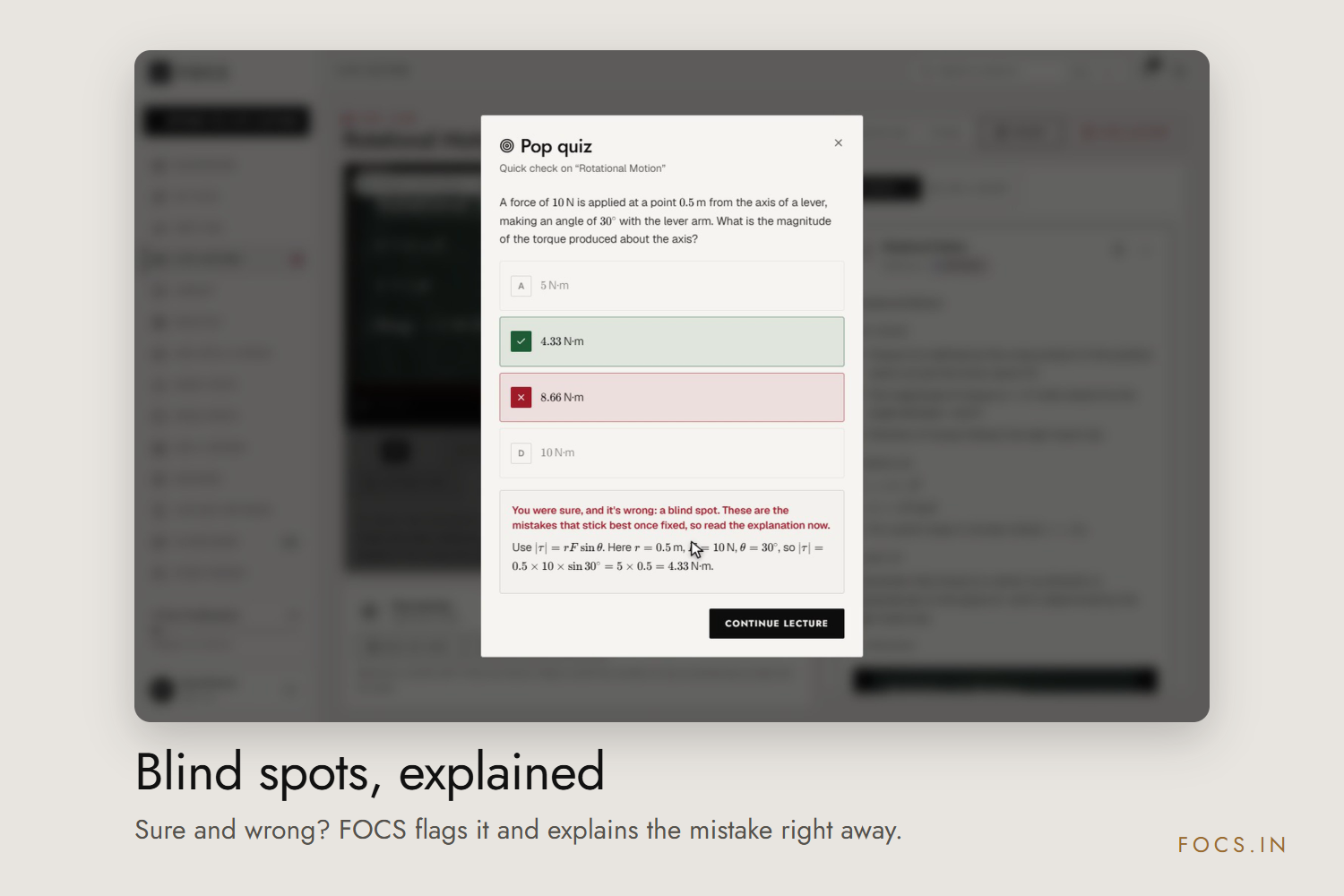
- Understanding: every quiz answer is marked Sure or Guessing. Answers that are sure but wrong are blind spots, and they lead the revision plan.
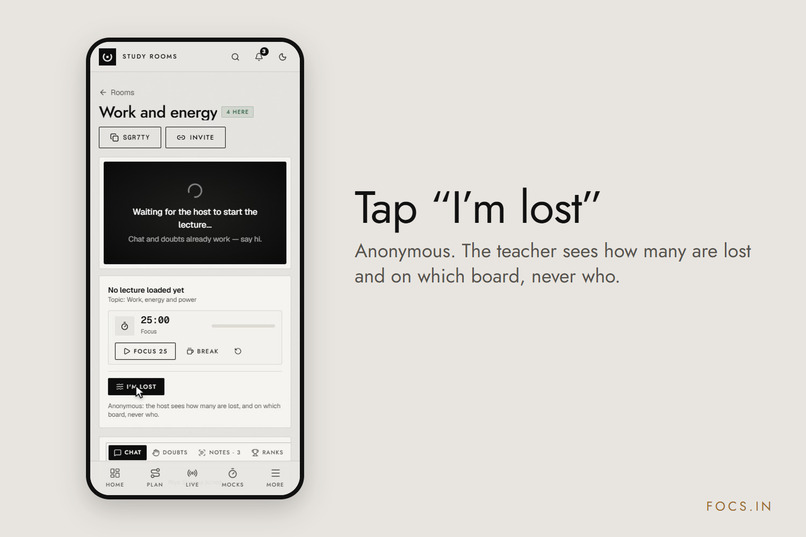
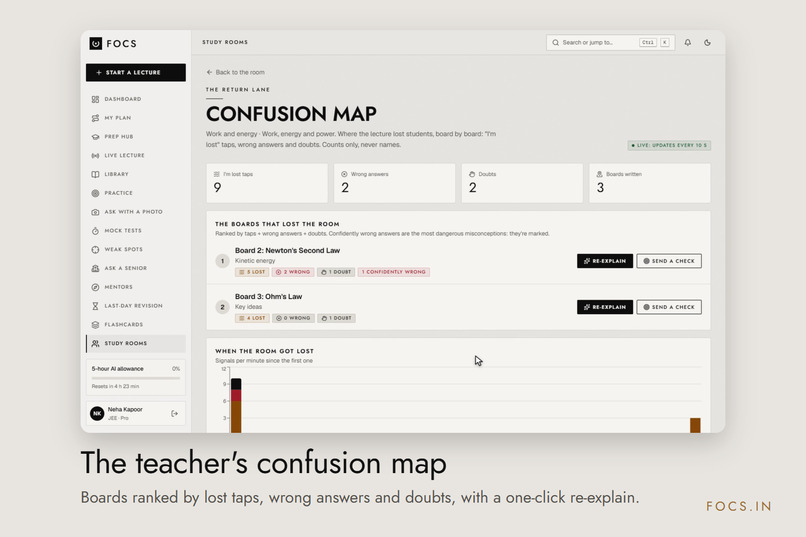
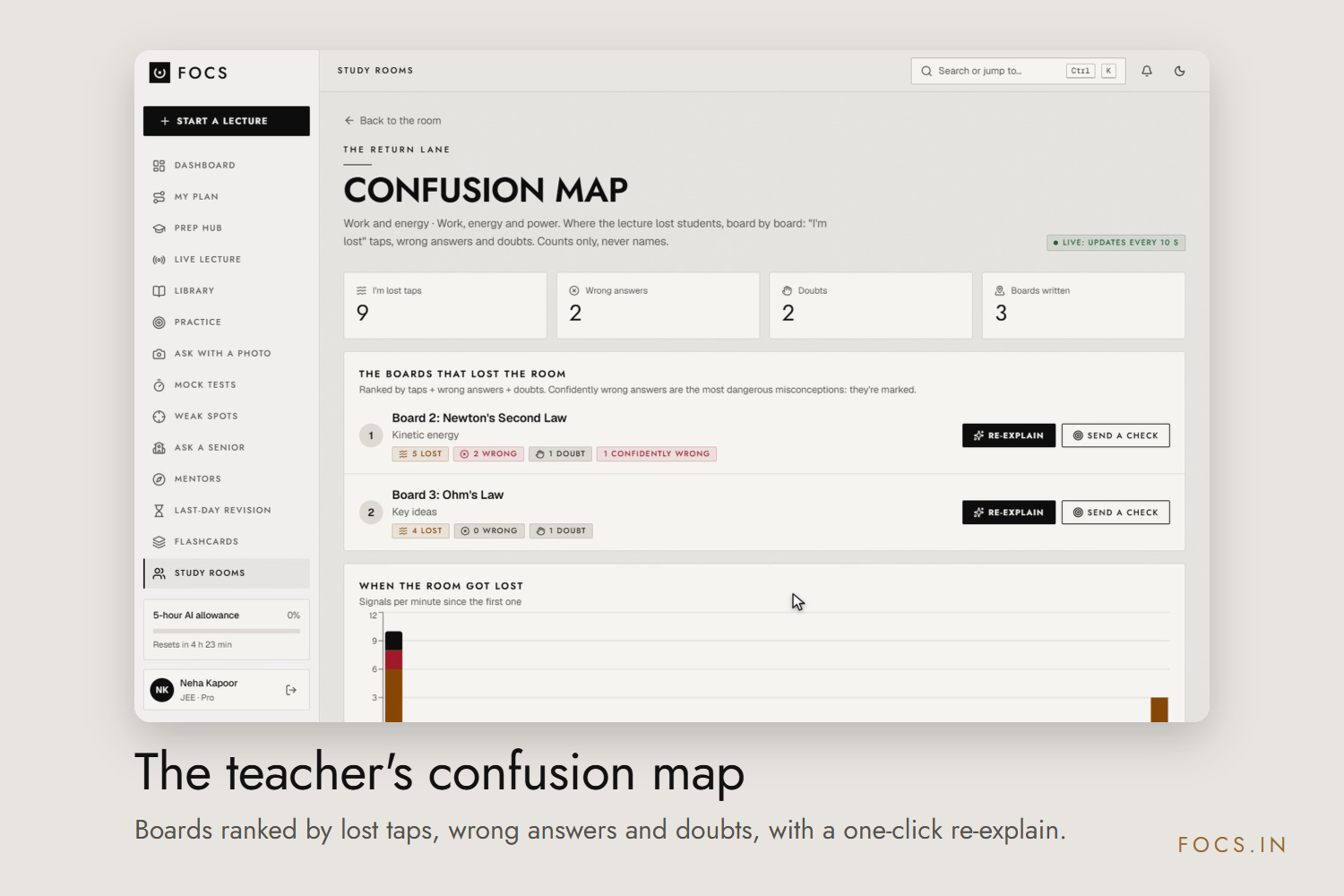
- Return: an anonymous "I'm lost" button. The teacher sees how many students are lost and on which board, never who. After the lecture, a confusion map ranks the boards and offers a recap or a quick check on any of them.
After a course, students can use Ask a senior: a junior's question gets an AI draft at once, clearly labelled as AI, and a senior B.Tech student checks or corrects it.
How we built it
- FocsOCR: our own model for reading lecture boards. On 240 held-out lecture frames it reached a 0.48% character error rate, against 7.27% for PP-OCRv4 on the same frames. (These frames are synthetic, which flatters any model. We are collecting a benchmark on real classroom photos.)
- Backend: Python and FastAPI, with a Supabase database.
- Frontend: a React and TypeScript web app, usable on phones and tablets.
- AI: language models write notes, quizzes and doubt answers. A second model solves every quiz question before a student sees it, and a third breaks ties when two disagree.
- Offline fallback: without any AI key, notes are written from the OCR text and the app still works.
- Deployment: Docker, live at https://focs.in.
Challenges we ran into
- Wrong AI answers. A retest of the live site found 15 problems, including wrong quiz keys and broken maths options. We added the second-model check, a tie-breaker, and a step that repairs broken formulas. Questions that cannot be settled are dropped instead of shown.
- Reading real boards. Stacked fractions and handwriting are hard. A second vision model reads each new board, with our OCR as the fallback.
- Speed on poor connections. Waiting screens now show something useful from the student's own material (a due flashcard or a past mistake) while the AI works, and that needs no AI at all.
- Fair use. We built an AI allowance per 5-hour window so live lectures fall back to basic notes instead of stopping.
Accomplishments that we're proud of
- A working product that is live today at focs.in, not a mock-up.
- Our own OCR model that beats a well-known baseline on our test frames.
- An anonymous way for students to speak up that actually reaches the teacher, pinned to the board that caused it.
- Accessibility checks (axe, WCAG 2.1 A and AA) find no serious or critical problem on the main pages, in both themes, and CI re-runs them on every push.
What we learned
- AI answers must be checked before a student sees them. A confident wrong answer is worse than no answer.
- Language is not a feature, it is access. Hindi and Hinglish change who can follow a lecture at all.
- Students will not say they are lost out loud, but they will tap a button when it is anonymous.
What's next for FOCS
- Next 3 weeks: move the database to Mumbai for faster pages, test on real phones, tablets and payments, and measure the real board-to-note delay.
- Next 3 months: run a small learning study (12 to 20 students, with and without FOCS), benchmark the OCR on real classroom photos, and pilot with a coaching batch.
- Next 12 months: more Indian languages beyond Hindi, partnerships with schools and coaching centres, and a free core for every student.
Try it: https://focs.in Team FOCS: Ashpreet (NSUT) and Mukul (IIIT Delhi)
What it does
How we built it
Challenges we ran into
Accomplishments that we're proud of
What we learned
What's next for FOCS - FOCUS ON COGNITIVE STUDIES
Built With
- amazon-web-services
- axe-core
- docker
- fastapi
- gemini
- groq
- katex
- onnx
- onnxruntime
- opencv
- playwright
- postgresql
- python
- rapidocr
- react
- recharts
- sentry
- sqlalchemy
- supabase
- tailwindcss
- typescript
- vite
