-
-
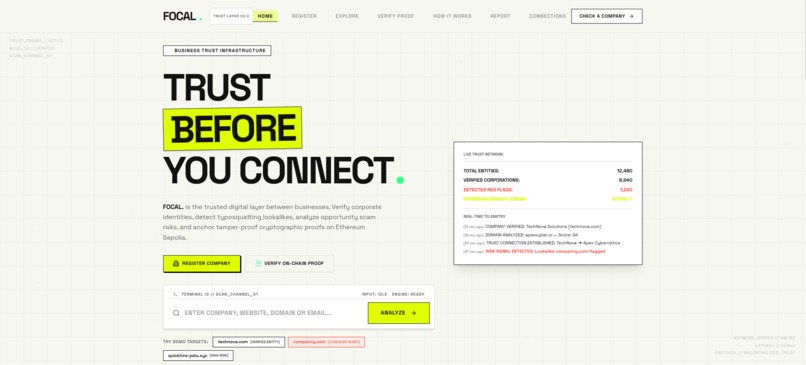
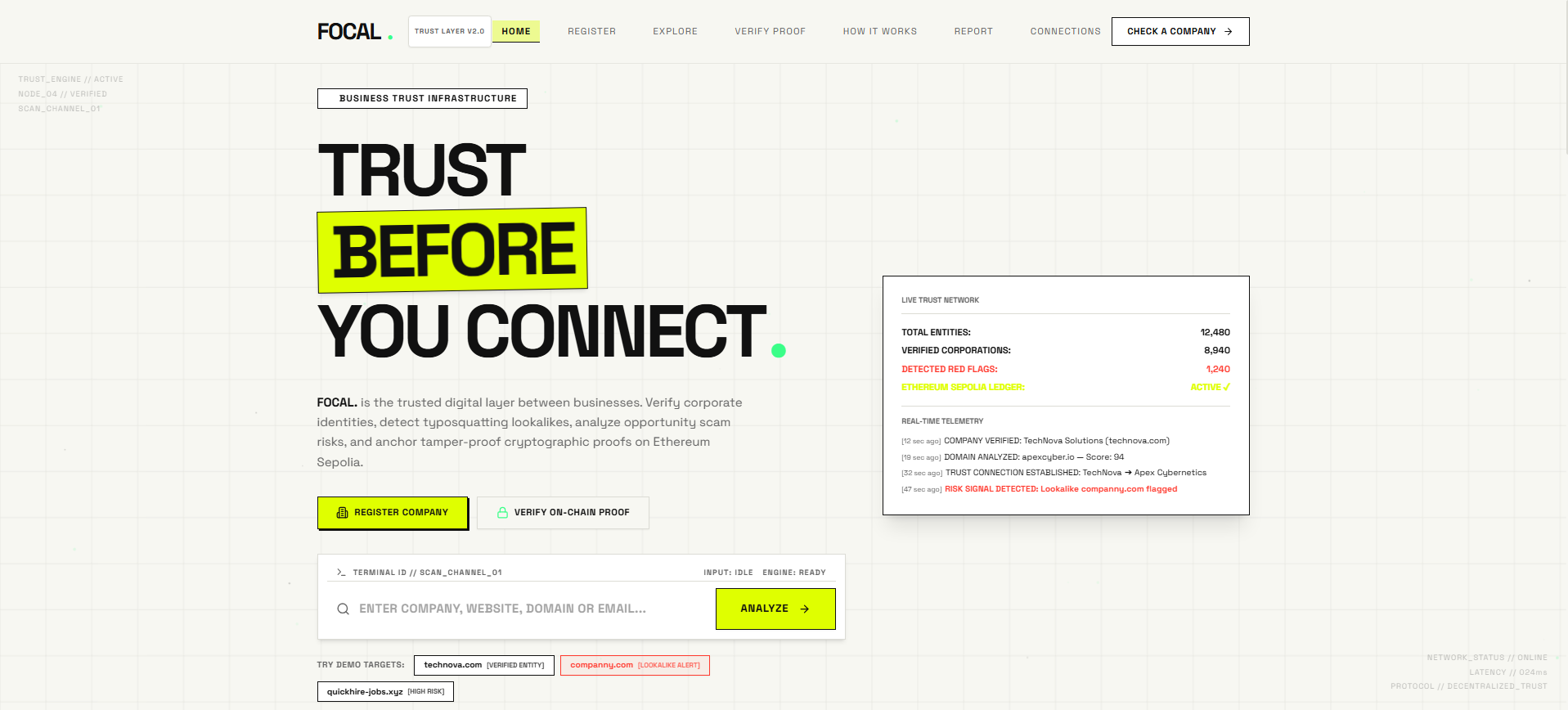
home page
-
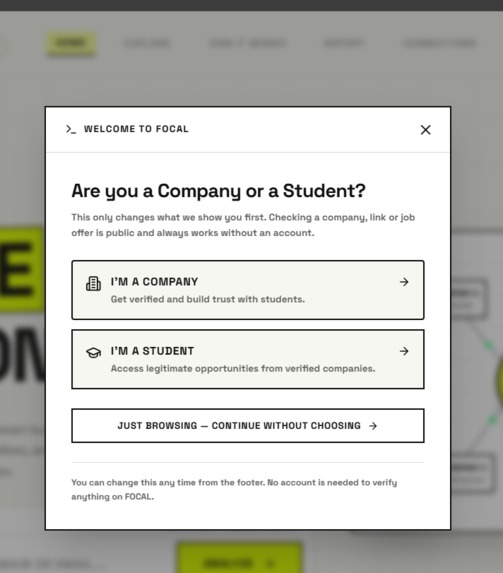
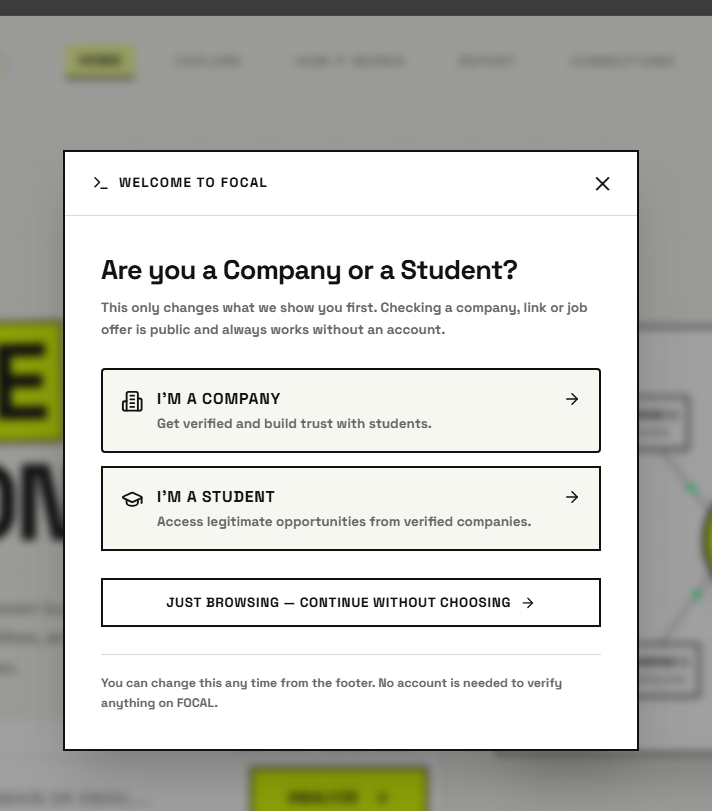
user can choose who are they
-
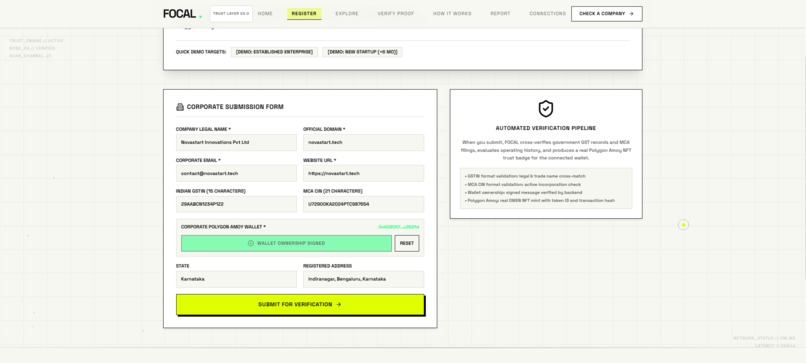
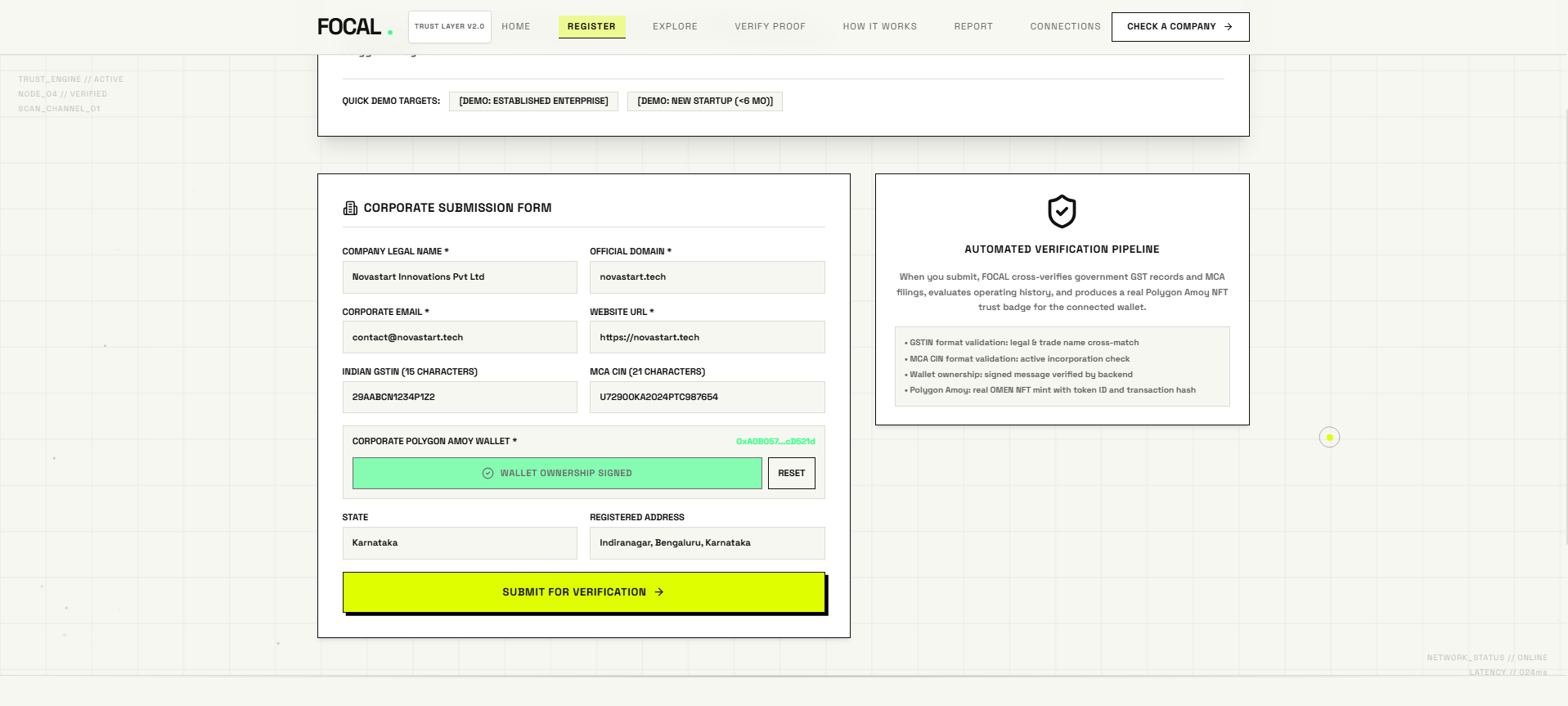
company registration for focal
-
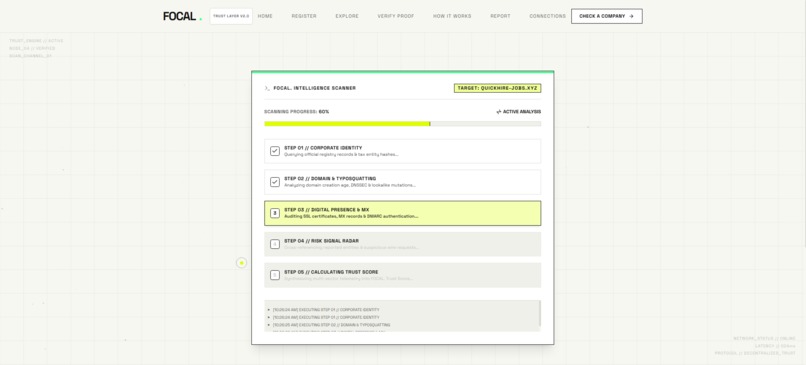
verification process
-
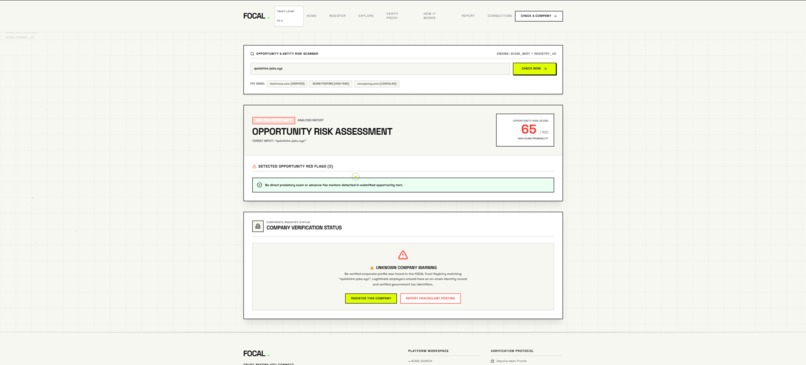
company assesment
-
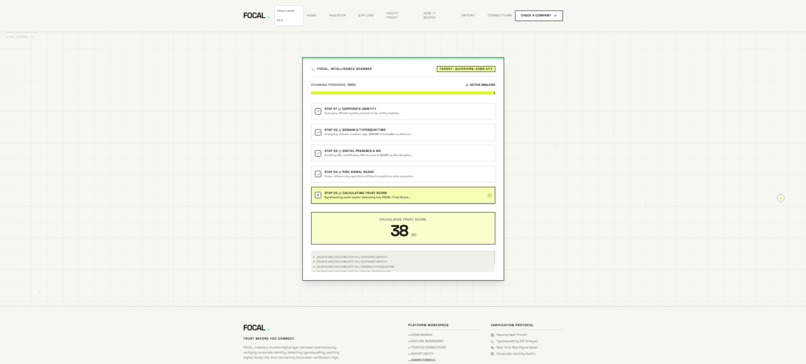
company report
-
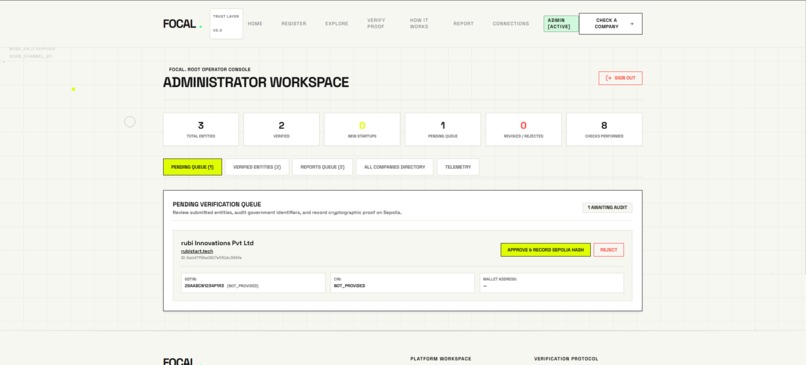
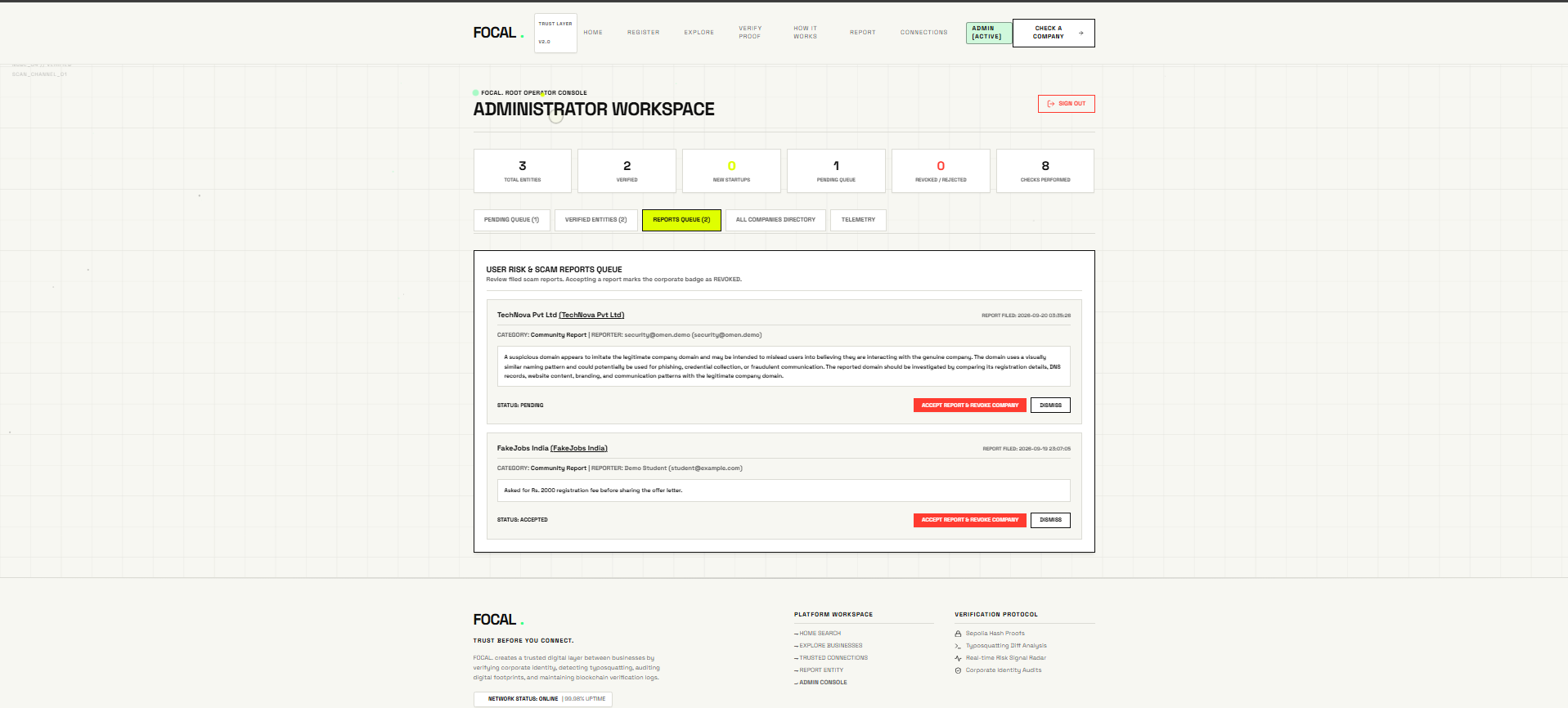
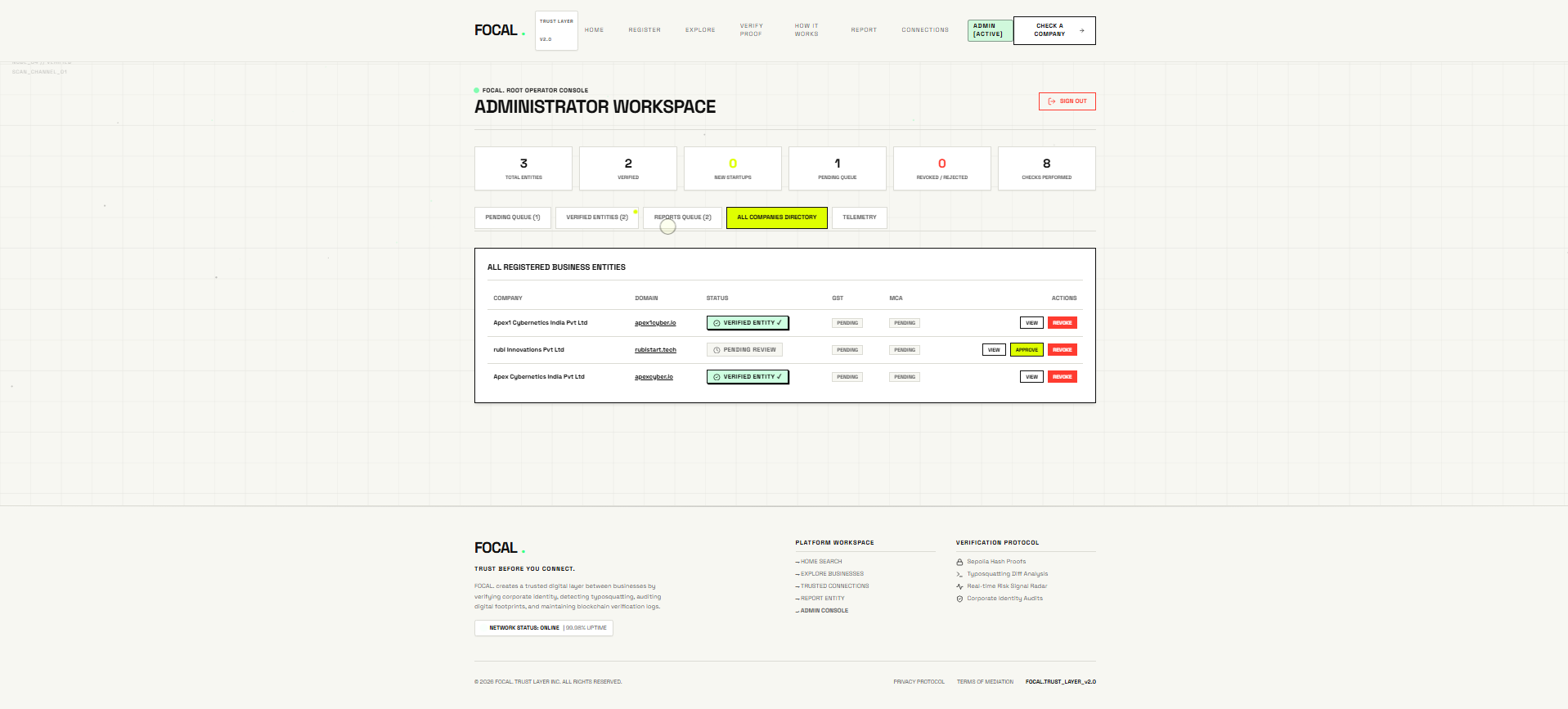
Admin portal
-
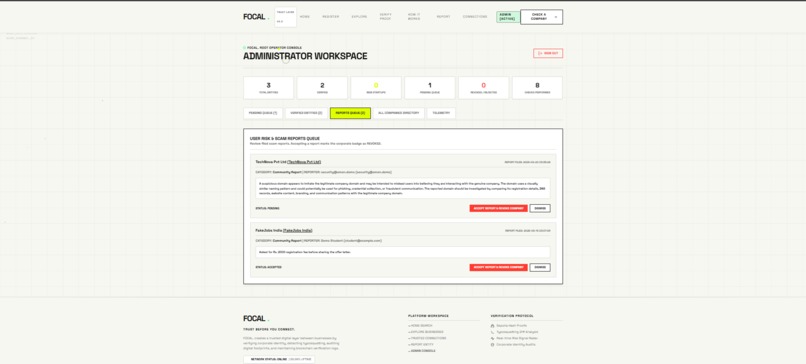
student report submissions
-
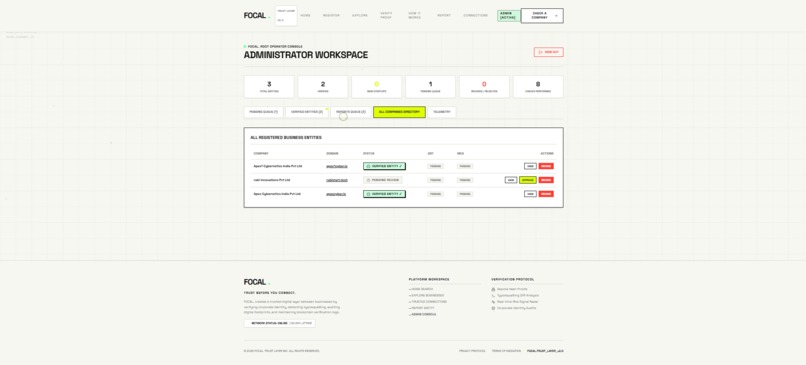
company queue
Inspiration
The idea for FOCAL came from a problem we personally experienced. We received multiple internship and job offers through email, and some of them looked genuine at first. When we became suspicious, we mainly used Google to search for the company and the opportunity.
The problem was that there was no single platform where we could easily check whether an opportunity was trustworthy. We had to go through many emails and search different sources ourselves, and the information available online was not always consistent.
This made us think: What if students had one platform where they could check a company, analyze its risk, and see verifiable proof of its verification?
That idea became FOCAL.
What it does
FOCAL is an AI and blockchain-powered trust platform designed to help students verify companies and job opportunities.
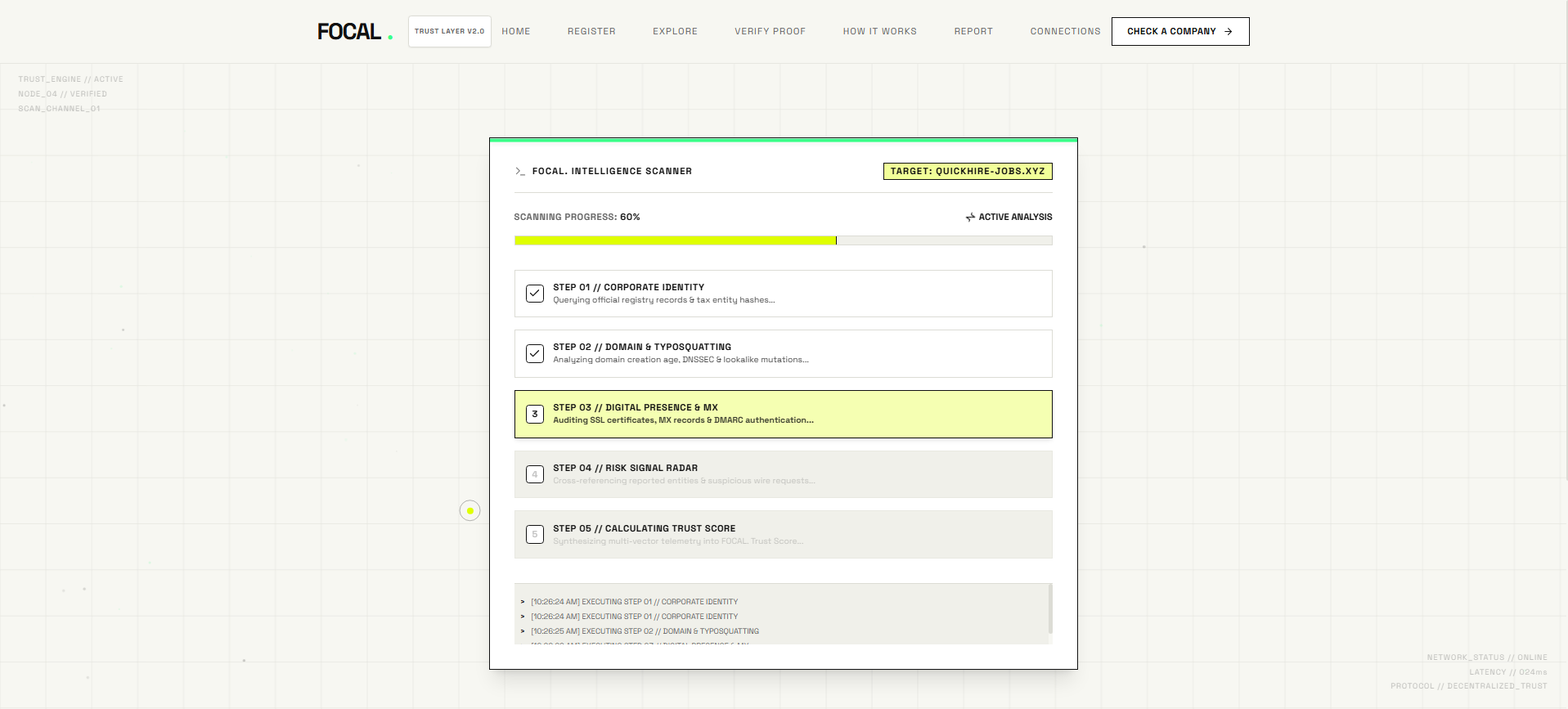
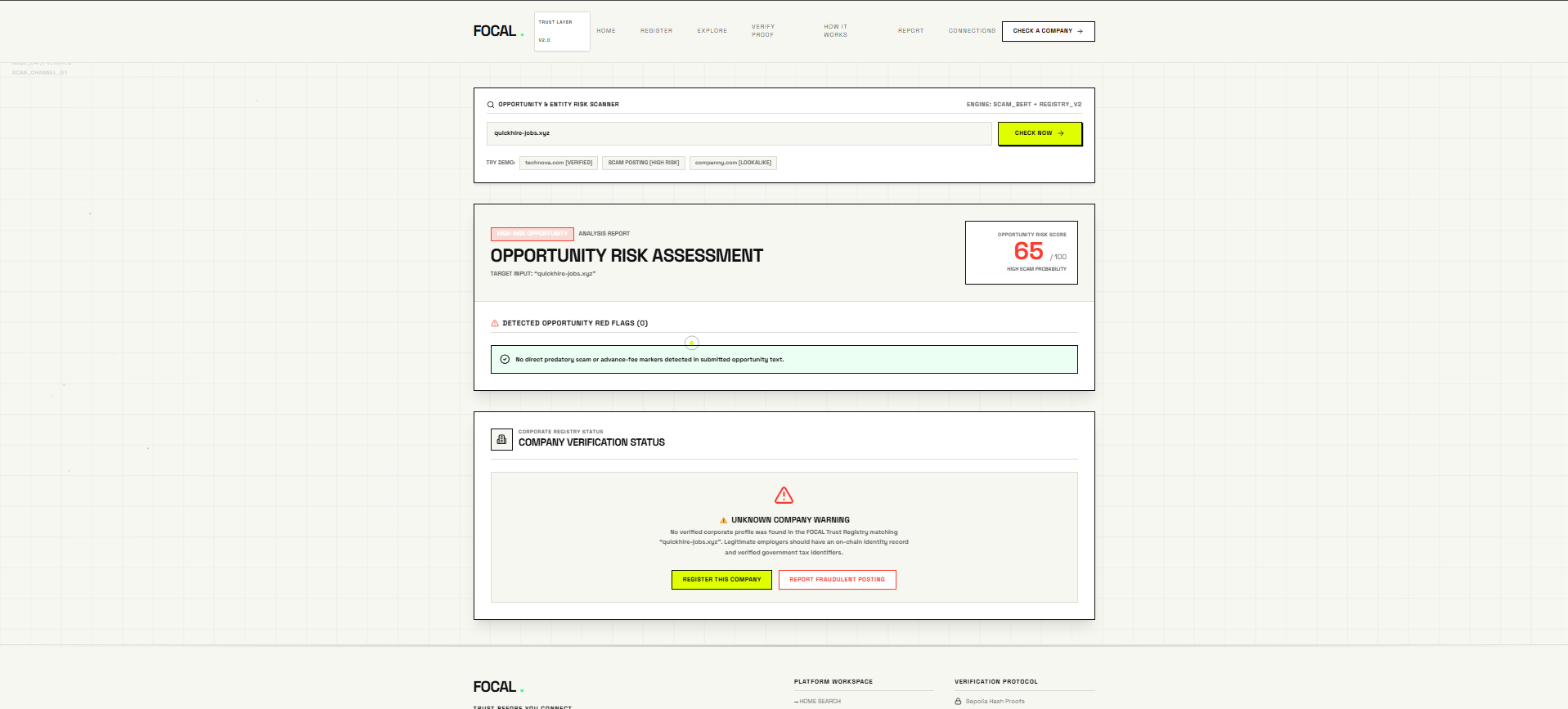
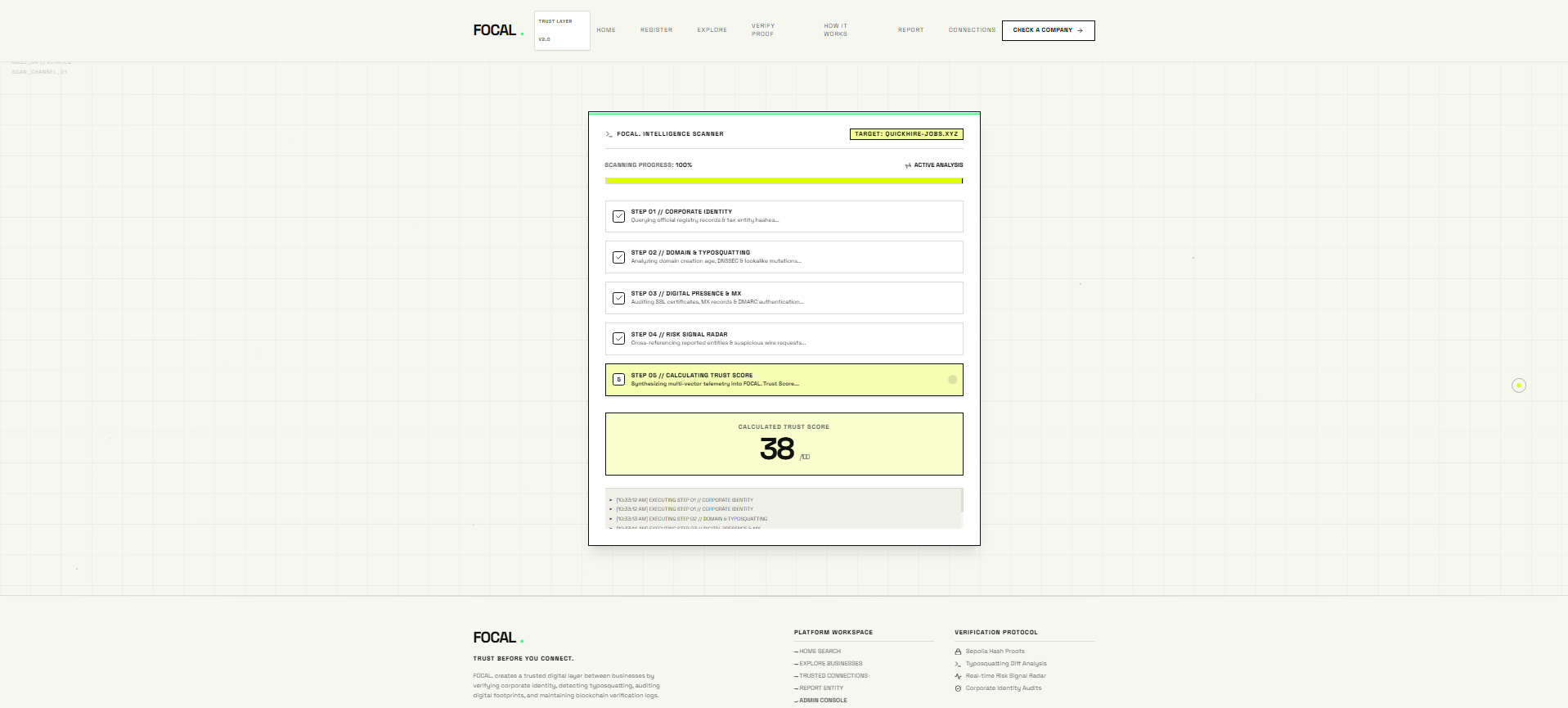
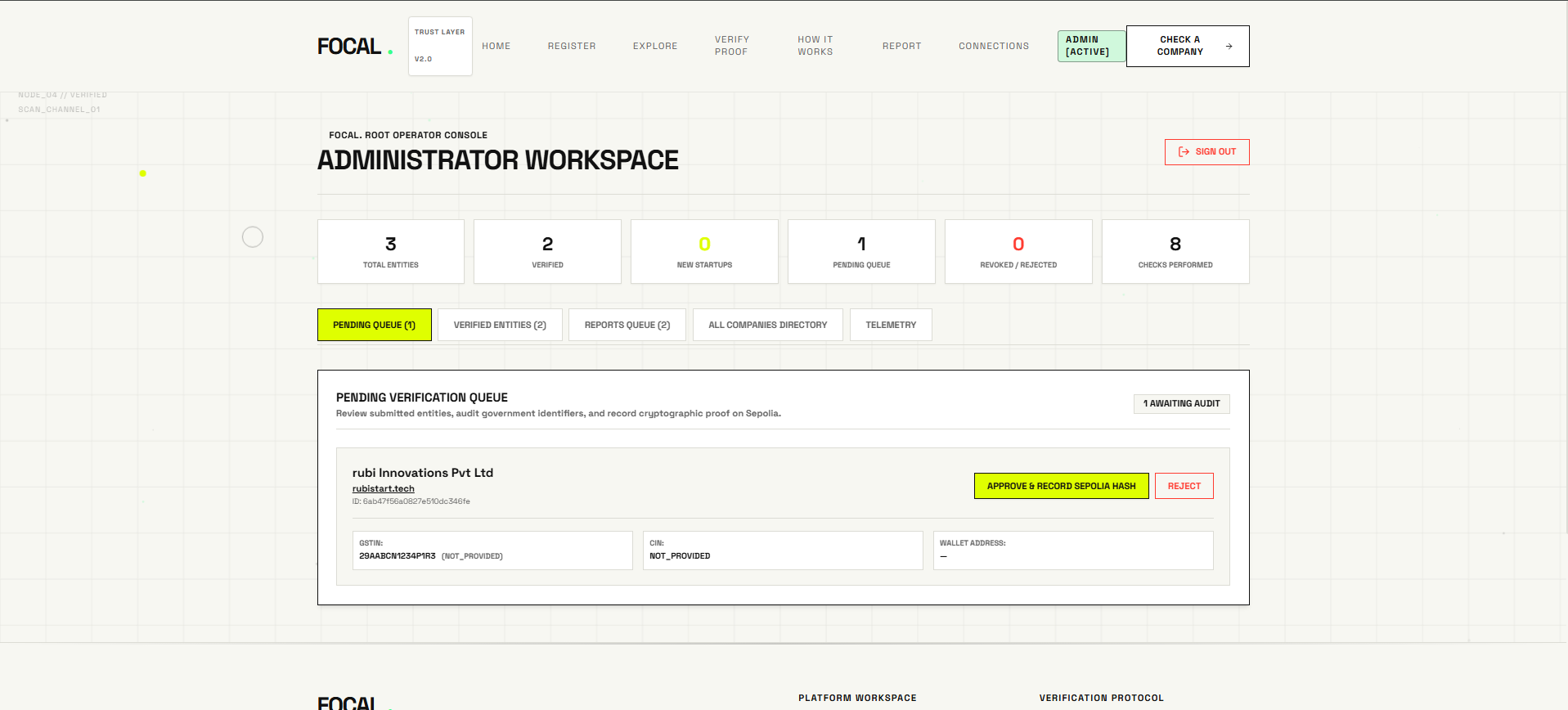
Companies can register their details and go through a verification process using information such as GST and MCA details. FOCAL also performs AI-based risk analysis to identify potential warning signs.
After verification, the company can connect its MetaMask wallet and receive a soulbound NFT badge as a digital proof of verification.
Students do not need to create an account or connect a wallet. They can publicly check a company or opportunity, view its verification status, risk information, and blockchain proof before deciding whether to trust or apply.
How we built it
We built FOCAL as a full-stack application combining AI, blockchain, and traditional web technologies.
The frontend was built using React and Vite, while the backend uses Node.js, Express.js, and MongoDB to manage company and verification data.
For risk analysis, we built a Python-based ML service using FastAPI and machine learning tools.
For the blockchain layer, we developed Solidity smart contracts and used Hardhat for development and deployment. Ethereum Sepolia is used to store the company's verification proof, while Polygon Amoy is used for the soulbound NFT badge.
We use Ethers.js to communicate with the blockchain, MetaMask for company wallet authentication, and IPFS to store NFT metadata.
Our overall workflow is:
Company Registration → GST/MCA Verification → AI Risk Analysis → Admin Verification → Blockchain Proof → Soulbound NFT → Student Verification
Challenges we ran into
One of our biggest challenges was connecting multiple technologies into one complete working system.
It was not enough to build the frontend, backend, AI model, and blockchain contract separately. We had to make sure that all of them worked together correctly.
We faced challenges with blockchain RPC connections, smart contract configuration, transaction handling, verification status, wallet authentication, and connecting the NFT metadata with IPFS.
Another important challenge was understanding what blockchain should actually store. We learned that putting the entire company database on-chain is unnecessary. Instead, we store important verification proofs on the blockchain while keeping detailed application data in MongoDB.
Accomplishments that we're proud of
We are proud that we turned a problem we personally experienced into a working platform combining AI and blockchain.
We successfully built the complete verification workflow, deployed our smart contracts, recorded real verification data on the blockchain, and created a soulbound NFT verification badge for verified companies.
We are also proud of the fact that students do not need an account, crypto wallet, or cryptocurrency just to use FOCAL. They can publicly access the verification information and make their own decision.
What we learned
Building FOCAL taught us that different technologies solve different parts of the trust problem.
We learned that AI can help identify risk signals, but it cannot guarantee that a company is legitimate. Blockchain can provide tamper-resistant proof, but it does not independently prove that a company is genuine.
We also learned how to integrate technologies such as React, Node.js, MongoDB, Python, Solidity, Hardhat, Ethers.js, MetaMask, and IPFS into a single application.
Most importantly, we learned that blockchain should be used where it adds real value rather than simply adding it to a project because it is a new technology.
What's next for FOCAL
Our next goal is to make FOCAL more comprehensive and reliable by integrating more official verification sources and improving the AI risk analysis.
We also want to expand opportunity-level verification so that students can check not only a company but also a specific internship or job offer, including its website, email, and job link.
In the future, we want FOCAL to become a single trust layer where students can quickly investigate opportunities before sharing personal information or applying.
Our vision is simple: make it easier for students to know what they are dealing with before they trust an opportunity.
Built With
- blockchain
- ethereum
- machine-learning
- polygon
- python


Log in or sign up for Devpost to join the conversation.