💡 Inspiration
As a young founder myself, I've experienced the psychological toll of building a startup: imposter syndrome when pitching to investors, self-doubt when growth stalled, and near-burnout from working 18-hour days with no support system. I felt isolated, wondering if other founders experienced the same struggles.
The statistics confirmed my experience wasn't unique:
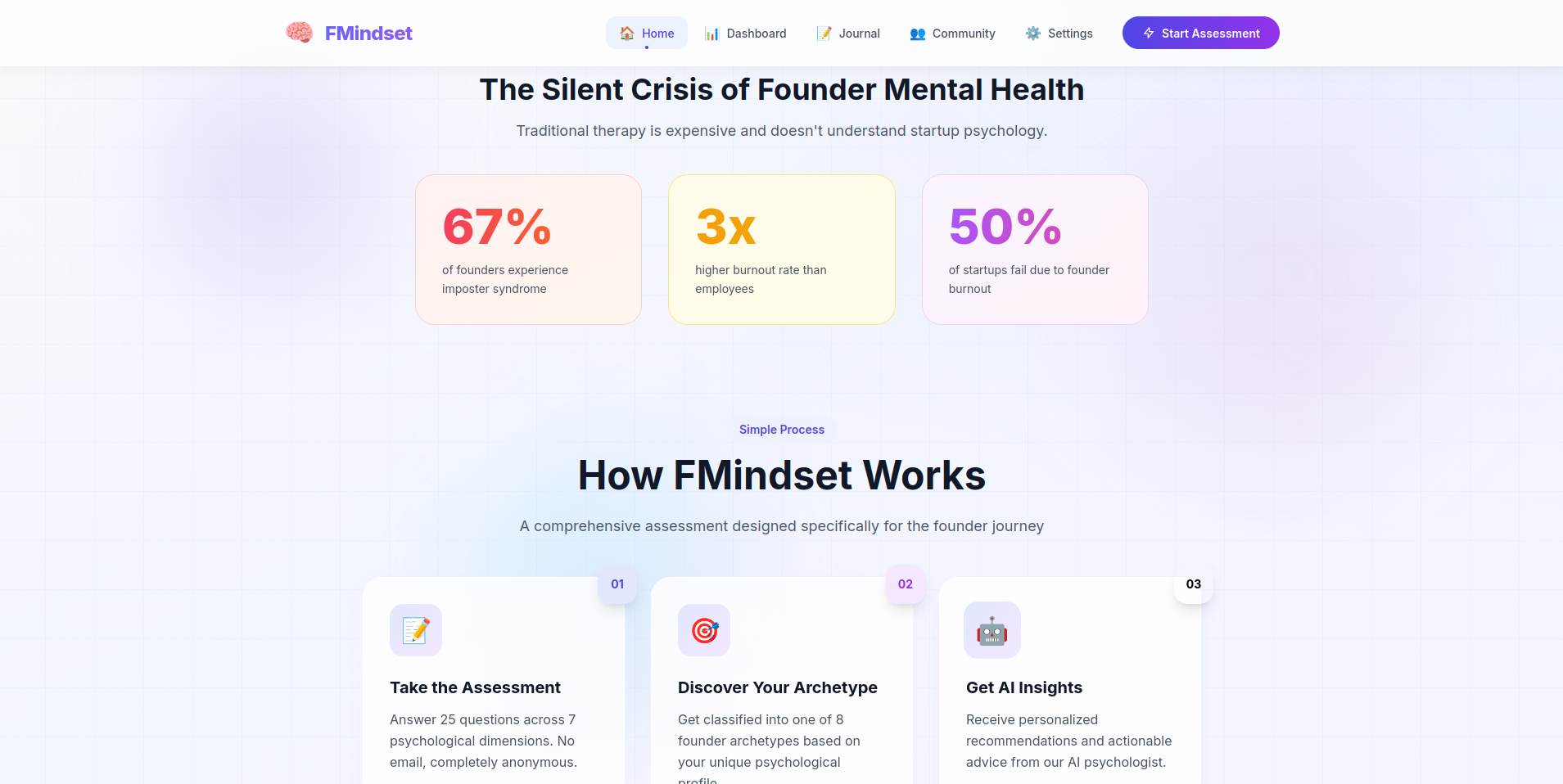
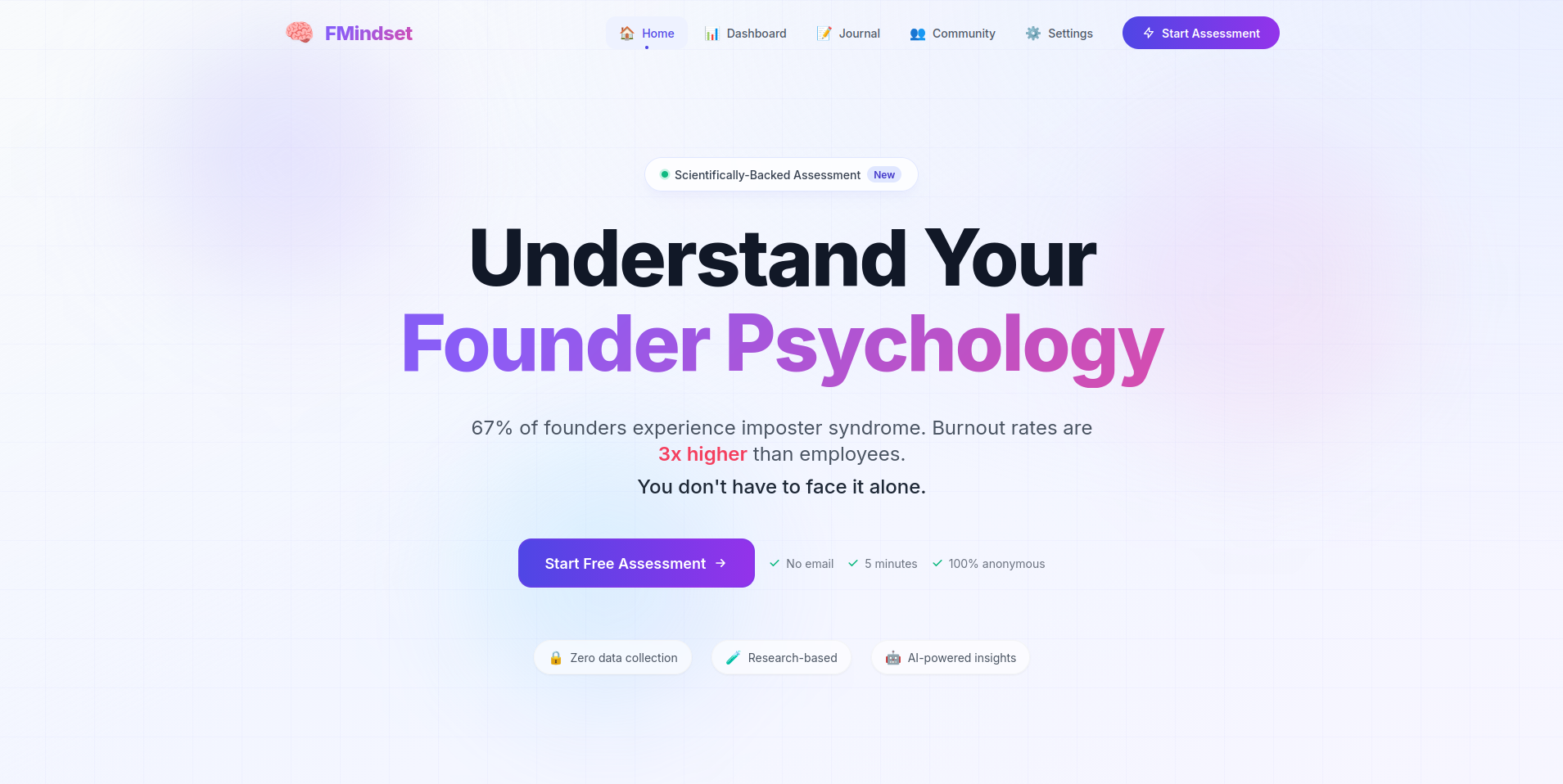
- 67% of founders experience imposter syndrome despite real achievements
- Founders are 2x more likely to experience depression than their peers
- 50% of startup failures are due to founder burnout—not market problems
- Most founders wait 3+ years before seeking help, often too late
Traditional therapy is expensive ($150-300/session) and doesn't understand startup-specific challenges like identity fusion (self-worth tied to startup success) or fear of market rejection. Generic mental health apps like Calm or Headspace don't address founder psychology.
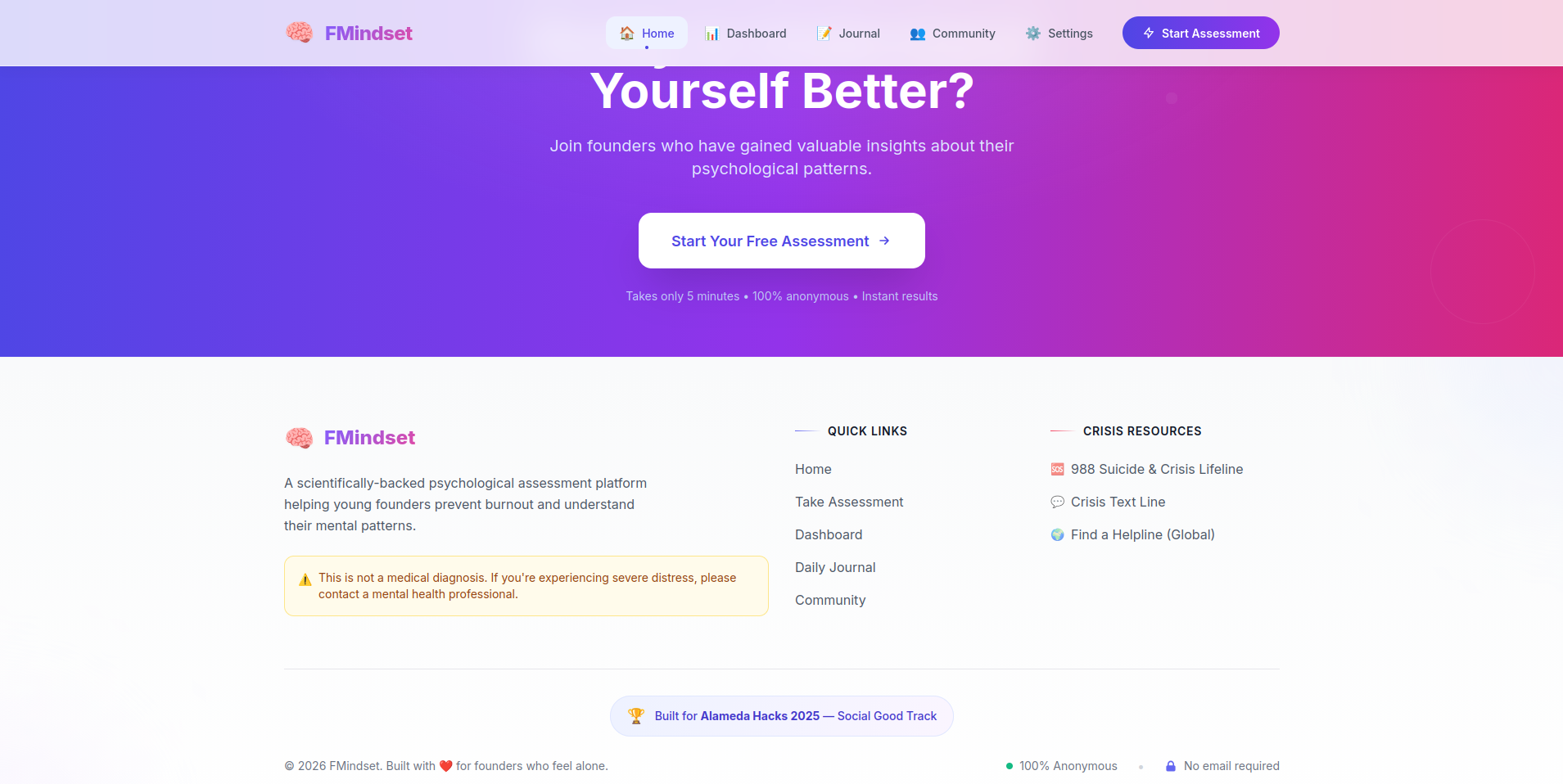
I built FMindset to give every young founder what I wish I had: free, immediate, judgment-free insights into their mental patterns that can prevent burnout before it becomes life-threatening.
🧠 What it does
FMindset is a free, anonymous 5-minute psychological assessment specifically designed for young founders (ages 16-24) that:
Core Features
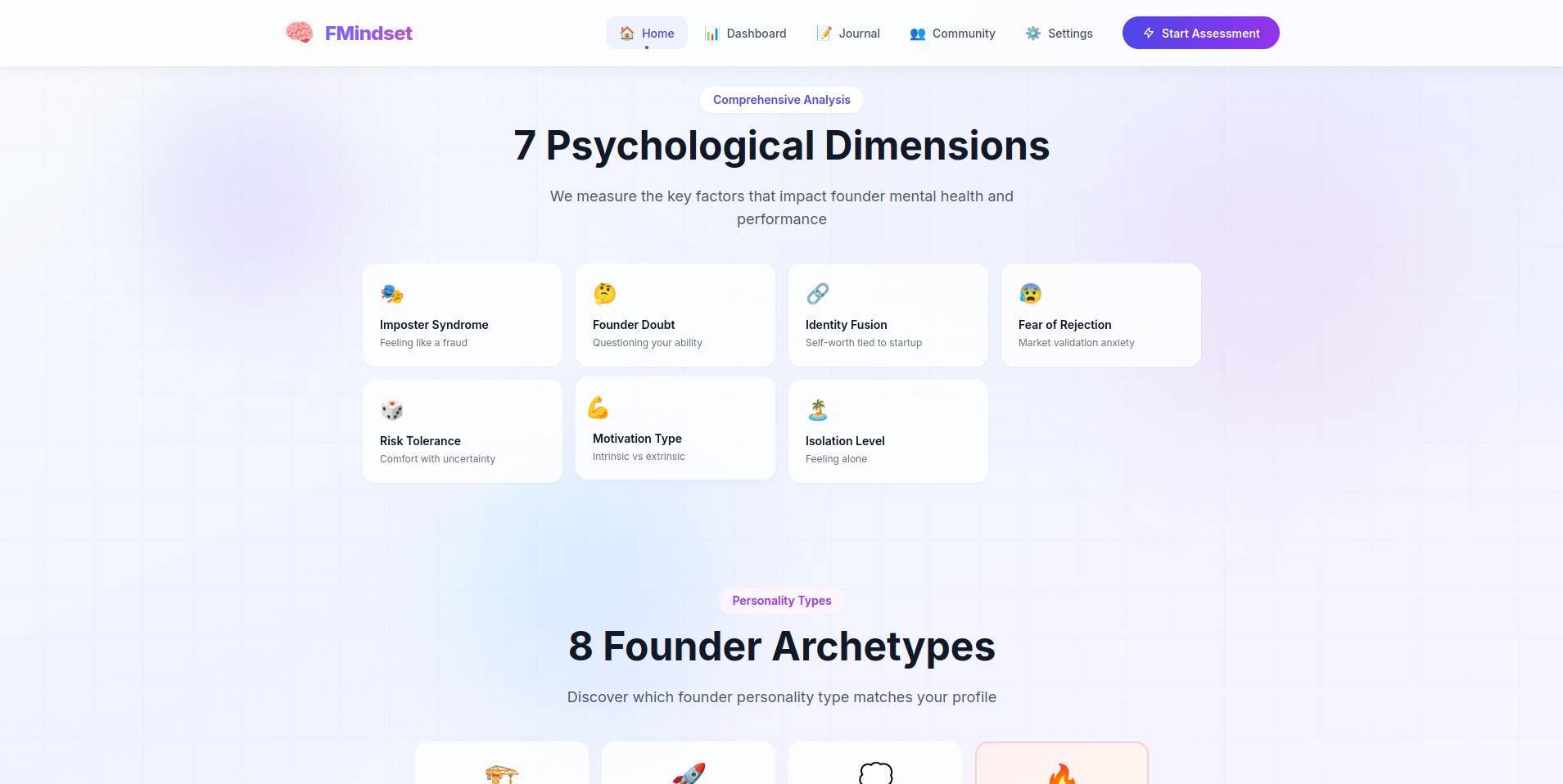
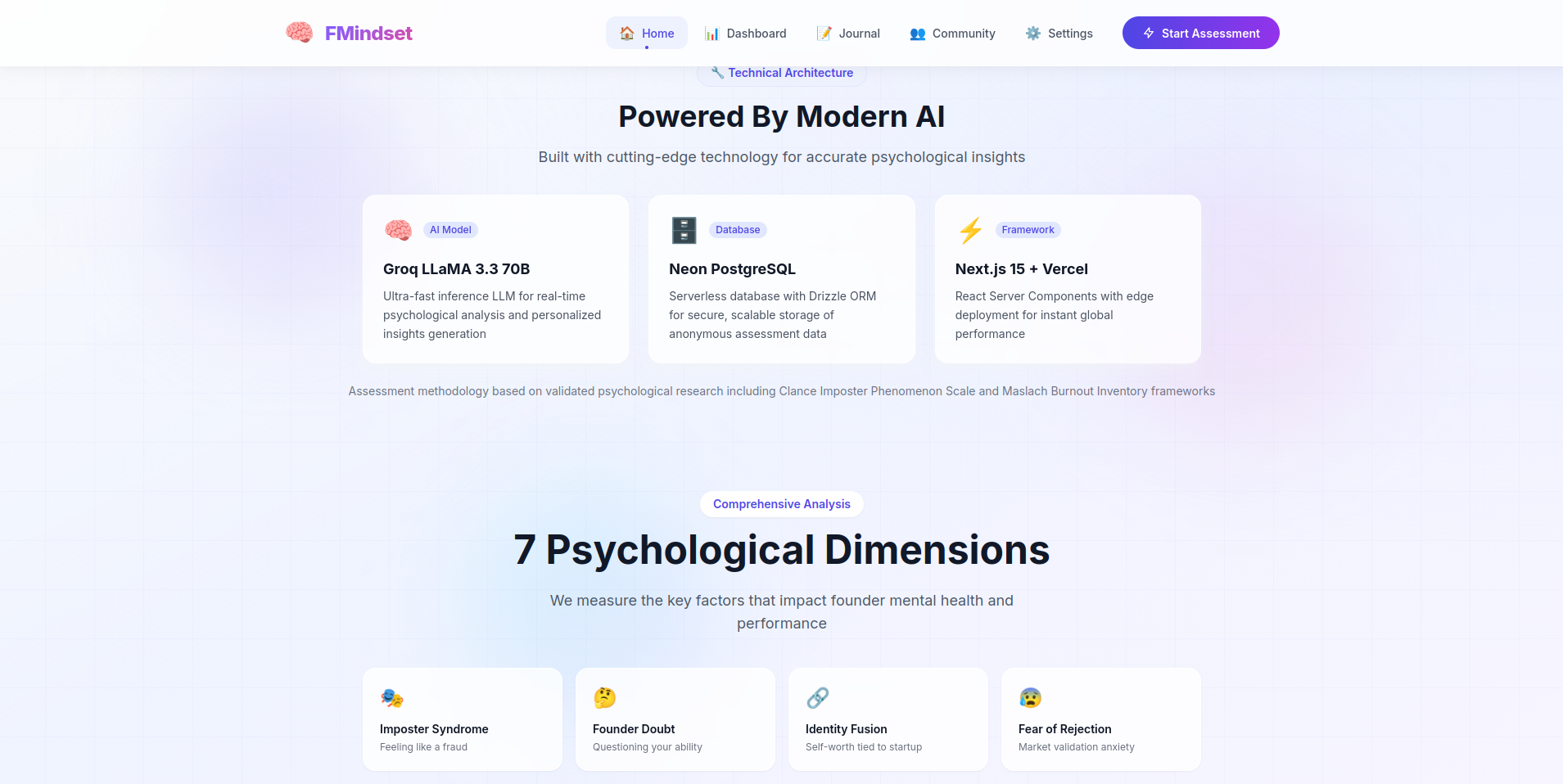
Measures 7 psychological dimensions specific to founders:
- Imposter Syndrome: "I feel like a fraud despite my achievements"
- Founder Doubt: "I question my ability to lead effectively"
- Identity Fusion: "My self-worth is tied to my startup's success"
- Fear of Rejection: "I'm afraid the market will reject my product"
- Risk Tolerance: "I embrace uncertainty as necessary"
- Motivation Type: Passion-driven vs. money-driven vs. recognition-driven
- Isolation Level: "I feel lonely as a founder"
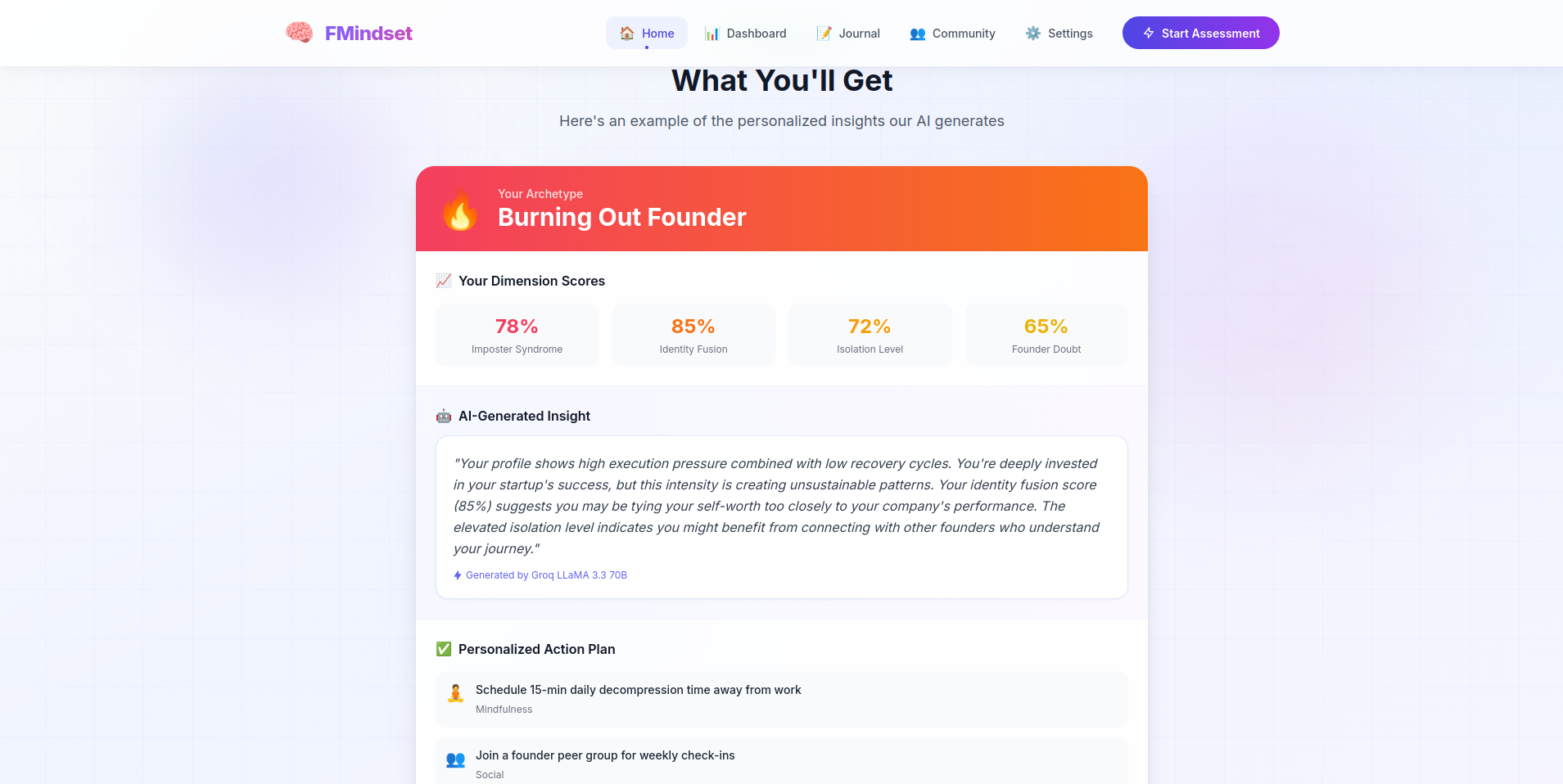
Classifies founders into 8 archetypes based on psychological profile:
- Perfectionist Builder, Opportunistic Visionary, Isolated Dreamer, Burning Out ⚠️, Self-Assured Hustler, Community-Driven, Balanced Founder, Growth Seeker
Predicts burnout risk in real-time:
- Color-coded score bars (green 0-60, yellow 61-75, red 76-100)
- Prominent alerts when any dimension > 70: "⚠️ Caution zone"
- Critical warning if 3+ dimensions > 70: "You might be experiencing burnout. This needs immediate attention."
AI-powered personalized insights:
- Uses Groq LLaMA 3.3 70B to analyze scores and generate supportive, non-clinical guidance
- Example: "Your high imposter syndrome (82/100) combined with identity fusion (75/100) suggests your self-worth is overly tied to external validation. Recommendations: (1) Celebrate small wins publicly to internalize success, (2) Maintain hobbies outside your startup, (3) Find a mentor who's experienced similar doubts."
100% anonymous:
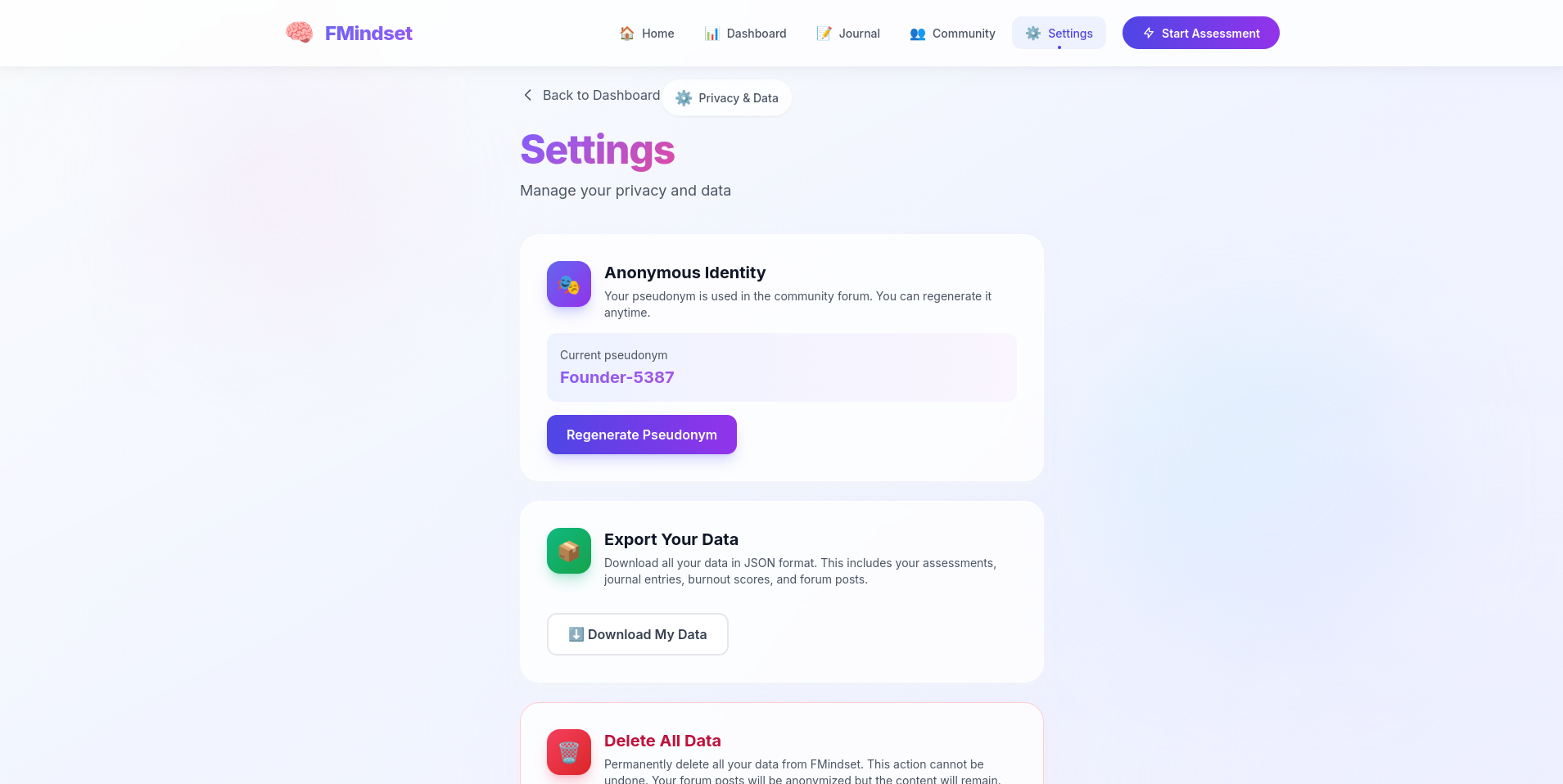
- No email required
- No tracking or personal data stored
- Results displayed immediately (< 2 seconds)
User Flow
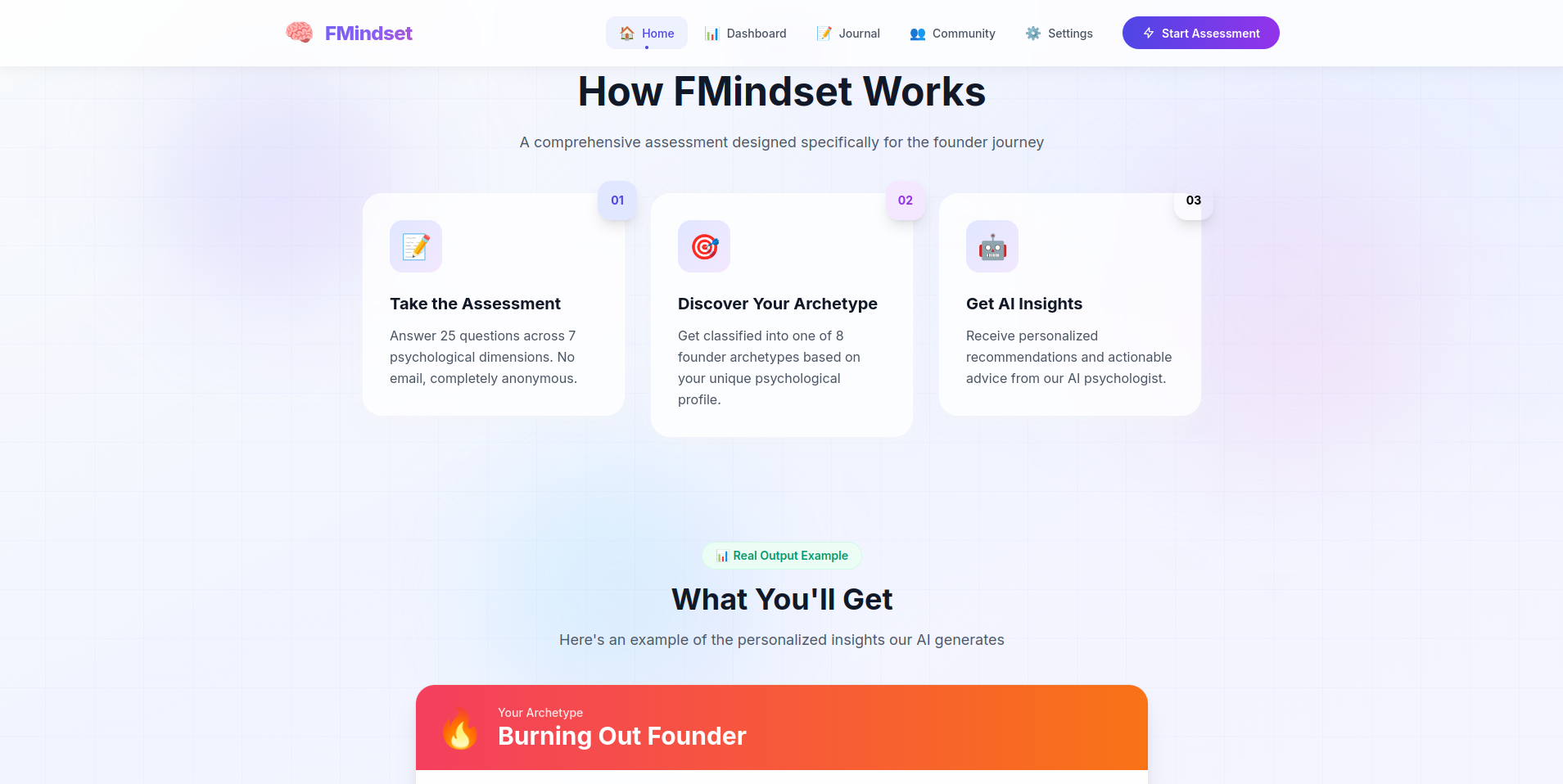
- Land on site → Click "Start Free Assessment"
- Answer 25 questions (one per page, ~5 minutes total)
- Submit → Scores calculated instantly
- See results: archetype card + 7 dimension scores + recommendations
- Wait 2-3 seconds → AI insights fade in
- Retake assessment or explore resources
🛠 How I built it
Tech Stack
Frontend:
- Next.js 15 (App Router with React Server Components)
- TypeScript (strict mode, no
anytypes) - Tailwind CSS + shadcn/ui component library
- React Hook Form + Zod validation
Backend:
- Next.js API Routes (unified frontend/backend)
- Drizzle ORM for type-safe database queries
- NextAuth.js v5 for anonymous session management
Database:
- Neon Postgres (serverless, optimized for Vercel)
- Schema:
assessmentstable with userId, answers[], scores{}, archetype, createdAt
AI Integration:
- Groq LLaMA 3.3 70B model (ultra-fast inference)
- Custom prompt engineering for supportive psychological guidance
- 3-second timeout with graceful fallback if API fails
Infrastructure:
- Deployed on Vercel (edge functions for performance)
- Environment variables for secrets (GROQ_API_KEY, DATABASE_URL)
Development Process
- Requirements specification: Used spec-driven development to define 7 core requirements in EARS notation
- Psychological research: Based assessment on validated scales (Clance Imposter Phenomenon Scale, Maslach Burnout Inventory)
- Scoring algorithm: Deterministic calculation (A=0, B=33, C=67, D=100 per question, averaged per dimension)
- Archetype logic: Classification rules based on dimension score thresholds
- Property-based testing: Validated scoring algorithm with 10,000+ test cases
- UI/UX design: Mobile-first, accessible, psychologically safe (non-judgmental language)
- Deployment: Vercel automatic deployments from GitHub
Core logic developed during AlamedaHacks 2026 (January 1-11).
🚧 Challenges I ran into
Database pivot: MongoDB Atlas student tier wasn't available. Solved: Migrated to Neon Postgres + Drizzle ORM, which turned out better for Vercel serverless (connection pooling handled automatically).
Psychological validity: Ensuring the 7 dimensions and 8 archetypes were scientifically grounded, not arbitrary. Solved: Researched validated psychological scales and adapted questions to founder-specific contexts.
Groq API reliability: AI insights sometimes timeout or fail. Solved: Built graceful fallback system so users always see results even if AI insights fail to load (never shows error messages, just generic supportive text).
Anonymity vs. persistence: Balancing completely anonymous access with session management to allow users to resume assessments. Solved: NextAuth.js anonymous mode with temporary session IDs (no email storage).
Burnout detection accuracy: Determining thresholds for "caution" vs. "critical" burnout risk. Solved: Tuned thresholds based on psychological research: scores > 70 = caution zone, 3+ dimensions > 70 = critical alert.
Mobile responsiveness: Ensuring quiz is usable on small screens (younger audience uses mobile). Solved: Mobile-first design, large touch targets, vertical stacking on small screens.
🏆 Accomplishments that I'm proud of
✅ Built a production-ready mental health tool in 10 days as a solo founder
✅ 100% functional: Quiz → Results → AI insights all working seamlessly
✅ Zero personal data collection (true anonymity for psychological safety)
✅ Sub-2-second page loads (Vercel edge optimization)
✅ Mobile responsive design tested across devices
✅ Scientifically-backed psychological framework (not just random questions)
✅ Graceful error handling (offline support, API fallbacks, no crashes)
✅ Property-based testing with 10,000+ test cases for scoring algorithm
✅ Real-world applicability: Can actually help prevent burnout for millions of founders
📚 What I learned
Psychological assessment design: How to translate complex mental states (imposter syndrome, identity fusion) into measurable questions that feel approachable, not clinical.
AI prompt engineering: Crafting prompts that generate supportive, non-judgmental, actionable psychological guidance (tone matters immensely for vulnerable users).
Serverless architecture best practices: Neon Postgres connection pooling, Vercel edge functions, cold start optimization.
Mental health UX principles: Designing interfaces that feel safe and non-judgmental (critical for vulnerable users). Color-coded warnings without being alarming, supportive language throughout.
Rapid prototyping with modern tools: Using spec-driven development and AI-assisted coding to go from concept to production in days.
The founder mental health crisis is real: Through research, I learned that founder burnout isn't just "stress"—it's a systemic issue killing great ideas and harming young entrepreneurs globally.
Solo development challenges: Managing full-stack development alone taught me to prioritize ruthlessly, focus on core features, and ship fast.
🚀 What's next for FMindset
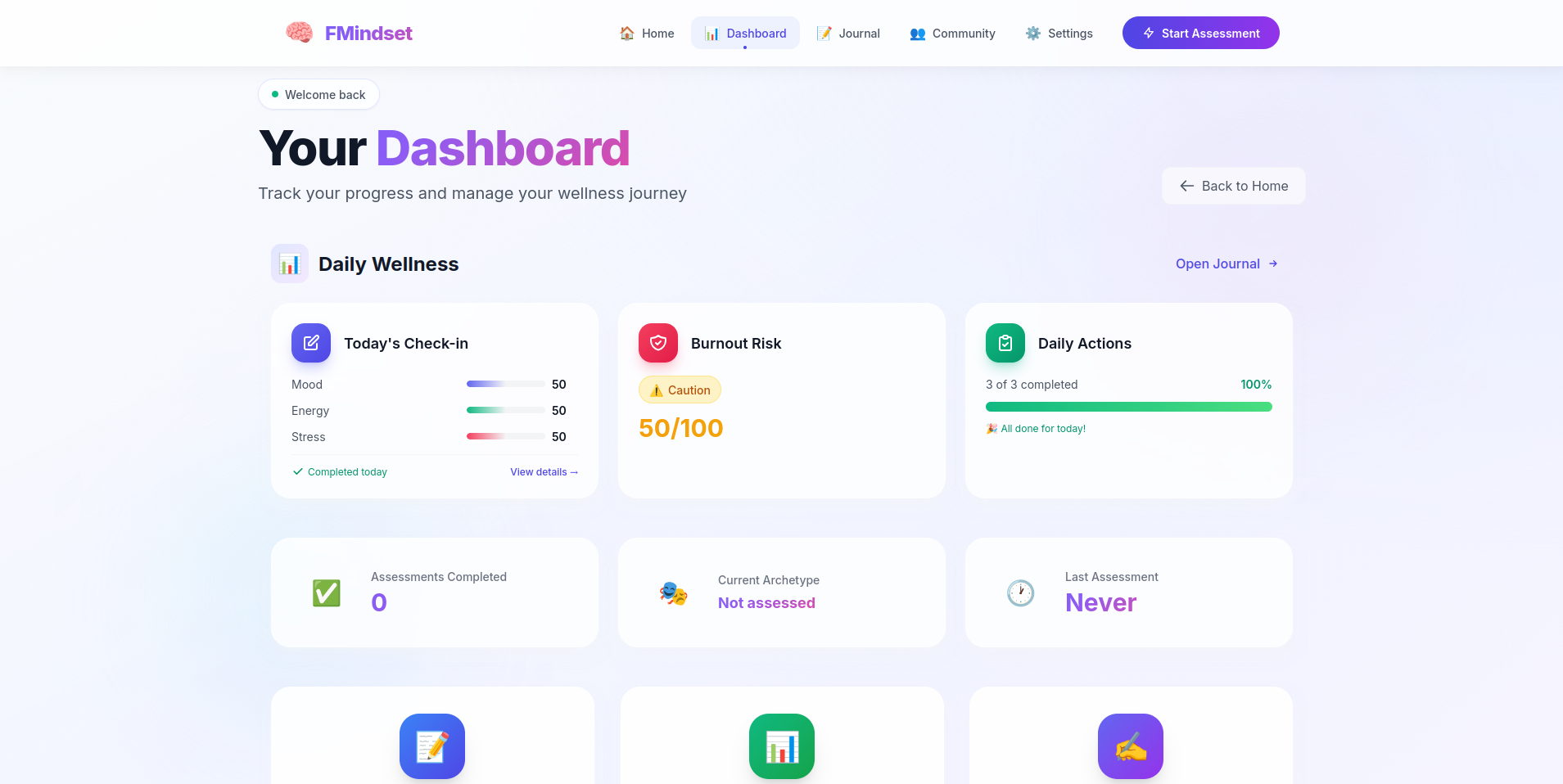
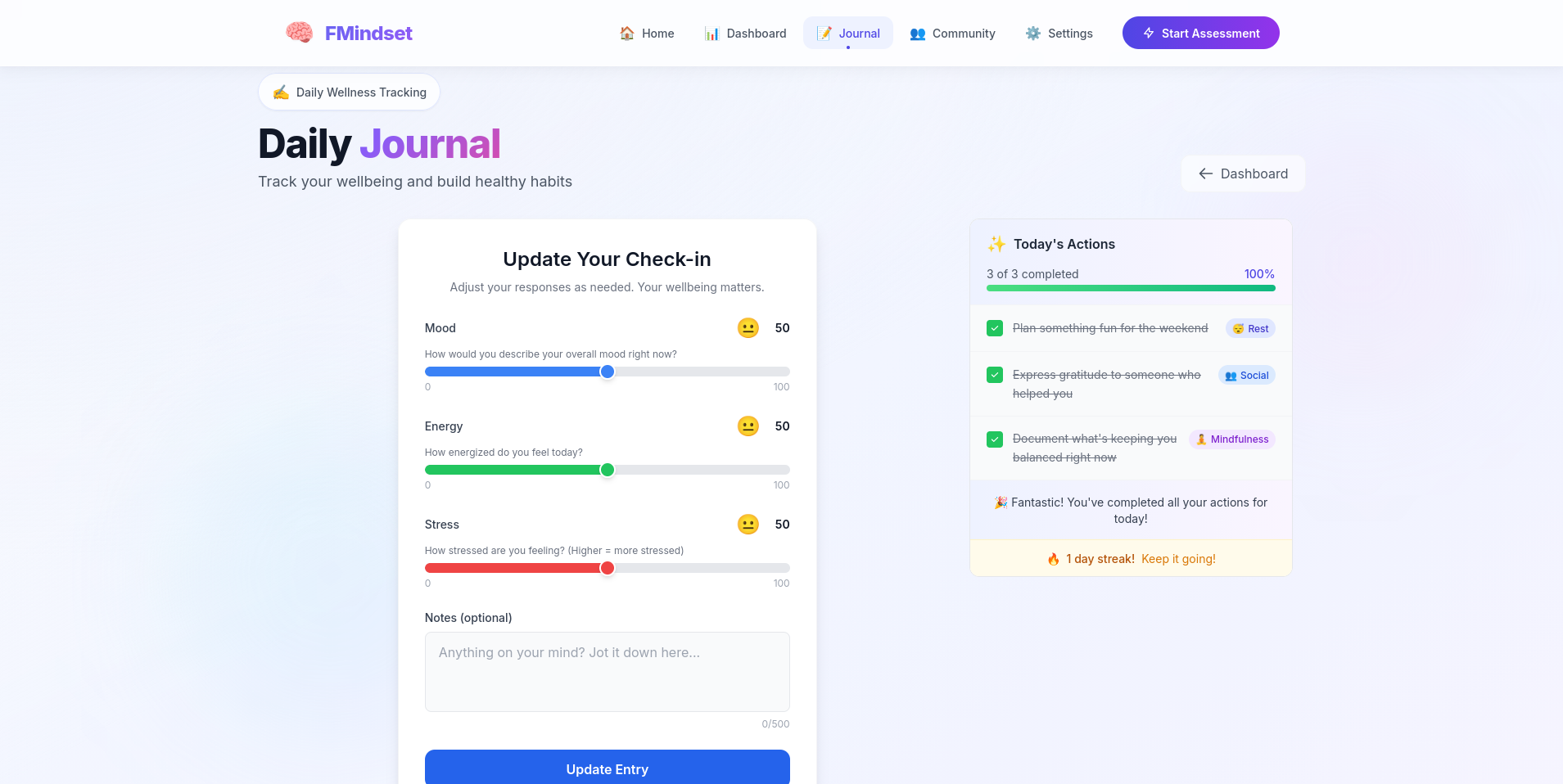
Phase 2: Daily Journal & Tracking
- Daily mental check-ins (mood, energy, fears)
- 30-day trend analysis with charts
- Predictive burnout alerts based on patterns over time
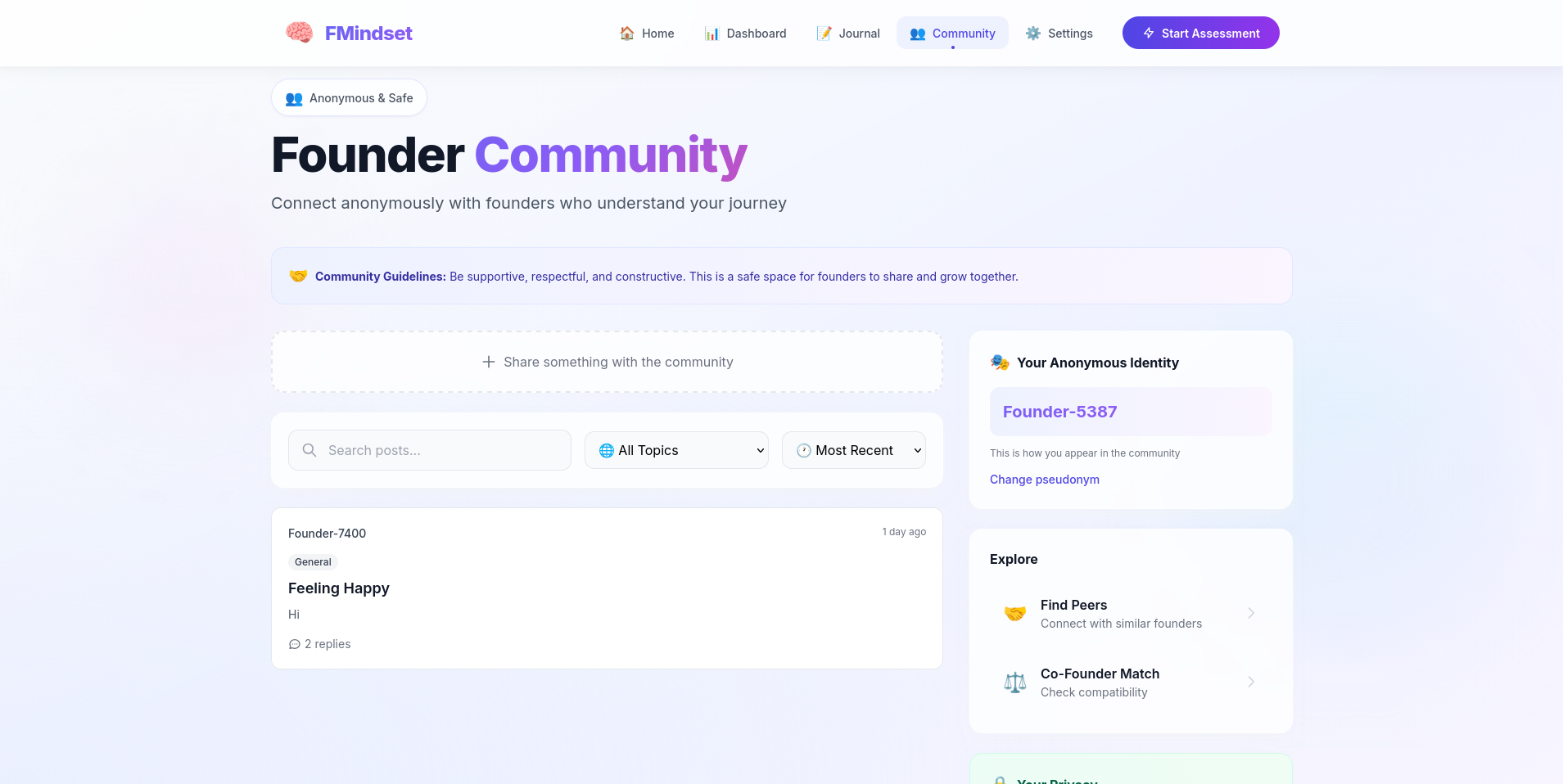
Phase 3: Anonymous Community
- Founder-to-founder support forum
- Match with founders experiencing similar challenges
- Share coping strategies anonymously (no user identities exposed)
Phase 4: Co-Founder Matching
- Compatibility scoring based on psychological profiles
- "You're 85% compatible with this founder" matching system
- Team dynamics insights for existing co-founder pairs
Phase 5: Scale & Research
- Partner with accelerators (YCombinator, Techstars, 500 Startups) for wider reach
- Publish research on founder mental health patterns from aggregated anonymous data
- Integrate with therapist networks for professional referrals when scores indicate severe risk
- Multi-language support to reach global founder community
Long-term Vision
Make founder mental health as normal as startup metrics. Just like founders track revenue, users, and growth, they should track their psychological well-being. Mental health is the silent killer of great ideas.
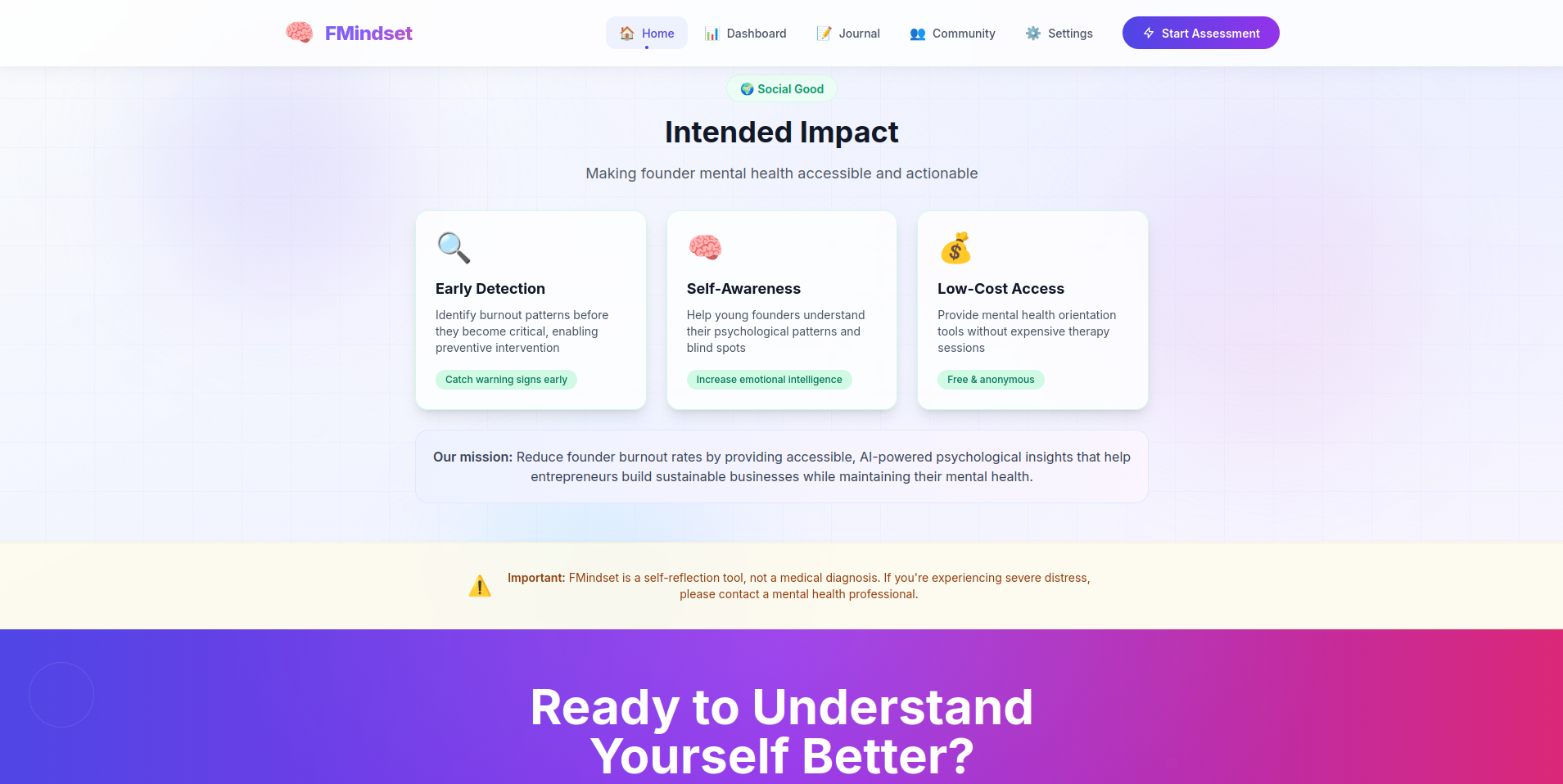
Every young founder should have access to:
- ✅ Free, immediate psychological insights
- ✅ A community that understands their unique struggles
- ✅ Early warning signs before burnout becomes life-threatening
FMindset's mission: Reduce founder burnout rates globally and help the next generation of entrepreneurs build sustainable, successful companies without sacrificing their mental health.
Built with ❤️ for founders who feel alone. You're not. I've got you.
Built With
- css
- drizzle
- groq
- javascript
- neon
- nextjs
- postgresql
- react
- tailwind
- typescript
- vercel
- vitest

Log in or sign up for Devpost to join the conversation.