Inspiration
Every weight-loss tool I have used asks the same thing of me: be the experiment. Log the food, step on the scale, wait three weeks, find out it did not work, and start over. The failure is almost never a knowledge problem. It is a bandwidth problem. I have exactly one body, so I can only run one protocol at a time, and every failed run costs weeks of momentum plus one more round of "I guess I just have no willpower."
Biology solved this problem a century ago with the fruit fly. Drosophila is cheap, breeds fast, and dies harmlessly, so researchers can run thousands of genetic experiments that would be impossible on a human, then carry the surviving principles back. That is the idea I wanted to make digital: a swarm of disposable twins that absorbs the cost of failure, so a real person only ever runs the version that survived.
The hackathon theme closed the loop. "Agents for Humans" asks for agents that take the busywork and the emotional weight, and that run autonomously while only surfacing when there is a real decision. Weight loss is exactly that shape: weeks of noise between a handful of decisions that actually matter. Most apps fill that gap with notifications. I wanted an agent that fills it with computation and stays quiet.
What it does
Fly Weight-Lab is an agent that works in the background and only interrupts you when there is a real decision to make.
- It builds a behavioral digital twin of you. Not a metabolic simulator — a model of how your weight, adherence, and binge triggers behave, fitted from your real logs.
- It breeds a swarm of candidate protocols. Each fly is a genotype: calorie target, protein split, eating window, late-night rule, training, sleep, refeed cadence, step target. Each fly runs through thousands of simulated futures against your twin.
- It culls and converges. Flies that would cause a plateau, a binge, or a dropout go red and die. Survivors breed, cross over, and mutate until one champion remains.
- It surfaces exactly one decision. Something like "Switch to this protocol this week: lower your daily calorie target from 1,700 to 1,686 kcal and keep a fixed late-night snack" — one action, one reason. Then it goes quiet again.
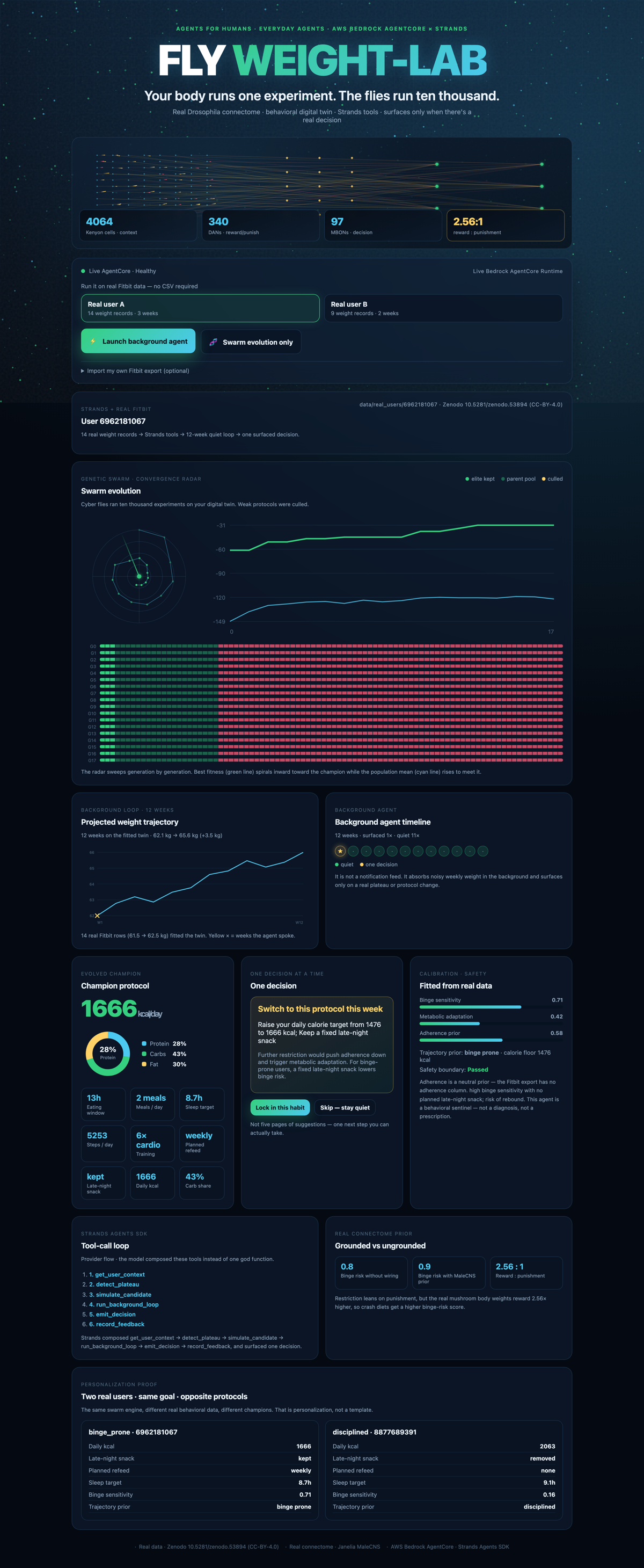
Two real Fitbit users are preloaded into the deployed runtime, so the live demo runs the entire real flow with no CSV upload and no local backend. The demo shows the swarm converging, the real weight trajectory, the weeks the agent spoke versus stayed silent, the champion protocol, the surfaced decision, and a two-user comparison.
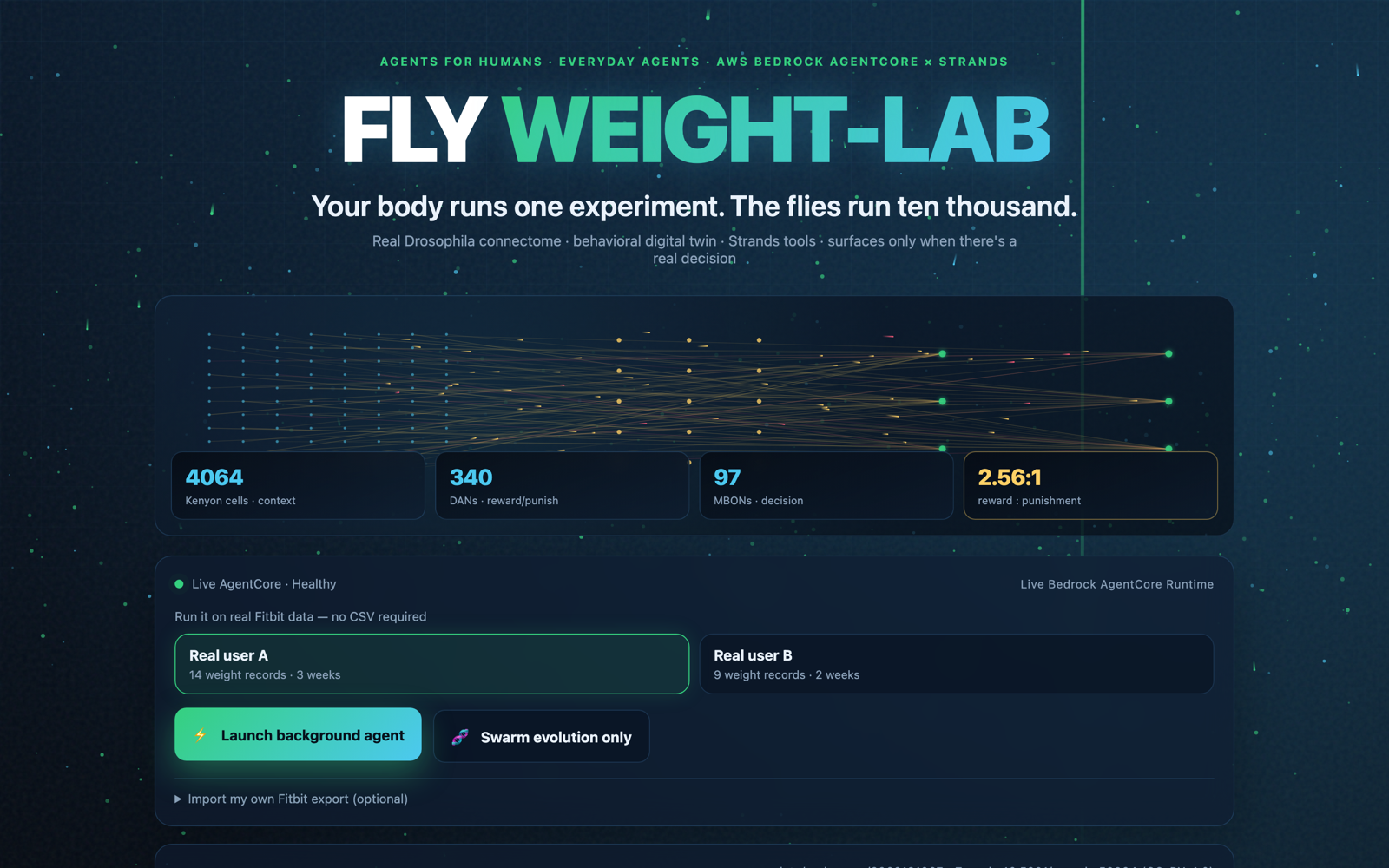
The agent is also grounded in a real brain. The binge-risk model uses the measured Janelia MaleCNS mushroom body: 4,064 Kenyon cells, 340 reward and punishment neurons, 97 decision neurons, and a reward-to-punishment weight ratio of 2.56 to 1. Dieting leans on restriction, which is punishment, so the real circuit predicts restriction gets answered with disproportionate craving pressure — and the aggressive plan's simulated binge risk rises accordingly.
Live demo: https://fly-weight-lab-demo.vercel.app Source: https://github.com/rectinajh/fly-weight-lab
How we built it
The engine (Python + NumPy). flylab/genotype.py encodes a protocol as a genotype. flylab/fitness.py scores it on a sustainable loss band rather than pure maximization, so the swarm cannot crown either a do-nothing plan or a crash diet, and adherence carries the heaviest weight. flylab/evolution.py runs tournament selection with elitism, uniform crossover, and per-gene mutation. flylab/twin.py is the behavioral twin, and flylab/agent_loop.py is the background agent: it ingests a weekly weight, reruns the swarm, fingerprints the champion to detect real change, detects plateaus, and only calls the decision surface when something genuinely changed.
Real data, not sample rows. scripts/ingest_fitbit_data.py downloads the CC-BY-4.0 Fitbit dataset from Zenodo (10.5281/zenodo.53894) and normalizes the small per-user weight and activity files into data/real_users/. flylab/business_flow.py runs the full product loop over real weekly checkpoints: calibrate the twin, run background ticks, surface one decision, then record the real next-week outcome into durable memory.
Strands Agents SDK. The agent layer exposes six narrow tools — get_user_context, detect_plateau, simulate_candidate, evolve_champion, surface_decision, record_feedback — so the model composes capabilities instead of calling one black-box function. The default path uses a deterministic MockModel, which runs a complete tool-call loop with no API key; switching to Ollama, OpenAI, Anthropic, or Bedrock is one environment variable.
Amazon Bedrock AgentCore. agentcore/main.py wraps everything in BedrockAgentCoreApp, which gives us the standard /invocations and /ping contract. The container is a linux/arm64 image on port 8080 pushed to ECR. scripts/deploy_agentcore.py builds it, pushes it, creates the runtime the first time and updates it afterwards, and waits for READY. The runtime execution role is least-privilege: ECR pull, CloudWatch Logs, X-Ray, CloudWatch metrics, Bedrock model invocation, and the AgentCore memory and identity actions.
The frontend and the edge. A browser cannot SigV4-sign an AgentCore call, so the Vercel site ships two serverless functions: one forwards /api/invocations to InvokeAgentRuntime, and one does a real health check via the control-plane GetAgentRuntime. The static UI is dependency-free and hand-draws its charts in SVG and canvas: a squad of cyber flies that periodically dive with glowing trails, a sonar-style radar where best fitness spirals inward toward the champion, and a live wiring diagram of the connectome. Authentication is Vercel ↔ AWS OIDC federation, so there are no long-lived AWS keys anywhere.
Verification. 14 unit tests cover the genotype, the swarm, connectome grounding, the background loop's quietness, calibration, safety, memory, offline evaluation, and the Strands tool-call loop. GitHub Actions runs them on every push, and the Vercel production deploy is green.
Challenges we ran into
Our "deterministic" simulation was not deterministic. Each fly's simulated future was seeded with Python's built-in hash() on a string, which is salted per process. The same fly got a different future every run and the fitness ranking silently reshuffled. We replaced it with a stable SHA-1 digest of the genotype, so the same fly always receives the same future. This was the single most important bug we fixed: nothing you show a judge is trustworthy if you cannot reproduce it.
AgentCore runtime names reject hyphens. CreateAgentRuntime enforces [a-zA-Z][a-zA-Z0-9_]{0,47}, so fly-weight-lab fails validation outright. The runtime is now flyweight_lab.
Invoking a runtime needs a sub-resource permission. We scoped the edge role to the runtime ARN, and the call was denied for a resource we had not anticipated: .../runtime/<id>/runtime-endpoint/DEFAULT. Invoking through the default endpoint requires the endpoint sub-resource too. The lesson: read the ARN in the IAM error message — it tells you exactly which resource shape to grant.
Removing long-lived keys took more than deleting an environment variable. The first working version of the proxy used an access key stored in Vercel. We replaced it with OIDC federation to sts:AssumeRoleWithWebIdentity, then scoped the trust policy to production environments of two specific Vercel projects and limited the permissions to two AgentCore actions on one runtime.
The "broken CI" that was not CI. GitHub showed a red failure on every push. GitHub Actions was green the whole time — the failure was a Vercel deployment status posted back to the commit. The repository-root Vercel project was set to the Python framework preset, so it tried to deploy our backend as a Python function and died with No python entrypoint found. Pointing that project at the web directory and setting the framework to Other turned the commit status green.
Resisting the dishonest version. The tempting pitch is "we simulate your metabolism." We do not, and we cannot. We model behavior: will this person do it, and what happens if they do. In the same spirit, a weight-only log cannot prove someone followed a diet, so when there is no explicit adherence data the model keeps adherence as an explicitly neutral prior instead of pretending the logging cadence proves consistency. Being precise here made the product stronger under questioning, not weaker.
Accomplishments that we're proud of
- It is genuinely deployed. A real Bedrock AgentCore Runtime in
us-east-1,READYand invoked through the data plane returning real swarm output — not a recorded demo. The live page calls it through a serverless proxy on every button press. - Two users, same goal, opposite protocols. The two-user comparison is the proof that personalization is real: the binge-prone twin keeps a planned late-night snack and a weekly refeed, while the disciplined twin gets a tighter calorie target and neither.
- The agent actually stays quiet. Across the demo window it surfaces a handful of decisions and is silent the rest of the time, because it only speaks on a new plateau or a genuine champion change. That behavior is the product, and it is visible in the timeline.
- The metaphor is load-bearing. The real connectome ratio changes the binge-risk model, which changes the champion protocol. It is not decoration.
- No long-lived AWS credentials anywhere. OIDC federation, a narrow trust policy, and two narrowly scoped permissions on one runtime.
- Honesty and safety by design. Hard calorie floors, filtered dangerous protocols, and escalation to a clinician instead of a plan when a profile is out of scope. The agent never diagnoses and never prescribes.
- Reproducibility. 14 tests, deterministic scoring, green CI, and a green production deploy on every push.
What we learned
- Managed runtimes surface bugs that local demos hide. Determinism, IAM resource shapes, and naming constraints only appear when you actually deploy. Every one of our best fixes came from running the real thing.
- IAM errors are documentation. The denial names the exact resource ARN you forgot. Reading it carefully is faster than guessing at policies.
- Reproducibility is a prerequisite, not a nicety. A silently non-deterministic scorer invalidates every comparison you might want to present.
- Honest scoping wins. Saying "behavioral twin, not metabolic simulator" made the project easier to defend and easier to build.
- A constraint can be a design tool. "One decision at a time" is not just a feature; it forced us to decide what genuinely deserves to interrupt a person.
- The last 5% of least privilege is where the learning is. Being broadly correct is easy. Scoping to a single runtime and an endpoint sub-resource is where you learn how the resource model actually works.
What's next for fly-weight-lab
- Let a real model narrate. Point
STRANDS_MODEL_PROVIDERat Bedrock so the decision is phrased in the user's own context instead of a template, using the same six tools. - Move state into DynamoDB. Today the agent persists JSON snapshots; a multi-user version wants durable per-user state and long-running experiments.
- Use AgentCore Memory. Keep a user's history across sessions without resending the whole log on every call.
- Refit on a schedule inside the runtime. Right now the twin refits per request; a scheduled job would let the swarm run while the user sleeps.
- Connect real wearables. Replace CSV import with the Fitbit and Apple Health APIs so the twin keeps improving without anyone exporting a file.
- Learn from accept/reject over longer horizons. Feed whether a surfaced decision was actually kept back into fitness, so the swarm learns what this person follows through on.
- Widen the safety evaluation. More adversarial profiles, more edge cases, and a clinical review before anything resembling real medical use.
Your body runs one experiment. The flies run ten thousand.
Built With
- agentcore
- janelia
- malecns

Log in or sign up for Devpost to join the conversation.