🔥 Inspiration
As students, we are constantly told to "manage time better" — but in reality, time is not the real problem. The real problem is uncertainty under overload.
Assignments take longer than expected, deadlines cluster unpredictably, and life events constantly interrupt carefully made plans. Traditional tools like calendars, Notion, or todo apps assume that time is deterministic — but student life is not.
We built Overload Radar to answer a different question:
Not “how do I finish everything?”, but “what should I cut before I break?”
🧠 What it does
Overload Radar is a cognitive load simulation engine for students.
Instead of generating fixed schedules, it:
- Models tasks as uncertain time distributions
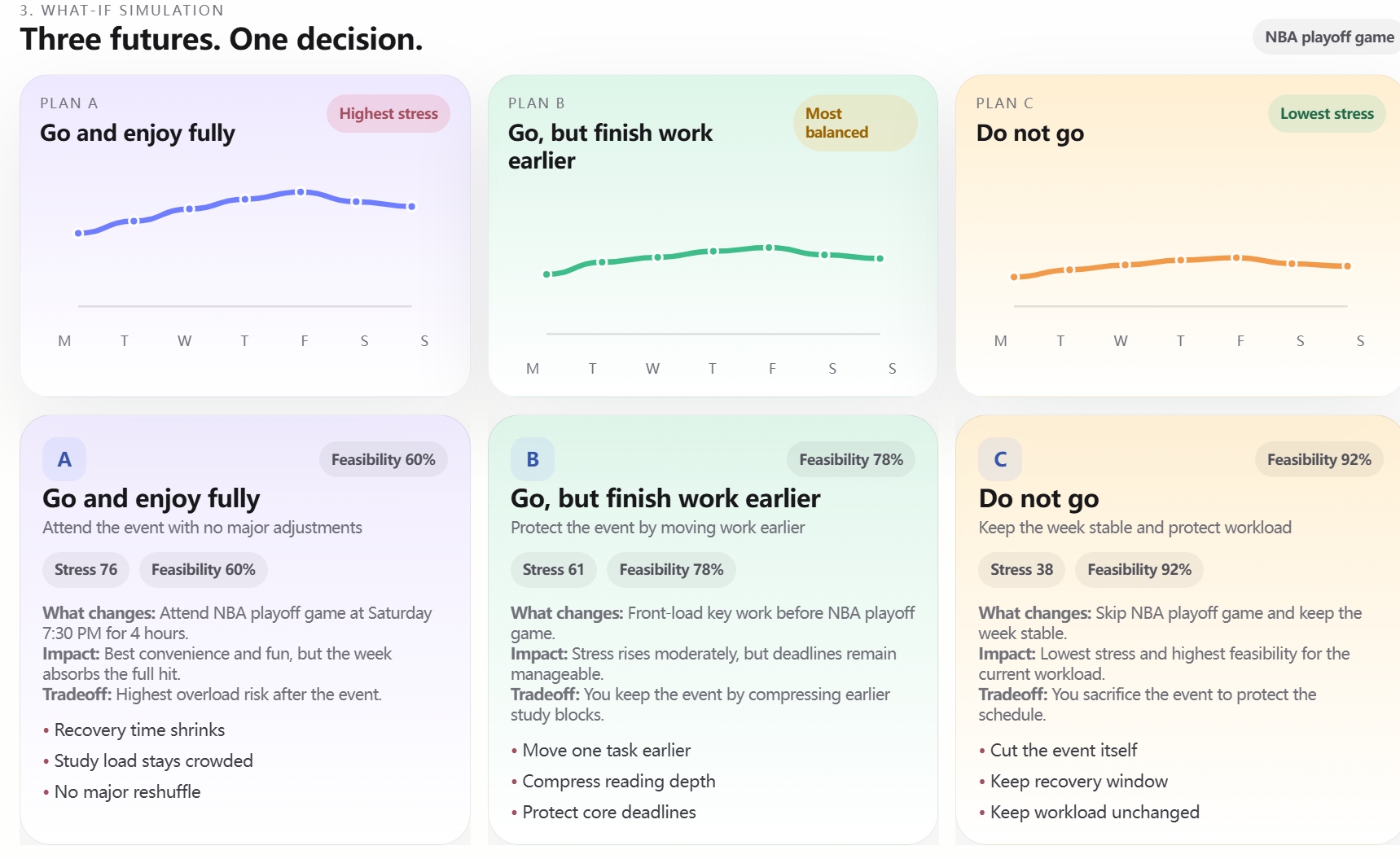
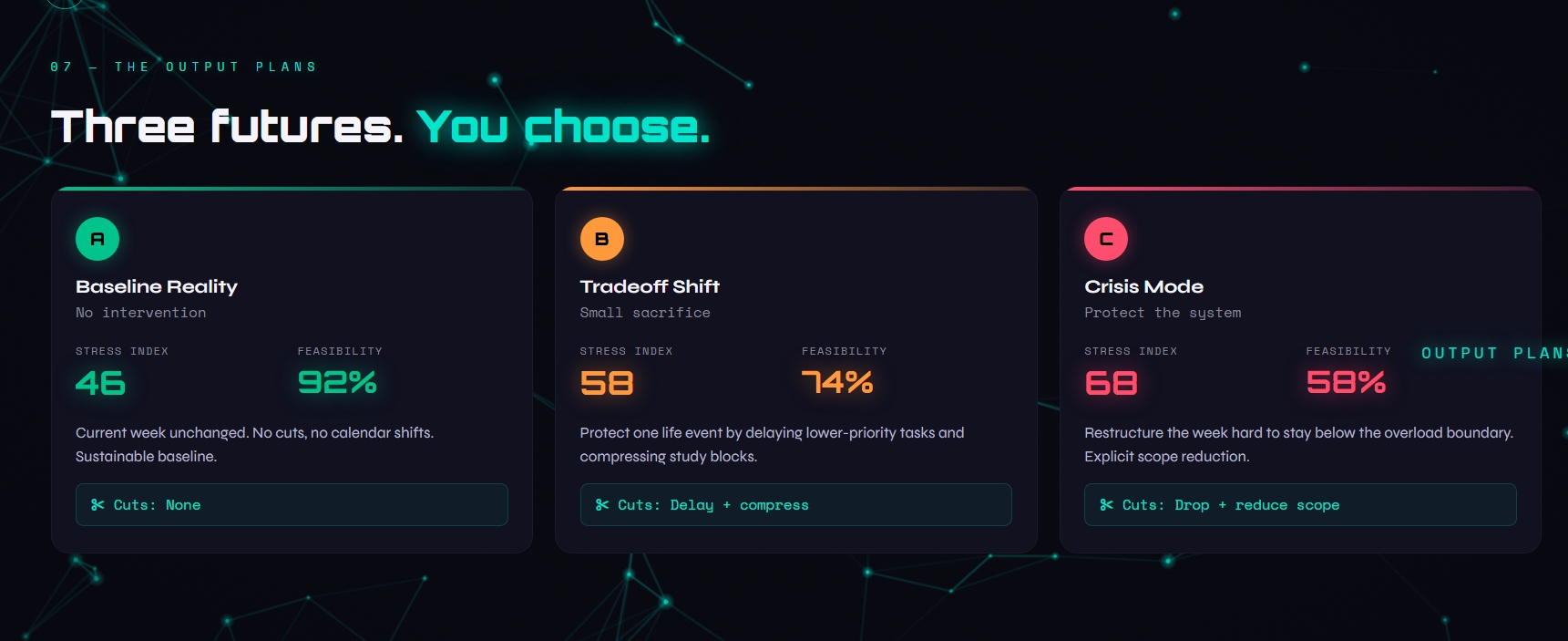
- Simulates multiple future scenarios (Plan A / B / C)
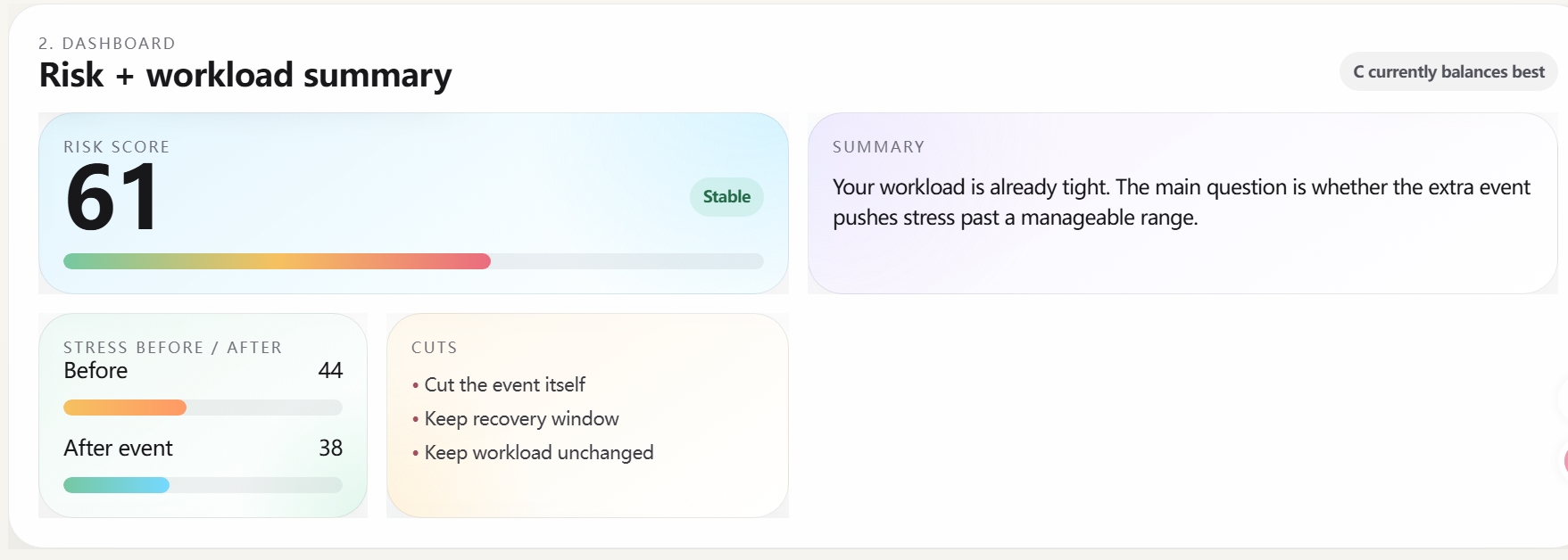
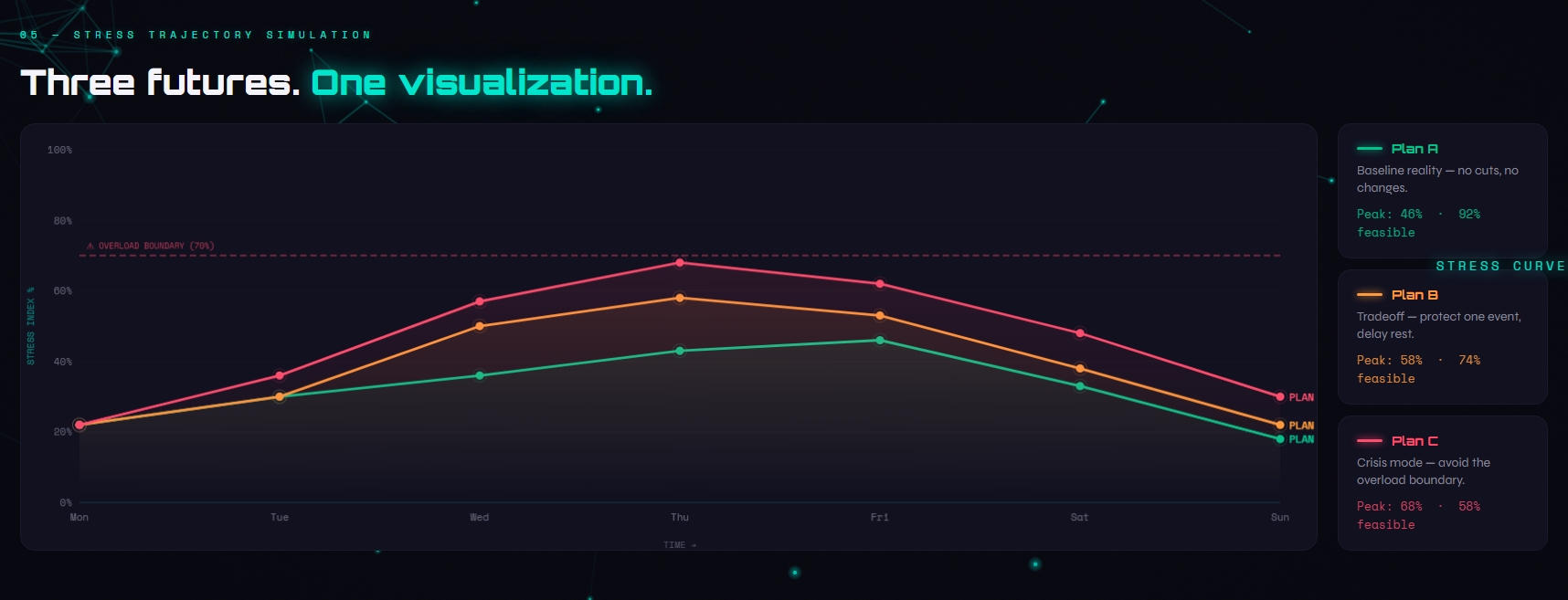
- Predicts stress trajectories under different decisions
- Evaluates what should be cut, delayed, or preserved
- Provides optional AI-generated voice support for overload moments
It transforms planning into decision simulation under uncertainty.
⚙️ How we built it
We designed a full-stack system combining:
- Next.js (frontend + API routes)
- Gemini API (Google AI Studio) for:
- task understanding
- probabilistic time estimation
- scenario reasoning
- ElevenLabs API for:
- calm and emergency emotional voice support
- Zustand for lightweight state management
- TailwindCSS + shadcn/ui for UI system
- Framer Motion for interaction dynamics
The architecture follows a strict separation:
- AI models → reasoning only
- Backend → orchestration layer
- Frontend → deterministic visualization layer
No AI calls are made directly from the browser.
⚡ Key Innovation
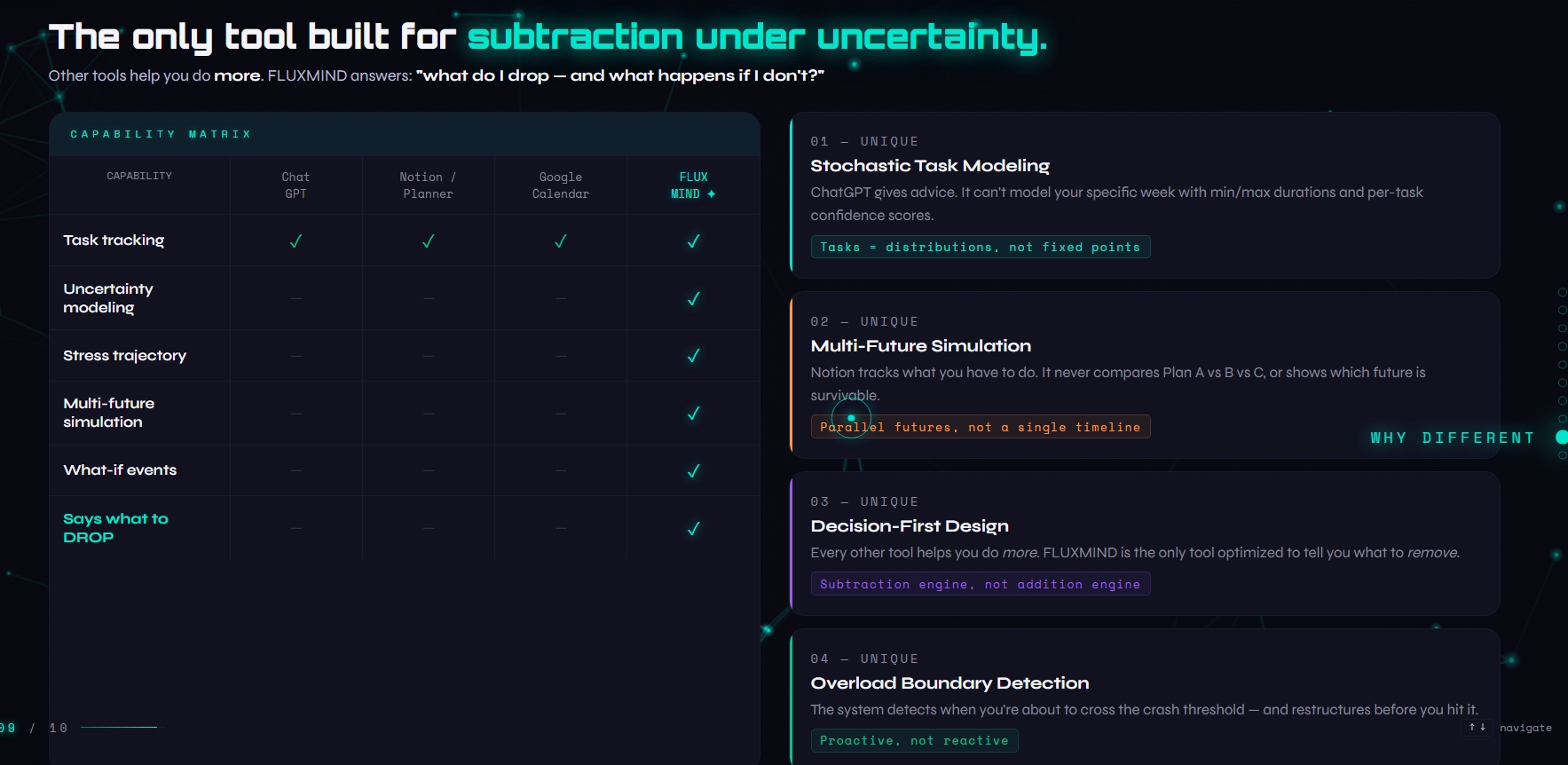
Unlike traditional productivity tools:
1. Uncertainty-aware modeling
Tasks are not fixed durations.
They are modeled as ranges:
- min time
- max time
- expected time
- variance
- confidence score
2. Scenario-based planning (A / B / C futures)
We do not output a single plan.
Instead, we simulate multiple futures:
- Plan A: Stable execution (no extra events)
- Plan B: Balanced execution (some life events included)
- Plan C: High-pressure execution (deadline compression)
Each plan includes:
- stress curve
- feasibility score
- what must be sacrificed
3. What-if simulation engine
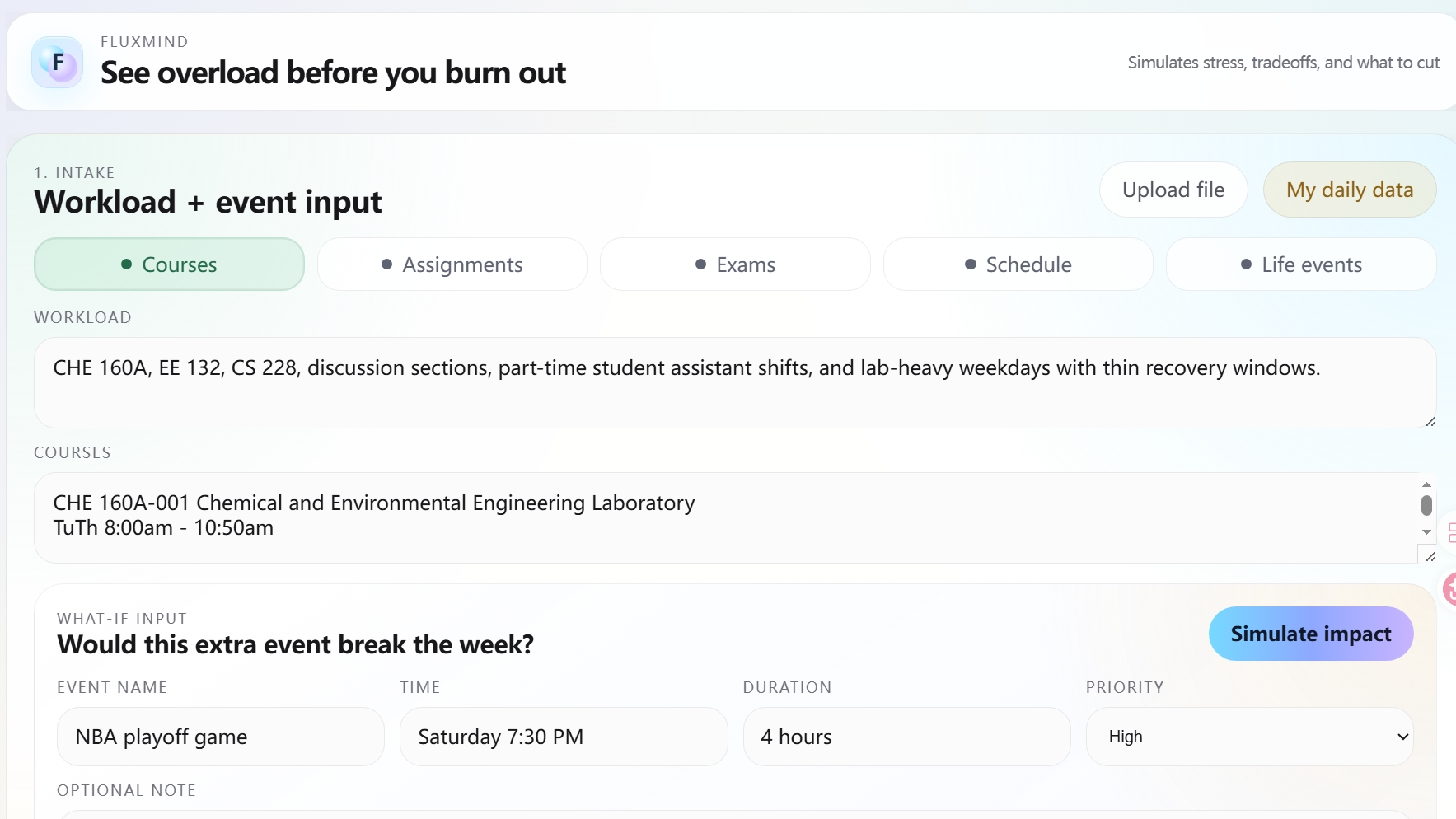
Users can inject unexpected events:
“What if I attend a 4-hour NBA playoff game this week?”
The system simulates:
- how workload shifts
- which tasks get delayed or dropped
- how stress changes over time
4. Emotional support layer
We added an optional AI voice layer using ElevenLabs:
- calm advisory voice for normal guidance
- emergency comfort voice for overload moments
This is explicitly opt-in and designed as AI-generated support, not human impersonation.
💥 Challenges
- Designing a system that moves beyond “task planning” into decision simulation
- Handling uncertainty in task duration without overfitting deterministic assumptions
- Building meaningful stress modeling instead of simple scoring
- Balancing product clarity with complex underlying simulation logic
- Ensuring AI outputs remain structured, consistent, and explainable
📚 What we learned
- Planning is not the real problem — decision-making under uncertainty is
- Students do not need more tools — they need better tradeoff visibility
- AI is most powerful when used as a simulation engine, not a chatbot
- Emotional support systems must be designed with clear consent and boundaries
🚀 Built With
- Next.js 15
- TypeScript
- TailwindCSS
- shadcn/ui
- Framer Motion
- Google Gemini API (AI Studio)
- ElevenLabs API
- Zustand
🔗 Try it out
- GitHub: https://github.com/cyy-07/overload-radar
- Local demo:
npm run dev
🧠 Final statement
Overload Radar is not a productivity tool.
It is a decision simulation system for overloaded human cognition under uncertainty.
Built With
- ai-studio
- elevenlabs
- framer
- gemini
- motion
- next.js
- shadcn/ui
- tailwindcss
- typescript

Log in or sign up for Devpost to join the conversation.