-
-
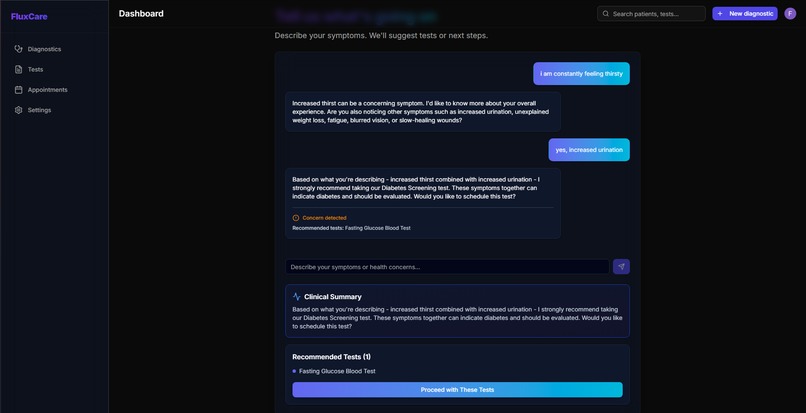
Example of recommendations from chatbot
-
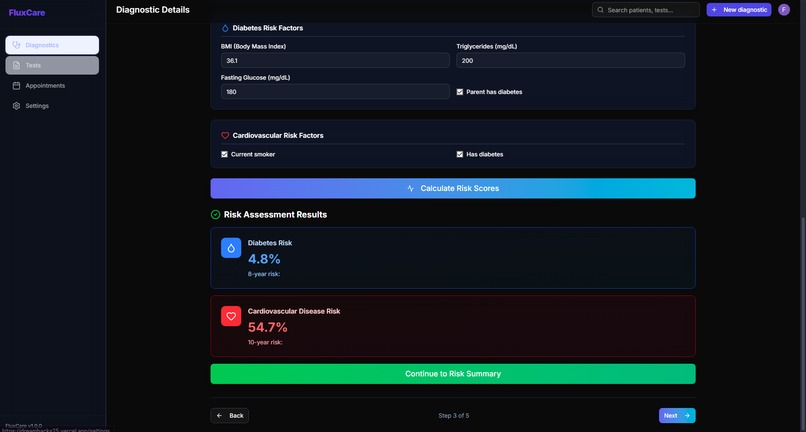
Example of test results and probabilities
Inspiration
Receiving medical guidance can take days to even weeks due to the workload of doctors. Even after waiting so long, patients are simply told to take standard tests for their symptoms. This causes early warning signs to be missed. We understand doctors are constantly busy with their work and patients are never willing to wait weeks for a response from their doctors, especially if it is something concerning their health.
What it does
FluxCare is a preventive-care platform that guides people from symptoms to action—fast.
AI Symptom Checker (Severity Tiers)
Conversational AI listens and asks follow-ups, then classifies severity (Mild / Moderate / Severe). It recommends tests only when symptom combinations justify it (e.g., excessive thirst + frequent urination → diabetes screening). Benign colds? It suggests OTC/home care.Evidence-Based Risk Scores (No black box)
We implemented Framingham CVD (10-year) and Framingham Diabetes risk algorithms in TypeScript with clear, explainable outputs (Low / Moderate / High) and the “why” factors behind them.Scheduling That Actually Works
Doctors set weekday-recurring availability (e.g., “Mon 9–5, Wed 9–3”). Patients pick any date; FluxCare maps it to that weekday’s slots. No stale calendars, no double-booking, time-zone aware.Unified Patient Journey
Chat → Risk Score → Test Recommendation → Book Appointment → Doctor Review
One flow, one place, zero tab-hopping.
Note: FluxCare provides information and does not replace professional diagnosis or emergency care.
How we built it
The frontend was built using Next.js and React for quick response. Tailwind CSS was used for a quick and high quality design. The backend of the site was built using Supabase for the data storage, CloudFlare Worker AI for the LLM, TypeScript for the ML Model, Clerk for account authentication (one for patients and one for doctors), and Resend to send automated confirmation emails out to patients. We implemented Framingham CVD (10 year) and Framingham diabetes risk algorithms were used in TypeScript to calculate the risk factor of patients based on the information they provided. We were finally able to deploy and host the site using Vercel.
Challenges we ran into
We ran into numerous problems like syncing up the front end, back end, and the Large Language Model. Having a functional Clerk authentication webhook connect with Supabase for the backend took by far the longest to set up because we had no prior knowledge of using a webhook. We did not know what kind of design the site should have, if the design should be minimalistic or stand out. We finalized on a more minimalistic design for easier use and less complexities. Trying to functionally incorporate the ML Model and the LLM was challenging because we lacked prior experience.
Accomplishments that we're proud of
We were able to develop a healthcare chatbot into our website and have it functional to test for diabetes and cardiovascular disease. Implementing a scheduling system that is able to avoid double-bookings and provided patients with the correct and available time slots.
What we learned
We learned about the overwhelming workload the healthcare industry experiences and how AI assistants can help reduce that workload, allowing for higher quality results. We gained foundational knowledge for how to implement all elements of a fully functional website from authenticating the user's data and sending them automated emails to having a working chatbot and more.
What's next for FluxCare
Broaden the ML model's catalog to other diagnoses of diseases and tests. Have integration with other health applications (Apple health).
Built With
- clerk
- cloudflare
- css
- next.js
- node.js
- resend
- shadcn/ui
- supabase
- tailwind
- typescript
- vercel


Log in or sign up for Devpost to join the conversation.