-
-
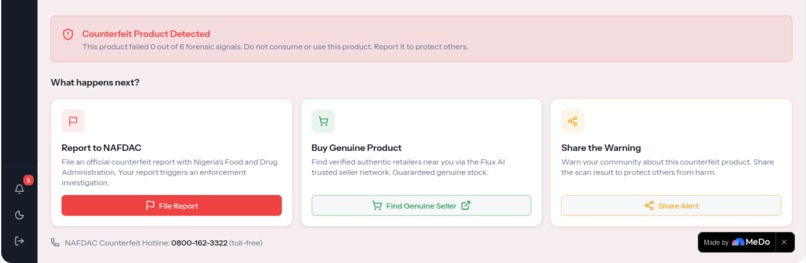
view-verified-vendors/sellers
-
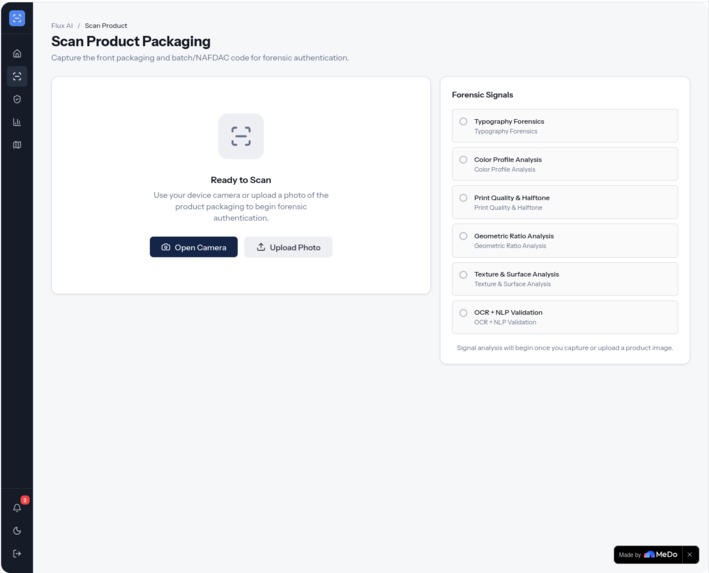
product-scan-page
-
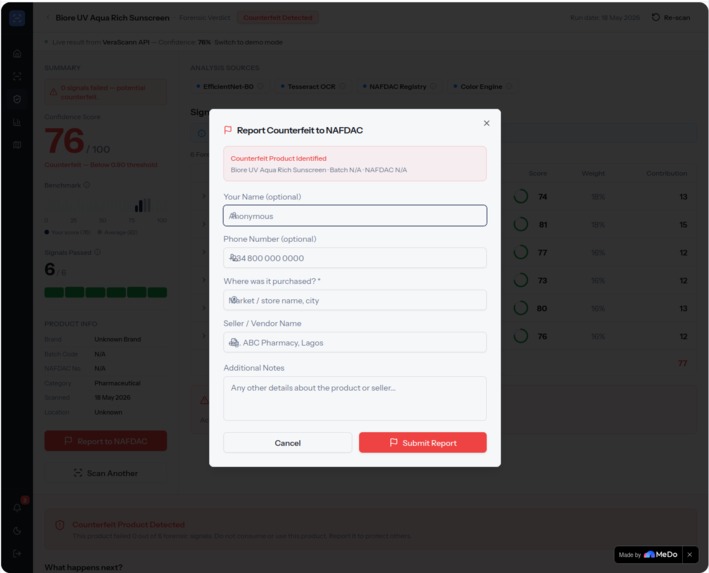
report-counterfeit-form
-
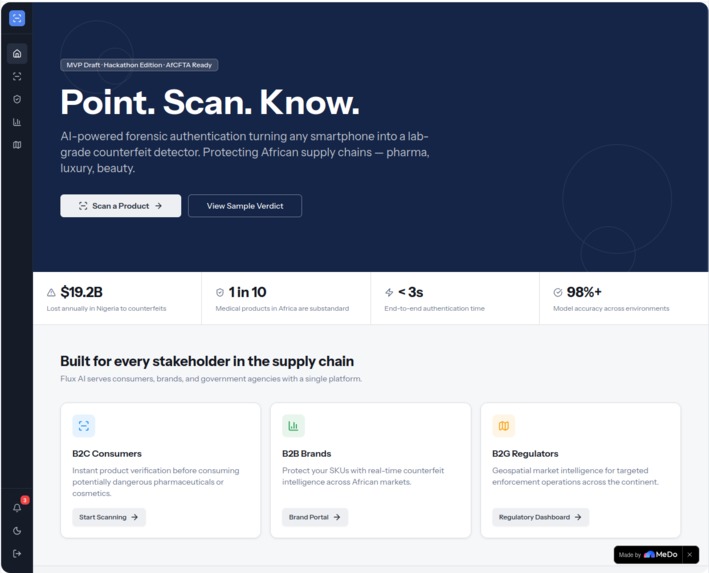
Homepage
-
confidence-scoring/counterfeit
Inspiration
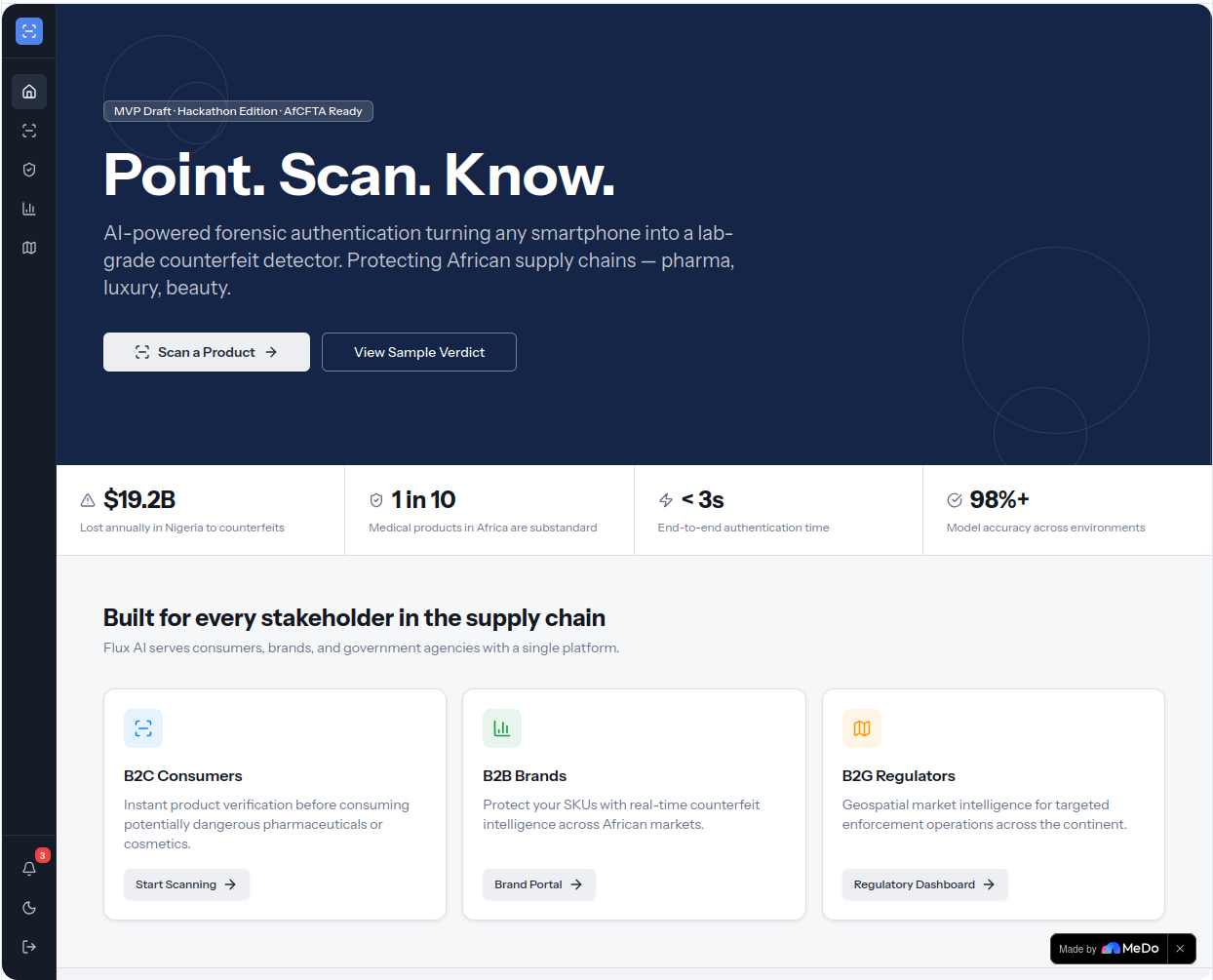
Across the African continent, counterfeits don’t just steal revenue, they risk lives. Africa is disproportionately affected by the global counterfeit crisis. The World Health Organization (WHO) estimates that up to 1 in 10 medical products circulating in developing nations are substandard or falsified, with Africa bearing the heaviest burden. In Nigeria alone, over $19.2 billion is lost annually to counterfeit goods, and an estimated 30% of pharmaceutical products in the market are fake.
We realized that as the African Continental Free Trade Area (AfCFTA) accelerates cross-border trade, the supply chain vulnerabilities will only multiply. We decided to build first to target two markets where the pain of counterfeits hits hard, Pharma and Beauty markets with a combine worth of $11 Billion in NIgeria alone. We wanted to build a defense mechanism that scales as fast as the problem. Our inspiration was to equip the over 500 million smartphone users across Africa with a tool that turns their everyday device into a lab-grade forensic detector.
What it does
Flux is an AI-powered forensic engine that enables instant, lab-grade authentication for supply chain products (specifically pharma, luxury, and beauty) using just a smartphone camera.
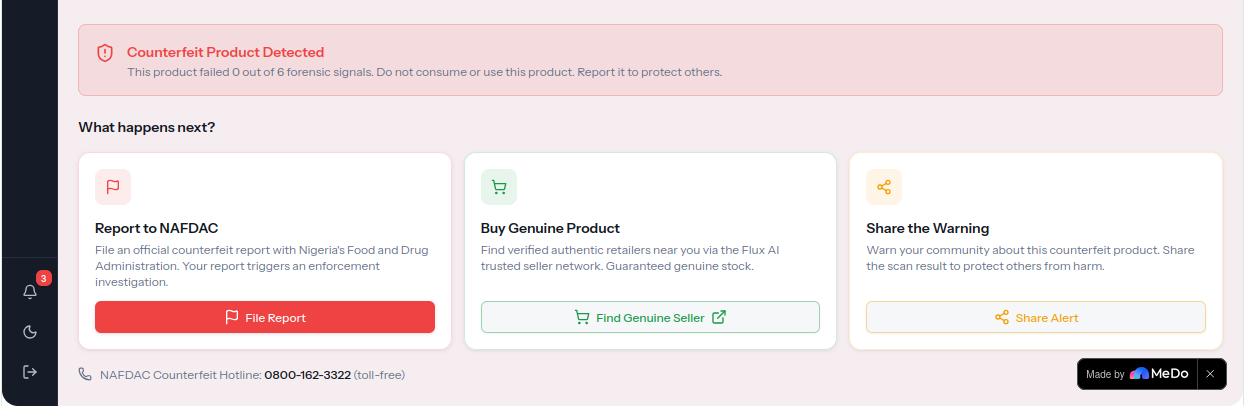
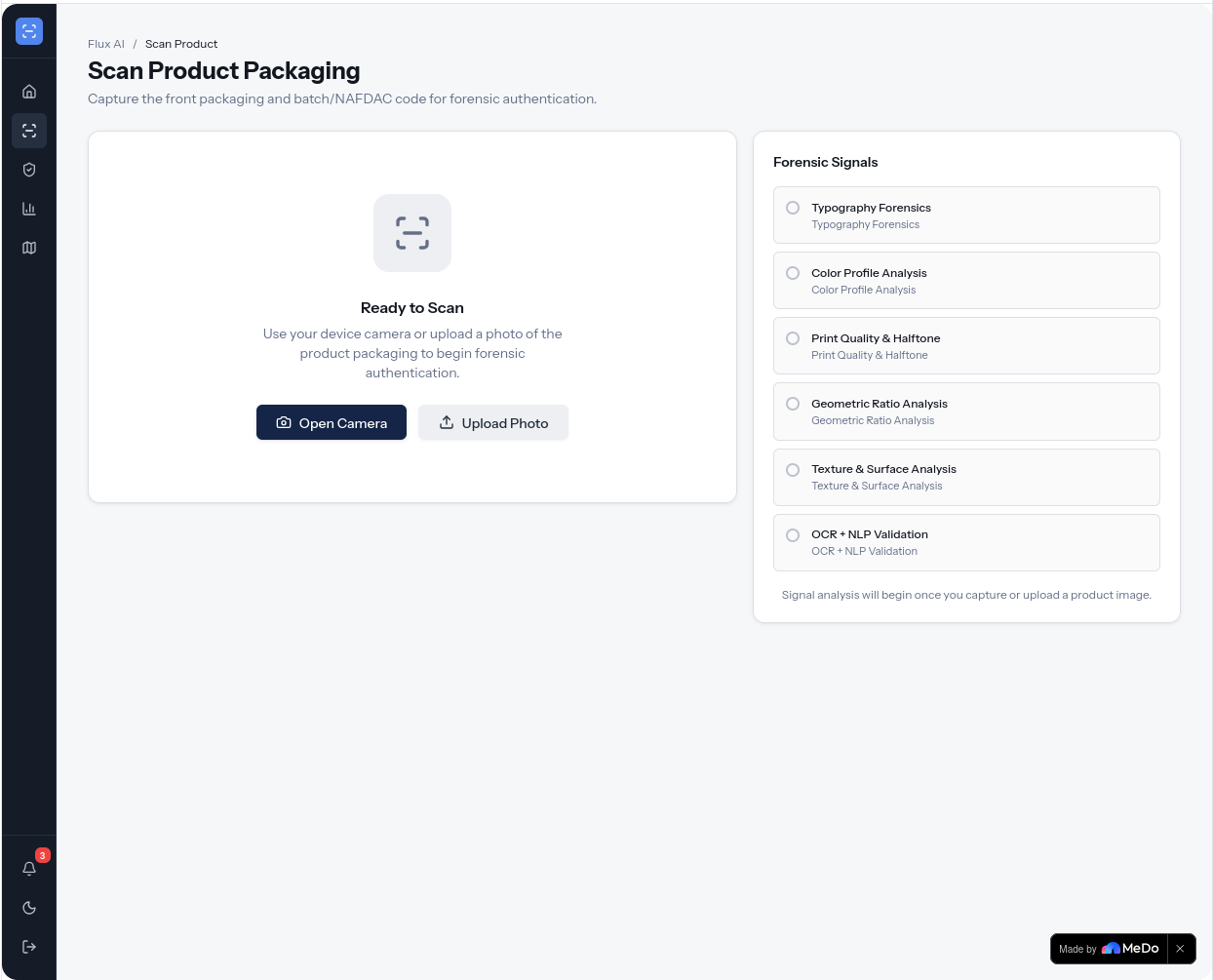
For the everyday African consumer, the workflow is Point. Scan. Know. In under 3 seconds, a user can snap a photo of product packaging and instantly know if it is genuine. If a product is flagged as a counterfeit, Flux protects the user by securely redirecting them to a verified, authentic vendor shop to make a safe purchase.
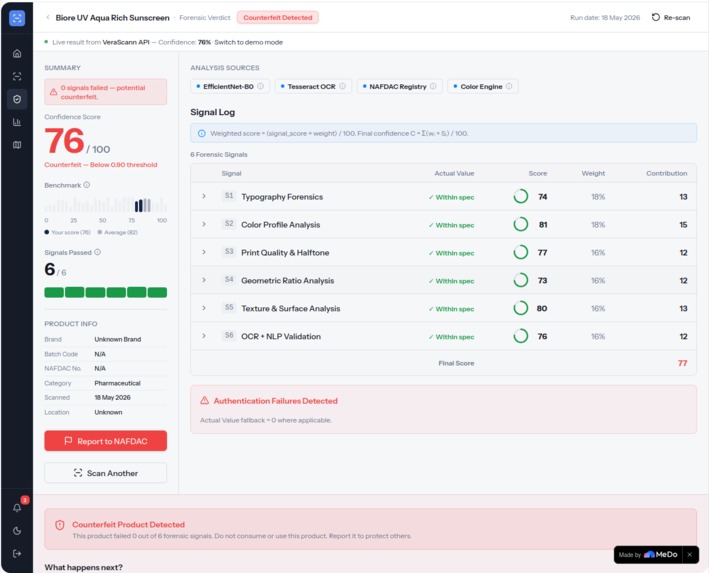
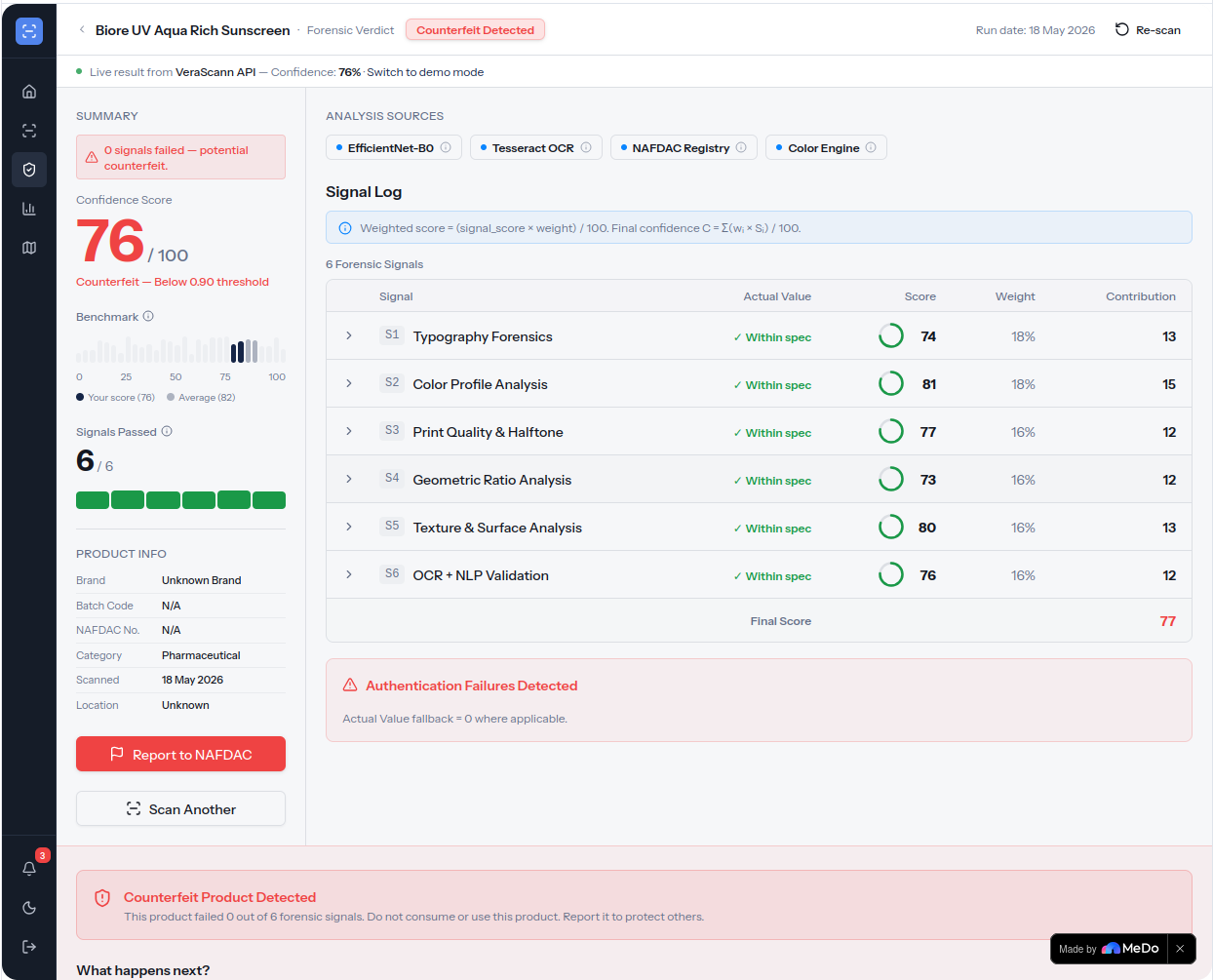
Under the hood, Flux isn't just looking at barcodes; it analyzes artifacts invisible to the naked eye through a Six-Signal Forensic Pipeline:
Typography Forensics: Detects micro-variations in font weights.

Color Profile Analysis: Measures CMYK/Pantone deviations.

Print Quality & Halftone: Analyzes print dot density.

Geometric Ratio Analysis: Validates logo proportions and positioning.

Texture and Surface: Verifies packaging material consistency.

OCR + NLP Validation: Instantly cross-references batch codes and regulatory numbers (e.g., NAFDAC, SAHPRA) with regional databases.
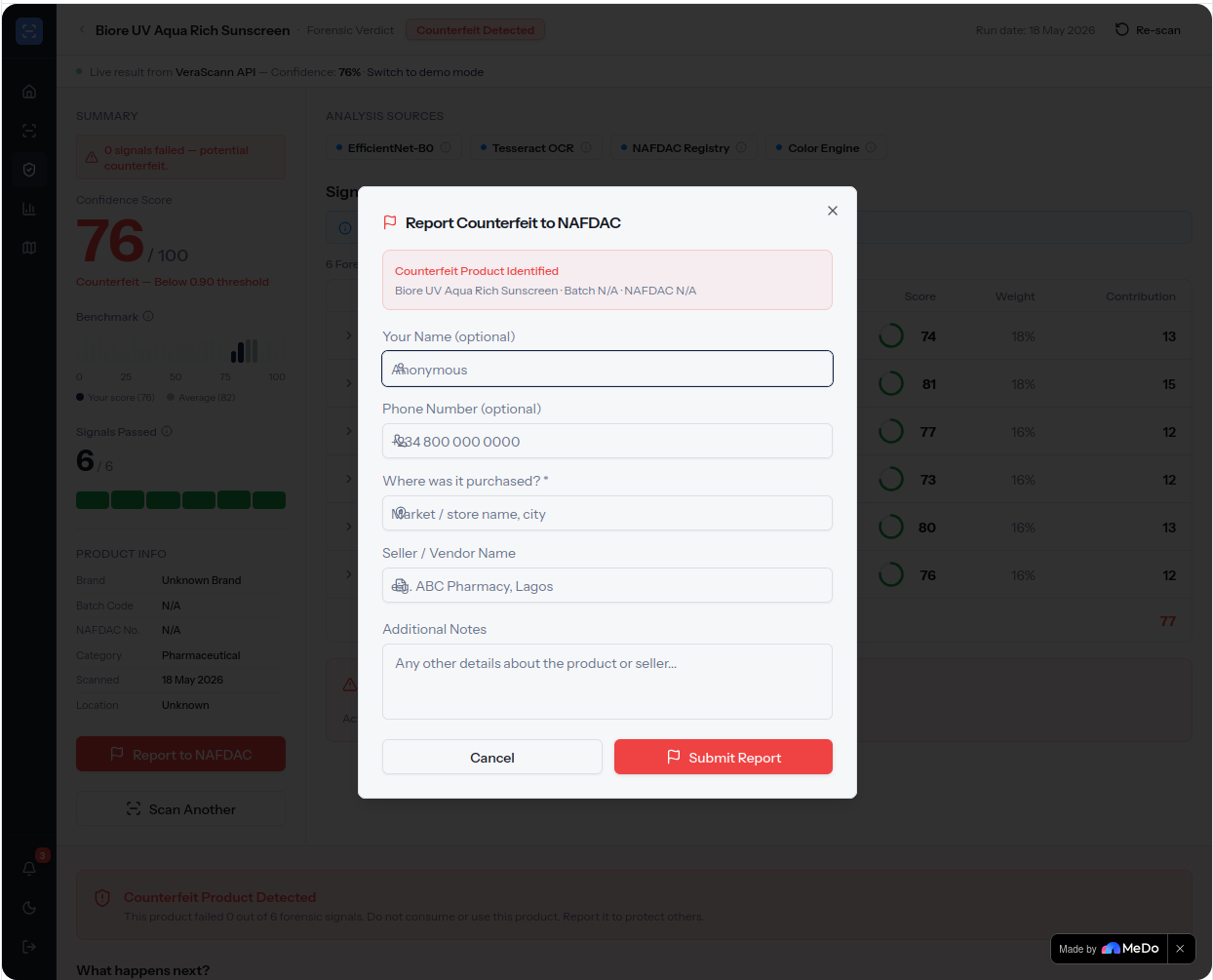
For B2B Brands and B2G Regulators, Flux acts as a real-time geographic intelligence dashboard. Every scan maps counterfeit hot spots across the continent, allowing authorities to target warehouse raids with data-driven precision rather than guesswork.
How we built it
We built Flux using a robust, highly scalable micro services architecture to ensure sub-3-second response times even on low-bandwidth mobile networks common in some parts of Africa.
Front end: Built with React.js + Vite for a fast, lightweight Progressive Web App (PWA) experience, ensuring zero-friction adoption without needing to download a native app.
Back-end: Node.js + Express handles the core application logic and routing, backed by MongoDB + Mongoose for dynamic data storage of product specifications and vendor networks.
AI/CV Micro service: We deployed Fast API to handle the heavy lifting of our AI models. We used EfficientNet-B0 for our core Computer Vision (CV) model due to its high accuracy-to-compute ratio, perfect for edge-device images. We combined this with Tesseract OCR and BERT NLP to extract and validate regulatory text and claims.
Payments & Vendor Integration: We integrated the Squad API for our B2B SaaS billing (charging brands $5k/product and vendors a $100 listing fee) and utilized Squad's Payment Links and Web Hooks to seamlessly trigger product registration and route consumers to verified vendor checkouts.
Challenges we ran into
Our biggest challenge was data collection and establishing ground truth. There is no open-source, centralized database of proprietary packaging specifications for African consumer goods. Furthermore, training an AI to spot fakes requires feeding it actual counterfeit products which meant we had to physically source fake goods from local markets to train our anomaly detection pipeline. To overcome this limited initial dataset, we utilized few-shot learning techniques so the model could generalize from a small number of authentic and fake samples.
Once we had the data, we faced the hurdle of environmental variance. A photo taken in a brightly lit pharmacy looks vastly different mathematically than one taken in a dimly lit open-air market with a low-end smartphone. To solve this, we had to heavily augment our training dataset with artificial noise, glare, and varying focal lengths to make our EfficientNet-B0 model resilient to real-world conditions.
Finally, chaining OCR, NLP, and visual half toning into a single pipeline initially caused latency spikes. We had to aggressively optimize our FastAPI endpoints and run asynchronous tensor operations to compress the inference time down to under 3 seconds.
Accomplishments that we're proud of
High Accuracy: Our computer vision model achieved a 98.4% accuracy in detecting font-weight variations on generic pharma packaging, proving that we can catch "super-fakes" that easily fool the human eye.
Market Validation: We didn't just code, We went out and interviewed market women, students, and everyday shoppers to validate the User experience. Their feedback directly shaped our "zero-installation" PWA approach.
Seamless Ecosystem: Successfully bridging the gap between deep-tech AI and fintech by using the Squad API to instantly turn a "counterfeit detected" moment into a "secure purchase" conversion for verified vendors.
What we learned
We learned that technology alone doesn't solve supply chain fraud,incentives do. By creating a model where brands pay to protect their revenue ($18M ARR target), regulators get intelligence, and consumers get free safety, we learned how to align the entire ecosystem against counterfeiters. And technically, we improved our understanding of combining deep convolutional neural networks (CNNs) with natural language processing to create a multi-modal authentication system.
What's next for Flux
Pan-African Regulatory Integration: Expanding our API hooks to integrate with other continental regulatory bodies like FDA Ghana, Kenya's PPB, and South Africa's SAHPRA.
On-Device Edge Inference: Transitioning our EfficientNet-B0 model to run entirely on-device (via Web Assembly/TensorFlow.js) so consumers can verify products even in offline, rural areas without strong internet access.
Vendor Network Expansion: Scaling our Squad-powered verified vendor network so that no matter where a consumer is in Africa, they are always one click away from buying a safe, authentic product.
Built With
- b0
- efficientnet
- express.js
- fastapi
- mongodb
- mongoose
- node.js
- react.js
- tesseract
- vite

Log in or sign up for Devpost to join the conversation.