Inspiration
Flux is for the people who feel like they’re losing a race against the clock. It’s for the burnt-out high achievers, the students, and the deep thinkers who watch their days blur and their weeks vanish. We designed this for anyone who looks at the end of a month and realizes they can’t actually remember where the time went or how it felt.
Most of us live in a state of constant context-switching. We’re rarely present at the moment because we’re too busy compulsively checking our phones to see how much time we have left. This creates a low-level, persistent anxiety—a feeling that life is moving too fast and we’re just struggling to keep up. We want to be more present, but "being mindful" feels like just another chore on a to-do list.
We realized the world doesn't need another productivity app or a nagging meditation reminder. Flux is built on a different philosophy: sensory training. It works quietly in the background, teaching you to stop managing time and start actually feeling it. By turning duration into a tactile pulse, we’re giving users a way to anchor themselves in the present and reclaim the hours that used to slip away.
Our product is for those who feel like time is slipping away from them. Whether they are a burnt out high achiever, a student, a professional or a deep thinker. For them, days blur together, weeks disappear, and they often can't remember what they actually did or felt.
What it does
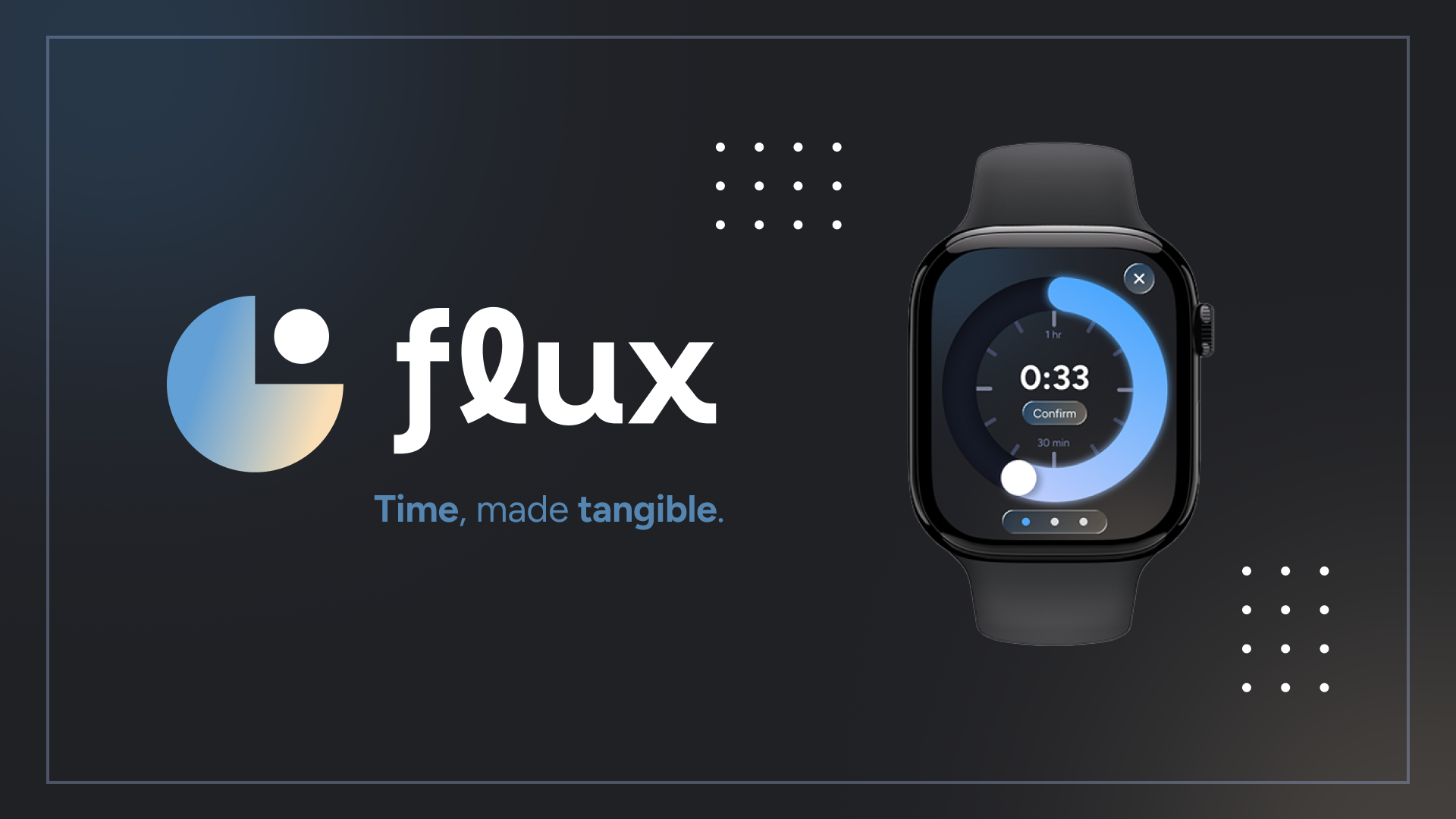
1. The Haptic Challenge This is the heart of the experience. When you feel a vibration on your wrist, the watch face prompts you to guess how much time has passed. To keep you in the flow, there are no clocks and no distractions. You aren't doing math; you’re using the dial in a felt duration. The entire interaction takes less than ten seconds, giving you an immediate "reveal" of your accuracy before fading back into the background.
2. The Calibration Timeline You don’t need to check Flux constantly. When you’re curious about your progress, you can head to the mobile interface to see a visual map of your day. It shows exactly when the pulses happened and maps your guesses against reality. Over time, this becomes a visual record of your chronoception—a weekly view that tracks whether your internal clock is actually syncing up with the world.
3. The Insight Surface Flux doesn't nag. It offers a single, quiet observation about how you experience time. Instead of a wall of data, you get a focused insight: "Your perception was 20% more accurate this week," or "You consistently underestimate time in the late afternoon." It’s a gentle nudge to help you notice the patterns in your own life without adding to your digital noise.
How we built it
The development of Flux began with a deep dive into chronoception—the physiological study of time perception. To ground our design in reality, we synthesized research from psychological papers on attention and sensory duration, establishing a scientific foundation for our haptic vibration concept. Our process was highly iterative, utilizing Gemini and Claude for rapid ideation before mapping out the user experience in FigJam. From initial Procreate sketches to low-fidelity Figma wireframes, we focused on building an intuitive journey that transformed an abstract concept into a tangible tool.
Our design direction was inspired by a "calm-tech" aesthetic, curated through Pinterest to land on a dark-themed palette of soft yellows and blues. To realize the app’s most complex feature—the interactive dial—we leveraged Figma Make. Through over 15 rounds of precise, technical prompting, we engineered a functional prototype that handles multi-hour loops, shifting color gradients, and real-time data synchronization. The final result is a high-fidelity experience that uses smooth animations to provide immediate, intuitive feedback on a user's time-blindness.
Challenges we ran into
The centerpiece of Flux—the dial—presented our greatest design hurdle. We explored dozens of iterations for the progress and correction bars, seeking a balance between high readability and our minimalist aesthetic. We ultimately developed a system where a blue progress bar tracks the user's guess, while a yellow fill intelligently visualizes the "drift" of an over- or underestimate.
Perfecting this interaction required a rigorous approach to AI-assisted engineering. We went through multiple cycles of prompt engineering within Figma Make, feeding the system specific constraints to preserve our original formatting while executing complex logic. By treating the prompt as a living document and adjusting conditions after every generation, we successfully bridged the gap between our conceptual vision and a fully functional Apple Watch interface.
Accomplishments we’re proud of
In just three days, we transformed a complex psychological concept into a high-fidelity, interactive prototype. By balancing rapid production with a cohesive brand identity, we moved from initial research to a fully functional dial interface that handles real-time calculations and dynamic feedback. More than just a design exercise, this project served as a learning experience in efficient task management and technical storytelling. We’ve also created a portfolio-ready case study that demonstrates how emerging tools can bridge the gap between neuroscientific theory and tangible UI.
What we learned
This sprint was a deep dive into the future of "human-in-the-loop" design. We learned to treat AI—from Claude and Gemini to Figma Make—as a specialized collaborator rather than a shortcut, using it to speed up our workflow in all facets—copy, research, and design. This process taught us the art of precise prompting: translating a creative vision into technical conditions that an AI can execute accurately. Above all, we learned effective prioritization, in how to split our focus between research, branding, and AI to maintain a highly productive workflow.
What’s next for Flux
The next phase for Flux is centered on long-term validation and ecosystem expansion. We plan to move into user testing to measure the "residual effect" of the app—specifically whether a user’s internal clock sees improvement even when they aren't wearing the device.
Beyond the wrist, we are looking to develop a dedicated mobile companion app to house deeper statistical insights and more expansive data visualizations. We also intend to refine the haptic "ghost taps," experimenting with different resonant frequencies to find the perfect balance between a clear anchor and a quiet, non-intrusive background presence.
Built With
- chatgpt
- claude
- figma
- figmamake
- gemini


Log in or sign up for Devpost to join the conversation.