FLUX: Good-Day Pact
Your decisions. Your money. Your safety net.
Inspiration
Imagine experiencing a severe depressive episode. Your rent is due, you know you should contact your landlord, but you cannot face opening your banking app.
Most financial applications are designed around the assumption that customers can consistently manage their money and respond to financial warnings. However, for individuals experiencing fluctuating mental health conditions or disabilities, this isn't always realistic.
We recognised that the problem isn't necessarily a lack of financial information. Sometimes, it's the difficulty of acting on that information during periods of poor health.
This inspired us to ask:
What if people could make financial decisions on their good days that would protect them during their difficult ones?
That question became FLUX: Good-Day Pact, an AI-powered financial safety net designed to make banking more inclusive, proactive and accessible.
What It Does
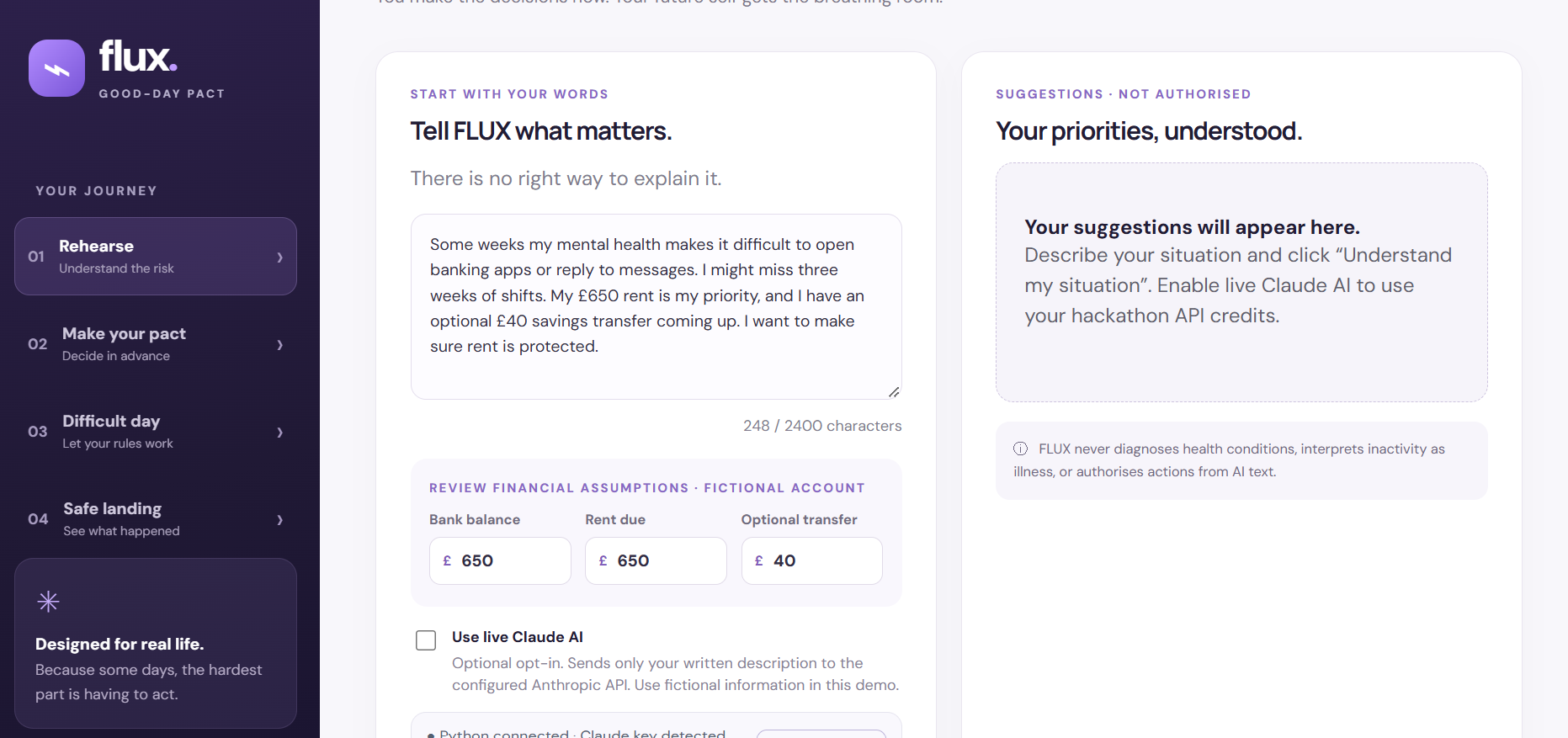
FLUX allows users to prepare for potential financial difficulties in advance through a personalised Good-Day Pact.
The experience consists of four stages:
Financial Time Travel: Users describe their circumstances in natural language. FLUX helps interpret their situation and uses financial simulations to forecast potential shortfalls, including uncertainty over future expenses and income.
Create Your Pact: Users review and explicitly authorise protective rules, such as pausing optional savings transfers, preparing hardship communications or arranging discreet check-ins with trusted individuals.
Difficult Day Protection: When a financial risk triggers an approved rule, FLUX can execute the permitted action through a simulated banking system without requiring the customer to make another complex decision.
Safe Landing: Users receive a transparent explanation of the actions taken, their financial impact and any unresolved risks. They can review or revoke future permissions.
For example, if a customer has £650 reserved for rent but an optional £40 savings transfer would leave them short, FLUX can simulate pausing that transfer under a previously approved rule.
The goal isn't to generate money artificially. It's to protect existing financial resources and reduce preventable financial harm.
How We Built It
We developed FLUX using the following technologies:
- React and Vite: An interactive, accessible frontend for financial forecasting, consent management and the customer journey.
- JavaScript: A deterministic financial simulation and rules engine that models future balances, evaluates triggers and executes authorised actions.
- Python: A backend supporting API requests and integration with external AI services.
- Anthropic Claude API: An optional integration designed to interpret natural-language descriptions, suggest personalised financial scenarios and help draft hardship communications.
- HTML and CSS: Responsive styling, financial dashboards and accessible interface components.
We deliberately separated generative AI from financial decision-making.
AI assists with understanding and communication, while transparent calculations and predefined consent rules determine which financial protections can be activated.
Our prototype uses fictional financial data and simulated banking integrations. An offline rule-based mode allows the core experience to be demonstrated without depending on a live AI connection.
Challenges We Faced
Balancing automation with user autonomy was our biggest design challenge.
We wanted FLUX to act when customers might struggle to manage their finances, without allowing AI to make uncontrolled financial decisions. We addressed this through explicit consent, bounded permissions, audit trails and the ability to revoke future actions.
Another challenge was ensuring our financial forecasts remained consistent with the actions performed. We refined the simulation so the financial dashboard and final outcome use the same calculations, distinguishing immediate rent protection from financial risks that remain later in the month.
Integrating the frontend with a Python-based AI backend also introduced practical challenges involving local development, API authentication and error handling.
Finally, we had to acknowledge the limitations of financial automation. Banks cannot independently change contractual payment obligations, and protecting money doesn't necessarily resolve an underlying income shortfall. Our prototype therefore distinguishes simulated actions, customer-approved communications and situations requiring human support.
What We Learned
This project taught us that financial inclusion is about more than access to financial services. It's also about making those services usable when people are most vulnerable.
We learned the importance of designing around real human limitations rather than assuming every customer can consistently engage with an application.
From a technical perspective, we explored financial scenario modelling, consent-driven automation, API integration and responsible use of generative AI.
Most importantly, we learned that AI does not need complete control over financial decisions to provide meaningful value. It can instead help people prepare, understand their options and retain autonomy.
What's Next?
Our long-term vision is to integrate FLUX directly into banking applications, allowing participating banks to provide safe, pre-authorised financial protections.
Future developments could include integration with banking systems, improved financial forecasting, additional accessibility features and partnerships with financial support organisations.
We also envision extending FLUX to other vulnerable groups, including elderly customers and individuals experiencing significant life transitions.
Ultimately, we want to make financial protection proactive rather than reactive.
We're not building AI to replace people's decisions. We're building AI that helps people honour the decisions they've already made for themselves.
Built With
- anthropic-claude-api
- css3
- financial-forecasting
- html5
- javascript
- monte-carlo-simulation
- python
- react
- rest-api
- rule-based
- vite
